
Sensitivity Analysis
Template for Valuation面向 AI 投资研究的
敏感性分析模板
Build valuation sensitivity tables with bull, base, and bear cases, key assumptions, evidence, and audit notes.
用关键假设、证据与审计说明构建 bull、base、bear 估值敏感性表。
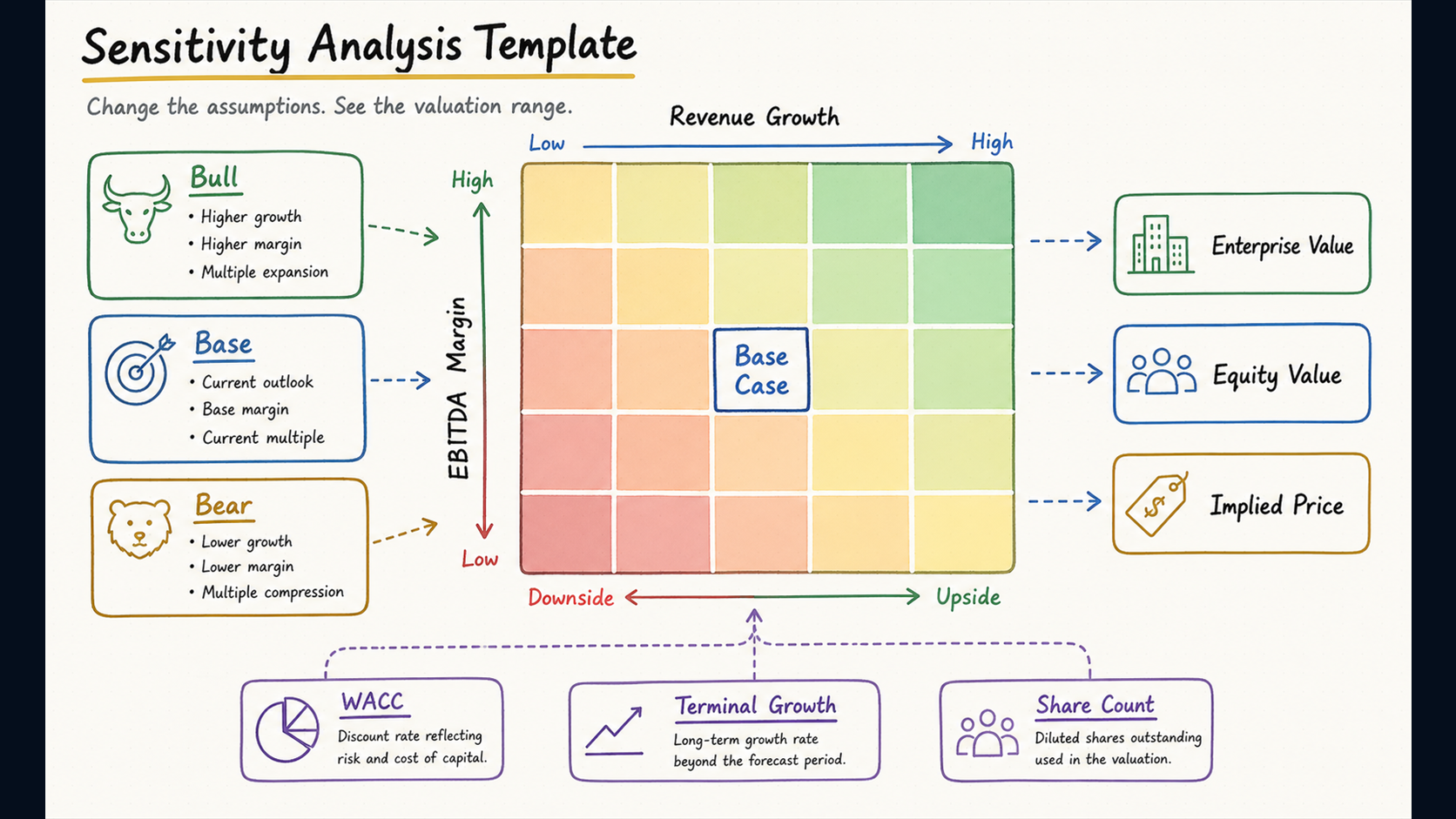
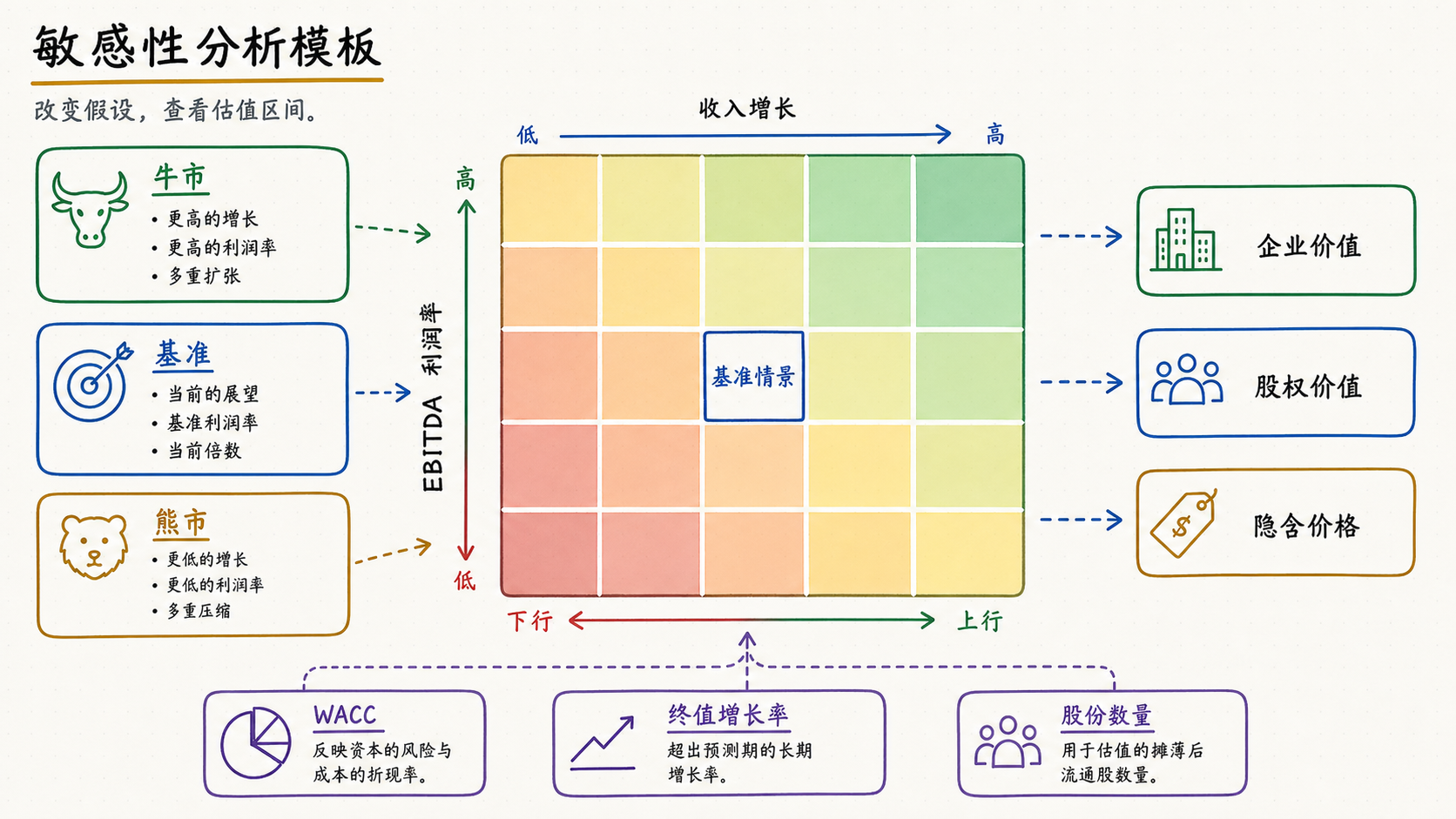
What Is a Sensitivity Analysis Template?
Sensitivity analysis tests how model outputs change when key assumptions move. In investment research, analysts use sensitivity analysis to understand valuation ranges, downside risk, upside scenarios, and which drivers matter most.
This QVeris scenario uses the high-volume keyword sensitivity analysis as the traffic entry point, then connects it to the QVeris Scenario Sensitivity Builder skill. The workflow helps agents build bull, base, and bear-case sensitivities from revenue, margin, valuation, rates, and catalyst assumptions.
What a Scenario Sensitivity Builder Covers
A useful builder turns assumptions into an auditable range of outcomes, not just a spreadsheet grid.
Revenue Assumptions
Model growth rates, customer demand, pricing, volume, churn, market share, and business-line contribution across scenarios.
Margin Assumptions
Test gross margin, operating leverage, cost inflation, hiring plans, unit economics, and profitability paths.
Valuation Ranges
Compare multiples, terminal values, discount rates, target prices, and valuation bands under bull, base, and bear cases.
Rates and Macro Inputs
Connect interest rates, inflation, FX, commodity prices, credit conditions, and macro sensitivity to model outputs.
Catalyst Assumptions
Map earnings events, product launches, regulation, financing, M&A, and company-specific catalysts to scenario changes.
Evidence Strength
Return source notes, missing data, assumption confidence, risk language, and next checks for analyst review.
How QVeris Builds Bull Base Bear Cases
QVeris keeps the workflow agent-native: discover relevant capabilities, inspect assumptions, call the skill, then return structured scenario output.
// Example sensitivity analysis workflow
goal: "Build bull, base, and bear-case sensitivity analysis"
discover: revenue, margin, valuation, rates, catalysts, historical data, evidence
inspect: assumptions, source freshness, model fields, confidence notes
call: "QVeris Scenario Sensitivity Builder skill"
output: sensitivity table, valuation range, scenario memo, sources, audit appendix
Where Sensitivity Analysis Fits
The same workflow can support equity research, valuation review, FP&A planning, investment banking, and startup financing models.
Equity Research
Compare upside and downside cases for stock research using revenue, margin, valuation, rates, and catalyst assumptions.
Valuation Review
Build valuation sensitivity tables for multiples, discount rates, terminal value, growth rates, and target prices.
FP&A and Planning
Stress test operating plans, budget scenarios, cost structures, hiring assumptions, and cash runway projections.
QVeris Scenario Sensitivity Builder Skill
Use the actual QVeris skill to build bull, base, and bear-case sensitivities from revenue, margin, valuation, rates, and catalysts.
Spreadsheet Model vs QVeris Sensitivity Workflow
| Need | Spreadsheet sensitivity table | QVeris sensitivity workflow |
|---|---|---|
| Build assumptions | Analyst manually edits model drivers | Uses agent workflow to map assumptions, sources, and scenario logic |
| Explain scenario changes | Notes often live outside the model | Returns a source-backed memo for bull, base, and bear cases |
| Track evidence | Sources and data gaps are easy to lose | Includes evidence strength, assumptions, gaps, and audit notes |
| Repeat at scale | Manual updates slow down across tickers or plans | Reusable AI agent workflow for recurring sensitivity analysis |
Useful Sensitivity Analysis References
External references help readers understand sensitivity analysis, scenario analysis, and financial modeling context.
Investopedia Sensitivity Analysis
Introductory reference explaining sensitivity analysis and how variable changes affect outcomes.
CFI Scenario Analysis
Financial modeling reference for scenario analysis, assumption cases, and model outputs.
Investopedia Scenario Analysis
Reference explaining how investors and companies evaluate possible future outcomes.
Sensitivity Analysis FAQ
What is sensitivity analysis?
What is scenario analysis?
What is a bull base bear case model?
Which QVeris skill is connected to this page?
Build a Sensitivity Analysis Agent
Use QVeris to connect sensitivity analysis, scenario models, bull base bear cases, valuation ranges, assumptions, sources, and audit notes in one agent workflow.
Open the Scenario Sensitivity Builder skill面向 AI 投资研究的敏感性分析构建器
Build valuation sensitivity tables with bull, base, and bear cases, key assumptions, evidence, and audit notes.
用关键假设、证据与审计说明构建 bull、base、bear 估值敏感性表。
什么是敏感性分析?
敏感性分析用于测试关键假设变化时模型输出会如何改变。在投资研究中,分析师用它理解估值区间、下行风险、上行情景,以及最重要的价值驱动因素。
这个 QVeris 场景用大流量关键词 sensitivity analysis 作为入口,再连接到 QVeris Scenario Sensitivity Builder skill。它可以帮助 agents 基于收入、利润率、估值、利率和催化因素假设构建 bull、base、bear 三种情景敏感性分析。
情景敏感性构建器应该覆盖什么
好的构建器不只是生成表格,而是把假设变成可审计的结果区间。
收入假设
在不同情景下建模增长率、客户需求、定价、销量、流失率、市场份额和业务线贡献。
利润率假设
测试毛利率、经营杠杆、成本通胀、招聘计划、单位经济模型和盈利路径。
估值区间
比较倍数、终值、折现率、目标价和 bull/base/bear 情景下的估值带。
利率和宏观输入
把利率、通胀、汇率、商品价格、信用环境和宏观敏感性连接到模型输出。
催化因素假设
把财报事件、产品发布、监管、融资、并购和公司特定催化因素映射到情景变化。
证据强度
返回来源说明、缺失数据、假设置信度、风险语言和下一步核查项。
QVeris 如何构建 Bull Base Bear Cases
QVeris 保持 agent-native 的流程:发现相关能力,检查假设,调用 skill,再返回结构化情景输出。
// 敏感性分析 workflow 示例
goal: "构建 bull、base、bear 情景敏感性分析"
discover: 收入、利润率、估值、利率、催化因素、历史数据、证据
inspect: 假设、来源新鲜度、模型字段、置信度说明
call: "QVeris Scenario Sensitivity Builder skill"
output: 敏感性表、估值区间、情景 memo、来源、审计附录
敏感性分析适合哪些场景
同一个 workflow 可以服务股票研究、估值复盘、FP&A 规划、投行业务和创业公司融资模型。
股票研究
用收入、利润率、估值、利率和催化因素假设比较股票的上行和下行情景。
估值复盘
为倍数、折现率、终值、增长率和目标价建立估值敏感性表。
FP&A 和规划
压力测试经营计划、预算情景、成本结构、招聘假设和现金 runway。
QVeris Scenario Sensitivity Builder Skill
使用真实 QVeris skill,基于收入、利润率、估值、利率和催化因素构建 bull/base/bear 情景敏感性分析。
电子表格模型 vs QVeris 敏感性 Workflow
| 需求 | 电子表格敏感性表 | QVeris 敏感性 workflow |
|---|---|---|
| 构建假设 | 分析师手动编辑模型驱动因素 | 用 agent workflow 映射假设、来源和情景逻辑 |
| 解释情景变化 | 说明往往在模型外部 | 返回有来源支撑的 bull/base/bear 情景 memo |
| 追踪证据 | 来源和数据缺口容易丢失 | 包含证据强度、假设、缺口和审计说明 |
| 规模化复用 | 多个标的或计划更新会很慢 | 可复用的 AI agent workflow,适合周期性敏感性分析 |
Sensitivity Analysis FAQ
什么是敏感性分析?
什么是情景分析?
什么是 bull base bear case 模型?
这个页面连接的是哪个 QVeris skill?
搭建敏感性分析 Agent
用 QVeris 把敏感性分析、情景模型、bull/base/bear cases、估值区间、假设、来源和审计说明连接到一个 agent workflow。
Open the Scenario Sensitivity Builder skill