Tool Calling Platform for AI Agents: QVeris Guide
A tool calling platform for AI agents gives a language model controlled access to external data and actions. Without tools, an LLM can explain concepts but cannot reliably fetch a live quote, inspect an SEC filing, query a macro series, or verify a crypto market event. The engineering challenge is that every API has different authentication, parameters, errors, limits, and response structures. QVeris addresses that fragmentation with a shared discovery, inspection, and execution layer focused on financial capabilities.
Function calling defines how a model requests a function. MCP standardizes how AI applications connect to external tools and context. A tool calling platform adds the catalog, schemas, authentication, routing, execution, cost information, governance, and observability required to operate those tools in production.
What Is Tool Calling for AI Agents?
Tool calling is the mechanism that lets an LLM request an external capability using structured arguments. An application supplies tool names, descriptions, and schemas to the model. The model chooses a tool and produces arguments; the host validates the request, executes code or an API, and returns the result to the model. The model can then reason over fresh evidence rather than relying entirely on training data.
Function calling for AI agents is often the model-provider term for this structured request. It does not automatically provide the function implementation, credentials, retries, permissions, or monitoring. Those responsibilities remain with the application. Tool calling becomes “agentic” when the system can select and sequence tools, inspect results, revise a plan, and stop according to explicit policies.
Tool calling is central because most valuable tasks cross the model boundary. A finance agent may retrieve a quote, compare income statements, inspect a filing, calculate ratios, search news, and write a cited report. Each step needs deterministic access to an external system. The LLM supplies planning and language; tools supply current data and controlled actions.
The Model Context Protocol has emerged as an open standard for connecting AI applications with tools and data sources. MCP defines a client-server architecture and common primitives, reducing one-off integrations between every AI client and every tool provider. MCP is an interoperability layer, however, not a complete operational platform. Teams still need tool quality, discovery, authentication, policies, logs, costs, and domain coverage.
Why Traditional AI Agent Tool Calling Breaks at Scale
A prototype can expose three handwritten functions. A production agent may need hundreds of capabilities across many providers. At that scale, integration work becomes a product of its own.
- API fragmentation: providers use different ticker formats, date conventions, pagination styles, status codes, rate limits, and nested response shapes.
- Authentication variation: API keys, OAuth, signed requests, account entitlements, and exchange data agreements require different handling.
- No shared discovery: developers usually choose integrations in advance. An agent cannot search a normalized catalog to find the best capability for a new task.
- Inconsistent reliability: every adapter needs timeout policies, retries, caching, validation, and fallback behavior.
- Limited governance: a model may see tools it should not use, call an expensive endpoint unexpectedly, or access data outside the user’s permissions.
- Scattered observability: latency, failures, costs, provider metadata, and model decisions live in separate systems.
A thin tool calling API can normalize the HTTP request, but normalization alone is insufficient. Developers need to know which tools exist, whether the schema matches the task, how much the call costs, what its expected latency is, and whether the output can be used commercially. These concerns are especially important in finance, where data freshness, licensing, and source provenance affect whether a result is usable.
Maintenance also compounds over time. Providers add fields, deprecate endpoints, alter limits, and introduce new authentication. If every agent team owns its own adapters, the same integration work is repeated across products. A platform can centralize that operational burden while allowing applications to retain their own prompts, policies, calculations, and user experience.
Choosing a Tool Calling Platform for AI Agents
Evaluate a platform by the quality of the complete execution path, not only by connector count. Five criteria are particularly important.
1. Unified Protocol and MCP Support
The platform should expose stable schemas through MCP and application APIs. Confirm how it handles versioning, structured errors, streaming, timeouts, and client compatibility. MCP support should complement REST or SDK access rather than lock the application into one host.
2. Searchable Tool Discovery
Agents and developers need descriptions that can be searched by intent. Discovery should return relevant tools, not merely a long alphabetical catalog. Inspection must reveal inputs, outputs, requirements, and operational metadata before money is spent.
3. Relevant Capability Coverage
Broad SaaS coverage is valuable for workflow agents, while financial agents require depth in market data, fundamentals, filings, compliance, crypto, macroeconomics, and news. Verify actual datasets and regions, not marketing totals alone.
4. Transparent Usage Pricing
Separate free discovery from paid execution and identify provider pass-through costs. Usage-based pricing fits variable agents, but teams still need budgets, per-tool cost visibility, quotas, and alerts to prevent accidental spending.
5. Permissions and Observability
Production systems need scoped credentials, tenant isolation, allowlists, audit logs, request traces, latency, success rates, and cost records. Sensitive tools should require confirmation or policy checks before execution.
Also review data retention, regional hosting, support expectations, and vendor portability. The platform should make tools easier to operate without hiding the information required for risk management.
How QVeris Powers AI Agent Tool Calling
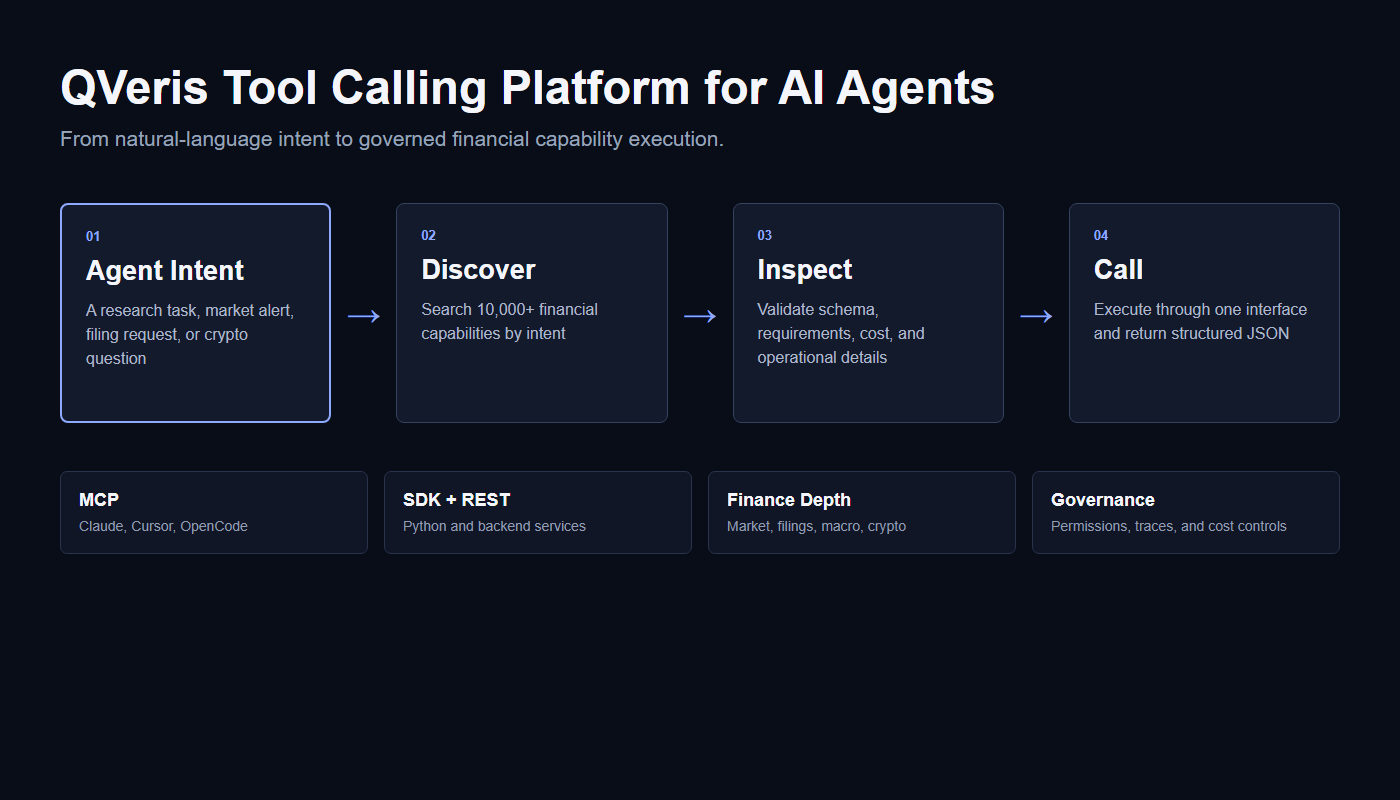
QVeris is a capability routing network designed for AI agents, with a particular focus on financial data and actions. Instead of requiring the developer to know every provider endpoint in advance, it organizes execution into three stages.
The platform advertises more than 10,000 financial capabilities spanning market data, corporate fundamentals, regulatory and compliance information, cryptocurrency, macroeconomic data, news, and related workflows. Developers can connect through MCP, Claude Desktop, Cursor, OpenCode, a Python SDK, or REST APIs. This allows the same capability layer to serve interactive coding assistants, scheduled backend jobs, and embedded fintech products.
Discover and Inspect are permanently free under the current model; Call consumes credits according to the capability. Current onboarding materials advertise 1,000 registration credits and 100 daily login credits. Offers and prices can change, so production estimates should use the current QVeris pricing page.
import os
from qveris import QVeris

client = QVeris(api_key=os.environ["QVERIS_API_KEY"])

candidates = client.discover(
    "Find an SEC 10-K capability for US stocks "
    "with structured financial statement output"
)

tool = client.inspect(candidates[0]["capability_id"])
print(tool["input_schema"])

result = client.call(
    candidates[0]["capability_id"],
    {"ticker": "MSFT", "form_type": "10-K", "limit": 1}
)

print(result)
The snippet illustrates the Discover → Inspect → Call design; developers should verify current SDK method names in the official documentation. A production implementation should validate schemas, set timeouts, record capability IDs, cache immutable results, and constrain which tools each user or agent may call.
What the Platform Does Not Replace
QVeris does not replace application-level reasoning, deterministic financial calculations, user authorization, or investment controls. Developers still decide how the agent plans, which evidence is required, how results are normalized, and when a human must approve an action. A unified execution layer reduces integration overhead; it does not remove the need for sound agent architecture.
QVeris vs Other AI Agent Tool Calling Approaches
| Approach | Tool discovery | Financial coverage | MCP | Maintenance | Pricing |
|---|---|---|---|---|---|
| Build multiple APIs directly | Application-defined | Any providers the team integrates | Team builds or deploys servers | Highest: adapters, auth, retries, schemas | Provider contracts plus engineering |
| QVeris | Discover + Inspect | Finance-first, 10,000+ capabilities | Supported | Centralized capability execution | Free discovery; credit-based calls |
| Composio | Broad toolkit catalog | General SaaS; finance is not its sole focus | Supported in its ecosystem | Managed auth and tools | Plans and usage; verify current terms |
| LangChain Tools | Developer composes tools and toolkits | Depends on selected integrations | Can integrate with MCP | Framework reduces code, team operates tools | Open-source framework plus provider costs |
Composio is well suited to agents that act across general SaaS applications and need managed authentication. LangChain Tools provides a flexible framework abstraction for defining and binding tools to models. QVeris is differentiated by finance-focused capability discovery and routed execution. These products can also be combined: a LangChain agent may call QVeris financial capabilities and Composio business-app tools.
Use Cases for MCP Tool Calling in Financial Agents
Financial Data Analysis Agent
Discover fundamentals, prices, estimates, and macro series; normalize periods; calculate ratios in code; then generate a sourced explanation. Use deterministic calculations for numbers and the LLM for narrative synthesis.
Real-Time Market Monitoring Agent
Schedule quote and volume capabilities, detect anomalies, enrich alerts with news, and send structured notifications. Set strict freshness requirements and suppress duplicate alerts with idempotency keys.
SEC Filing Analysis Agent
Monitor 10-K, 10-Q, and 8-K filings, extract relevant sections, compare periods, and flag changes in risk factors, guidance, debt, or segment reporting for analyst review.
Crypto Market Sentiment Agent
Combine token prices, volume, market structure, and news or social signals. Preserve timestamps and source identity because sentiment decays quickly and varies across venues.
In every case, define a research contract before calling tools: required evidence, accepted age, region, currency, output schema, and failure behavior. Log the model’s chosen capability, arguments, returned source metadata, cost, and final interpretation. This makes the system auditable and gives developers evidence for improving tool selection.
Getting Started with the QVeris Tool Calling API
Create a free QVeris account, generate an API key, and select the client that matches the workflow. Claude Code, Cursor, and OpenCode can use MCP for interactive development. Backend services can use the Python SDK or REST API. Start with Discover and Inspect because both are free, then test Call with a small budget and representative tasks.
Do not expose every capability to every agent. Create allowlists by environment and user role, validate arguments against inspected schemas, and store secrets outside prompts. Add budget limits and call traces before scaling. Evaluate success with realistic cases: whether the agent selected the right tool, returned complete data, respected freshness requirements, and produced a supported conclusion.
Define a routing policy before enabling autonomous selection. The policy can prefer a primary capability by coverage and freshness, reject tools above a cost threshold, and require confirmation for regulated or account-specific actions. When two tools return comparable data, choose deterministically using documented criteria rather than letting the model alternate unpredictably. Record rejected candidates as well as the selected tool; those records reveal whether discovery descriptions are clear and whether the model repeatedly considers unsuitable capabilities.
Handle tool output as untrusted external input. Validate JSON types, enforce size limits, remove instructions embedded in retrieved text, and keep provider content separate from system prompts. For financial reports, preserve original timestamps, currencies, units, and source identifiers before the model summarizes anything. These controls reduce prompt-injection risk and make later audits possible.
Once the flow is stable, add schedules, queues, caching, retries, and human review. This staged approach turns an attractive demo into maintainable agent infrastructure.
Why Use a Tool Calling Platform for AI Agents?
A production agent needs more than a list of functions. It needs searchable capabilities, explicit schemas, reliable execution, permissions, logs, cost controls, and interoperability. QVeris packages those concerns into a finance-oriented Discover → Inspect → Call workflow while supporting MCP, SDK, and REST clients.
The core value of a tool calling platform for AI agents is not that it removes engineering. It lets developers spend more time on research logic, user experience, evaluation, and governance instead of rebuilding provider adapters. For finance agents that need diverse data and structured execution, that shared layer can materially reduce maintenance without sacrificing application control.
Build with QVeris AI Agent Tool Calling
Explore financial capabilities for free, inspect their schemas, and test structured calls with your preferred agent client.