
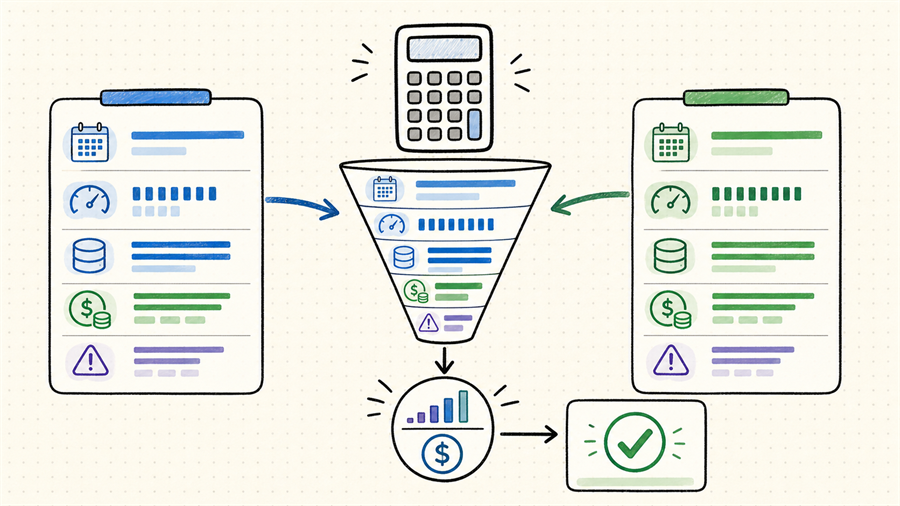
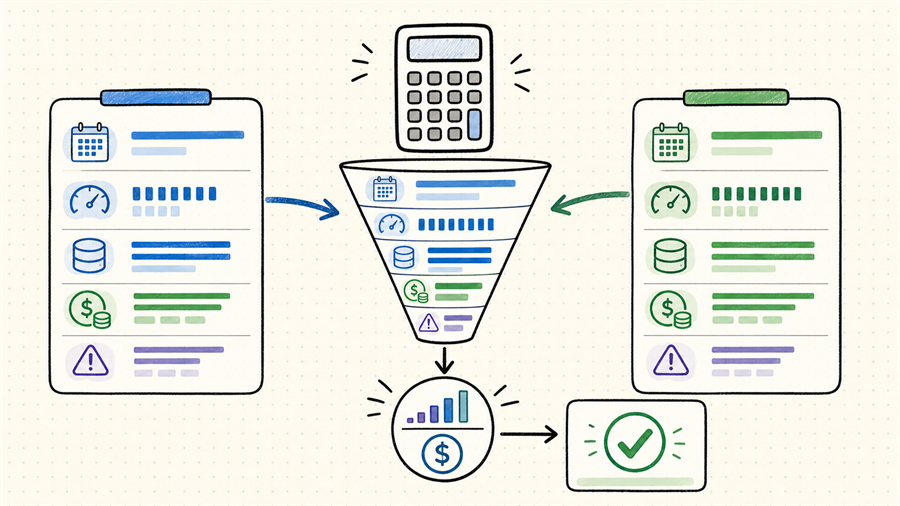
- Current individual stock plans: Basic $0/month, Starter $29/month, Developer $79/month and Advanced $199/month.
- The free tier is real but limited: five API calls per minute, two years of history and end-of-day data. Fifteen-minute delayed data begins at Starter; real-time stock data begins at Advanced.
- Do not treat $29 as an all-market price: the table on this page covers the Stocks product for individual, non-professional use. Options, indices, currencies, futures, partner datasets and business licensing are separate decisions.
- Massive versus QVeris: Massive can be the simpler and cheaper choice for continuous, high-volume access to a stable stock-data surface. QVeris is better aligned with agents that discover and call multiple providers or tools with irregular demand. There is no universal winner.
How much does Polygon.io—now Massive—cost in 2026?
Massive's individual US stock-data plans are Basic at $0/month, Starter at $29/month, Developer at $79/month and Advanced at $199/month. Basic provides end-of-day data at five calls per minute. Starter and Developer provide unlimited API calls with 15-minute delayed data; Developer extends history to 10 years and adds trades. Advanced provides real-time data, quotes, 20+ years of history and Financials & Ratios. These prices are for individual, non-professional use; business use and other asset classes are priced separately. (Source checked July 24, 2026: Massive Stocks pricing.)
Pay a recurring price for a defined stock-data entitlement.
Paid stock plans list unlimited API calls, which can be economical at sustained volume.
Data recency, history depth, event types and licensing—not call count alone—determine the required tier.
Discover and Inspect are free; successful capability calls consume credits.
The model fits irregular agent workflows and cross-provider orchestration, but cost depends on credits per call.
Credits do not expire and there is no monthly subscription, so idle months do not create a fixed software charge.
Current Polygon.io pricing under Massive and what each plan includes
Polygon.io officially became Massive.com on October 30, 2025. The brand and primary domain changed, but existing accounts, keys and APIs continued to work. Massive states that api.polygon.io and api.massive.com operate in parallel during the transition. For current purchasing decisions, use Massive's live pricing rather than archived Polygon.io screenshots. Read the official rebrand notice.
Stocks Basic — $0/month
Basic is a genuine free tier for learning the API, validating symbols, building end-of-day screens and running low-frequency research jobs. It covers all US stock tickers, two years of history, reference data, corporate actions, technical indicators and minute aggregates. The limiting factors are five API calls per minute and end-of-day freshness. It is not the right plan for intraday monitoring, live alerts or execution-adjacent workflows, but it is sufficient for many notebooks, coursework projects and nightly batch jobs.
Stocks Starter — $29/month
Starter removes the published API-call cap, expands history to five years and adds flat files, WebSockets, snapshots and second aggregates. Its data remains 15 minutes delayed. This makes Starter a practical fit for dashboards, backtests, paper-trading interfaces and prototypes that need market-hours behavior without exchange-grade real-time freshness. The plan is about access pattern and history depth, not merely 'more calls.'
Stocks Developer — $79/month
Developer keeps the 15-minute delay but expands stock history to 10 years and adds trades. It is a better match for event studies, longer-window factor research, trade-level investigations and agents that need to explain what happened around a historical event. It does not unlock real-time stock data or quotes. A common pricing mistake is to quote this tier as $99 or assume that it bundles options, crypto and forex; the current Stocks Developer price is $79 and other asset classes have their own product tabs.
Stocks Advanced — $199/month
Advanced is the listed individual plan for real-time US stock data. It provides 20+ years of history and adds quotes plus Financials & Ratios to the features in lower paid tiers. This is the relevant baseline for live quote boards, intraday market monitors, real-time alerting and agents whose answer quality depends on the latest bid, ask or trade context. Real-time access does not remove the need to review redistribution, professional-use and business licensing requirements.
Massive Basic vs Starter vs Developer vs Advanced
Choose by the most restrictive requirement in your product. A five-year backtest can fit Starter even at high request volume; a single live bid/ask feature can push the same application to Advanced. If the application is commercial, serves professional users or redistributes data, individual pricing may not apply at all.
| Plan | Price | Freshness | History | Published API limit | Notable additions |
|---|---|---|---|---|---|
| Basic | $0/mo | End of day | 2 years | 5 calls/min | Reference data, corporate actions, indicators, minute aggregates |
| Starter | $29/mo | 15-minute delayed | 5 years | Unlimited | Flat files, WebSockets, snapshot, second aggregates |
| Developer | $79/mo | 15-minute delayed | 10 years | Unlimited | Trades |
| Advanced | $199/mo | Real time | 20+ years | Unlimited | Quotes, Financials & Ratios |
Scope: monthly list prices for the Stocks product and individual, non-professional use. Annual billing may offer a discount. Verify exchange entitlements, business use, redistribution rights and add-on datasets before procurement.
Cost formulas: compare subscriptions with QVeris credits correctly
A fixed subscription and a credit system cannot be compared from their entry prices alone. Massive cost is driven mainly by the required data entitlement. QVeris cost is driven by successful calls and credits consumed by each capability. Use the formulas below with a measured workload, not a guessed 'average call.'
Massive subscription formula
Monthly software cost equals the selected plan price plus any separately priced asset classes, partner datasets, exchange entitlements or business-license charges. For the listed individual stock plans alone, annual month-to-month totals are $0, $348, $948 and $2,388 respectively. Three-year totals are $0, $1,044, $2,844 and $7,164 before annual discounts or price changes.
QVeris credit formula
Monthly credits = calls per day × 30 × weighted-average credits per successful call. Multiply that total by the effective package price per credit. As of this review, Pro is $19 for 10,000 credits; Scale examples are $100 for 52,500 credits, $500 for 275,000 and $1,000 for 575,000. Discover and Inspect are free, but capability calls range from 1 to 100 credits depending on the task.
| Average credits/call | Credits/month | Approx. monthly cost | Interpretation |
|---|---|---|---|
| 1 | 30,000 | ~$57 | Below Massive Developer; above Starter |
| 5 | 150,000 | ~$285 | Above Massive Advanced before licensing/add-ons |
| 15 | 450,000 | ~$818 | Use only when cross-provider value justifies the execution cost |
| 30 | 900,000 | ~$1,636 | A fixed data subscription is likely cheaper for a repetitive single-source task |
Estimates use the $100/52,500 effective rate (about $0.001905 per credit) for the first two rows and the $500/275,000 effective rate (about $0.001818 per credit) for larger totals. Actual purchases come in packages, unused credits do not expire, and enterprise terms may differ.
Useful break-even checks
- At roughly $0.0019 per credit, a one-credit call reaches the $29 Starter price at about 15,225 calls/month, the $79 Developer price at about 41,475 calls/month and the $199 Advanced price at about 104,475 calls/month.
- At five credits per call, divide those break-even call counts by five. Continuous quote polling can cross the threshold quickly; occasional research or multi-tool workflows may not.
- A price break-even is not a feature break-even. A cheaper plan is irrelevant if it lacks real-time quotes, required history, commercial rights or the non-market capabilities your agent must call.
Which Massive plan fits common developer workloads?
Nightly stock screener or classroom project
Start with Basic when end-of-day freshness, two years of history and five requests per minute are acceptable. Batch symbols, cache reference data and schedule work outside user-facing request paths. Upgrade only after the rate limit or history window becomes a measured constraint.
Delayed dashboard, paper-trading app or five-year backtest
Starter is the natural baseline. Unlimited API calls, snapshots, WebSockets, flat files and second aggregates support richer development, while the 15-minute delay keeps it unsuitable for decisions that claim to be live. Write the delay into the interface and acceptance tests so downstream users do not mistake delayed observations for executable prices.
Historical research agent that needs trade-level evidence
Developer fits when 10 years of history and trades matter more than real-time freshness. This can support event-window analysis, earnings-reaction studies and source-backed explanations of unusual moves. Confirm that the exact endpoint and data fields required by the agent are included; a plan label is not a substitute for an endpoint-level acceptance test.
Live market monitor or real-time alert agent
Advanced is the first listed individual stock tier with real-time data and quotes. Budget $199/month before annual discounts, then verify professional status, business use, display and redistribution rights. Also test WebSocket recovery, stale-data detection, market-session handling and entitlement failures; buying real-time data does not automatically make an agent operationally safe.
Cross-provider research agent with irregular demand
A capability-routing layer such as QVeris becomes relevant when the workflow mixes market data with filings, news, document parsing, search or other tools and does not run continuously. Free discovery and inspection reduce evaluation cost, but production execution must be modeled by capability. Record the credit charge for a representative week, calculate the weighted average and compare that total with the fixed subscriptions and engineering effort it replaces.
Massive vs Alpha Vantage vs QVeris: compare the job, not the brand
These products solve overlapping but different problems. Massive is a direct market-data product with rich stock REST, WebSocket and flat-file access. Alpha Vantage is often considered for lightweight REST research, indicators and notebooks. QVeris is a capability-routing network intended for agents that discover and invoke tools across providers. A useful shortlist starts with the workflow contract: required asset classes, freshness, history, output fields, allowed use, latency, volume and failure behavior.
| Question | Massive | Alpha Vantage | QVeris |
|---|---|---|---|
| Core model | Per-asset data subscriptions | Direct API plans | Cross-provider capability calls |
| Best-fit pattern | Sustained market-data workloads, streaming and deep history | REST research, indicators and modest-volume prototypes | Variable agent workflows spanning data and tools |
| Cost driver | Entitlement tier and add-ons | Plan and request allowance | Successful calls × credits per capability |
| Evaluation approach | Basic free tier and endpoint tests | Free quota and endpoint tests | Free Discover/Inspect plus measured call trials |
If the agent calls the same stock endpoint every few seconds, Massive's unlimited paid API access can be more cost-effective than a per-call layer. If the agent runs only when a user asks a question and needs several unrelated sources, QVeris may reduce integration sprawl even when its per-call unit cost is higher. Architecture and operational effort belong in the comparison alongside the invoice.
Polygon.io to Massive migration: what developers actually need to change
The October 2025 rebrand did not force an immediate rewrite. Massive says existing keys, accounts and api.polygon.io endpoints continue to work, while api.massive.com and Massive-branded SDKs are available in parallel. That means the safest path is controlled migration rather than an emergency cutover.
1. Inventory domain and SDK dependencies
Search application code, environment variables, allowlists, dashboards, runbooks and tests for polygon.io domains and Polygon-branded package names. Record which dependencies can stay temporarily and which should move to Massive defaults during a normal upgrade.
2. Recheck plan entitlements before changing endpoints
A successful domain migration does not prove that the selected plan covers the endpoint, freshness or usage rights your product needs. Build tests for history windows, delay markers, trades, quotes, flat files and WebSocket channels. Fail closed when the returned data is stale or lacks a required entitlement.
3. Run old and new routes in parallel
Compare response schemas, timestamps, error codes and retry behavior in a staging environment. Move low-risk traffic first, monitor differences, then update production configuration. Keep a rollback path until logs show that the new domain and SDK behave as expected across market sessions.
Example: make the API base configurable
// Keep the provider base configurable during the rebrand transition.
const baseUrl = process.env.MARKET_DATA_BASE_URL
  ?? 'https://api.massive.com';

const response = await fetch(
  `${baseUrl}/v2/aggs/ticker/AAPL/prev?adjusted=true`,
  { headers: { Authorization: `Bearer ${process.env.MARKET_DATA_API_KEY}` } }
);

if (!response.ok) throw new Error(`Market data request failed: ${response.status}`);
The exact authentication pattern and endpoint should follow the current Massive documentation. The design point is to separate provider configuration from business logic so a domain or SDK change does not require rewriting the agent's reasoning layer.
Decision framework: choose the plan from requirements, not traffic alone
- Choose Massive Basic when end-of-day data, two years of history and five calls per minute cover a personal learning, research or batch workflow.
- Choose Starter when you need five years, unlimited REST calls, snapshots, WebSockets or files but can tolerate a 15-minute delay.
- Choose Developer when 10 years of history and trades are required, while delayed data remains acceptable.
- Choose Advanced when the application needs real-time stock data, quotes, 20+ years of history or included Financials & Ratios.
- Request business pricing when the data supports a company product, professional users, redistribution, display or another use not covered by individual non-professional terms.
- Evaluate QVeris when the agent must discover and invoke multiple providers or non-market tools, demand is intermittent, or reducing integration surface matters more than minimizing the unit cost of a repeated stock call.
- Use a hybrid when Massive supplies a high-volume market-data backbone while QVeris routes occasional filings, news, document or specialist capabilities.
A five-step evaluation before you buy
List exact fields, symbols, exchanges, timestamps, history windows and freshness requirements. Separate 'nice to have' data from acceptance criteria.
State who sees the output, whether data is displayed or redistributed, and whether users are professional. Do this before comparing list prices.
Test the real symbols, sessions, corporate actions and failure cases your application will encounter. Check schema completeness and stale-data behavior.
Record request counts, WebSocket traffic, retries, cache hits and—for QVeris—credits by capability. Use the measured mix in the cost formula.
Include monitoring, retries, provider-specific adapters, incident response, compliance review and migration effort. The cheapest invoice is not always the lowest total cost.