
Tool Calling Best Practices
A practical engineering guide to building reliable AI agents with robust tool calling, including validation, error handling, fallback routing, MCP integration, and QVeris capability workflows.
Reliable · Safe · Observable · Scalable
What Is Tool Calling in Production AI Agents?
Production tool calling is not just invoking APIs. It is a controlled engineering system where AI agents select tools, validate schemas, execute calls, handle failures, verify outputs, log results, and route to fallback tools when needed — all within a predictable, observable, and recoverable architecture.
The gap between demo and production is real. In a demo, a tool call succeeds once with pre-configured inputs, a valid API key, and no rate limits. In production, tools fail for dozens of reasons: expired credentials, schema mismatches, network timeouts, rate limit 429s, empty responses, malformed JSON, stale provider metadata, or simply because the wrong tool was selected. Demo = tool works once. Production = tool must work reliably under failure, scale, latency, and missing data.
Why Tool Calling Fails in Production
1. No Schema Validation
Agent calls a tool with symbol when it expects ticker. The call fails — and the agent doesn't know why. Schema validation before calling catches this silently.
2. Wrong Tool Selected
Three tools overlap. The agent picks one based on name similarity, not schema fit. The tool returns partial data. The agent proceeds with incomplete information.
3. Missing Authentication
The tool requires an API key that expired or was never provisioned. The agent discovers this at call time — with no fallback configured.
4. No Retry Strategy
A transient network error kills the call. Without retry logic, a one-second blip becomes a permanent failure in the agent's output.
5. No Fallback Tools
The primary tool returns 429 (rate limited). The agent has no second option. It returns "I couldn't complete the task" when a fallback tool was available but unconfigured.
6. Silent Failures
The tool returns HTTP 200 with an empty body or a partial JSON. The agent treats it as success. The downstream workflow receives garbage data with no error flag.
7. Rate Limits & Latency
Free-tier API limits are hit during a market event. Calls start returning 429s. The agent has no rate-limit-aware routing.
8. Unstructured Outputs
The tool returns HTML instead of JSON, or plain text instead of structured fields. The agent's parsing logic breaks. No output validation catches the mismatch.
Core Principles of Reliable Tool Calling
| Principle | What It Means in Production |
|---|---|
| Validate Before Call | Check input schema, required fields, types, and auth before execution — never call blind |
| Assume Failure | Tools will fail sometimes. Design every call path with that assumption built in from the start |
| Always Have Fallback | Every critical tool category should have at least one ranked backup capability |
| Normalize Outputs | Convert all tool responses to structured, validated formats before passing to downstream reasoning |
| Log Everything | Record tool name, inputs, outputs, latency, status, retries, and fallback usage for every call |
| Separate Reasoning from Execution | The LLM decides what to do. The execution layer handles how — validation, retry, routing, logging |
| Route, Don't Hardcode | Use capability routing instead of hardcoding "always call Tool X" — providers change, schemas evolve |
Schema Validation Best Practices
Never call a tool without validating its input schema first. Schema validation is the single highest-ROI practice in production tool calling — it prevents the most common failure mode (parameter mismatch) before any API call is made.
✓ Validate Required Fields
Confirm every required parameter is present, correctly typed, and within allowed values before execution. A missing symbol or a string where an integer is expected will fail — catch it early.
✓ Validate Types and Enums
Ensure string fields are strings, numeric fields are numbers, boolean fields are booleans, and enum fields match allowed values. Type coercion at the API layer is not reliable across providers.
✓ Handle Optional Fields Gracefully
Optional fields should have explicit defaults or be omitted entirely. Do not pass null where the tool expects omission — provider behavior varies.
✓ Verify Auth Before Calling
Check that required API keys, OAuth tokens, or authentication headers are available and unexpired before attempting the call. Auth failures are the second most common production issue after schema mismatches.
Tool Selection Strategies
Production agents should not pick tools only by name. Selection should consider task intent, schema match, latency, cost, reliability, output structure, and historical success rate.
| Strategy | When to Use | Production Notes |
|---|---|---|
| Rule-Based Routing | Simple, predictable systems with few tools | Fragile when tools change; best for internal APIs |
| LLM-Based Selection | Flexible tasks with moderate tool counts | Adds latency; requires prompt engineering for consistency |
| Embedding-Based Matching | Large tool sets (50+) with diverse capabilities | Requires tool description embeddings; good for initial filtering |
| QVeris Capability Routing | Multi-provider agent systems with fallback needs | Discovers, inspects, and ranks capabilities by task intent; includes schema validation and fallback routing |
Error Handling & Retry Mechanisms
Every tool call path must include error handling. Common failures include timeouts, rate limits (429), invalid schemas (400), missing auth (401/403), empty responses, and malformed JSON. Each requires a different recovery strategy.
⏱ Exponential Backoff with Jitter
Retry with increasing delays: 1s → 2s → 4s → 8s (max 3 retries). Add random jitter to prevent thundering-herd retries. Never retry instantly — you will amplify the provider's load and worsen the outage.
🔌 Circuit Breaker Pattern
If a tool fails N consecutive times, stop calling it for a cooldown period. This prevents cascading failures and gives the provider time to recover. Re-enable gradually with a probe request.
🔄 Retry Flow
Tool A → fail → retry with backoff → fail → retry with backoff → fail → switch to Tool B (fallback) → success. The agent never returns "I couldn't complete the task" unless all fallbacks are exhausted.
Fallback Routing Strategies
Every critical tool category must have at least one ranked fallback. No single point of failure is acceptable in production.
Market Data Fallback Chain
Primary: real_time_stock_price → Fallback 1: cached_price_api → Fallback 2: historical_price_api → Fallback 3: secondary_provider. Each fallback may have higher latency or lower fidelity, but the agent continues to function.
Fallback Design Rules
1. Rank fallbacks by fidelity (closest to primary first). 2. Accept gracefully degraded outputs at lower tiers. 3. Log every fallback activation — it is a leading indicator of provider issues. 4. Test fallback paths regularly — untested fallbacks are not real fallbacks.
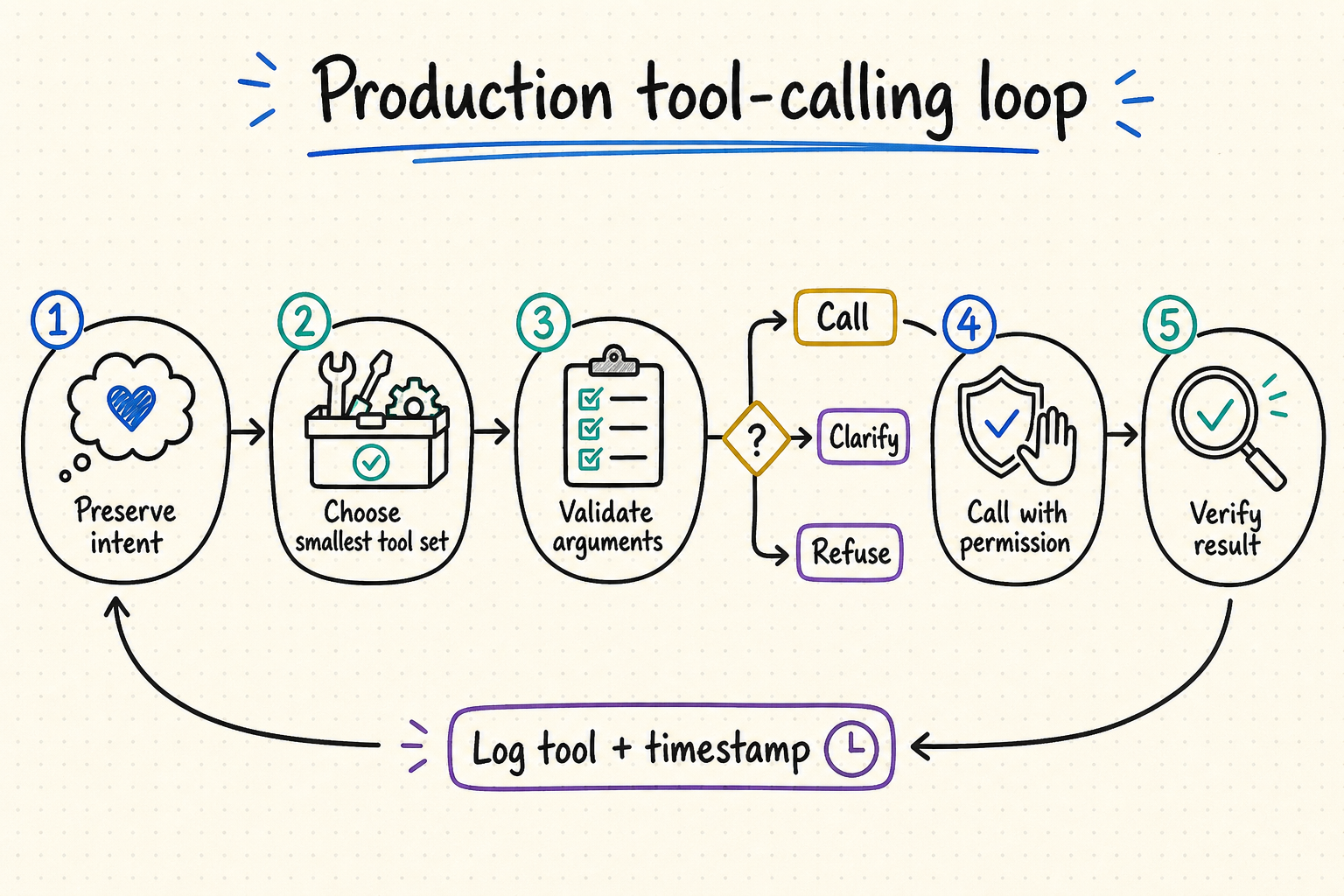
Security & Permission Control
API Key Isolation
Never share API keys across tools. Each tool or provider should have its own credential scope. Rotate keys regularly and never expose them in agent logs or LLM context windows.
Tool-Level Permissions
Not every agent should access every tool. Implement tool-level access control — read-only tools for research agents, write tools only for explicitly authorized workflows.
Sandbox Execution
Execute tool calls in isolated environments. A tool that writes files, sends emails, or modifies data should never run with unrestricted system access.
Input Sanitization & Output Filtering
Sanitize inputs before calling external tools. Filter outputs before passing to LLM reasoning — remove sensitive data, truncate oversized responses, and flag unexpected content.
Observability & Logging
Every tool call must be logged. Without observability, production agents are black boxes — you will not know which tool failed, why, or whether the fallback was activated until a user reports the issue.
Minimum Logged Fields
tool_name, input_schema_hash, output_status, latency_ms, error_type, retry_count, fallback_used, timestamp, provider. These 9 fields give you enough data to debug any production issue without logging sensitive payload contents.
MCP Integration Best Practices
MCP standardizes tool exposure, but production systems still need validation, routing, retry logic, and observability on top of MCP connectivity.
| Layer | Responsibility | Production Notes |
|---|---|---|
| MCP | Tool exposure and connectivity | Standardizes how tools are described and connected |
| Tool Calling | Execution and error handling | Validates inputs, executes calls, handles errors, retries |
| Tool Routing | Selection and fallback | Chooses the best tool; switches on failure |
| Production System | Reliability, observability, security | Logs, monitors, secures, and scales tool execution |
QVeris Support for Production Tool Calling
QVeris helps production agents implement the Discover → Inspect → Call → Validate → Route pattern — structured capability routing that replaces hardcoded single-tool dependencies with validated, fallback-aware execution.
Discover
Find relevant tools across MCP servers, external APIs, and capability catalogs based on task intent — not hardcoded tool names.
Inspect & Validate
Check schema, auth, cost, latency, and provider notes before calling. Validate input parameters. Eliminate unsuitable candidates early.
Call & Retry
Execute selected tool with retry logic. On failure, route to ranked fallback. Log every attempt. Never return "I couldn't complete the task" while fallbacks remain.
Validate & Report
Check output structure, timestamps, source metadata, errors. Return structured result with full traceability — tool used, latency, retry count, fallback status.
QVeris is a capability routing layer. It helps production agents implement structured tool discovery, inspection, and routing — replacing hardcoded single-tool dependencies with validated, fallback-aware execution. QVeris MCP Server documentation or view pricing →.
Getting Started Checklist
QVeris is a capability routing layer. Production agent reliability requires engineering across all layers — validation, routing, observability, and security.
Build Reliable Production AI Agents
QVeris gives your agents structured capability routing with built-in discovery, schema inspection, validation, and fallback — the production tool calling patterns that keep agents running when tools fail.
Test a Tool-Calling Workflow测试工具调用工作流Read the MCP Server Documentation阅读 MCP Server 文档FAQ
Why does tool calling fail in production AI agents?
Is function calling enough for production agents?
What is the most important production tool calling practice?
How does MCP affect production tool calling?
How many fallback tools should I have per capability?
How does QVeris help with production tool calling?
构建可靠 AI Agent 的实用工程指南,涵盖验证、错误处理、回退路由、MCP 集成和 QVeris 能力工作流。
可靠 · 安全 · 可观察 · 可扩展
什么是生产级工具调用?
生产级工具调用不仅仅是调用 API。它是一个受控的工程系统,AI Agent 在其中选择工具、验证 Schema、执行调用、处理故障、验证输出、记录结果,并在需要时路由到回退工具 — 所有这些都在可预测、可观察和可恢复的架构中进行。
演示和生产之间的差距是真实存在的。在演示中,工具调用使用预配置的输入、有效的 API 密钥且无速率限制,一次成功。在生产环境中,工具可能因数十种原因失败:凭证过期、Schema 不匹配、网络超时、速率限制 429、空响应、格式错误的 JSON、过时的提供商元数据,或仅仅因为选择了错误的工具。演示 = 工具工作一次。生产 = 工具必须在故障、规模、延迟和缺失数据条件下可靠工作。
为什么工具调用在生产中失败
1. 缺少 Schema 校验
工具需要 ticker 参数,Agent 却传入 symbol。调用随即失败,而且 Agent 无法判断原因。调用前执行 Schema 校验即可提前拦截这类问题。
2. 选错工具
三个工具的能力相互重叠,Agent 却按名称相似度而不是 Schema 匹配度选择工具。工具只返回部分数据,Agent 随后基于不完整信息继续推理。
3. 缺少认证
工具需要的 API Key 已过期或从未配置,Agent 到调用时才发现问题,而且没有可用的回退方案。
4. 没有重试策略
短暂网络错误导致调用中断;没有重试逻辑时,一秒钟的波动会变成 Agent 输出中的永久失败。
5. 没有备用工具
主工具返回 429 速率限制,Agent 却没有第二选择;明明存在备用工具,只因未配置就只能回复“无法完成任务”。
6. 静默失败
工具返回 HTTP 200,但正文为空或 JSON 不完整;Agent 仍把它视为成功,导致下游工作流接收到没有错误标记的无效数据。
7. 速率限制与延迟
市场事件期间免费 API 额度被耗尽,调用开始返回 429,而 Agent 没有感知速率限制的路由策略。
8. 非结构化输出
工具返回 HTML 而不是 JSON,或返回纯文本而不是结构化字段,解析逻辑随之失效;由于缺少输出验证,这种格式不匹配未被发现。
可靠工具调用的核心原则
| 原则 | 生产环境中的含义 |
|---|---|
| 调用前验证 | 执行前检查输入 Schema、必填字段、类型和认证,绝不盲目调用。 |
| 默认故障会发生 | 工具偶尔必然会失败,因此每条调用路径都应从一开始就按这一前提设计。 |
| 始终准备回退方案 | 每一类关键工具都应至少配置一个经过排序的备用能力。 |
| 规范化输出 | 所有工具响应都应先转换为经过验证的结构化格式,再交给下游推理。 |
| 记录完整调用轨迹 | 为每次调用记录工具名称、输入、输出、延迟、状态、重试次数和回退使用情况。 |
| 分离推理与执行 | LLM 负责决定做什么,执行层负责如何完成,包括验证、重试、路由和日志。 |
| 使用路由,不要硬编码 | 使用能力路由,不要硬编码“始终调用工具 X”;提供商会变化,Schema 也会演进。 |
Schema 验证最佳实践
永远不要在没有先验证其输入 Schema 的情况下调用工具。Schema 验证是生产工具调用中 ROI 最高的实践 — 它在任何 API 调用之前就防止了最常见的失败模式(参数不匹配)。
✓ 验证必填字段
执行前确认每个必填参数均已提供、类型正确且处于允许范围内。缺少 symbol,或在整数位置传入字符串,都会导致失败,应尽早拦截。
✓ 验证 类型和枚举
确保字符串、数字和布尔字段类型正确,枚举值符合允许范围;不同提供商的 API 层并不都能可靠完成类型转换。
✓ 妥善处理可选字段
可选字段应设置明确默认值,或完全省略。工具要求省略字段时不要传入 null,不同提供商对此的处理并不一致。
✓ 调用前验证认证
尝试调用前检查所需 API Key、OAuth Token 或认证请求头是否存在且未过期。除 Schema 不匹配外,认证失败是最常见的生产问题之一。
工具选择策略
生产 Agent 不应仅凭名称选择工具。选择应考虑任务意图、Schema 匹配、延迟、成本、可靠性、输出结构和历史成功率。
| 策略 | 适用场景 | 生产注意事项 |
|---|---|---|
| 规则路由 | 工具数量较少、行为可预测的简单系统 | 工具变化时较脆弱,更适合内部 API |
| 基于 LLM 的选择 | 工具数量适中、任务较灵活的场景 | 会增加延迟,并需要通过 Prompt 工程保持一致性 |
| 基于向量的匹配 | 包含 50 个以上工具、能力类型多样的大型工具集 | 需要工具描述向量,适合初步筛选 |
| QVeris 能力路由 | 需要回退能力的多提供商 Agent 系统 | 按任务意图发现、检查并排序能力,同时支持 Schema 验证与回退路由 |
错误处理与重试机制
每个工具调用路径都必须包含错误处理。常见故障包括超时、速率限制(429)、无效 Schema(400)、缺少认证(401/403)、空响应和格式错误的 JSON。每种故障需要不同的恢复策略。
⏱ 带随机抖动的指数退避
按 1 秒、2 秒、4 秒、8 秒递增延迟重试(最多 3 次),并加入随机抖动避免大量请求同时重试。不要立即重试,否则会放大提供商负载并加重故障。
🔌 熔断器模式
工具连续失败 N 次后,在冷却期内暂停调用,避免级联故障并给提供商恢复时间;之后通过探测请求逐步恢复。
🔄 重试流程
工具 A → 失败 → 退避重试 → 失败 → 再次退避重试 → 失败 → 切换到工具 B(回退)→ 成功。只有所有回退方案均已耗尽,Agent 才应返回“无法完成任务”。
回退路由策略
每个关键工具类别必须至少有一个排序的回退方案。生产环境中不允许单点故障。
市场数据备用链路
主工具: real_time_stock_price → 回退 1: cached_price_api → 回退 2: historical_price_api → 回退 3: secondary_provider。回退方案可能延迟更高或精度略低,但能保证 Agent 持续运行。
备用方案设计规则
1. 按保真度为回退工具排序,最接近主工具的优先;2. 允许较低层级返回可接受的降级结果;3. 记录每次回退激活,因为它是提供商问题的领先信号;4. 定期测试回退路径,未经测试的回退并不可靠。
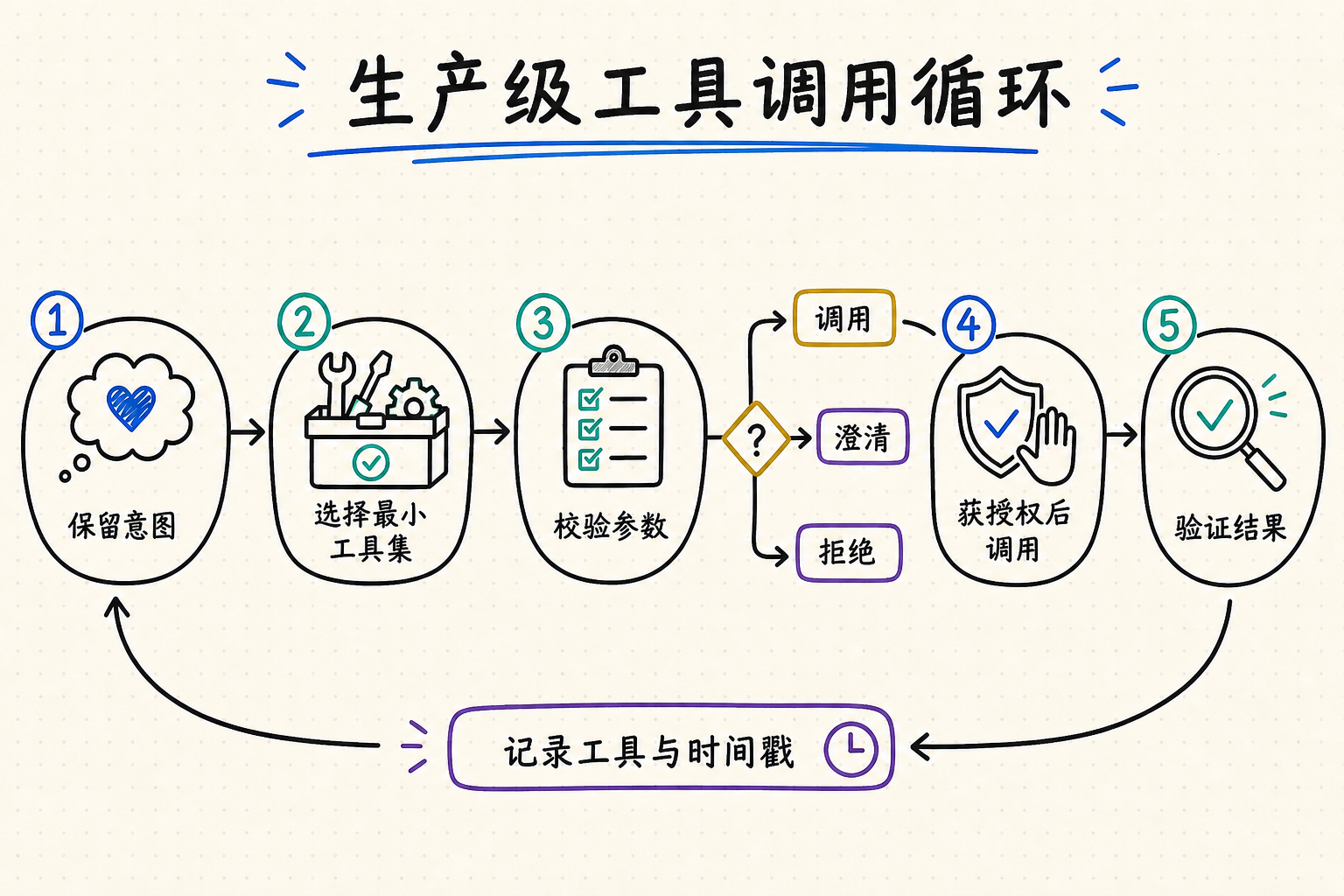
安全与权限控制
API Key 隔离
不要在工具之间共享 API Key。每个工具或提供商都应有独立凭据范围,定期轮换密钥,并避免在 Agent 日志或 LLM 上下文中暴露。
工具级权限
并非所有 Agent 都应访问全部工具。应实施工具级权限控制:研究 Agent 只使用只读工具,写入工具仅开放给明确授权的工作流。
沙箱执行
在隔离环境中执行工具调用。能够写文件、发邮件或修改数据的工具不应拥有不受限制的系统访问权限。
输入清洗与输出过滤
调用外部工具前清理输入;把输出交给 LLM 推理前进行过滤,包括移除敏感数据、截断过大响应并标记异常内容。
可观察性与日志记录
每次工具调用都必须记录。没有可观察性,生产 Agent 就是黑盒 — 直到用户报告问题,你才知道哪个工具失败了、为什么失败、回退是否被激活。
最小日志字段
tool_name、input_schema_hash、output_status、latency_ms、error_type、retry_count、fallback_used、timestamp、provider。这 9 个字段足以排查生产问题,同时无需记录敏感载荷内容。
MCP 集成最佳实践
MCP 标准化了工具暴露,但生产系统仍然需要在 MCP 连接之上进行验证、路由、重试逻辑和可观察性。
| 层级 | 职责 | 生产注意事项 |
|---|---|---|
| MCP | 工具暴露与连接 | 标准化工具描述与连接方式 |
| 工具调用 | 执行与错误处理 | 验证输入、执行调用、处理错误与重试 |
| 工具路由 | 选择与回退 | 选择最合适的工具,并在失败时切换 |
| 生产系统 | 可靠性、可观察性与安全 | 记录、监控、保护并扩展工具执行 |
QVeris 对生产工具调用的支持
QVeris 帮助生产 Agent 实现 发现 → 检查 → 调用 → 验证 → 路由 模式 — 结构化能力路由,用经过验证、支持回退的执行取代硬编码的单工具依赖。
发现
根据任务意图在 MCP 服务器、外部 API 和能力目录中查找相关工具,而不是依赖硬编码工具名称。
检查 & 验证
调用前检查 Schema、认证、成本、延迟和提供商说明,验证输入参数并尽早排除不合适的候选项。
调用并重试
使用重试逻辑执行选定工具;失败时路由到已排序的回退工具,并记录每次尝试。只要仍有回退方案,就不应直接回复“无法完成任务”。
验证并生成报告
检查输出结构、时间戳、来源元数据与错误,并返回具有完整追踪信息的结构化结果,包括所用工具、延迟、重试次数和回退状态。
QVeris 是能力路由层。它帮助生产 Agent 实现结构化工具发现、检查和路由 — 用经过验证、支持回退的执行取代硬编码的单工具依赖。QVeris MCP Server 文档 或 查看定价 →。
快速上手指南
QVeris 是能力路由层。生产 Agent 的可靠性需要在所有层面进行工程 — 验证、路由、可观察性和安全。
构建可靠的生产级 AI Agent
QVeris 为您的 Agent 提供结构化能力路由,内置发现、Schema 检查、验证和回退 — 在工具失败时保持 Agent 运行的生产级工具调用模式。
测试工具调用工作流阅读 MCP Server 文档