QVeris
运行任务
2026 platform comparison2026 平台对比

Toolhouse vs QVeris: AI Workers vs Capability RoutingToolhouse 与 QVerisAI Worker 平台与能力路由

Toolhouse helps teams build, run, schedule and observe AI workers. QVeris helps existing agents discover, inspect and call external capabilities. This guide compares the operating model—not just the feature list—so you can choose the layer your stack is actually missing.

Toolhouse 帮助团队构建、运行、定时和观测 AI Worker;QVeris 帮助现有 Agent 发现、检查并调用外部能力。本文比较的是两者在系统中的职责,而不只是功能清单,方便你判断当前技术栈真正缺少哪一层。
Based on official product documentation依据双方官方产品文档
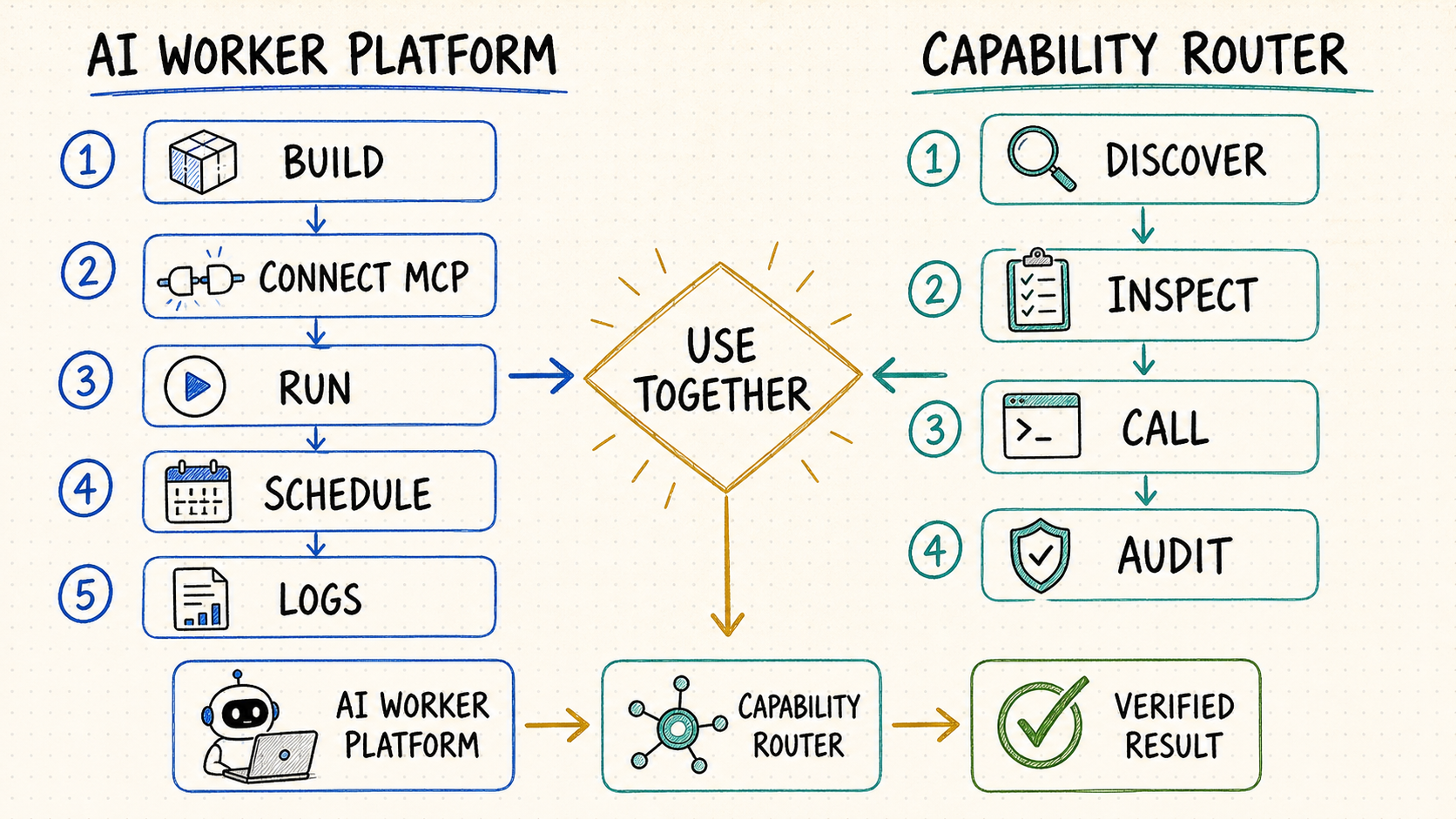
Decision map comparing Toolhouse AI worker workflow with QVeris capability routing workflow
Decision map: Toolhouse owns the worker lifecycle; QVeris owns capability discovery and execution routing. The two layers can also be combined.决策图:Toolhouse 负责 Worker 生命周期,QVeris 负责能力发现与执行路由;两层也可以组合使用。
TL;DR

The decision in 60 seconds60 秒做出初步判断

These products overlap around MCP and tool use, but they solve different primary problems. Start with the system boundary you want a vendor to own.

两者都涉及 MCP 和工具调用,但主要解决的问题不同。先判断你希望平台替你承担哪一段系统边界。

Choose Toolhouse选择 Toolhouse

When you want a managed place to create AI workers, attach tools and knowledge, run schedules, deploy an agent API, and inspect logs or evaluations.

当你需要一个托管平台来创建 AI Worker、接入工具和知识、运行定时任务、部署 Agent API,并查看日志或评测时。

Choose QVeris选择 QVeris

When your agent runtime already exists and the missing layer is natural-language capability discovery, parameter inspection, provider routing, and controlled execution.

当你的 Agent 运行时已经存在,缺少的是自然语言能力发现、参数检查、服务商路由和受控执行时。

Use both组合使用

When Toolhouse should own worker orchestration while QVeris supplies a broader, inspectable capability layer to that worker through MCP or API.

当 Toolhouse 负责编排和运行 Worker,而 QVeris 通过 MCP 或 API 为它提供更广、可检查的能力层时。

Who this is for适用人群

Two different starting points两种不同的起点

A useful comparison begins with what your team already has. Buying a second runtime when you need integrations—or buying integrations when you need a runtime—creates avoidable complexity.

有效的比较要从团队已有的系统开始。缺集成却买了第二套运行时,或缺运行时却只买了集成层,都会增加不必要的复杂度。

Toolhouse is a stronger fit if…以下情况更适合 Toolhouse
  • Operations or business teams want repeatable AI workers with a managed interface.运营或业务团队希望通过托管界面建立可重复运行的 AI Worker。
  • Developers want agents-as-code, a hosted endpoint, schedules, memory, RAG and logs in one platform.开发者希望在一个平台内获得 Agent-as-code、托管端点、定时、记忆、RAG 和日志。
  • The main deliverable is a running worker or agent service.最终交付物是一项持续运行的 Worker 或 Agent 服务。
QVeris is a stronger fit if…以下情况更适合 QVeris
  • You already use your own agent framework, model SDK, workflow engine or MCP client.你已经使用自己的 Agent 框架、模型 SDK、工作流引擎或 MCP 客户端。
  • Agents need to find capabilities dynamically instead of hard-coding every provider.Agent 需要动态发现能力,而不是把每个服务商硬编码进系统。
  • You need inspectable parameters, price, latency or success signals before execution.执行前需要检查参数、价格、延迟或成功率等信息。
Architecture架构

What each platform owns in your stack两者在技术栈中分别负责什么

Toolhouse is positioned as an AI worker platform and its technical documentation describes an agentic backend-as-a-service. QVeris is positioned as a capability routing network. That difference changes deployment, observability, and lock-in.

Toolhouse 当前以 AI Worker 平台定位,其技术文档将底层描述为 Agent 后端服务;QVeris 则定位为能力路由网络。这会直接影响部署方式、可观测性和迁移成本。

Toolhouse

Define the worker → attach MCP, RAG, memory or browser/code tools → run or schedule it → deploy as an API → inspect logs and evaluations.

定义 Worker → 接入 MCP、RAG、记忆或浏览器/代码工具 → 运行或定时 → 部署为 API → 查看日志与评测。

QVeris

Describe the capability needed → discover candidates → inspect inputs and execution signals → call the selected capability → retain an auditable result.

描述所需能力 → 发现候选项 → 检查输入和执行信号 → 调用选定能力 → 留下可审计结果。

Key distinction: Toolhouse can be the place your agent lives. QVeris is more often the capability layer your agent calls. If you already have LangGraph, CrewAI, an internal orchestrator or an MCP host, this distinction matters more than the number of integrations on a landing page.

关键区别:Toolhouse 可以是 Agent 本身运行的地方;QVeris 更多是 Agent 调用的能力层。如果你已经有 LangGraph、CrewAI、内部编排器或 MCP Host,这个区别比落地页上的集成数量更重要。

Side-by-side逐项对比

Toolhouse vs QVeris capability comparisonToolhouse 与 QVeris 能力对比

The table uses current official documentation and avoids unverified performance claims. Product details can change, so verify the linked source before procurement.

下表依据当前官方文档,不使用无法验证的性能数字。产品信息可能变化,采购前请再次核对文末官方来源。

Decision area决策维度ToolhouseQVeris
Primary job主要职责Build, run, manage and deploy AI workers or agents.构建、运行、管理和部署 AI Worker / Agent。Discover, inspect, route and call capabilities for an existing agent.为现有 Agent 发现、检查、路由并调用能力。
Typical owner典型使用者Business automation teams, agent builders and developers who want a managed runtime.业务自动化团队、Agent 构建者,以及需要托管运行时的开发者。Agent platform teams and developers who already control orchestration.已掌握编排层的 Agent 平台团队和开发者。
Agent runtimeAgent 运行时Included: run, schedule, publish as API, maintain continuity and inspect activity.包含运行、定时、发布 API、保持会话连续性和查看活动。Not the primary product; connects to your runtime through MCP, SDK, CLI or REST.不是主要产品;通过 MCP、SDK、CLI 或 REST 接入你的运行时。
Capability discovery能力发现Connect curated or custom MCP servers; Studio can suggest MCP connections from a task.连接精选或自定义 MCP Server;Studio 可根据任务建议 MCP 连接。Natural-language discovery is a core operation, followed by inspect and call.自然语言发现是核心操作,之后再进行 inspect 与 call。
MCPMCP servers become tools available to the worker or agent.MCP Server 作为 Worker / Agent 可使用的工具。MCP exposes discover, inspect and call to compatible clients.通过 MCP 向兼容客户端暴露 discover、inspect 和 call。
Knowledge and memory知识与记忆RAG and memory are documented platform features.RAG 和记忆属于文档列出的平台功能。Bring your own memory or knowledge layer; QVeris focuses on capabilities.记忆或知识层由你自备;QVeris 聚焦能力调用。
Deployment部署CLI deployment and hosted agent endpoints with authentication for private agents.支持 CLI 部署和托管 Agent 端点,私有 Agent 可使用认证。No new agent deployment required; integrate the routing layer into the runtime you operate.无需新增 Agent 部署;把路由层接入你现有的运行时。
Observability可观测性Action logs, evaluations and optimization features at the worker/runtime layer.在 Worker / 运行时层提供操作日志、评测和优化功能。Inspect and execution records at the capability-routing layer; keep end-to-end traces in your runtime.在能力路由层提供检查与执行记录;端到端链路仍由你的运行时保存。
Pricing unit计费单位Subscription plans bundle worker limits and credits.订阅计划打包 Worker 数量与 Credits。Discover and Inspect are free; Call consumes credits according to the selected capability.Discover 与 Inspect 免费;Call 根据所选能力消耗 Credits。
Best fit最佳适配A team wants a managed worker lifecycle from creation through operation.团队需要从创建到运行的完整托管 Worker 生命周期。A team wants to expand an existing agent with a flexible capability network.团队希望用灵活的能力网络扩展已有 Agent。
Use cases使用场景

Which platform wins in real projects?真实项目中应该选哪个?

Scheduled research worker定时研究 Worker

A worker gathers sources every morning, summarizes changes, stores context and posts a report. Toolhouse is the more complete starting point because schedules, worker runtime and logs are central.

每天早上自动收集来源、总结变化、保存上下文并发布报告。由于定时、Worker 运行时和日志是核心,Toolhouse 更适合作为起点。

Existing agent needs more tools现有 Agent 需要更多工具

Your internal agent already handles planning, memory and approval. It needs to find and compare external capabilities at runtime. QVeris adds that layer without replacing the orchestrator.

内部 Agent 已经处理规划、记忆和审批,只需在运行时发现并比较外部能力。QVeris 可以补齐这一层,而无需替换编排器。

Business-owned automation业务团队主导的自动化

A nontechnical team wants repeatable workers and visible operations. Toolhouse’s current AI-worker positioning and managed interface align more directly with that ownership model.

非技术团队希望建立可重复运行、过程可见的 Worker。Toolhouse 当前的 AI Worker 定位和托管界面更贴合这种所有权模式。

Provider resilience服务商韧性

An agent should inspect options before committing to a provider and keep integration logic thin. QVeris is designed around discover → inspect → call, which matches this requirement.

Agent 需要在确定服务商前先检查候选项,并尽量减少集成逻辑。QVeris 的 discover → inspect → call 模式与此需求一致。

One platform for agent operations统一的 Agent 运营平台

The team wants deployment, continuity, RAG, memory, browser use, code execution, logs and evaluations together. Toolhouse covers more of this operational surface.

团队希望统一获得部署、连续会话、RAG、记忆、浏览器、代码执行、日志和评测。Toolhouse 覆盖的运营面更完整。

Managed worker + broad capabilities托管 Worker + 广泛能力

The worker lifecycle belongs in Toolhouse, but capability selection should remain dynamic and inspectable. Use Toolhouse for orchestration and QVeris as an MCP/API capability layer.

Worker 生命周期由 Toolhouse 承担,但能力选择需要保持动态、可检查。可以用 Toolhouse 做编排,用 QVeris 的 MCP/API 做能力层。

Pricing and TCO定价与总成本

Do not compare the sticker prices directly不要直接比较标价

The products meter different work. A fair comparison prices the same end-to-end workflow, including the runtime and capability calls you would otherwise source elsewhere.

两者计量的是不同工作。公平比较应该针对同一条端到端工作流,把运行时和原本需要另行购买的能力调用一起计算。

Toolhouse pricing snapshotToolhouse 定价快照

As checked July 30, 2026, the official page lists Business at $500/month with 25,000 credits and up to 50 workers; Business Max at $1,200/month with 80,000 credits and up to 500 workers; Enterprise is custom. A 14-day trial is listed.

截至 2026 年 7 月 30 日,官方页面列出 Business 为 500 美元/月,含 25,000 Credits、最多 50 个 Worker;Business Max 为 1,200 美元/月,含 80,000 Credits、最多 500 个 Worker;Enterprise 为定制价,并提供 14 天试用。

QVeris pricing snapshotQVeris 定价快照

Discover and Inspect are listed as free. Call consumes 1–100 credits depending on the capability. The official page lists Free at $0 with signup and daily credits, Pro at $19 with 10,000 credits, and Scale as on-demand.

Discover 和 Inspect 免费;Call 根据能力消耗 1–100 Credits。官方页面列出 Free 为 0 美元并提供注册及每日 Credits,Pro 为 19 美元含 10,000 Credits,Scale 按需购买。

TCO checklist: worker/runtime subscription + model tokens + capability/provider charges + retries + schedule frequency + log retention + engineering time + credential operations. Re-run the model with your own workload; published prices may change.

总成本清单:Worker/运行时订阅 + 模型 Token + 能力/服务商费用 + 重试 + 定时频率 + 日志保留 + 工程时间 + 凭据运维。请用自己的工作量重新测算,公开价格也可能变化。

Security, cost and latency controls安全、成本与延迟控制

Compare control points, not security adjectives比较控制点,而不是安全口号

Credentials凭据

Map where provider secrets live, who can rotate them, whether they appear in MCP URLs, and which component signs each request. Toolhouse custom MCP documentation explicitly warns about credentials in URLs.

确认服务商密钥存放位置、轮换权限、是否出现在 MCP URL 中,以及每次请求由哪个组件签名。Toolhouse 的自定义 MCP 文档明确提示了 URL 中凭据的风险。

Execution policy执行策略

Require allowlists for high-impact actions, explicit approval for writes, budget ceilings, timeouts and bounded retries. Keep discovery separate from execution permission.

对高影响操作设置白名单,写操作需要明确审批,并设置预算上限、超时和有限重试。能力发现权限不应等同于执行权限。

Audit trail审计链路

Retain the user intent, selected capability, inspected schema, sanitized arguments, provider response, latency, cost and approval decision under one correlation ID.

在同一个关联 ID 下保留用户意图、所选能力、检查过的 Schema、脱敏参数、服务商响应、延迟、成本和审批决策。

QVeris implementation patternQVeris 实施模式

Use Toolhouse as the worker, QVeris as the capability router用 Toolhouse 运行 Worker,用 QVeris 路由能力

This hybrid pattern is appropriate when you want Toolhouse’s worker lifecycle but do not want every external provider embedded as permanent workflow logic.

当你需要 Toolhouse 的 Worker 生命周期,又不希望把每个外部服务商永久写进工作流逻辑时,可以采用这种组合模式。

Define the worker’s responsibility定义 Worker 的职责

Keep the system prompt focused on the business outcome, approval policy and stopping conditions.

让系统提示词聚焦业务结果、审批策略和停止条件。

Connect the QVeris capability interface接入 QVeris 能力接口

Expose discover, inspect and call through MCP, or call the REST/SDK surface from a custom tool.

通过 MCP 暴露 discover、inspect、call,或从自定义工具调用 REST/SDK。

Inspect before execution执行前先检查

Select a candidate only after validating its input schema, cost and operational signals against policy.

先验证候选能力的输入 Schema、成本和运行信号是否符合策略,再做选择。

Log one end-to-end decision记录一条端到端决策链

Pass a correlation ID from the Toolhouse run into capability execution and your own audit store.

把关联 ID 从 Toolhouse Run 传入能力执行和自有审计存储。

{
  "worker": "daily-market-brief",
  "capability_policy": {
    "discover": true,
    "inspect_before_call": true,
    "max_credits_per_run": 80,
    "write_actions_require_approval": true,
    "timeout_ms": 15000,
    "max_retries": 2
  },
  "audit": ["run_id", "capability_id", "cost", "latency", "result_status"]
}
Validation checklist验证清单

Run the same production-shaped test on both用同一条接近生产的任务测试两者

A demo that succeeds once is not a procurement test. Use one representative workflow and record the same evidence for both options.

一次成功的演示不等于采购验证。请选择一条有代表性的工作流,并为两个方案记录相同证据。

Functional acceptance功能验收
  • Correct result on normal, empty and malformed inputs正常、空值和错误输入都能得到正确处理
  • Approval blocks high-impact writes高影响写操作会被审批机制拦截
  • Provider or tool failure degrades predictably服务商或工具故障时能按预期降级
  • A human can reproduce the decision from logs人工可以从日志中复现决策过程
Operational acceptance运营验收
  • P50/P95 latency measured with your model and data用自己的模型和数据测量 P50/P95 延迟
  • Cost per successful outcome, including retries包含重试后的每次成功结果成本
  • Credential rotation and least-privilege test凭据轮换与最小权限测试
  • Export, rollback and incident ownership documented明确导出、回滚与事故责任边界
Migration path迁移路径

Move one boundary at a time一次只迁移一个边界

Inventory the current stack盘点现有技术栈

Separate orchestration, model access, memory, tools, credentials, schedules, logging and approvals.

把编排、模型访问、记忆、工具、凭据、定时、日志和审批分别列出。

Select the missing layer确定缺失层

If runtime operations dominate, pilot Toolhouse. If capability integration dominates, pilot QVeris.

如果主要问题是运行时运营,先试 Toolhouse;如果主要问题是能力集成,先试 QVeris。

Shadow one workflow影子运行一条工作流

Run beside production without write permission and compare result quality, failure rate, latency and cost.

在没有写权限的情况下与生产并行运行,比较结果质量、失败率、延迟和成本。

Cut over with rollback带回滚方案切换

Keep the old route available until retry, timeout, credential and audit requirements pass.

在重试、超时、凭据和审计要求全部通过前,保留旧路径作为回滚方案。

Common failure modes常见失败模式

Mistakes that make either choice look worse than it is让选型结果失真的常见错误

Comparing different units比较不同计费单位

A worker subscription and a capability call are not equivalent. Normalize to cost per completed business outcome.

Worker 订阅和一次能力调用并不等价,应统一折算为每个业务结果的成本。

Skipping inspect跳过 Inspect

Letting an agent call the first discovered capability without checking schema, cost or permissions creates brittle automation.

Agent 发现能力后不检查 Schema、成本或权限就直接调用,会造成脆弱的自动化。

Duplicating orchestration重复建设编排层

Running planning, retries and state in two platforms makes incident ownership ambiguous. Assign one runtime as the system of record.

在两个平台同时处理规划、重试和状态,会让事故责任不清。应指定一个运行时作为权威系统。

Using public benchmarks迷信公开 Benchmark

Latency depends on model, region, provider and workflow. Measure the exact path you plan to ship.

延迟取决于模型、区域、服务商和工作流,应该测量你真正要上线的完整路径。

FAQ

Toolhouse vs QVeris questionsToolhouse 与 QVeris 常见问题

What is the main difference between Toolhouse and QVeris?Toolhouse 与 QVeris 的核心区别是什么?

Toolhouse is designed to build, run, schedule, deploy and observe AI workers or agents. QVeris is designed to let an existing agent discover, inspect and call external capabilities through one routing layer.

Toolhouse 用于构建、运行、定时、部署和观测 AI Worker / Agent;QVeris 用于让现有 Agent 通过统一路由层发现、检查和调用外部能力。

Is QVeris a Toolhouse replacement?QVeris 能完全替代 Toolhouse 吗?

Not as a complete agent runtime. QVeris can replace or simplify the capability integration and routing layer, while Toolhouse also provides agent construction, hosting, schedules, memory, logs and evaluations.

如果指完整 Agent 运行时,不能直接替代。QVeris 可以替代或简化能力集成与路由层,而 Toolhouse 还提供 Agent 构建、托管、定时、记忆、日志和评测。

Can Toolhouse and QVeris work together?Toolhouse 和 QVeris 可以一起使用吗?

Yes. A Toolhouse agent can own the workflow and runtime while QVeris acts as a capability router for discovery, inspection and execution.

可以。Toolhouse Agent 负责工作流与运行时,QVeris 作为能力路由层负责发现、检查和执行。

Which is better if we already have an agent runtime?已经有 Agent 运行时,哪个更合适?

QVeris is usually the more direct fit when the runtime already exists and the missing layer is capability discovery, normalized inspection, routing or pay-as-you-go execution.

如果运行时已经存在,缺少的是能力发现、标准化检查、路由或按量执行,QVeris 通常更直接。

How should we compare pricing?应该如何比较价格?

Model the same production workflow. Toolhouse plans package worker runtime and credits, while QVeris meters capability calls by credits. Include model usage, schedules, retries, storage, provider fees and operational labor.

请针对同一条生产工作流测算。Toolhouse 套餐打包 Worker 运行时和 Credits,QVeris 按能力调用消耗 Credits;还要加入模型、定时、重试、存储、服务商费用和运维人力。

Do both products support MCP?两者都支持 MCP 吗?

Yes, but MCP serves different roles. Toolhouse connects MCP servers to workers and agents. QVeris exposes discover, inspect and call as MCP tools so an MCP client can find and execute capabilities.

都支持,但作用不同。Toolhouse 把 MCP Server 接入 Worker / Agent;QVeris 把 discover、inspect、call 暴露为 MCP 工具,供 MCP 客户端发现和执行能力。

Official sources官方来源

Verify product details before you buy采购前核对产品信息

This comparison was checked against the following first-party pages on July 30, 2026.

本文于 2026 年 7 月 30 日根据以下一手页面核对。

Toolhouse Pricingtoolhouse.ai/en/pricing ↗ Toolhouse Documentationdocs.toolhouse.ai/toolhouse ↗ Toolhouse DeploymentPublish and run agents ↗发布与运行 Agent ↗ Toolhouse Custom MCPRemote MCP integration ↗远程 MCP 集成 ↗ QVeris MCP Server Documentationqveris.ai/docs/mcp-server ↗ QVeris Pricingqveris.ai/pricing ↗
Start with the missing layer从缺失的一层开始

Already have an agent runtime? Test capability routing first.已经有 Agent 运行时?先测试能力路由。

Use QVeris to discover and inspect capabilities before spending credits on execution. Keep your existing orchestrator, memory and approval flow.

先用 QVeris 免费发现和检查能力,再决定是否消耗 Credits 执行;现有编排器、记忆和审批流程可以继续保留。
2026 platform comparison2026 平台对比

Toolhouse vs QVeris: AI Workers vs Capability RoutingToolhouse 与 QVerisAI Worker 平台与能力路由

Toolhouse helps teams build, run, schedule and observe AI workers. QVeris helps existing agents discover, inspect and call external capabilities. This guide compares the operating model—not just the feature list—so you can choose the layer your stack is actually missing.

Toolhouse 帮助团队构建、运行、定时和观测 AI Worker;QVeris 帮助现有 Agent 发现、检查并调用外部能力。本文比较的是两者在系统中的职责,而不只是功能清单,方便你判断当前技术栈真正缺少哪一层。

Based on official product documentation依据双方官方产品文档
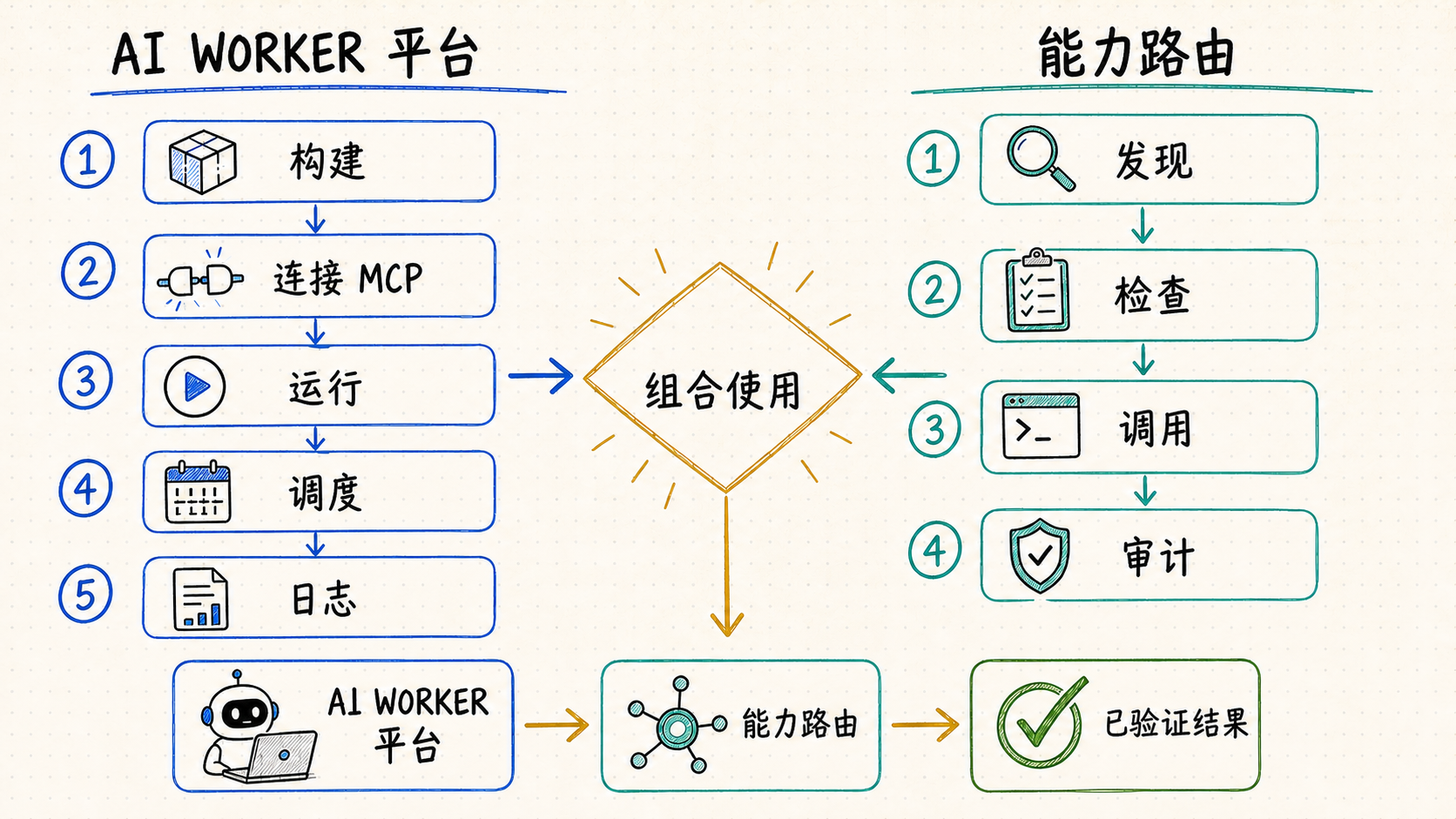
Toolhouse AI Worker 工作流与 QVeris 能力路由工作流决策图
Decision map: Toolhouse owns the worker lifecycle; QVeris owns capability discovery and execution routing. The two layers can also be combined.决策图:Toolhouse 负责 Worker 生命周期,QVeris 负责能力发现与执行路由;两层也可以组合使用。
TL;DR

The decision in 60 seconds60 秒做出初步判断

These products overlap around MCP and tool use, but they solve different primary problems. Start with the system boundary you want a vendor to own.

两者都涉及 MCP 和工具调用,但主要解决的问题不同。先判断你希望平台替你承担哪一段系统边界。

Choose Toolhouse选择 Toolhouse

When you want a managed place to create AI workers, attach tools and knowledge, run schedules, deploy an agent API, and inspect logs or evaluations.

当你需要一个托管平台来创建 AI Worker、接入工具和知识、运行定时任务、部署 Agent API,并查看日志或评测时。

Choose QVeris选择 QVeris

When your agent runtime already exists and the missing layer is natural-language capability discovery, parameter inspection, provider routing, and controlled execution.

当你的 Agent 运行时已经存在,缺少的是自然语言能力发现、参数检查、服务商路由和受控执行时。

Use both组合使用

When Toolhouse should own worker orchestration while QVeris supplies a broader, inspectable capability layer to that worker through MCP or API.

当 Toolhouse 负责编排和运行 Worker,而 QVeris 通过 MCP 或 API 为它提供更广、可检查的能力层时。

Who this is for适用人群

Two different starting points两种不同的起点

A useful comparison begins with what your team already has. Buying a second runtime when you need integrations—or buying integrations when you need a runtime—creates avoidable complexity.

有效的比较要从团队已有的系统开始。缺集成却买了第二套运行时,或缺运行时却只买了集成层,都会增加不必要的复杂度。

Toolhouse is a stronger fit if…以下情况更适合 Toolhouse
  • Operations or business teams want repeatable AI workers with a managed interface.运营或业务团队希望通过托管界面建立可重复运行的 AI Worker。
  • Developers want agents-as-code, a hosted endpoint, schedules, memory, RAG and logs in one platform.开发者希望在一个平台内获得 Agent-as-code、托管端点、定时、记忆、RAG 和日志。
  • The main deliverable is a running worker or agent service.最终交付物是一项持续运行的 Worker 或 Agent 服务。
QVeris is a stronger fit if…以下情况更适合 QVeris
  • You already use your own agent framework, model SDK, workflow engine or MCP client.你已经使用自己的 Agent 框架、模型 SDK、工作流引擎或 MCP 客户端。
  • Agents need to find capabilities dynamically instead of hard-coding every provider.Agent 需要动态发现能力,而不是把每个服务商硬编码进系统。
  • You need inspectable parameters, price, latency or success signals before execution.执行前需要检查参数、价格、延迟或成功率等信息。
Architecture架构

What each platform owns in your stack两者在技术栈中分别负责什么

Toolhouse is positioned as an AI worker platform and its technical documentation describes an agentic backend-as-a-service. QVeris is positioned as a capability routing network. That difference changes deployment, observability, and lock-in.

Toolhouse 当前以 AI Worker 平台定位,其技术文档将底层描述为 Agent 后端服务;QVeris 则定位为能力路由网络。这会直接影响部署方式、可观测性和迁移成本。

Toolhouse

Define the worker → attach MCP, RAG, memory or browser/code tools → run or schedule it → deploy as an API → inspect logs and evaluations.

定义 Worker → 接入 MCP、RAG、记忆或浏览器/代码工具 → 运行或定时 → 部署为 API → 查看日志与评测。

QVeris

Describe the capability needed → discover candidates → inspect inputs and execution signals → call the selected capability → retain an auditable result.

描述所需能力 → 发现候选项 → 检查输入和执行信号 → 调用选定能力 → 留下可审计结果。

Key distinction: Toolhouse can be the place your agent lives. QVeris is more often the capability layer your agent calls. If you already have LangGraph, CrewAI, an internal orchestrator or an MCP host, this distinction matters more than the number of integrations on a landing page.

关键区别:Toolhouse 可以是 Agent 本身运行的地方;QVeris 更多是 Agent 调用的能力层。如果你已经有 LangGraph、CrewAI、内部编排器或 MCP Host,这个区别比落地页上的集成数量更重要。

Side-by-side逐项对比

Toolhouse vs QVeris capability comparisonToolhouse 与 QVeris 能力对比

The table uses current official documentation and avoids unverified performance claims. Product details can change, so verify the linked source before procurement.

下表依据当前官方文档,不使用无法验证的性能数字。产品信息可能变化,采购前请再次核对文末官方来源。

Decision area决策维度ToolhouseQVeris
Primary job主要职责Build, run, manage and deploy AI workers or agents.构建、运行、管理和部署 AI Worker / Agent。Discover, inspect, route and call capabilities for an existing agent.为现有 Agent 发现、检查、路由并调用能力。
Typical owner典型使用者Business automation teams, agent builders and developers who want a managed runtime.业务自动化团队、Agent 构建者,以及需要托管运行时的开发者。Agent platform teams and developers who already control orchestration.已掌握编排层的 Agent 平台团队和开发者。
Agent runtimeAgent 运行时Included: run, schedule, publish as API, maintain continuity and inspect activity.包含运行、定时、发布 API、保持会话连续性和查看活动。Not the primary product; connects to your runtime through MCP, SDK, CLI or REST.不是主要产品;通过 MCP、SDK、CLI 或 REST 接入你的运行时。
Capability discovery能力发现Connect curated or custom MCP servers; Studio can suggest MCP connections from a task.连接精选或自定义 MCP Server;Studio 可根据任务建议 MCP 连接。Natural-language discovery is a core operation, followed by inspect and call.自然语言发现是核心操作,之后再进行 inspect 与 call。
MCPMCP servers become tools available to the worker or agent.MCP Server 作为 Worker / Agent 可使用的工具。MCP exposes discover, inspect and call to compatible clients.通过 MCP 向兼容客户端暴露 discover、inspect 和 call。
Knowledge and memory知识与记忆RAG and memory are documented platform features.RAG 和记忆属于文档列出的平台功能。Bring your own memory or knowledge layer; QVeris focuses on capabilities.记忆或知识层由你自备;QVeris 聚焦能力调用。
Deployment部署CLI deployment and hosted agent endpoints with authentication for private agents.支持 CLI 部署和托管 Agent 端点,私有 Agent 可使用认证。No new agent deployment required; integrate the routing layer into the runtime you operate.无需新增 Agent 部署;把路由层接入你现有的运行时。
Observability可观测性Action logs, evaluations and optimization features at the worker/runtime layer.在 Worker / 运行时层提供操作日志、评测和优化功能。Inspect and execution records at the capability-routing layer; keep end-to-end traces in your runtime.在能力路由层提供检查与执行记录;端到端链路仍由你的运行时保存。
Pricing unit计费单位Subscription plans bundle worker limits and credits.订阅计划打包 Worker 数量与 Credits。Discover and Inspect are free; Call consumes credits according to the selected capability.Discover 与 Inspect 免费;Call 根据所选能力消耗 Credits。
Best fit最佳适配A team wants a managed worker lifecycle from creation through operation.团队需要从创建到运行的完整托管 Worker 生命周期。A team wants to expand an existing agent with a flexible capability network.团队希望用灵活的能力网络扩展已有 Agent。
Use cases使用场景

Which platform wins in real projects?真实项目中应该选哪个?

Scheduled research worker定时研究 Worker

A worker gathers sources every morning, summarizes changes, stores context and posts a report. Toolhouse is the more complete starting point because schedules, worker runtime and logs are central.

每天早上自动收集来源、总结变化、保存上下文并发布报告。由于定时、Worker 运行时和日志是核心,Toolhouse 更适合作为起点。

Existing agent needs more tools现有 Agent 需要更多工具

Your internal agent already handles planning, memory and approval. It needs to find and compare external capabilities at runtime. QVeris adds that layer without replacing the orchestrator.

内部 Agent 已经处理规划、记忆和审批,只需在运行时发现并比较外部能力。QVeris 可以补齐这一层,而无需替换编排器。

Business-owned automation业务团队主导的自动化

A nontechnical team wants repeatable workers and visible operations. Toolhouse’s current AI-worker positioning and managed interface align more directly with that ownership model.

非技术团队希望建立可重复运行、过程可见的 Worker。Toolhouse 当前的 AI Worker 定位和托管界面更贴合这种所有权模式。

Provider resilience服务商韧性

An agent should inspect options before committing to a provider and keep integration logic thin. QVeris is designed around discover → inspect → call, which matches this requirement.

Agent 需要在确定服务商前先检查候选项,并尽量减少集成逻辑。QVeris 的 discover → inspect → call 模式与此需求一致。

One platform for agent operations统一的 Agent 运营平台

The team wants deployment, continuity, RAG, memory, browser use, code execution, logs and evaluations together. Toolhouse covers more of this operational surface.

团队希望统一获得部署、连续会话、RAG、记忆、浏览器、代码执行、日志和评测。Toolhouse 覆盖的运营面更完整。

Managed worker + broad capabilities托管 Worker + 广泛能力

The worker lifecycle belongs in Toolhouse, but capability selection should remain dynamic and inspectable. Use Toolhouse for orchestration and QVeris as an MCP/API capability layer.

Worker 生命周期由 Toolhouse 承担,但能力选择需要保持动态、可检查。可以用 Toolhouse 做编排,用 QVeris 的 MCP/API 做能力层。

Pricing and TCO定价与总成本

Do not compare the sticker prices directly不要直接比较标价

The products meter different work. A fair comparison prices the same end-to-end workflow, including the runtime and capability calls you would otherwise source elsewhere.

两者计量的是不同工作。公平比较应该针对同一条端到端工作流,把运行时和原本需要另行购买的能力调用一起计算。

Toolhouse pricing snapshotToolhouse 定价快照

As checked July 30, 2026, the official page lists Business at $500/month with 25,000 credits and up to 50 workers; Business Max at $1,200/month with 80,000 credits and up to 500 workers; Enterprise is custom. A 14-day trial is listed.

截至 2026 年 7 月 30 日,官方页面列出 Business 为 500 美元/月,含 25,000 Credits、最多 50 个 Worker;Business Max 为 1,200 美元/月,含 80,000 Credits、最多 500 个 Worker;Enterprise 为定制价,并提供 14 天试用。

QVeris pricing snapshotQVeris 定价快照

Discover and Inspect are listed as free. Call consumes 1–100 credits depending on the capability. The official page lists Free at $0 with signup and daily credits, Pro at $19 with 10,000 credits, and Scale as on-demand.

Discover 和 Inspect 免费;Call 根据能力消耗 1–100 Credits。官方页面列出 Free 为 0 美元并提供注册及每日 Credits,Pro 为 19 美元含 10,000 Credits,Scale 按需购买。

TCO checklist: worker/runtime subscription + model tokens + capability/provider charges + retries + schedule frequency + log retention + engineering time + credential operations. Re-run the model with your own workload; published prices may change.

总成本清单:Worker/运行时订阅 + 模型 Token + 能力/服务商费用 + 重试 + 定时频率 + 日志保留 + 工程时间 + 凭据运维。请用自己的工作量重新测算,公开价格也可能变化。

Security, cost and latency controls安全、成本与延迟控制

Compare control points, not security adjectives比较控制点,而不是安全口号

Credentials凭据

Map where provider secrets live, who can rotate them, whether they appear in MCP URLs, and which component signs each request. Toolhouse custom MCP documentation explicitly warns about credentials in URLs.

确认服务商密钥存放位置、轮换权限、是否出现在 MCP URL 中,以及每次请求由哪个组件签名。Toolhouse 的自定义 MCP 文档明确提示了 URL 中凭据的风险。

Execution policy执行策略

Require allowlists for high-impact actions, explicit approval for writes, budget ceilings, timeouts and bounded retries. Keep discovery separate from execution permission.

对高影响操作设置白名单,写操作需要明确审批,并设置预算上限、超时和有限重试。能力发现权限不应等同于执行权限。

Audit trail审计链路

Retain the user intent, selected capability, inspected schema, sanitized arguments, provider response, latency, cost and approval decision under one correlation ID.

在同一个关联 ID 下保留用户意图、所选能力、检查过的 Schema、脱敏参数、服务商响应、延迟、成本和审批决策。

QVeris implementation patternQVeris 实施模式

Use Toolhouse as the worker, QVeris as the capability router用 Toolhouse 运行 Worker,用 QVeris 路由能力

This hybrid pattern is appropriate when you want Toolhouse’s worker lifecycle but do not want every external provider embedded as permanent workflow logic.

当你需要 Toolhouse 的 Worker 生命周期,又不希望把每个外部服务商永久写进工作流逻辑时,可以采用这种组合模式。

Define the worker’s responsibility定义 Worker 的职责

Keep the system prompt focused on the business outcome, approval policy and stopping conditions.

让系统提示词聚焦业务结果、审批策略和停止条件。

Connect the QVeris capability interface接入 QVeris 能力接口

Expose discover, inspect and call through MCP, or call the REST/SDK surface from a custom tool.

通过 MCP 暴露 discover、inspect、call,或从自定义工具调用 REST/SDK。

Inspect before execution执行前先检查

Select a candidate only after validating its input schema, cost and operational signals against policy.

先验证候选能力的输入 Schema、成本和运行信号是否符合策略,再做选择。

Log one end-to-end decision记录一条端到端决策链

Pass a correlation ID from the Toolhouse run into capability execution and your own audit store.

把关联 ID 从 Toolhouse Run 传入能力执行和自有审计存储。

{
  "worker": "daily-market-brief",
  "capability_policy": {
    "discover": true,
    "inspect_before_call": true,
    "max_credits_per_run": 80,
    "write_actions_require_approval": true,
    "timeout_ms": 15000,
    "max_retries": 2
  },
  "audit": ["run_id", "capability_id", "cost", "latency", "result_status"]
}
Validation checklist验证清单

Run the same production-shaped test on both用同一条接近生产的任务测试两者

A demo that succeeds once is not a procurement test. Use one representative workflow and record the same evidence for both options.

一次成功的演示不等于采购验证。请选择一条有代表性的工作流,并为两个方案记录相同证据。

Functional acceptance功能验收
  • Correct result on normal, empty and malformed inputs正常、空值和错误输入都能得到正确处理
  • Approval blocks high-impact writes高影响写操作会被审批机制拦截
  • Provider or tool failure degrades predictably服务商或工具故障时能按预期降级
  • A human can reproduce the decision from logs人工可以从日志中复现决策过程
Operational acceptance运营验收
  • P50/P95 latency measured with your model and data用自己的模型和数据测量 P50/P95 延迟
  • Cost per successful outcome, including retries包含重试后的每次成功结果成本
  • Credential rotation and least-privilege test凭据轮换与最小权限测试
  • Export, rollback and incident ownership documented明确导出、回滚与事故责任边界
Migration path迁移路径

Move one boundary at a time一次只迁移一个边界

Inventory the current stack盘点现有技术栈

Separate orchestration, model access, memory, tools, credentials, schedules, logging and approvals.

把编排、模型访问、记忆、工具、凭据、定时、日志和审批分别列出。

Select the missing layer确定缺失层

If runtime operations dominate, pilot Toolhouse. If capability integration dominates, pilot QVeris.

如果主要问题是运行时运营,先试 Toolhouse;如果主要问题是能力集成,先试 QVeris。

Shadow one workflow影子运行一条工作流

Run beside production without write permission and compare result quality, failure rate, latency and cost.

在没有写权限的情况下与生产并行运行,比较结果质量、失败率、延迟和成本。

Cut over with rollback带回滚方案切换

Keep the old route available until retry, timeout, credential and audit requirements pass.

在重试、超时、凭据和审计要求全部通过前,保留旧路径作为回滚方案。

Common failure modes常见失败模式

Mistakes that make either choice look worse than it is让选型结果失真的常见错误

Comparing different units比较不同计费单位

A worker subscription and a capability call are not equivalent. Normalize to cost per completed business outcome.

Worker 订阅和一次能力调用并不等价,应统一折算为每个业务结果的成本。

Skipping inspect跳过 Inspect

Letting an agent call the first discovered capability without checking schema, cost or permissions creates brittle automation.

Agent 发现能力后不检查 Schema、成本或权限就直接调用,会造成脆弱的自动化。

Duplicating orchestration重复建设编排层

Running planning, retries and state in two platforms makes incident ownership ambiguous. Assign one runtime as the system of record.

在两个平台同时处理规划、重试和状态,会让事故责任不清。应指定一个运行时作为权威系统。

Using public benchmarks迷信公开 Benchmark

Latency depends on model, region, provider and workflow. Measure the exact path you plan to ship.

延迟取决于模型、区域、服务商和工作流,应该测量你真正要上线的完整路径。

FAQ

Toolhouse vs QVeris questionsToolhouse 与 QVeris 常见问题

What is the main difference between Toolhouse and QVeris?Toolhouse 与 QVeris 的核心区别是什么?

Toolhouse is designed to build, run, schedule, deploy and observe AI workers or agents. QVeris is designed to let an existing agent discover, inspect and call external capabilities through one routing layer.

Toolhouse 用于构建、运行、定时、部署和观测 AI Worker / Agent;QVeris 用于让现有 Agent 通过统一路由层发现、检查和调用外部能力。

Is QVeris a Toolhouse replacement?QVeris 能完全替代 Toolhouse 吗?

Not as a complete agent runtime. QVeris can replace or simplify the capability integration and routing layer, while Toolhouse also provides agent construction, hosting, schedules, memory, logs and evaluations.

如果指完整 Agent 运行时,不能直接替代。QVeris 可以替代或简化能力集成与路由层,而 Toolhouse 还提供 Agent 构建、托管、定时、记忆、日志和评测。

Can Toolhouse and QVeris work together?Toolhouse 和 QVeris 可以一起使用吗?

Yes. A Toolhouse agent can own the workflow and runtime while QVeris acts as a capability router for discovery, inspection and execution.

可以。Toolhouse Agent 负责工作流与运行时,QVeris 作为能力路由层负责发现、检查和执行。

Which is better if we already have an agent runtime?已经有 Agent 运行时,哪个更合适?

QVeris is usually the more direct fit when the runtime already exists and the missing layer is capability discovery, normalized inspection, routing or pay-as-you-go execution.

如果运行时已经存在,缺少的是能力发现、标准化检查、路由或按量执行,QVeris 通常更直接。

How should we compare pricing?应该如何比较价格?

Model the same production workflow. Toolhouse plans package worker runtime and credits, while QVeris meters capability calls by credits. Include model usage, schedules, retries, storage, provider fees and operational labor.

请针对同一条生产工作流测算。Toolhouse 套餐打包 Worker 运行时和 Credits,QVeris 按能力调用消耗 Credits;还要加入模型、定时、重试、存储、服务商费用和运维人力。

Do both products support MCP?两者都支持 MCP 吗?

Yes, but MCP serves different roles. Toolhouse connects MCP servers to workers and agents. QVeris exposes discover, inspect and call as MCP tools so an MCP client can find and execute capabilities.

都支持,但作用不同。Toolhouse 把 MCP Server 接入 Worker / Agent;QVeris 把 discover、inspect、call 暴露为 MCP 工具,供 MCP 客户端发现和执行能力。

Official sources官方来源

Verify product details before you buy采购前核对产品信息

This comparison was checked against the following first-party pages on July 30, 2026.

本文于 2026 年 7 月 30 日根据以下一手页面核对。

Toolhouse Pricingtoolhouse.ai/en/pricing ↗ Toolhouse Documentationdocs.toolhouse.ai/toolhouse ↗ Toolhouse DeploymentPublish and run agents ↗发布与运行 Agent ↗ Toolhouse Custom MCPRemote MCP integration ↗远程 MCP 集成 ↗ QVeris MCP Server Documentationqveris.ai/docs/mcp-server ↗ QVeris Pricingqveris.ai/pricing ↗
Start with the missing layer从缺失的一层开始

Already have an agent runtime? Test capability routing first.已经有 Agent 运行时?先测试能力路由。

Use QVeris to discover and inspect capabilities before spending credits on execution. Keep your existing orchestrator, memory and approval flow.

先用 QVeris 免费发现和检查能力,再决定是否消耗 Credits 执行;现有编排器、记忆和审批流程可以继续保留。

Toolhouse 与 QVeris:AI Worker 平台与能力路由 | QVeris Guides