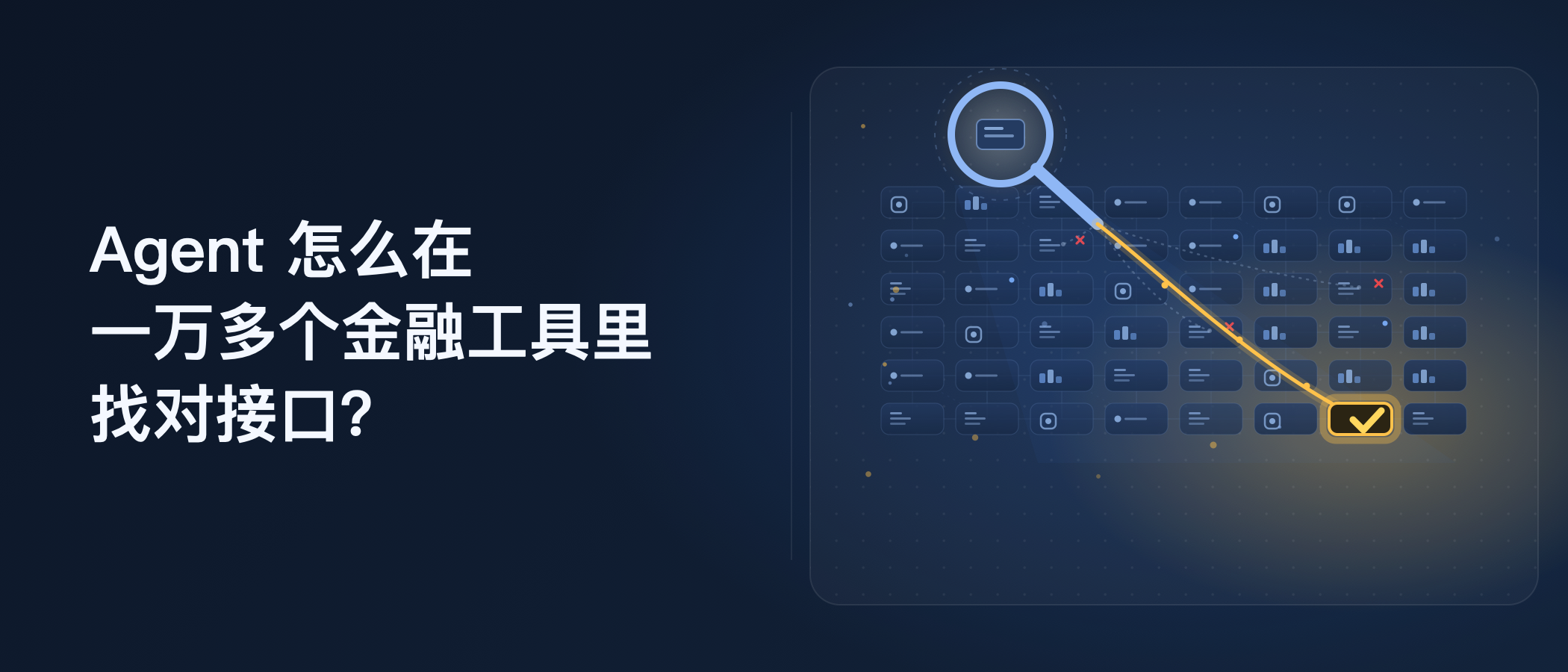
How Does an Agent Find the Right Interface Among 10,000+ Financial Tools?

How Does an Agent Find the Right Interface Among 10,000+ Financial Tools?

A customer asked: "The DRC has banned exports of copper and cobalt concentrates — what impact does that have on the related companies?" The agent answered quickly: "No matching events found on the platform." Yet the database clearly held 50 relevant records: 38 commentary items, 7 research reports, and 3 news items.
The data was there — "retrieval" was the step that kept it out of reach. This is also the most underestimated hurdle for financial agents: tool integration answers whether a capability exists; tool retrieval answers whether you can actually find it.
01 When Tools Multiply, "Finding the Right Interface" Becomes a New Problem
A financial agent is never backed by a single interface but by an interface network: quotes, announcements, research reports, events, financials, valuations — hundreds of tools and tens of thousands of interfaces, each with its own parameters, fields, and coverage.
Users do not speak interface names. They say "dividends" (股息) while the interface description says "分红、派息" (bonus payouts and distributions); they say "DRC" while the data title says "Congo (DRC)"; they say "export ban" while the event summary says "prohibition on exports of copper and cobalt concentrates."
So an agent's first hurdle is not calling the tool — it is translation: turning a piece of natural language into "which tool to query, what keywords to use, and what parameters to fill." Once this layer goes wrong, everything downstream is a chain reaction — no search results means no evidence, and without evidence the model can only make things up.
02 Case One: A Single "No Results" Is Actually Three Errors Stacked
A customer re-tested an old topic in the system; both retrieval rounds returned 0 results, and the system automatically added: "No matching in-platform events; escalation flow triggered."
But the data was there. During the investigation, searching "Congo" immediately returned 5 results; then the customer's exact query "DRC bans exports of copper and cobalt concentrates" returned 0. Same database, same topic — the only difference was the query terms.
At least three errors were stacked together: the model defaulted the event type to "news," filtering out the 38 most relevant commentary items outright; the query was not segmented, so the whole sentence had to match exactly as a single term; and there was no relaxation or fallback logic on zero results — it simply concluded "nothing found."
The lesson is concrete: retrieval failures are rarely "the model does not understand." More often, query construction turns a good question into a bad query — words that should be split are not, types that should be relaxed are not, and when it fails, no one knows why.
03 Case Two: The AI Knows "Dividends," but the Interface Is Called "Bonus Payouts"
Another pitfall hides in the recall layer, and it is more insidious than query construction.
In one retrieval evaluation, the user asked about "股息" (dividends), and the correct dividend interface actually ranked second in vector recall — semantic understanding was fine. But in full-text retrieval, the interface description only mentioned "分红、派息" and never "股息," so its rank dropped to 21. After the two recall results were fused and re-ranked, the correct interface was dragged down by the low score.
This is not the embedding's fault — semantic similarity can recover part of the gap, but exact matching of financial terms and the naming conventions of different data sources still require alias governance. The long-term fix is not stuffing keywords into interface descriptions, which pollutes the corpus and gets messier over time; it is building a Chinese-English alias table, unifying the indexed corpus, and rebuilding the index so that "股息 = 分红 = 派息" becomes a fact in the system, not common knowledge the model has to gamble on every time.
04 Why This Cannot Be Solved with Prompts
A natural idea: write clear instructions to the model — "search with core terms, not whole sentences; if nothing is found, try different words."
But that pins correctness on the model's improvisation: the same question can produce different results with a different model or different parameters. Retrieval is not creative writing; it needs to be stable, verifiable, and reversible.
So retrieval correctness should sink from "model discipline" to "system contract": aliases live in the tool layer, parameter constraints live in the interface layer, and zero-result fallback lives in the retrieval layer. This continues where our previous article left off — a "must" in a prompt is not a "must" in a program, and the retrieval layer is no exception.
05 QVeris's Approach: Turning "Finding an Interface" into a Verifiable Retrieval Chain
At QVeris, we break "finding an interface" into a retrieval chain where every link is verifiable:
- Tool layer: every tool maintains Chinese-English aliases and capability tags; before retrieval, it completes a translation from "plain language → interface semantics."
- Recall layer: full-text and vector recall run in parallel and are fused, while the corpus is governed so that description defects do not drag down the fused results.
- Parameter layer: natural language is expanded and corrected into parameters, so missing or wrong fields are exposed before the call.
- Result layer: zero results do not immediately mean "nothing"; first relax the type and retry with segmented keywords; if it truly is not there, clearly tell the user "not found, and here is why."
The value of this chain: every failure leaves a trace, and every step can be rolled back. The model does not need to memorize 10,000 interfaces — it only needs to learn to use a reliable retrieval chain.
06 Closing: Too Many Tools Is Not the Problem — the Retrieval Layer Is the New Bottleneck
Users will not memorize interface names, and they will not fill in parameters. They only say "DRC" and "dividends."
An agent's value is not remembering 10,000 interfaces; it is translating plain language into the correct call, and honestly telling you why something cannot be found when it cannot.
Tool integration answers whether a capability exists; tool retrieval answers whether you can actually find it. The former makes an agent more capable; the latter determines whether an agent can be trusted.