
Financial Agents Must Do More Than Fetch Data. They Must Align Definitions.
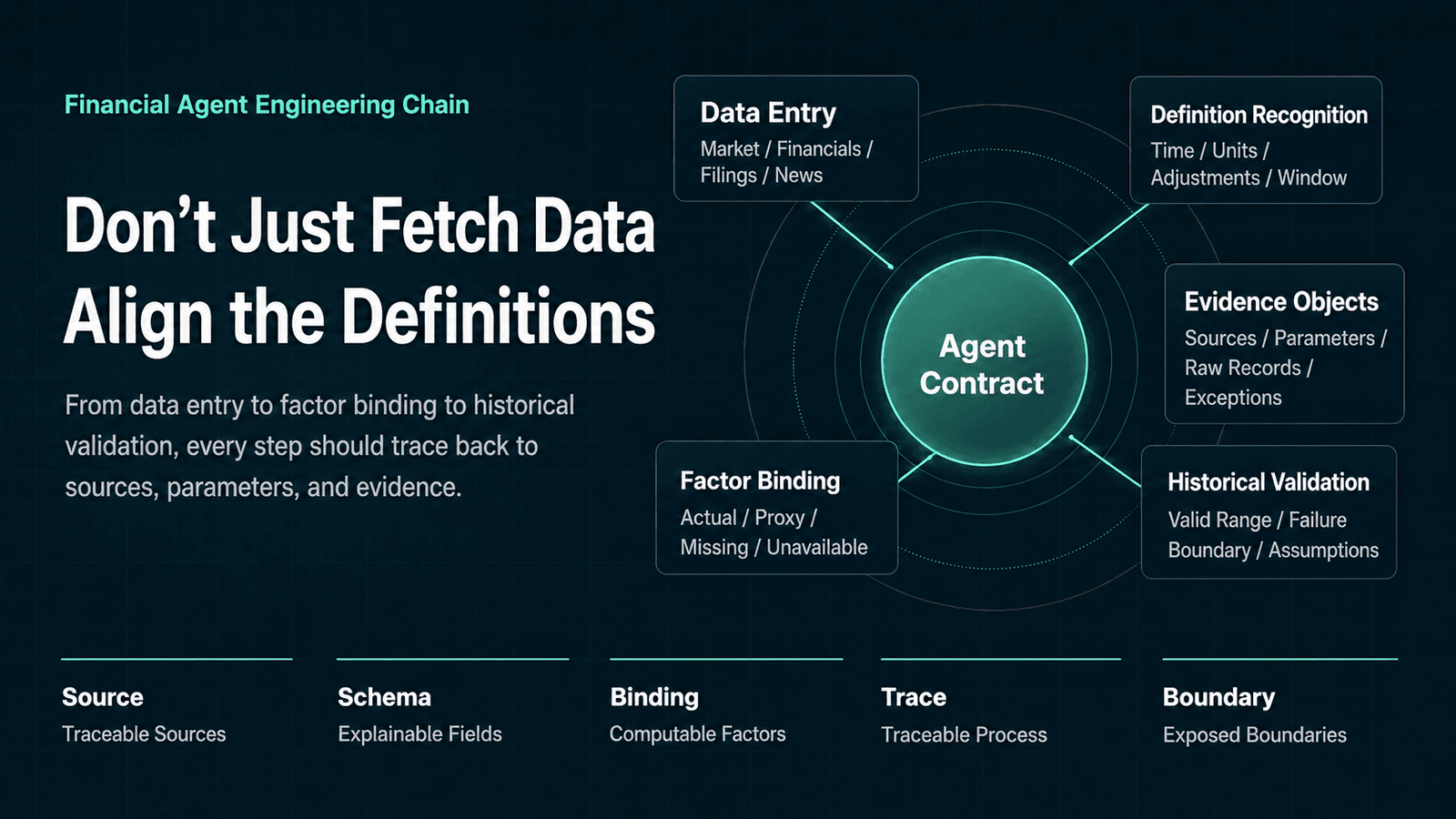
Financial Agents Must Do More Than Fetch Data. They Must Align Definitions.
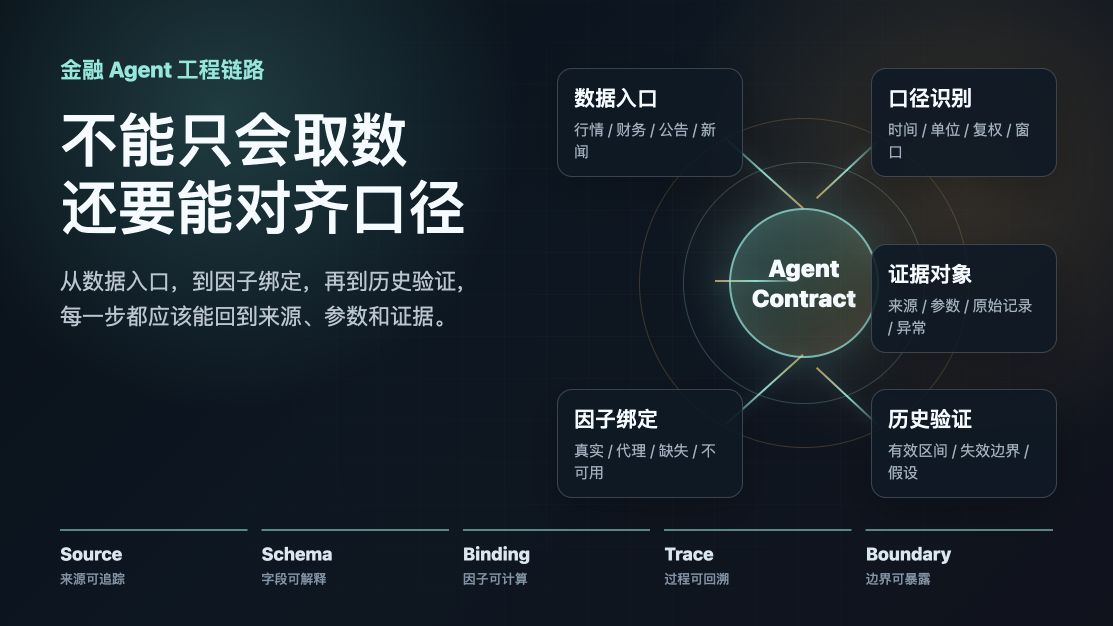
In financial scenarios, an agent is rarely short of callable data.
Market data, financial statements, filings, news, industry indexes, fund flow data, and macro indicators can all expand into a long list of interfaces.
But once you actually start building a financial agent, a more fundamental problem appears:
Data has entered the system, but that does not mean it is usable.
The same price data may be forward-adjusted, backward-adjusted, or unadjusted.
The same financial metric may use a reporting period, disclosure date, TTM, single-quarter value, or cumulative value.
The same news item or filing may have a publication time, event time, and market reaction time.
The same factor name may correspond to completely different data windows, missing-value treatment, and calculation definitions.
If these definitions are not aligned, the more complete the agent's output looks, the more dangerous it may become.
It appears to be analyzing, but it may only be stitching together data with different definitions into a smooth explanation.
This is exactly the problem we have repeatedly encountered while building A-share research workflows:
The difficulty for financial agents is not only whether they can retrieve data.
The more important question is whether they can turn data into a set of definition contracts that are explainable, computable, and verifiable.
01
The Most Error-Prone Part of Financial Data Is Often the Definition, Not the Model
Many failures in financial agents do not happen because the model cannot reason.
They happen because the data given to the model is already mixed together.
For example, if a price series does not state whether it is adjusted, every later calculation based on return, volatility, moving average, or momentum can be affected.
If a financial field only says "revenue" but does not say whether it is annual, single-quarter, cumulative, or TTM, later comparisons can easily become distorted.
If a filing records only the text but not the disclosure time and event time, the agent will struggle to decide which research window it belongs to.
If an industry index does not specify constituents, weights, and update frequency, using it as a reference naturally introduces bias.
Each issue looks small on its own.
Inside an agent workflow, these issues keep getting amplified.
Because the agent does not read only one data point.
It chains together prices, financials, events, industries, and calculation results.
Once the definition at the beginning is unclear, the longer the later reasoning becomes, the harder the bias is to detect.
So the first thing a financial agent really needs to solve is not connecting more interfaces.
It is ensuring that every piece of data enters the system with clear source, time, unit, window, and processing method.
02
A Factor Is Not a Word in a Prompt. It Is a Data Contract.
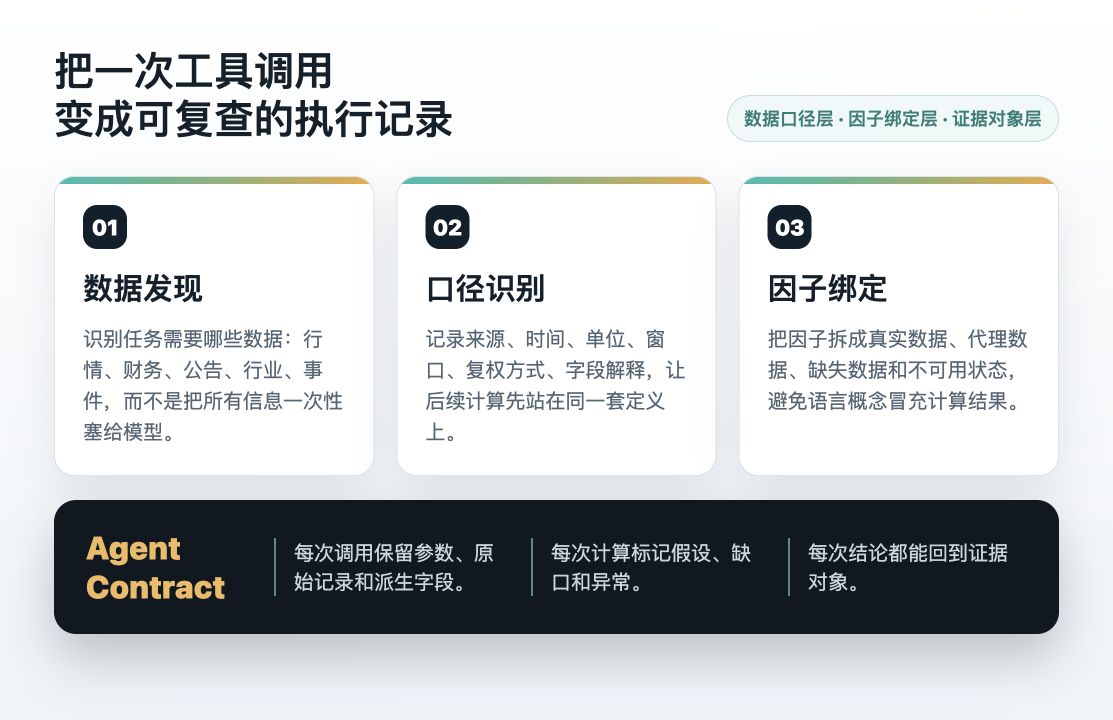
Many people treat a factor as a word.
Momentum, reversal, volatility, turnover, fund flow, valuation, sentiment.
But inside a system, a factor is not a name. It is a contract.
At minimum, it needs to answer several questions:
What raw data is used?
Where does the data come from?
How long is the time window?
How are missing values handled?
Does the calculation require adjusted prices?
Are proxy fields allowed?
Can the result be traced back to the raw data?
If these questions are not clearly defined, seeing the words "momentum factor" does not mean the agent truly knows how to calculate it.
Ten-day momentum and sixty-day momentum are not the same thing.
A result calculated from unadjusted prices is not the same as one calculated from adjusted prices.
A result based on trading-day windows is still not the same as one based on calendar-day windows.
That is why a financial agent cannot treat factors only as language concepts.
It needs to understand the data binding behind each factor.
Which factors can be calculated directly from price data?
Which factors require financial statements?
Which factors require filings, news, or industry data?
Which factors currently only have proxy fields?
Which factors should be explicitly marked as unavailable because the data is insufficient?
This step is less visible than generating an answer, but it determines whether the agent's later analysis can stand.
03
Tool Calls Should Return Evidence Objects, Not Only Results
In financial agents, tool calls are often designed as a simple process:
The user asks a question, the agent selects a tool, the tool returns a result, and the model organizes an answer.
But if a tool only returns a number, a summary, or a table, the agent still has difficulty judging whether that result can be trusted.
A more robust method is to have the tool return an "evidence object."
This object should include not only the result, but also:
data source;
call parameters;
time range;
field definitions;
raw records;
derived calculations;
missing-data notes;
exception warnings;
reusable reference identifiers.
In this way, the agent does not generate an isolated answer. It generates a traceable execution record.
When a conclusion needs to be reviewed later, the system can know which tool was called, what parameters were used, which raw data supported it, whether any fields were missing, and whether a degradation path was triggered.
This matters a great deal for financial agents.
Because in finance, "roughly the same" often is not the same at all.
One field definition, one trading day, or one disclosure window can change the later explanation.
So the goal of a tool call should not be only to let the agent obtain a result.
It should let the agent obtain evidence that can be inspected, cited, and recalculated.
04
Historical Validation Is Not for Endorsing Conclusions. It Is for Exposing Boundaries.
Once financial agents enter research workflows, historical validation naturally appears.
But the value of historical validation is not letting the system say, "It worked in the past, so it will work in the future."
Its more important role is exposing the boundary of an analytical logic.
In which market regimes does this variable have explanatory power?
In which regimes does it fail?
When it fails, is it because of sparse data, industry rotation, event shocks, or because the factor itself only fits a certain sample?
Are the results stable under different time windows, sample ranges, and data definitions?
These questions matter more than any single metric.
If an agent gives a polished conclusion but does not know under what conditions that conclusion can easily fail, it is still only a text generator.
If an agent can record valid intervals, invalid intervals, data gaps, and calculation assumptions from historical validation, it starts to resemble a real research system.
This is the boundary between financial agents and ordinary Q&A tools.
Ordinary Q&A tools care more about whether the answer is complete.
Research agents care more about whether the answer can be reviewed.
05
From "Can Call Tools" to "Can Constrain Tools"
The first step for many agent systems is teaching the model to call tools.
But in financial scenarios, being able to call tools is not enough.
The agent also needs to constrain tools.
It needs to know when it should stop calculating;
when it should state that data is insufficient;
when it can only use proxy fields;
when it should preserve raw records instead of directly generating an explanation;
and when it should mark an analysis as an interim result.
This constraint layer is what makes a financial agent stable.
From an engineering perspective, it is not a single capability. It is a full chain:
first data discovery;
then definition identification;
then factor binding;
then tool calls;
then historical validation;
and finally turning every step into a reviewable execution record.
This is where QVeris is truly valuable in financial scenarios.
It does not only give the agent one more data entry point. It gives the agent a chance to turn "data retrieval, calculation, validation, and review" into one connected chain.
The future difference between financial agents may not be whose text sounds more like an analyst.
It may be who can manage data definitions, tool contracts, and validation processes more clearly.
Because in financial research, the hardest part is not saying a complete answer.
It is making every answer trace back to the data, definitions, and evidence it depends on.