
Market Sentiment API: Teaching Trading Agents to Read Fear, Greed, and News Tone
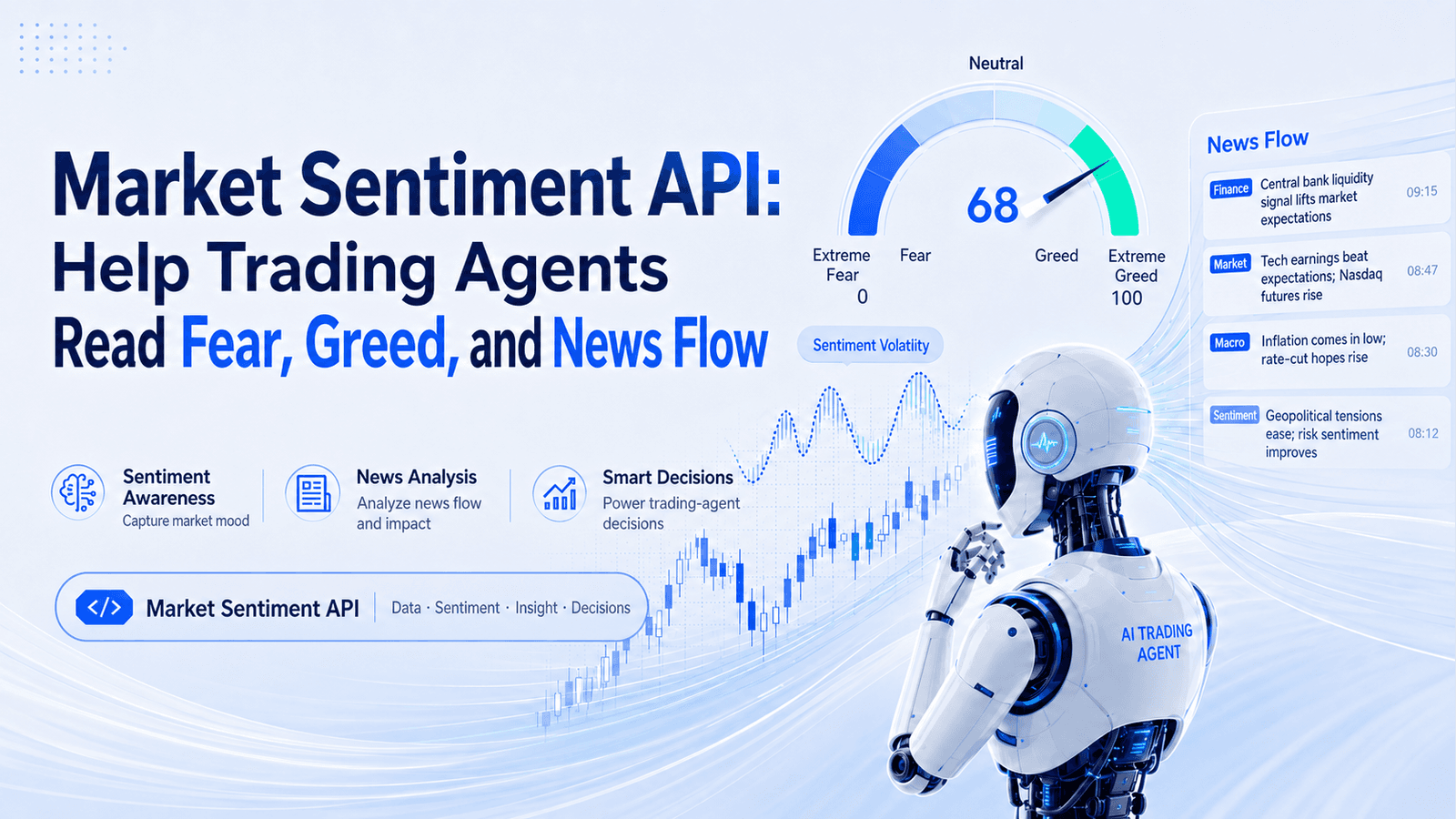
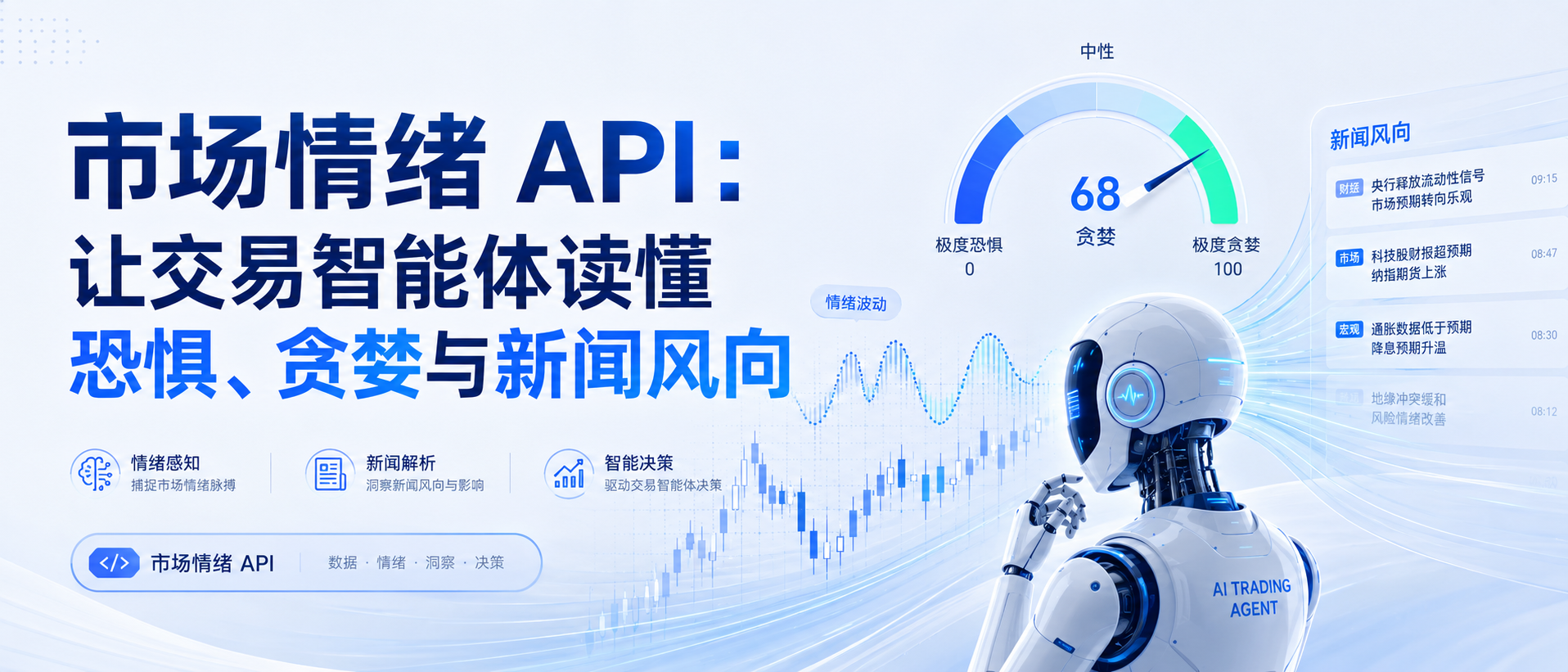
A trading agent focused solely on price often only realizes what has happened after market movements have occurred.
The Sentiment API fills in a critical layer of information: whether the current market is driven by fear, greed, or sudden shifts in news tone. However, a common misconception is treating sentiment signals as direct buy or sell buttons.
Sentiment is merely an assumption. Ultimately, price, volume, and fundamentals should determine whether this assumption warrants an alert or should be ignored.
What Does "Sentiment" Mean in Trading Systems?
In practice, agents typically encounter three types of sentiment signals.
The first type is news tone, used to determine whether news headlines and content lean bullish or bearish.
The second type is social platform and content popularity, used to observe where market attention is concentrating.
The third type is market-level fear and greed indicators, used to summarize overall crowd density and risk appetite for a specific asset or index.
If an agent cannot identify which signal type generated a sentiment score, it may assign excessive weight to noise.
News Tone Is the Best Starting Point
For stock markets, prioritize financial news with stock code tags over general internet news headlines.
In QVeris, agents typically obtain relevant data from Finnhub, Alpha Vantage, Financial Modeling Prep (FMP), or Yahoo Finance, based on coverage scope and call frequency limits.
Do not request only a "bullish" or "bearish" polarity label. More valuable return fields usually include:
- Corresponding stock code
- Publication time
- News source
- Confidence score (where available)
Fear & Greed Indicators Must Specify Time Windows
A panic-driven sentiment spike within an hour differs significantly from a sustained week-long risk-averse state.
Before an agent concludes "the market is currently fearful," explicitly define the sampling time window in prompts or tool strategies.
Cryptocurrency trading teams often combine CoinGecko or CoinMarketCap price data with news sentiment or social platform sentiment, as narrative shifts in crypto markets typically outpace stock markets.
Social Popularity Has Value but Is Easily Misused
Discussions on social platforms can sometimes expose developing market events before they reach professional financial terminals.
Through QVeris, TikHub and X Developer Platform help agents read public content and single-post engagement momentum, not just analyzed news articles and official reports.
However, likes and shares do not equate to institutional capital flows.
A more reasonable approach is treating social popularity spikes as early warnings, then requiring confirmation from news tone or price behavior.
Always Verify Sentiment Signals with Market Data
A negative news item in a low-volume, low-volatility market may be insignificant.
The same news item in a low-liquidity environment, however, could have amplified impact.
Therefore, after a sentiment signal triggers, have the agent continue calling quote or candlestick APIs for verification. In QVeris, common data sources include Twelve Data, FMP, and EODHD.
No trade-directed actions should be executed without confirmation rules.
Design Explainable Alerts for Agents
A qualified alert must answer four questions:
- Which stock code or topic is involved
- Which data source generated the sentiment signal
- What specific change occurred
- Which market fact was verified
"Market sentiment turned negative" is insufficient. For trading teams needing 30-second decisions, such prompts lack actionable value.
Additionally, save original news links or article IDs in execution audit trails for post-hoc human review of the agent's reasoning.
Understand Common Failure Modes Before Automation
Sentiment analysis can be disrupted by multiple factors, including:
- Irony and sarcasm
- Reposted old news
- Stock code or company name conflicts
- Outdated rating information
- Entity recognition errors
- Improper time decay handling
For example, a downgrade published overnight should not carry equal weight to a breaking news item from two minutes ago.
When an agent cannot confirm, a more reasonable approach is to forgo judgment and request human review.
A Simple, Honest, and Explainable Agent Loop
- Detect anomalous sentiment changes in news or social platforms.
- Parse and match the event subject to the correct stock code.
- Confirm using real-time price and volume.
- Only generate briefings, watchlist markers, or risk alerts after confirmation.
QVeris can serve as the capability routing layer between these steps, enabling agents to dynamically discover and call news, social, and market data tools without hardcoding to specific data vendors.
What to Build First
Do not start by building a comprehensive sentiment monitoring dashboard covering all assets.
Instead, prioritize a single, stable workflow:
Watchlist News Tone Monitoring → Price Confirmation → Generate Concise Trading Desk Briefings
Once this pipeline stabilizes, gradually add:
- Social popularity monitoring for cryptocurrency assets
- Content popularity signals for consumer goods companies
- Broader fear and greed market context
Sentiment APIs cannot replace market data.
Their value lies in helping trading agents understand why market movements might be occurring. When such "reasons" require evidence, QVeris enables agents to call Finnhub, Alpha Vantage, FMP, Twelve Data, TikHub, and other relevant data sources to build more reliable decision frameworks.