
Recently, Tech Stocks Have Sold Off. Is the AI Trade Over?

Recently, Tech Stocks Have Sold Off. Is the AI Trade Over?
After a sharp decline in technology stocks, two narratives usually appear very quickly.
One says the AI bubble has finally burst. The other says this is a once-in-a-generation buying opportunity.
They sound opposite, but they make the same mistake: both try to use a fall in share prices as direct proof of the industry's final outcome.
Share prices matter, of course. But a rapid selloff can tell us only so much: capital is retreating, valuations are compressing, or leverage is being unwound. It cannot, by itself, prove that AI demand has peaked. Nor can it prove that prices have fallen far enough to mark a bottom.
To separate these two questions, I used QVeris to organize TSMC's public financial data from recent quarters, then compared the drawdown, valuation, and cash-flow profile of semiconductor funds side by side. The answer that emerged was more complex than either "the bull market is over" or "buy the dip with your eyes closed":
The slope of AI industry demand may still be moving upward, but the way public markets price that demand has already changed.

Share Prices Are Falling, but the Industry's Growth Slope Is Still Moving Up
Capital markets rarely pay for "growth" alone. They care more about whether growth is accelerating or decelerating.
That is the slope.
A company's revenue can still be rising without its stock price moving higher. If the market expected 30% growth and the company ultimately delivers 20%, the absolute number may still be strong, but expectations have been missed. Conversely, a company's current profits may not look spectacular, yet if its growth rate keeps rising, capital may reprice the business in advance.
TSMC offers one useful window into demand for AI compute. It cannot represent the entire AI industry, but it sits in a critical position in advanced process technology and high-performance computing. Orders from many chip companies eventually show up in its capacity utilization and revenue.
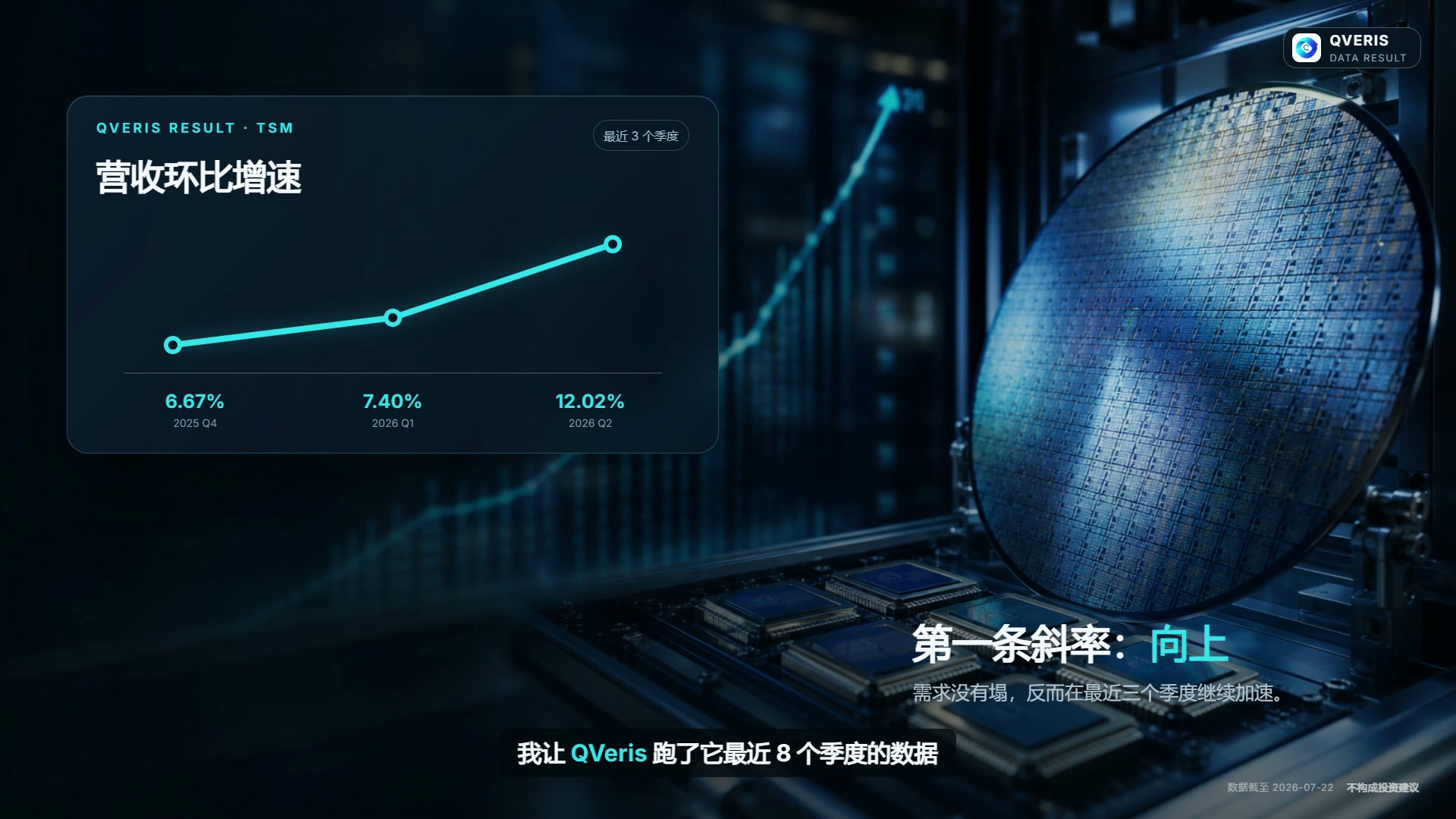
According to QVeris's organization and calculation of public financial data, TSMC's quarter-over-quarter revenue growth over the past three quarters was 6.67%, 7.40%, and 12.02%, respectively. Operating profit growth rose from 13.67% to 15.49%, then to 16.63%.
The slopes of revenue and operating profit are both moving upward.
Looking ahead, the midpoint of TSMC's third-quarter revenue guidance is about $45.2 billion. Using the second quarter as the base, that would still imply roughly 12.4% quarter-over-quarter growth.

This data set shows at least one thing: from the industry side alone, we do not yet see evidence that demand for AI compute has suddenly gone out.
But the market's next question is no longer just whether demand is still there. It is asking a harder question: at today's price, is that growth too expensive?
This Selloff May Be Hitting Price Before It Hits Profit
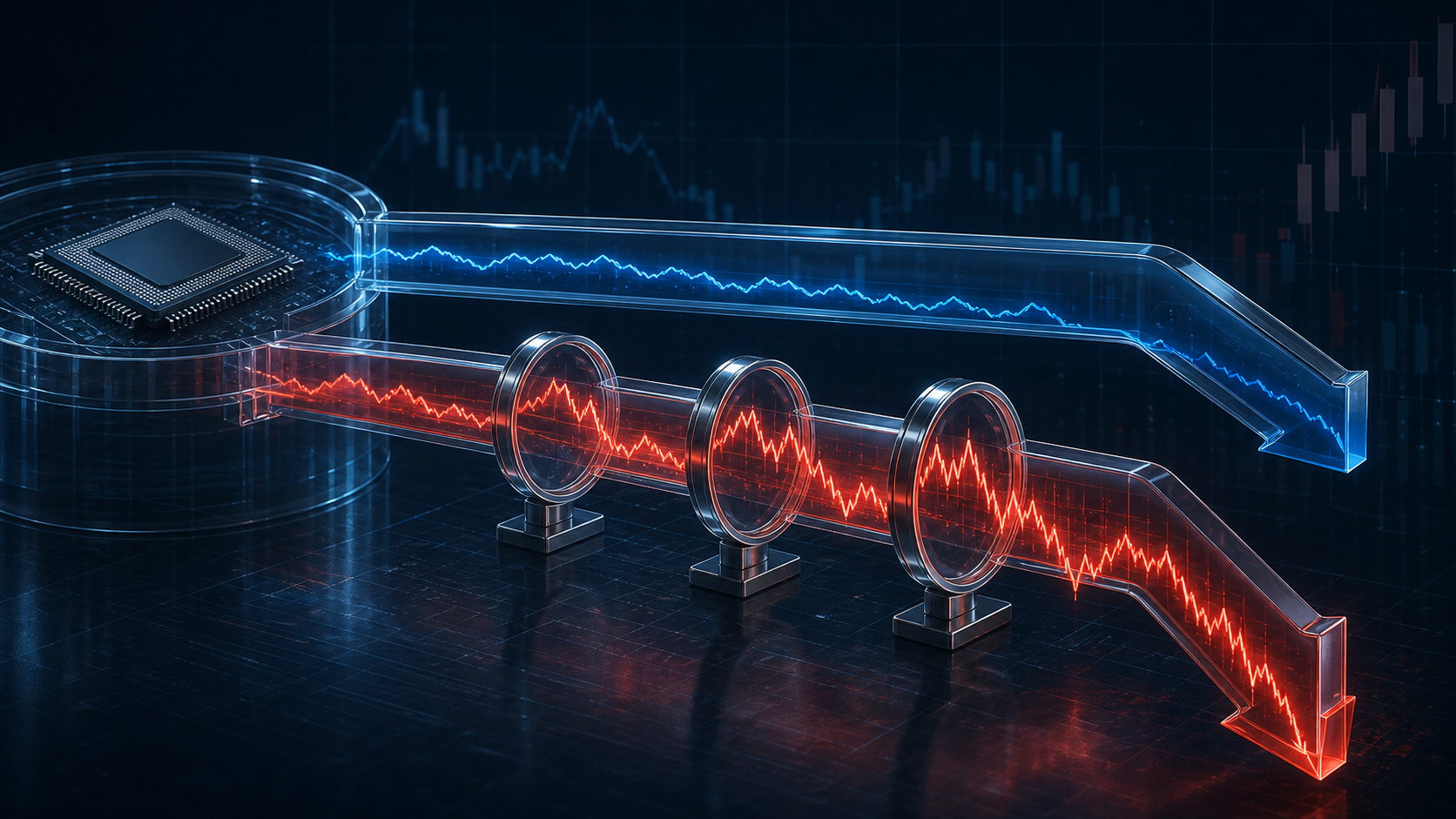
From June 22 to July 17, 2026, an unlevered fund covering 30 major semiconductor companies fell 20.34%. A comparable 3x leveraged fund fell 54.96%.
The second number looks like an industry collapse, but it includes the amplifying effect of leverage. A 3x leveraged fund aims to deliver a multiple of daily returns; it does not promise that long-term returns will always equal exactly three times the index. During consecutive swings, compounding and daily rebalancing can further magnify the loss.
Over the same period, the more important signal may be the change in valuation.
The unlevered semiconductor fund's price-to-earnings ratio fell from 79.60x to 66.24x. Put simply, the market was willing to pay less for the same dollar of earnings.
That is valuation compression.
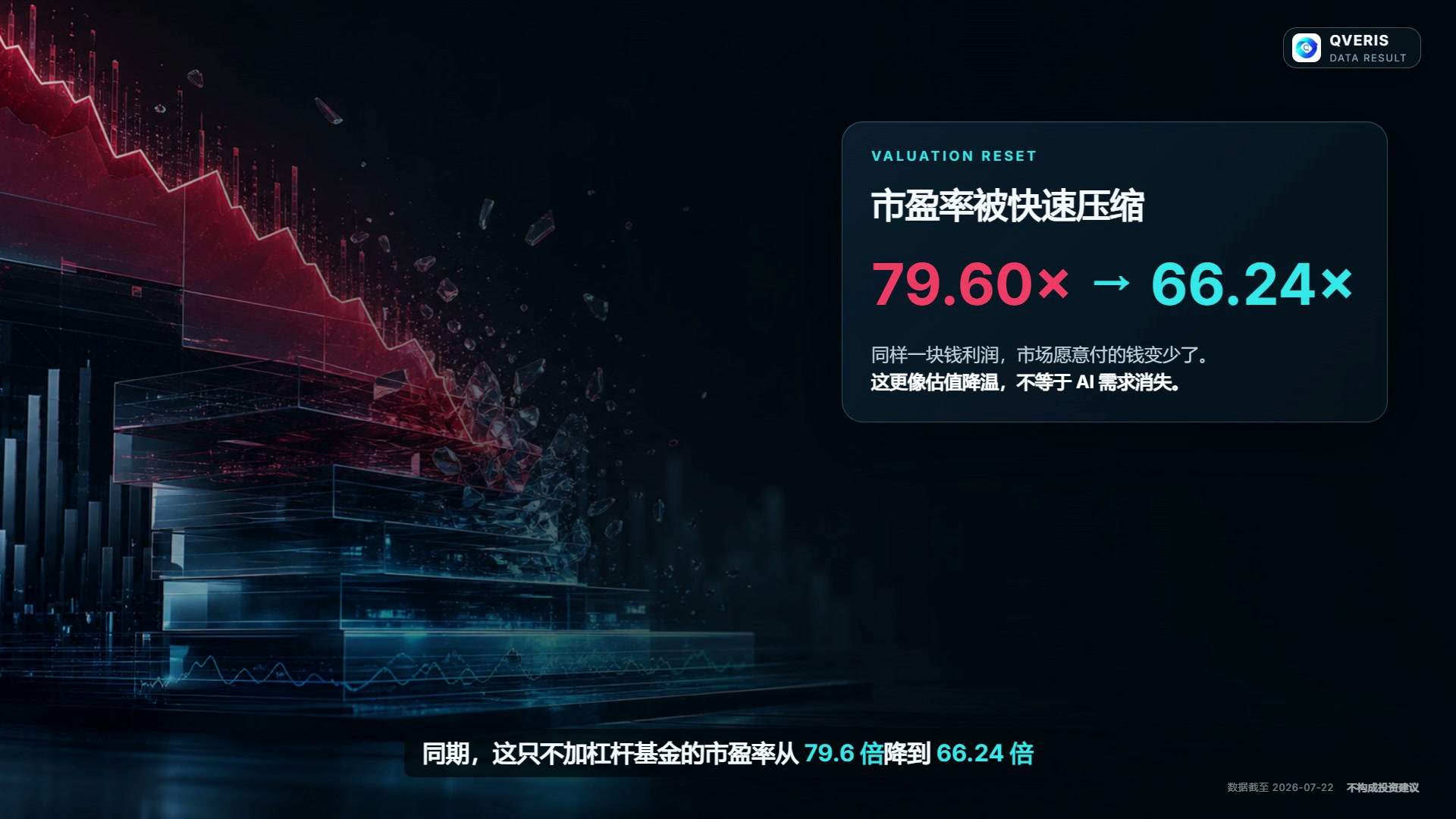
So the current decline reflects two overlapping forces: on one side, the market is lowering the price it is willing to pay for future growth; on the other, leverage is turning a normal drawdown into a much sharper loss.
That helps explain why prices have fallen so quickly, but it still does not answer whether this is the bottom.
Deleveraging explains the speed of the decline, not its endpoint.
The Real Risk Is That Growth Is Becoming More Expensive
If growth is still accelerating, why is the market less willing to assign a higher valuation?
The answer is in cash.
Corporate profits ultimately need to turn into cash. That cash gives a company the capacity to keep investing, repurchase shares, pay dividends, or survive the next cycle. Growth on the income statement can look attractive, but if every incremental dollar of earnings requires more and more capital, the quality of that growth starts to change.
According to QVeris's analysis, TSMC's second-quarter free cash flow fell by about 17.5% quarter over quarter. One important reason was that capital expenditure rose by about 41%.
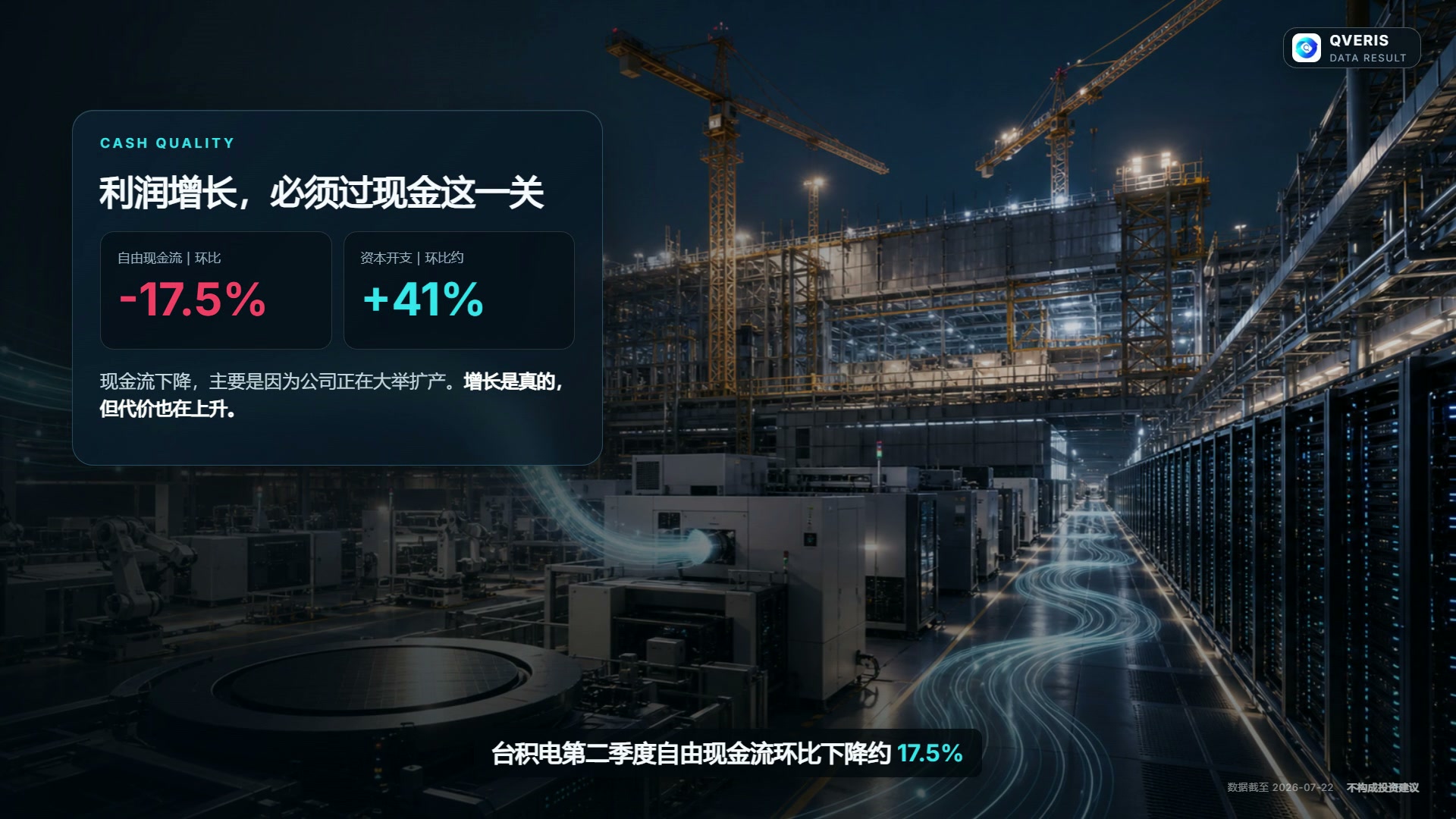
Higher capital expenditure is not inherently bad. For a foundry, advanced process nodes, fabs, and equipment all require large and long-term investment. A company willing to expand capacity often signals that it sees future orders.
But expansion has a cost: cash flows out first, while capacity and revenue may arrive later. If demand falls short of expectations, today's expansion becomes tomorrow's depreciation pressure.
At the same time, the midpoint of TSMC's third-quarter gross margin guidance is about 66.0%, below the second quarter's 67.7%.

The tension is now clear: revenue and operating profit are still accelerating, while cash conversion and gross margin are under pressure.
This is not proof that the AI trade is over, but it is enough to make the market more selective. In the previous phase, proving that AI demand was large enough could let the story carry the valuation. Now, investors are asking companies to prove that this demand can reliably become profit, and then become cash.
Growth is still there, but the free valuation premium is disappearing.
The AI Trade Has Not Simply Ended. It Has Changed How It Is Priced
So when we ask whether the AI trade is over, we cannot look only at how far an index has fallen, or only at whether a single company is still growing.
A better approach is to separate three lines of evidence.
The first is the growth slope. Are revenue and operating profit growth rates still rising, or have they slowed for two consecutive quarters?
The second is valuation. Is the price decline merely a lower market bid, or has it already begun to reflect deterioration in fundamentals?
The third is cash quality. Are free cash flow and margins being temporarily dragged down by explainable capacity expansion, or are they deteriorating persistently?

In my view, QVeris is most valuable in questions like this not because it outputs a simple "bullish" or "bearish" call, but because it puts scattered evidence from earnings reports, guidance, and market data onto the same table.
Tools cannot take responsibility for investment outcomes on your behalf. But they can reduce one common error: drawing conclusions about an industry from emotion alone when prices are moving at their most extreme.
Next Time Tech Stocks Sell Off, Check These Two Sets of Signals First
If, over the next two quarters, TSMC's revenue growth and operating profit growth both slow while free cash flow and margins continue to deteriorate, then the case for a fundamental turn will have stronger evidence.
If the growth slope remains upward, cash pressure is mainly explained by capacity expansion, and valuations continue to decline, then the market is more likely still repricing the story rather than declaring the end of industry demand.

Neither scenario means "buy immediately." Neither means "sell immediately." They simply turn a question compressed by emotion into a binary choice back into a judgment that can be tested.
The next time tech stocks fall sharply, it is worth separating price, growth, and cash first.
When the market is at its loudest, what is truly scarce is often not a louder conclusion, but a body of evidence that is not led around by every rise and fall in price.