
What QVeris Sports Tools Can Do: From Score Lookup to Pre-Match Intelligence Workflows
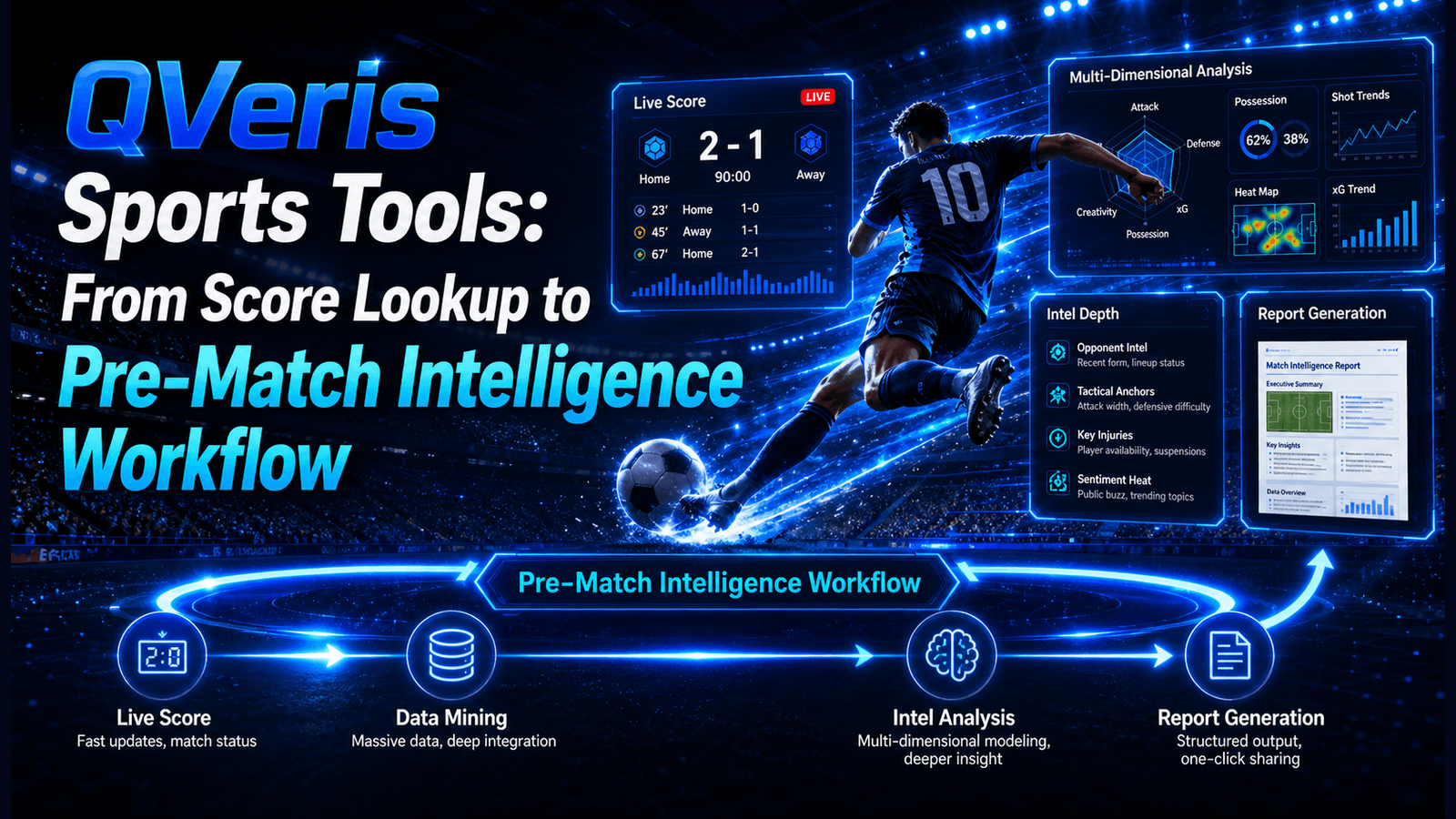
QVeris · Technical Deep Dive
The takeaway first:
QVeris can already discover a set of sports tools. Football is the most complete, covering fixtures, standings, teams, venues, injuries, top scorers, and odds. Basketball, MMA, volleyball, hockey, rugby, American football, and other sports also have varying levels of event, statistics, odds, or bookmaker capabilities. Its best use case is not "checking a single score," but organizing scattered sports data into reusable pre-match briefings, match monitoring, and multi-sport data Agents.
I used the QVeris search interface to query sports-related capabilities in both English and Chinese, including sports, football, basketball, NBA, soccer, tennis, baseball, odds, fixtures, standings, live score, as well as Chinese queries such as "体育, 比赛, 赛程, 积分榜, 比分, 足球, 篮球." The search results show that QVeris already covers sports capabilities across multiple layers: the football workflow is the most complete, while basketball, MMA, American football, volleyball, hockey, rugby, and other sports also expose composable event, statistics, odds, or bookmaker capabilities.
Figure 1:
The most valuable part of sports data tools is not returning one isolated number. It is putting fixtures, standings, players, injuries, odds, weather, and other information into the same "match workspace."

Figure 1: QVeris sports data tools can form a matchday intelligence workspace
Tool Coverage First: Football Is the Most Mature, Other Sports Are Usable by Layer
Sports data is somewhat like financial data: a single API is not hard to understand, but the real difficulty lies in inconsistent definitions across sports, competitions, and data objects. QVeris is valuable because it first helps the Agent find the right tools, then unifies execution records and results.
| Sport / capability layer | Representative tools discovered | Applications supported | Maturity assessment |
|---|---|---|---|
| Football | api-football.fixtures.list, api-football.standings.list, api-football.teams.list, api-football.injuries.list, api-football.players.topscorers, api-football.odds.retrieve | Pre-match briefings, standings tracking, top scorers, injury lists, fixture lookup, odds monitoring. | The most complete, suitable as the first showcase product. |
| Basketball / NBA | api_sports.teams.retrieve, api_sports.standings.retrieve, api_sports.games.statistics.players, api_sports.odds.retrieve | Team profiles, standings/rankings, player statistics, pre-match odds. | A second-layer capability, suitable for starting with team and player statistics. |
| MMA | api_sports.fights.list, api_sports.fights.results, api_sports.fights.statistics.fighters, api_sports.odds.list | Fight cards, fighter records, results review, odds dashboards. | Suitable for a vertical event assistant with a relatively clear product shape. |
| Volleyball, hockey, rugby, handball, AFL | Multiple odds, bookmakers, and bets tools. | Odds source management, pre-match line observation, cross-bookmaker data organization. | More trading/odds oriented, less suitable for a general sports content product. |
| Weather-related sports events | weather_api.sports.retrieve, weather_api.sports.list | Query football, cricket, golf, and other events by location, then combine with weather for viewing and travel reminders. | Well suited to combine with fixture tools into a "matchday assistant." |
| American football | api_sports.games.retrieve, api_sports.games.statistics.teams, api_sports.teams.retrieve, api_sports.standings.retrieve | Game lists, team statistics, standings, player information. | Usable, but parameters need further validation for NFL/NCAA scenarios. |
Real Validation: Football Data Can Already Form Pre-Match Materials
To avoid only listing tool names, I executed several real queries through QVeris. English Premier League 2024 season data returned complete results: standings, top scorers, and injury lists can all become part of pre-match materials.
| Validation item | Result summary | Notes |
|---|---|---|
| Premier League 2024 standings | Liverpool ranked 1st with 84 points, Arsenal ranked 2nd with 74 points, and Manchester City ranked 3rd with 71 points. | From api-football.standings.list, returning each team's points, goal difference, home/away record, and update time. |
| Premier League 2024 top scorers | Mohamed Salah had 29 goals and 18 assists, with Alexander Isak among the leading players. | From api-football.players.topscorers, also providing appearances, shots, passes, tackles, penalties, and other statistics. |
| Premier League 2024 injury list | Returned 3168 injury/absence records, including player, team, reason, and related match time. | The response body is large. QVeris returned truncated content and a full file link, making it suitable for asynchronous backend processing. |
| Team lookup | Searching Arsenal returned 25 related team records. | Suitable for team selectors, alias disambiguation, and fixture filtering entry points. |
| London sports weather events | Returned football events such as Wealdstone vs Carlisle United and Sutton United vs Scunthorpe United. | From weather_api.sports.retrieve, suitable for combining with weather, location, and viewing-trip planning. |
Three Real Examples Users Can Use Directly
The examples below are not hypothetical scenarios. They are user entry points organized from the real invocation results in this round. In a product, they can become buttons, prompt templates, or scheduled tasks.
| User question | Tools QVeris would combine | Real materials it can return |
|---|---|---|
| "Help me understand the Premier League 2024 title race." | api-football.standings.list | Liverpool ranked 1st with 84 points, Arsenal 2nd with 74 points, and Manchester City 3rd with 71 points; it can also expand each team's goal difference, home/away record, and update time. |
| "Before this match, which players' form and injuries should I watch?" | api-football.players.topscorers + api-football.injuries.list | Mohamed Salah had 29 goals and 18 assists on the top scorers list; the injury API can return player, team, absence reason, and corresponding match time, which is useful for organizing pre-match risk. |
| "I am in London. What weather-related sports events are coming up?" | weather_api.sports.retrieve | Returns football events such as Wealdstone vs Carlisle United and Sutton United vs Scunthorpe United, which can then be combined with location, weather, and viewing reminders. |
Product note:
Real examples should be turned into templates rather than asking users to remember tool names. Users only need to say "generate a Premier League pre-match briefing" or "find upcoming sports events in London." The Agent can then use QVeris to find tools, call them, and organize the results.
Boundary to clarify:
A small number of tools currently do not have latest-season or future-fixture data, mainly because the corresponding upstream capabilities require a higher-tier subscription. These permissions can be opened later based on specific product needs. Before those permissions are enabled, the product should clearly display "the current subscription does not support this season/query" to avoid making users think there is no data or that the API is broken.
What QVeris Can Do Is More Than "Check Scores"
Sports tools are easily misunderstood as score lookup. In real products, scores are only the lowest layer of information. What users actually need is scenario-specific material: what to watch before the match, what to monitor on matchday, how to review after the match, and which risks may affect lineups and odds.
Before the match — Pull both sides' fixtures, standings, recent form, injuries, and top scorers to generate a match preview.
During the match — Monitor live fixtures, scores, events, and odds changes for matchday tracking.
After the match — Combine results, player statistics, standings changes, and injury records into review materials.
Figure 2:
Treat different sports objects as data nodes: balls, teams, events, venues, weather, injuries, and odds. After unified QVeris search and execution, they become a reviewable sports briefing.

Figure 2: Multiple categories of sports data flow into the same application workflow through QVeris
Six Applications That Can Be Built
1. Matchday Intelligence Desk
For sports media, event operations, and content teams. It automatically pulls the day's fixtures, or fixtures for a specified league, along with standings, top scorers, injury lists, and venue information to generate a matchday dashboard. Editors no longer need to copy information from multiple websites. The Agent can organize the facts first, then humans decide the headline and point of view.
2. Pre-Match Briefing Generator
Enter one match or two teams, and output each side's ranking, recent record, key players, injury risks, and head-to-head clues. This scenario works well for WeChat Official Account posts, app push notifications, podcast outlines, or pre-stream briefings. Football is currently the best place to start because its related toolchain in QVeris is the most complete.
3. League Trend Tracking
The standings tool can return rankings, points, goal difference, home/away performance, and update time in structured form. Based on this data, teams can build weekly reports on title races, European qualification, and relegation-zone changes. The real value is not copying a standings table, but continuously tracking "which teams' form is changing."
4. Injury and Lineup Risk Monitoring
The injury tool returns a large volume of data, making it suitable for backend tasks. A system can aggregate by team, player, and match time, filter key absences, and alert editors, operators, or fantasy players. QVeris returns full file links and truncated summaries, which also makes long-result asynchronous processing easier.
5. Fantasy and Fan Assistant
Top scorers, player statistics, injuries, and fixture congestion can be combined into fantasy decision materials. Users do not need to read dozens of tables. They only need to ask: "Which Premier League forwards are in good form this week but carry injury risk?" The Agent can follow the QVeris toolchain to fetch data first, then organize a candidate list.
6. Odds and Bookmaker Monitoring
Football, basketball, MMA, volleyball, hockey, rugby, and other sports all have odds or bookmaker tools. This direction is suitable for market observation, odds source comparison, and pre-match risk alerts. It is important to note that these applications must comply with regional regulations and platform compliance requirements. Articles and products should not guide users to place bets.
Why Use QVeris for This
If the task is only to check one match once, directly using a sports API can also work. But when the application becomes a collaboration across multiple leagues, sports, and tools, QVeris's unified entry point becomes more valuable.
| Problem | Common state when calling APIs directly | Value QVeris provides |
|---|---|---|
| Tool discovery | Developers read documentation first, then manually decide which endpoint to use. | Agents can search for tools in natural language first, then execute the best-matching capability. |
| Cross-sport expansion | Football, basketball, MMA, and rugby each use a separate API stack, with scattered parameters and response definitions. | Search and execution are unified through QVeris, gradually accumulating reusable application templates. |
| Result review | A script outputs one result, and later it is hard to know exactly which API was called. | search_id, tool_id, parameters, and execution records are retained for tracing and debugging. |
| Long-result handling | Large responses can overload the frontend or Agent context. | QVeris can return truncated summaries and full file links, suitable for continued backend processing. |
| Productization | Every feature requires its own data glue code. | Fixtures, standings, injuries, odds, and weather can be combined into a stable workflow. |
Which Product to Build First
If choosing one product from the current tool coverage that can show value most quickly, I recommend starting with a "football pre-match briefing assistant." The reason is simple: the football toolchain is the most complete, the data structure is clear, user needs are explicit, and it can quickly expand into media content, fan services, and operations dashboards.
-
Stage one: support querying standings, top scorers, teams, and injuries by league and season.
-
Stage two: support entering two teams and automatically generating a pre-match briefing.
-
Stage three: add weather, venue, and odds, using them only as informational prompts rather than betting advice.
-
Stage four: accumulate daily/weekly league reports into subscribable content.
-
Stage five: expand to basketball, MMA, and American football, abstracting the workflow into a multi-sport template.
One-sentence summary:
QVeris sports tools are currently best suited to start with football, building pre-match briefings, matchday intelligence desks, and injury/standings/top-scorer monitoring. Once these workflows are stable, the same pattern can be copied to basketball, MMA, rugby, and other sports.
This article is based on QVeris online tool search and partial tool execution results collected on 2026-06-19. Odds-related content is used only for data product analysis and does not constitute betting advice. Specific event coverage and real-time freshness depend on current subscription permissions, and higher permissions can be enabled later based on product needs.