
Access OpenAI API Anywhere
Supported Locations, Approved Networks
随地访问 OpenAI API:仅使用受支持地点和获批网络
“Anywhere” must mean any supported location allowed by current OpenAI terms and applicable law. It does not mean bypassing geography, sharing accounts or hiding origin.
“随地”必须指当前 OpenAI 条款与适用法律允许的受支持地点,绝不意味着绕过地理限制、共享账户或隐藏来源。
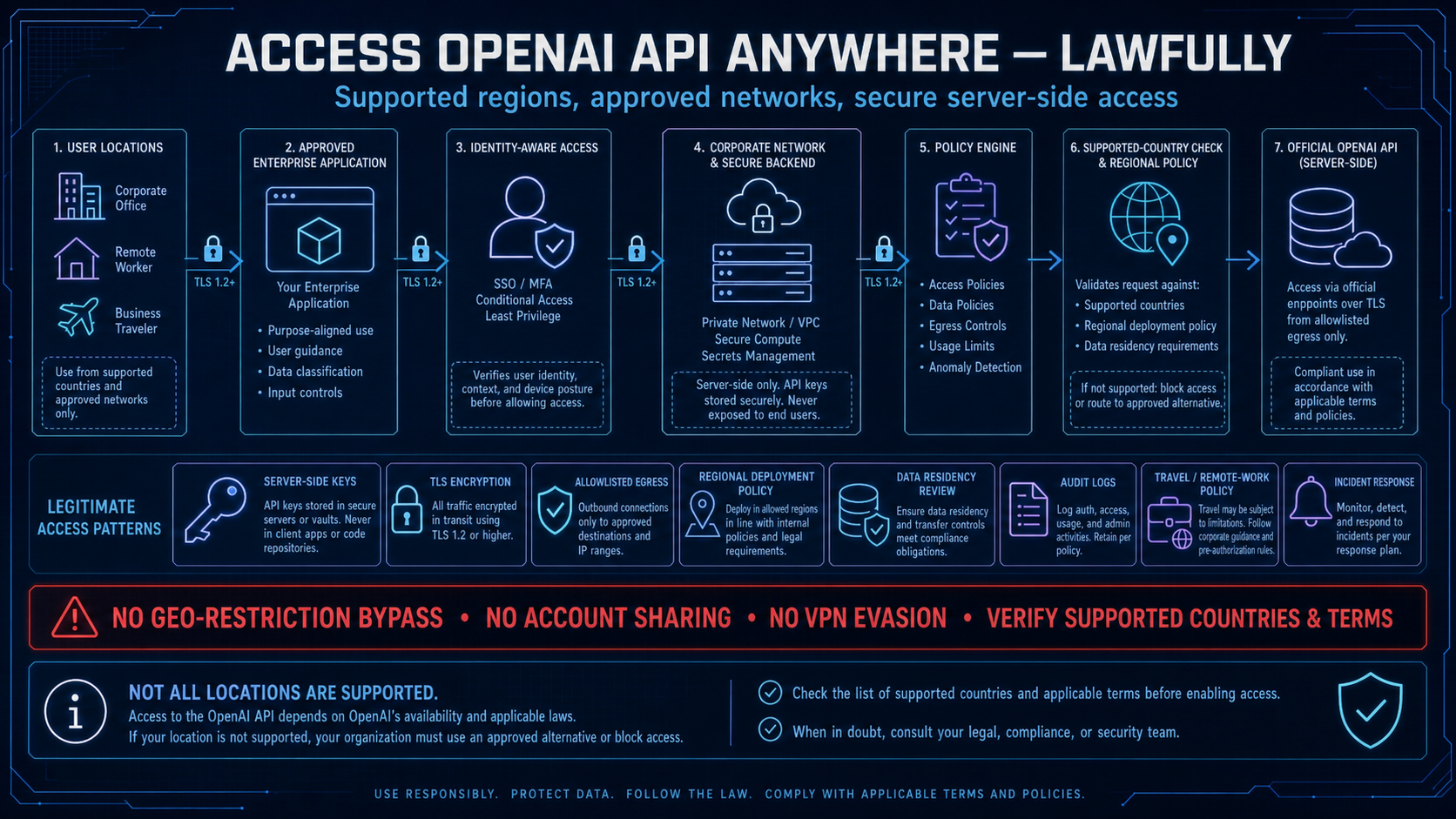
TL;DR
Use OpenAI's current supported-country list before enabling a location.
Users access an approved application; provider keys stay in trusted backends.
Use SSO, least privilege, device context, data classification and usage limits.
Use an approved alternative or deny the request; never evade restrictions.
启用某地点前查询 OpenAI 当前支持国家清单。
用户访问获批应用;供应商密钥保存在可信 Backend。
使用 SSO、最小权限、Device 上下文、数据分类与用量限制。
使用获批替代方案或拒绝请求,绝不规避限制。
Accessing the OpenAI API anywhere requires location eligibility 随地访问 OpenAI API 的前提是地点符合使用条件
OpenAI maintains a current list of supported countries and territories and warns that accessing or offering API access outside that list may lead to account blocking or suspension. Treat that list as dynamic policy data.
OpenAI 维护当前支持国家与地区清单,并警告从清单外访问或提供 API 访问可能导致账户被封锁或暂停。应把该清单视为动态策略数据。
Business travel, remote work, corporate egress and regional backends can make location ambiguous. Legal, security and compliance owners should define which signals control access and how exceptions are reviewed.
商务出行、远程办公、企业 Egress 与区域 Backend 会让位置判断复杂。法务、安全与合规负责人应定义哪些信号控制访问,以及例外如何审查。
Legitimate access patterns 合规访问模式
| Pattern 模式 | Best fit 最适合 | Verify before choosing 选择前验证 |
|---|---|---|
| Approved web application 获批 Web 应用 | Users in supported locations need centralized policy and no direct key. 受支持地点用户需要集中策略且不直接持有密钥。 | Identity, device, location, input controls, rate limits and audit. 核对身份、设备、位置、输入控制、限流与审计。 |
| Corporate backend 企业 Backend | Services call the API from approved egress and supported regions. 服务从获批 Egress 与受支持区域调用 API。 | Server location, user location, data path, residency and terms. 核对服务器位置、用户位置、数据路径、驻留与条款。 |
| Remote-work policy 远程办公策略 | Employees travel among supported locations with managed devices. 员工在受支持地点间出行并使用受管设备。 | Supported-country check, device posture, SSO, logs and incident response. 核对支持国家、Device Posture、SSO、日志与事件响应。 |
| Approved alternative 获批替代方案 | A location or workload is not eligible for the OpenAI route. 某地点或负载不符合 OpenAI 路由资格。 | Independent provider eligibility, user notice, data policy and semantics. 核对替代供应商资格、用户提示、数据策略与语义。 |
Access-control checklist 访问控制清单
Refresh the supported-country source and version the allow or deny decision.
Use a vault, scoped projects, rotation and no keys in browser or mobile code.
TLS, approved DNS, allowlisted egress, proxy trust and anomaly detection.
Purpose, data classification, retention, audit, travel and incident policy.
刷新支持国家来源,并版本化允许/拒绝决策。
使用密钥库、受限 Project、轮换,密钥不进入浏览器或移动端代码。
TLS、获批 DNS、Egress Allowlist、代理 Trust 与异常检测。
Purpose、数据分类、保留、审计、出行与事件策略。
Validate access without evasion 在不规避限制的前提下验证访问
- Test supported, unsupported, unknown and rapidly changing location states.
- Verify browser, mobile and logs never expose the provider API key.
- Exercise travel, compromised account, proxy change and location-data failure.
- Confirm unsupported requests block or use an independently approved alternative.
- 测试受支持、不受支持、未知与快速变化的位置状态。
- 验证浏览器、移动端与日志绝不暴露供应商 API 密钥。
- 演练出行、账户泄露、代理变化与位置数据故障。
- 确认不受支持请求被阻断,或使用独立获批替代方案。
Put supported-country policy before the provider call 在供应商调用前执行支持国家策略
The user authenticates to an approved application. An identity-aware backend evaluates purpose, device, user and server location, data policy and the current supported-country rule. Only eligible requests receive a server-side OpenAI call through approved egress; all decisions are logged.
用户向获批应用认证;身份感知 Backend 评估 Purpose、Device、User 与服务器 Location、Data Policy 和当前支持国家规则;只有合格请求才通过获批 Egress 在服务端调用 OpenAI,所有决策均记录。
Production rule: never use VPN evasion, account sharing, false identity or proxy origin masking to bypass geographic restrictions.
生产规则:绝不能使用 VPN 规避、账户共享、虚假身份或代理来源隐藏绕过地理限制。
Route only to independently eligible capabilities 只路由到独立合格的能力
If the OpenAI route is not eligible, QVeris can help discover external APIs, tools, services and live data only where those capabilities are independently authorized for the user, location and policy. It is not a geography-bypass layer.
若 OpenAI 路由不合格,QVeris 只能在相关能力对用户、位置与策略独立授权时帮助发现外部 API、工具、服务与实时数据;它不是地理限制绕过层。
Define the Production Contract for OpenAI API access across regions定义跨区域 OpenAI API 访问的生产契约
For Access OpenAI API Anywhere, protocol similarity lowers integration effort, but it does not guarantee behavioral parity. Put a versioned application contract between product code and the provider path so change remains testable and reversible.
针对“随地访问 OpenAI API”,协议相似可以降低集成工作量,却不能保证行为等价。应在产品代码与供应商路径之间建立版本化应用契约,让变更保持可测试、可回滚。
Document supported-country policy, account and billing eligibility, data residency, network path, lawful use, latency, and independently eligible fallback providers. Mark each item as required, optional, provider-native, or unsupported, and assign an owner for any transformation that changes its meaning.
记录支持国家策略、账户与计费资格、数据驻留、网络路径、合规使用、延迟,以及独立合格的备用供应商。把每一项标记为必需、可选、供应商原生或不支持,并为任何改变语义的转换明确负责人。
To validate Access OpenAI API Anywhere, create fixtures for short and long prompts, Unicode, streaming, JSON schema, parallel tools, refusals, cancellation, malformed input, and rate limits. Check required fields and event order instead of accepting one plausible text answer.
验证“随地访问 OpenAI API”时,为短与长提示词、Unicode、流式、JSON Schema、并行工具、拒绝、取消、畸形输入和限流建立 Fixture,检查必需字段与事件顺序,而不是接受一个看似合理的文本答案。
When operating Access OpenAI API Anywhere, trace internal request ID, resolved model and provider, model version, transformations, retries, latency, token classes, cost source, policy result, and output validation. Redact secrets without deleting the context needed to reproduce failure.
运营“随地访问 OpenAI API”时,追踪内部请求 ID、解析后的模型与供应商、模型版本、转换、重试、延迟、Token 类别、成本来源、策略结果和输出校验,在脱敏密钥的同时保留复现失败所需上下文。
Before rolling out Access OpenAI API Anywhere, shadow representative traffic, classify semantic differences, canary by reversible workload, monitor task completion and tail behavior, and keep the previous route available until rollback and return-to-primary have been rehearsed.
上线“随地访问 OpenAI API”前,运行代表性影子流量,分类语义差异,按可逆工作负载进行金丝雀发布,监控任务完成与长尾行为,并在演练回滚和恢复主路径之前保留原有路由。
FAQ
No. Do not evade geographic restrictions; follow the current supported-country policy.
No. Keep provider credentials in trusted server-side systems.
Treat it as unsupported, block the route and consult legal or compliance owners.
不能。不要规避地理限制,应遵循当前支持国家策略。
不可以。供应商凭证应保存在可信服务端系统。
视为不受支持、阻断该路由,并咨询法务或合规负责人。