
When Agents Become a Species
A deep dive into the emerging agentic AI ecosystem and why agents need infrastructure, not just intelligence.
The Inflection Point Has Arrived
By 2026, agents had moved beyond laboratory demonstrations into customer support, software development, research, operations, and other multi-step workflows. Adoption depth varies widely: a company experimenting with an embedded assistant is not equivalent to an organization delegating consequential decisions to autonomous systems.
In NVIDIA's February 2026 fiscal-results release, CEO Jensen Huang described an “agentic AI inflection point”; the company reported $68.1B in quarterly revenue, up 73% year over year. The figures show extraordinary demand for compute, but they do not by themselves prove that every agent deployment is mature or valuable.
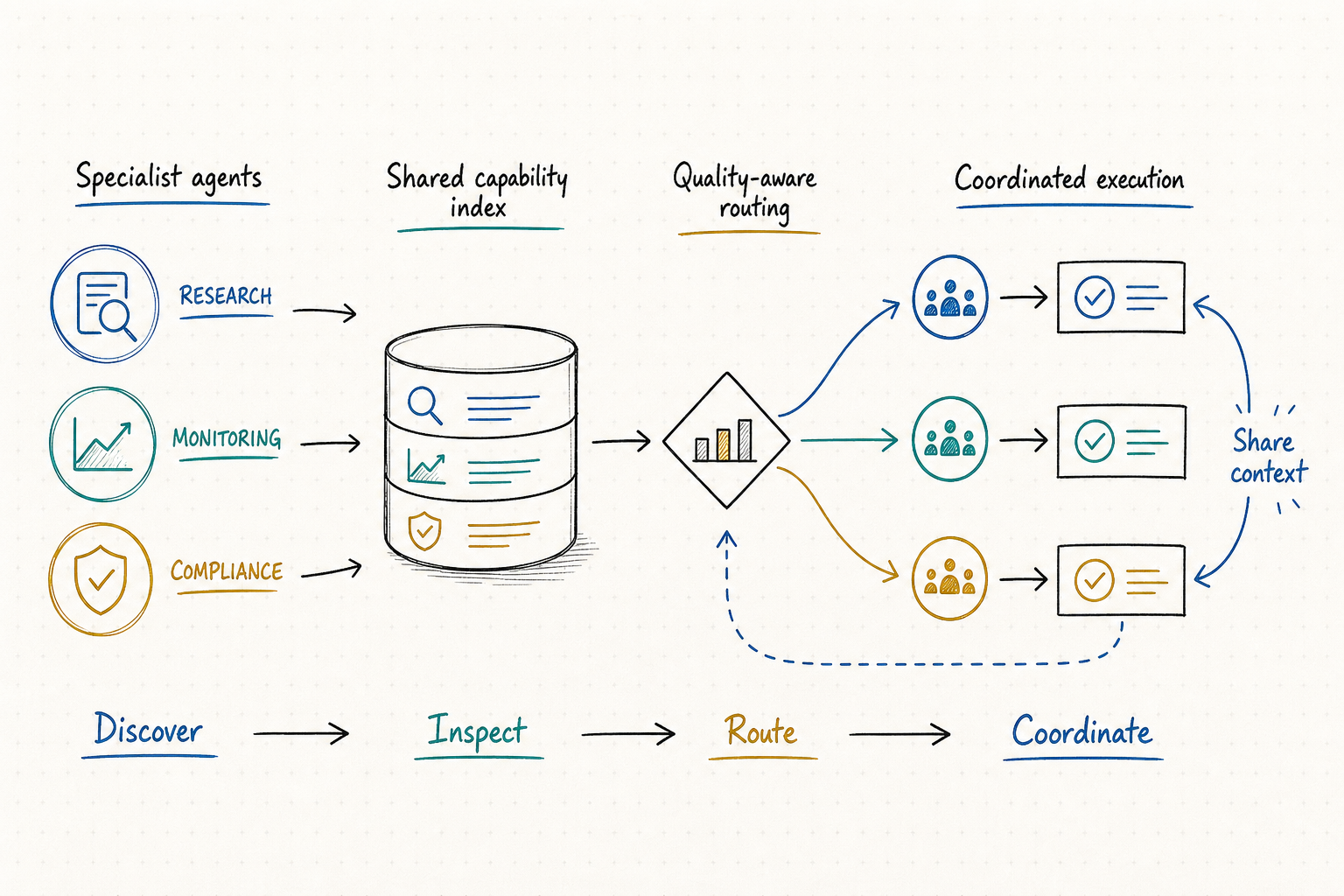
But infrastructure means more than GPUs. It means the systems that let agents discover tools, coordinate with each other, and route to the right capability at runtime. Intelligence is necessary. Infrastructure is what makes it useful.
The Real Bottleneck Isn't Intelligence
Agents don't know what tools exist.
Without tool discovery
- Agent only uses pre-wired tools
- Misses 99% of available capabilities
- Same provider every time, even if inferior
- Fails on tasks requiring unfamiliar tools
With capability routing
- Agent discovers tools at runtime
- Searches across 10,000+ capabilities
- Routes to best provider by quality signals
- Handles novel tasks autonomously
Before capability routing
Resolution in one QVeris internal benchmark
After capability routing
Resolution in the same internal benchmark
QVeris internal observation, not an industry benchmark. Results depend on task set, candidate tools, routing policy, model, and scoring method; teams should reproduce the comparison on their own evaluation set.
The Agent Ecosystem Is at Its 1998 Moment
🌐 1998 Internet
Over 1 million web pages — but no way to find what you needed. People relied on bookmarks, word of mouth, Yahoo's directory. Then Google arrived: crawlers + indexing + PageRank. Result: any content, findable by anyone, in milliseconds.
🤖 2026 Agents
10,000+ tools and APIs — scattered everywhere, no unified index. Agents can only use the tools they already know. A capability routing network arrives: semantic search + verified providers + quality signals. Result: any tool, discoverable by any agent, in natural language.
History doesn't repeat. But it rhymes.
What This Means for Teams Building with Agents
For Agent Developers
Stop hardcoding tool integrations. Use a discovery layer that lets your agent find the right capability at runtime — and route to the best provider automatically.
For Enterprise Teams
Survey evidence shows broad interest and adoption, but production maturity is uneven. The practical question is which workflows justify agents and whether identity, permissions, evaluation, and operations can support them safely.
For AI Researchers
The intelligence problem is largely solved. The infrastructure problem — how agents discover, coordinate, and share capabilities — is where the next decade of work lives.
When a Species Forms a Society, New Needs Emerge
💬 Communication
Agents running in parallel need to know what each other is doing and what capabilities each has already developed. Without shared awareness, multi-agent systems devolve into redundant, conflicting actions.
🔍 Discovery
An agent working with financial data knows Alpha Vantage. It does not know Polygon, Finnhub, or Tiingo exist. This is not an intelligence problem — it is a visibility problem. The agent is not dumb. It is blind.
🔀 Routing
When three providers offer the same capability, agents need quality signals — success rate, latency, cost — to route intelligently. Without signals, routing is random. With signals, routing is optimization.
🕸 Coordination
Complex workflows need agents to share experience, hand off tasks, and build on each other's solutions. This requires shared infrastructure — not just smarter individual agents working in isolation.
What “Agent Infrastructure” Actually Includes“Agent 基础设施”究竟包括什么
The infrastructure thesis is broader than tool search. A production agent needs identity, delegated permissions, capability metadata, schema inspection, routing, execution isolation, state, handoff contracts, observability, evaluation, budgets, and recovery. Discovery answers “what could perform this task?” The remaining layers decide whether the capability is permitted, appropriate, reliable, and safe to call now.
这里所说的基础设施远不只是工具搜索。生产级 Agent 还需要身份、委托权限、能力元数据、schema 检查、路由、执行隔离、状态、交接契约、可观测性、评测、预算与恢复。发现层回答“什么能力可能完成任务”,其他层则判断它此刻是否被允许、是否匹配、是否可靠和安全。
Control plane控制平面
Identity, policy, least privilege, approvals, budgets, tenancy, audit retention, and who can change an agent's allowed capabilities.
身份、政策、最小权限、审批、预算、租户、审计留存,以及谁可以修改 Agent 的能力范围。
Capability plane能力平面
Discovery, descriptions, schemas, provider coverage, quality signals, versioning, cost, latency, and fallback compatibility.
发现、描述、schema、provider 覆盖、质量信号、版本、成本、延迟和回退兼容性。
Execution plane执行平面
Argument validation, sandboxing, idempotency, timeouts, retries, result verification, provenance, rollback, and incident response.
参数校验、沙箱、幂等性、超时、重试、结果验证、来源血缘、回滚和事故响应。
Where the Species Metaphor Breaks Down“物种”比喻的边界在哪里
Agents do not independently form a society in the biological sense. Organizations design their objectives, tools, memory, permissions, incentives, and communication channels. The metaphor is useful for highlighting coordination needs, but it can hide accountability: when an agent causes harm, responsibility remains with the people and organizations that selected, deployed, and governed the system.
Agent 不会像生物物种那样自行形成社会。组织设计它们的目标、工具、记忆、权限、激励与通信渠道。这个比喻有助于说明协调需求,但也可能掩盖责任:当 Agent 造成损害时,责任仍属于选择、部署和治理系统的人与组织。
More agents can be worseAgent 越多可能越差
Parallelism can increase coverage, but also duplicated calls, conflicting actions, context loss, latency, and cost. A single well-instrumented agent may outperform a multi-agent design on tightly coupled work.
并行可能扩大覆盖,也会增加重复调用、冲突动作、上下文丢失、延迟和成本。对于强耦合任务,一个可观测性完善的单 Agent 可能更好。
Discovery is not authorization发现不等于授权
Finding a capable tool does not grant permission to use it. Runtime search must remain inside allowlists, data rights, user scope, provider terms, and approval policy.
找到可用工具并不代表有权调用。运行时搜索必须受白名单、数据权利、用户范围、provider 条款和审批政策约束。
Routing signals can mislead路由信号可能误导
Historical success, latency, and cost are incomplete proxies. They can drift, favor easy tasks, or obscure weak coverage. Route decisions need task-specific evaluation and result validation.
历史成功率、延迟和成本只是有限代理指标,可能漂移、偏向简单任务或掩盖覆盖不足。路由需要任务专项评测和结果验证。
A Practical Multi-Agent Coordination Contract可执行的多 Agent 协调契约
Before splitting work, define a shared task ID, objective, input evidence, subtask owner, allowed capabilities, output schema, deadline, token and monetary budget, dependencies, handoff condition, conflict rule, and termination condition. Agents should exchange structured state and evidence references rather than unconstrained conversation histories.
拆分工作前,应定义共享任务 ID、目标、输入证据、子任务负责人、允许能力、输出 schema、截止时间、Token 与资金预算、依赖、交接条件、冲突规则和终止条件。Agent 之间应交换结构化状态和证据引用,而不是无限增长的对话历史。
Evaluate the system, not only each agent评测整个系统,而不只是单个 Agent
Measure end-to-end task success, unsupported claims, duplicate work, handoff loss, conflicting mutations, permission violations, termination, latency, cost, human intervention, and recovery. A collection of individually accurate agents can still fail as a coordinated system.
测量端到端成功率、无依据结论、重复工作、交接丢失、冲突写操作、权限违规、终止、延迟、成本、人工干预和恢复。单个都准确的 Agent 组合后仍可能整体失败。
Prefer the smallest sufficient architecture优先选择最小充分架构
Start with one agent and deterministic tools. Add specialized agents only when task decomposition, independent context, parallel work, or distinct permissions produce a measured improvement that exceeds coordination overhead.
先从一个 Agent 和确定性工具开始。只有当任务拆分、独立上下文、并行执行或权限隔离带来的可测收益超过协调开销时,才增加专用 Agent。
Evidence Behind the Adoption Claims采用趋势数据的证据与限制
The figures on this page describe different populations and should not be combined into one universal adoption rate. PwC's May 2025 survey covered 308 U.S. executives and reported that 79% said agents were already being adopted in their companies. Salesforce's September 2025 Agentic Enterprise Index reported 119% growth in agent creation among first-mover companies using its products between January and June. NVIDIA's February 2026 release reported quarterly revenue and included its CEO's “agentic AI inflection point” characterization. Gartner listed multiagent systems among ten strategic technology trends for 2026. Each source measures a different signal and carries vendor, survey, or forecasting context.
本页数字描述的是不同样本,不能合并成一个通用采用率。PwC 2025 年 5 月调查覆盖 308 位美国高管,其中 79% 表示所在公司正在采用 Agent。Salesforce 2025 年 9 月的 Agentic Enterprise Index 报告,其产品中的先行企业在 1—6 月 Agent 创建量增长 119%。NVIDIA 2026 年 2 月发布季度收入,并引用 CEO 对“Agentic AI 拐点”的判断。Gartner 把多 Agent 系统列入 2026 年十大技术趋势。它们分别衡量不同信号,也各自带有调查、厂商数据或预测背景。
PwC AI agent survey
Survey wording, sample size, adoption and value findings.调查措辞、样本量、采用与价值结论。
Salesforce Agentic Enterprise Index
First-mover Agentforce usage data and the 119% creation-growth claim.Agentforce 先行企业使用数据与 119% 创建量增长口径。
NVIDIA fiscal 2026 results
Quarterly revenue and the CEO statement quoted on this page.本页引用的季度收入与 CEO 表述。
Gartner 2026 technology trends
Primary announcement listing multiagent systems among the 2026 trends.将多 Agent 系统列入 2026 年技术趋势的官方公告。