Use QVeris to help AI agents discover, inspect, and call verified capabilities for competitor monitoring, product research, company research, pricing analysis, and structured market intelligence workflows.
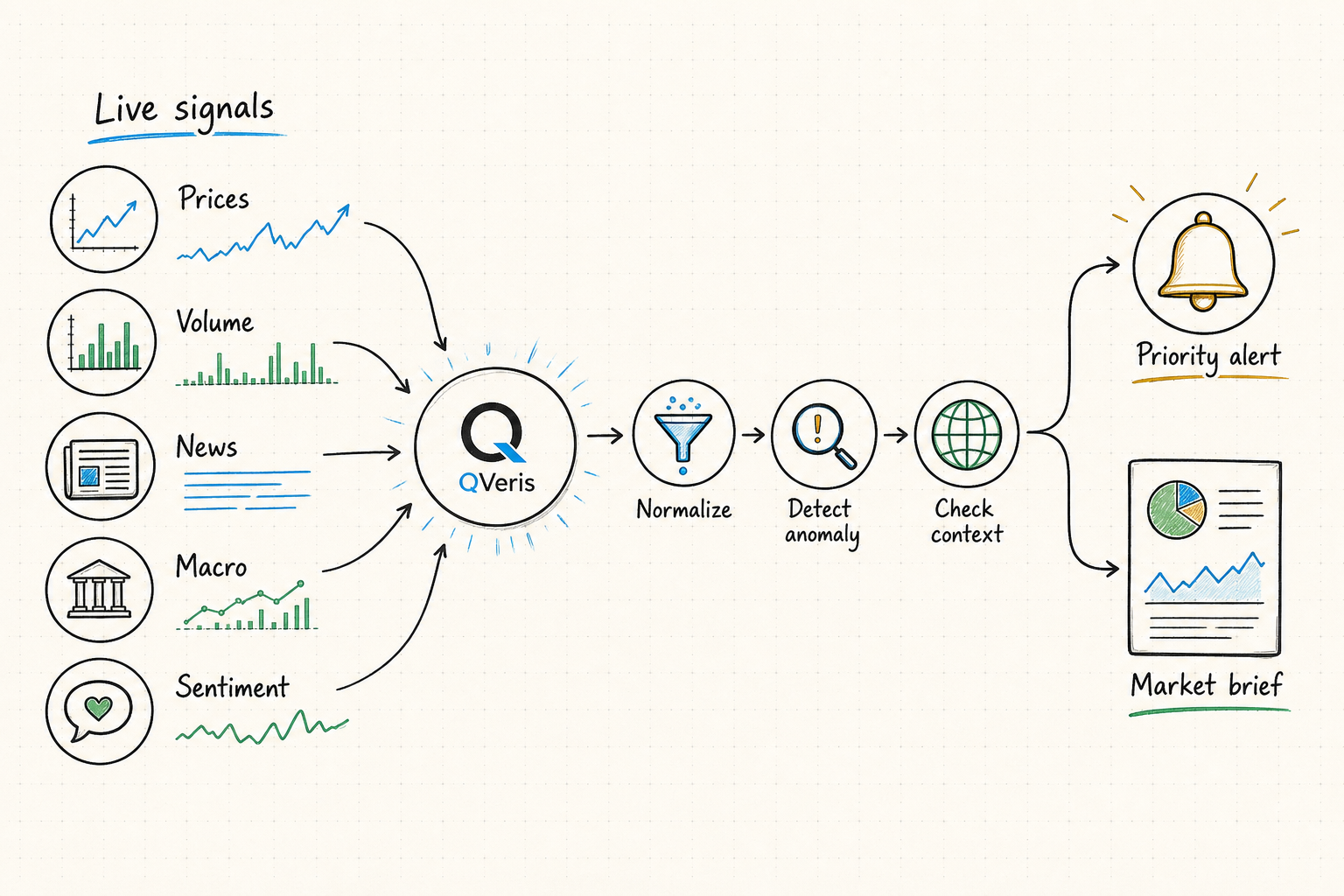
AI agents can summarize, classify, and reason over information, but useful market intelligence workflows require external tools and live public information. A market intelligence agent may need to search public sources, inspect product pages, compare competitor messaging, collect company context, extract content from documents, and generate structured briefs.
QVeris gives agents one capability layer for discovering, inspecting, and calling relevant research tools without hardcoding every search, document, company data, or research provider.
Four core challenges that make market intelligence agent development slow and fragmented.
Competitor websites, product pages, public company data, pricing pages, reports, reviews, and industry content often live across many different sources — each requiring separate access paths.
Before calling a research capability, agents need to understand required inputs, output format, provider behavior, cost signals, and when the tool should be used — not after a failed attempt.
Copying sources, comparing pages, checking updates, and formatting findings manually makes repeatable market intelligence workflows slow and inconsistent across teams.
Market research questions change often. Hardcoding each search, scraping, document, or company data provider makes workflows harder to adapt when new questions emerge.
Market monitoring becomes useful only when the agent knows what state it is watching, what counts as a meaningful change, and which decision owner is expected to respond. Otherwise it produces a stream of links rather than intelligence.
Store the last verified state for named entities, products, prices, positioning, leadership, locations, policies, and other monitored attributes. Record aliases and jurisdiction so similarly named companies or localized pages do not merge.
Represent the old and new value, first-seen time, effective time, direct excerpt, page version, independent confirmation, confidence, and affected market. Separate semantic change from redesign, tracking, translation, or personalization noise.
Connect each signal to a named owner and playbook: investigate, update a battlecard, contact a customer, review risk, monitor for confirmation, or close with no action. Add an expiry rule so stale alerts do not remain “urgent” forever.
只有当 Agent 清楚正在监测什么状态、什么才算重大变化,以及谁需要根据结果做决定时,市场监测才有价值;否则它只会持续堆积链接,而不是形成情报。
保存指定实体、产品、价格、定位、管理层、地点、政策及其他属性的上次验证状态。记录别名与司法辖区,避免把同名公司或地域版本页面错误合并。
记录旧值、新值、首次发现时间、生效时间、直接证据片段、页面版本、独立确认、置信度与受影响市场;区分真实语义变化和改版、追踪参数、翻译或个性化噪声。
把每个信号连接到明确负责人和行动手册:调查、更新销售战卡、联系客户、复核风险、等待更多确认或关闭告警;同时设置失效规则,避免过期信号一直保持“紧急”。
The agent searches QVeris for relevant capabilities such as web research, company lookup, product page analysis, document extraction, pricing page review, or structured summarization.
The agent inspects schema, required inputs, response shape, cost signals, and provider information before execution — no blind calls to unknown APIs.
The agent calls selected capabilities and turns returned outputs into competitor summaries, product comparisons, research briefs, dashboards, or follow-up plans.
Eight concrete market intelligence workflows powered by AI agents and QVeris capabilities.
Track competitor websites, messaging changes, product updates, public announcements, and category movement through discoverable research capabilities.
Collect product details, compare positioning, inspect public pages, and organize findings into structured product research notes for team review.
Monitor public pricing pages, plan structures, feature packaging, and messaging patterns across competitors through inspectable capabilities.
Gather public company context, product information, market signals, and structured notes for business research — from one capability layer.
Generate repeatable market briefs for a category, region, product segment, or emerging trend using selected research capabilities.
Help teams discover products, suppliers, alternatives, or market options and structure results for review and procurement workflows.
Collect public context, competitive messaging, topic angles, and market language to support content planning and campaign development.
Use structured outputs from QVeris capabilities to power market intelligence dashboards, watchlists, and review queues for ongoing monitoring.
An illustrative workflow showing how an AI agent uses QVeris for market intelligence. Not live market data or real competitor analysis.
The agent receives a market intelligence task — track competitors, compare positioning, or monitor pricing.
The agent uses QVeris to find capabilities for web research, company lookup, product page analysis, and document extraction.
Before calling, the agent inspects required parameters, output structures, provider info, and billing signals.
The agent executes selected capabilities and receives structured responses for downstream processing.
The agent organizes output into a competitor summary, comparison table, or research brief for human review.
A qualified reviewer inspects, validates, and applies judgment before using the output in business decisions.
This is an illustrative example. It does not represent live market data, real competitor analysis, or guaranteed research conclusions. All outputs should be reviewed and verified by qualified humans before business use.
More frequent collection is not automatically better. It raises cost, duplicates, false alerts, and access pressure. Set cadence according to how quickly a signal loses decision value.
Pricing pages, service status, product releases, exchange notices, and regulatory announcements may justify event-driven or daily checks, with rate limits and duplicate suppression.
Job openings, partner pages, customer stories, documentation, app listings, and channel activity benefit from trend comparison rather than an alert for every edit.
Company strategy, category definitions, policy frameworks, and organizational positioning require slower collection and deeper analyst interpretation.
采集越频繁并不一定越好,它会增加成本、重复、误报和访问压力。应根据信号失去决策价值的速度设定频率。
定价页、服务状态、产品发布、交易所通知和监管公告可能需要事件触发或每日检查,同时必须限流并抑制重复。
招聘、合作伙伴页、客户案例、文档、应用商店和渠道活动更适合观察趋势,而不是每次编辑都触发告警。
公司战略、品类定义、政策框架和组织定位变化较慢,需要更深的分析师解释。
| Requirement | Manual market research | Hardcoded research tools | QVeris for market intelligence |
|---|---|---|---|
| Source discovery | Users manually search, filter, and compare sources | Developers choose fixed providers in advance | ✓Agents can discover relevant capabilities based on the research task |
| Tool flexibility | Flexible but slow and difficult to repeat | Repeatable but limited to predefined integrations | ✓Reusable Discover, Inspect, Call pattern across multiple capabilities |
| Schema understanding | No structured schema for repeatable agent workflows | Developers maintain provider-specific documentation | ✓Agents inspect schema, parameters, and cost signals before execution |
| Research output | Often unstructured notes and copied links | Structured only where integrations are designed | ✓Structured outputs can be routed into briefs, dashboards, tables, or workflows |
| Usage visibility | Hard to track what tools and sources were used | Usage spread across multiple provider dashboards | ✓Usage can be reviewed through QVeris usage history and credits ledger |
A dramatic source does not make a material event, and a material event does not excuse weak evidence. The brief must show both judgments so reviewers know whether to verify, monitor, or act.
A precise before-and-after statement with entity, attribute, first-seen time, effective date, and direct citations.
A separate analyst interpretation tied to customers, revenue, product roadmap, sales positioning, regulation, or a named strategic assumption.
Conflicting evidence, source dependencies, inaccessible material, alternative explanations, and the next observation needed to resolve uncertainty.
Decision owner, deadline, playbook, escalation condition, related watchlist targets, and the point at which the alert can be closed.
来源语气强烈不代表事件重大,事件重大也不能成为使用弱证据的理由。简报必须同时展示这两个判断,让复核者知道应该核实、继续观察还是采取行动。
精确说明变化前后状态,包含实体、属性、首次发现时间、生效日期和直接引用。
把分析判断与事实分开,并连接到客户、收入、产品路线、销售定位、监管或某个明确战略假设。
记录冲突证据、来源依赖、不可访问材料、其他解释,以及消除不确定性所需的下一项观察。
指定决策负责人、期限、行动手册、升级条件、相关监控对象以及可以关闭告警的判断标准。
Teams tracking competitor updates, product positioning, pricing pages, category movement, and product opportunities — without manual source collection.
Researchers who need repeatable workflows for collecting, comparing, and structuring public information across multiple sources and formats.
Developers building market research assistants, competitive intelligence dashboards, or agent-powered research products with structured data needs.
Small teams that need faster research loops for positioning, product sourcing, campaign planning, and category discovery.
Browse the complete catalog of AI agent tools, platforms, and research capabilities.
Discover top MCP platforms for connecting agents to real-world research and data services.
Explore how AI agents access financial capabilities for stock screening and company research.
Explore web research, source discovery, and structured research brief scenarios.
Use QVeris to give AI agents access to research capabilities for competitor monitoring, product research, company lookup, pricing analysis, and structured intelligence workflows.
