
Start with the outcome
Define who will use the result, what decision it supports, which entity and time range matter, and what a successful answer must contain. This prevents teams from selecting a tool because its label merely sounds relevant.
A curated catalog of AI agents and tools for the financial services industry. Static reference — no API calls required.
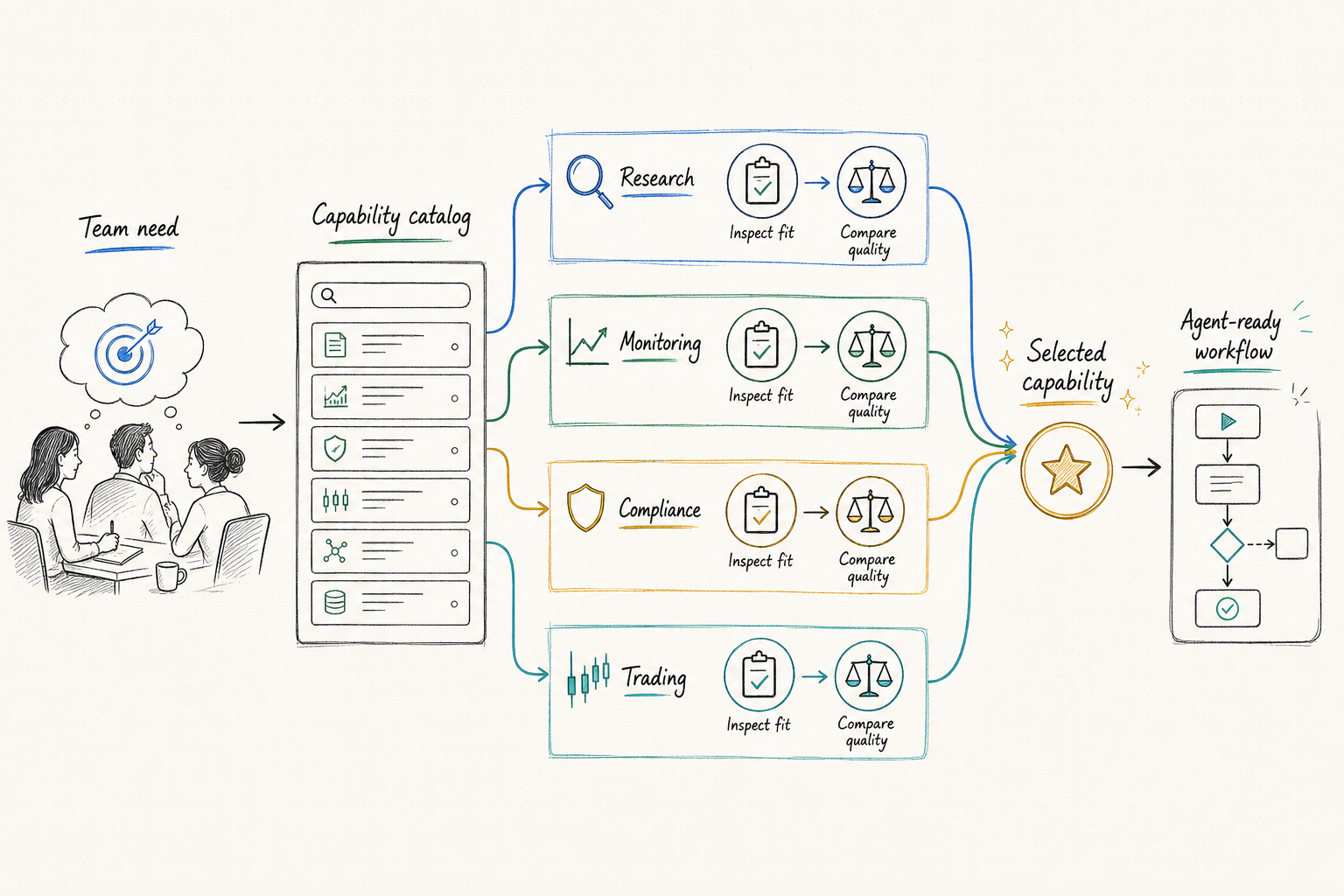
A useful AI tool catalog does more than list attractive names. It helps a team move from a business intent to a capability whose inputs, outputs, permissions, evidence, and failure behavior can be inspected before an agent is allowed to call it.
Define who will use the result, what decision it supports, which entity and time range matter, and what a successful answer must contain. This prevents teams from selecting a tool because its label merely sounds relevant.
Confirm required arguments, field definitions, source coverage, freshness, units, rate limits, and authentication. A tool is only a fit when its contract can express the user’s actual request without silently changing intent.
Separate read-only research from actions that send messages, place orders, modify records, or expose sensitive data. Document approval points, least-privilege credentials, and the conditions that require clarification.
Test a normal request, a missing parameter, stale or incomplete data, a provider timeout, and an unauthorized action. Record the selected capability, arguments, source timestamps, response status, and any fallback used.
Practical rule: shortlist by use case, inspect by contract, and approve by evidence. A maturity badge or concise description is a planning shortcut—not a substitute for testing in your environment.
Continue with the Capability Map to compare workflows, then use the developer documentation to validate the exact integration path.
有价值的 AI 工具目录不只是罗列名称,而是帮助团队从业务意图出发,找到一个在调用前就能检查输入、输出、权限、证据和失败行为的能力。
先说明谁会使用结果、结果支持什么决策、涉及哪个对象和时间范围,以及一份合格答案必须包含什么。这样可以避免仅凭名称相似就选错工具。
核对必填参数、字段定义、数据覆盖、新鲜度、单位、限流和认证方式。只有当能力契约能够准确表达用户请求,而不悄悄改变原意时,它才真正适用。
将只读研究与发送消息、下单、修改记录或接触敏感数据等操作分开,明确人工审批点、最小权限凭证,以及必须向用户追问的情况。
分别测试正常请求、参数缺失、数据过期或不完整、服务商超时和越权操作,并记录所选能力、调用参数、来源时间、响应状态和回退路径。
实用原则:按使用场景初选,按能力契约核验,按证据质量批准。成熟度标签和短描述只能辅助规划,不能替代真实环境中的测试。