A curated catalog of AI agents and tools for the financial services industry. Static reference — no API calls required.
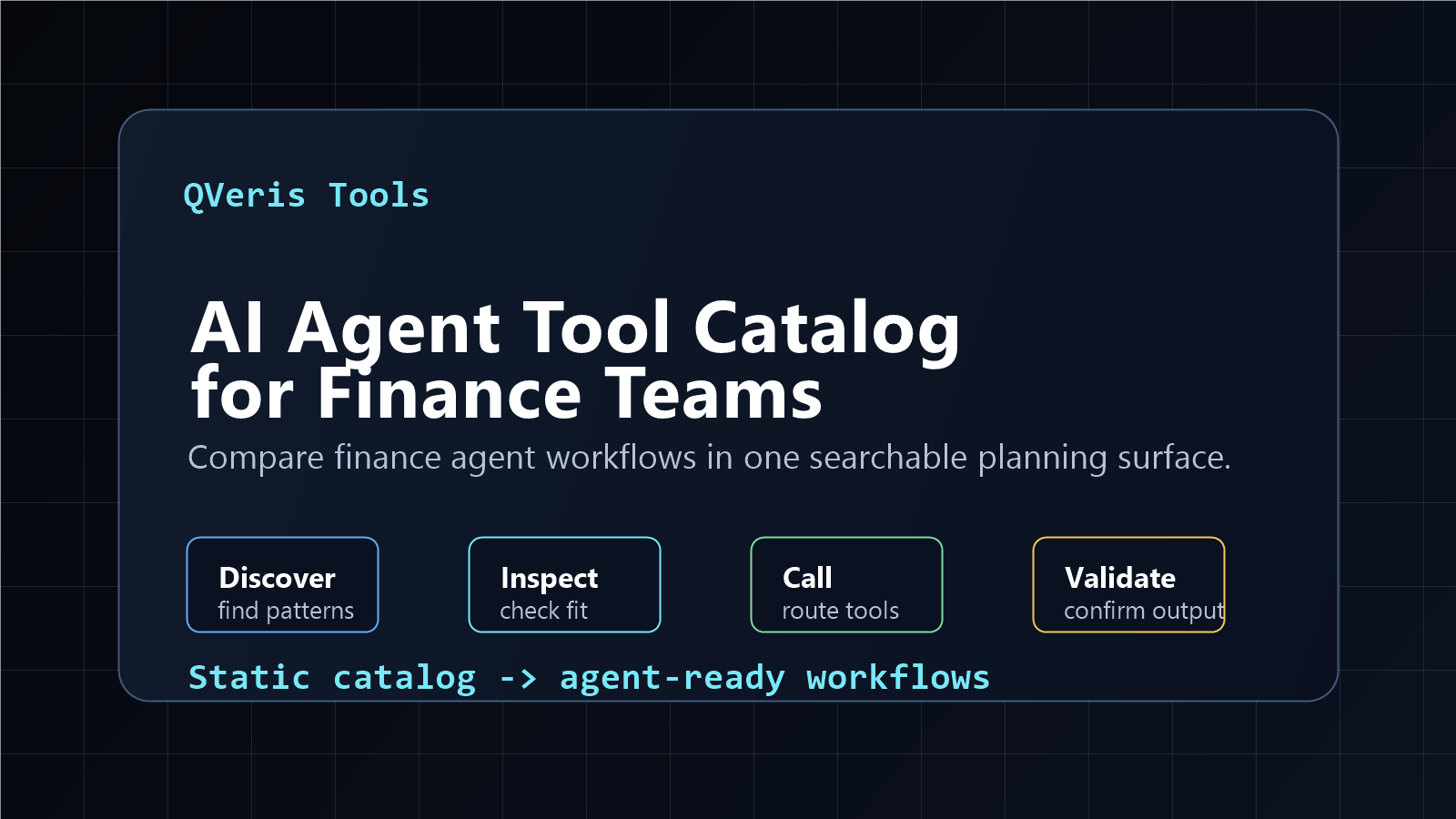
Use this catalog to compare finance agent ideas before committing engineering time. It helps teams sort workflows across research, trading, compliance, risk, portfolio operations, and data infrastructure.这个目录适合在投入研发前比较金融 Agent 想法,帮助团队把研究、交易、合规、风险、组合运营和数据基础设施等工作流分门别类。
Start with the business task: monitoring, research, compliance review, portfolio update, or data normalization.从业务任务开始:监控、研究、合规审查、组合更新或数据标准化。
Compare data freshness, output format, integration complexity, source quality, and production risk.比较数据新鲜度、输出格式、接入复杂度、来源质量和生产风险。
Move from a broad idea to the exact QVeris capabilities an agent needs to discover, inspect, and call.把宽泛想法拆成 Agent 需要发现、检查和调用的具体 QVeris 能力。
A catalog page gives searchers a clear planning surface instead of a thin list of names. It also sends users toward documentation, Skill Hub, and the Capability Map when they are ready to build.目录页不是薄薄的名称列表,而是给搜索用户一个清晰的规划界面。当用户准备动手时,也能自然进入文档、Skill Hub 和 Capability Map。
An AI agent tool catalog should do more than list names. Finance teams need to compare workflow intent, required data freshness, output format, integration complexity, governance risk, and whether a capability is ready for production.
Use this catalog as a planning layer before engineering work begins. A research assistant may need filings and fundamentals, while a monitoring agent may need live prices, news, and alert rules. QVeris helps connect these patterns to discoverable capabilities.
Group tools by research, monitoring, compliance, portfolio operations, and data infrastructure workflows.
Look for schema clarity, latency expectations, source metadata, auth needs, and fallback options.
Move from static catalog browsing into QVeris Skill Hub, docs, or Capability Map when implementation starts.
Implementation note: A catalog is strongest when it links every idea to a real capability, owner, expected output, and implementation path. Avoid treating it as a marketing gallery; use it to reduce ambiguity before engineering work starts.
Teams can also use the catalog during planning reviews: first shortlist the workflow, then open the related guide, then map the implementation to a QVeris skill or capability before writing integration code.
AI Agent 工具目录不应该只是名称列表。金融团队需要比较工作流意图、数据新鲜度、输出格式、集成复杂度、治理风险,以及某个能力是否适合生产环境。
这个目录适合作为工程投入前的规划层。研究助手可能需要 filings 和基本面数据,监控 Agent 可能需要实时价格、新闻和预警规则。QVeris 可以把这些模式连接到可发现的能力。
按研究、监控、合规、组合运营和数据基础设施工作流整理工具。
关注 schema 清晰度、延迟预期、来源元数据、认证需求和回退能力。
从静态目录浏览进入 QVeris Skill Hub、文档或 Capability Map,开始实现。
实施注意事项:目录页最有价值的地方,是把每个想法连接到真实能力、负责人、预期输出和实现路径。不要把它做成营销陈列页,而要用它在工程开始前减少模糊需求。
团队也可以在规划评审中使用这个目录:先筛选工作流,再打开相关指南,最后把实现路径映射到 QVeris skill 或能力,再开始写集成代码。