
AI Earnings Call Transcript
Analysis Guide
AI 财报电话会文本
分析指南
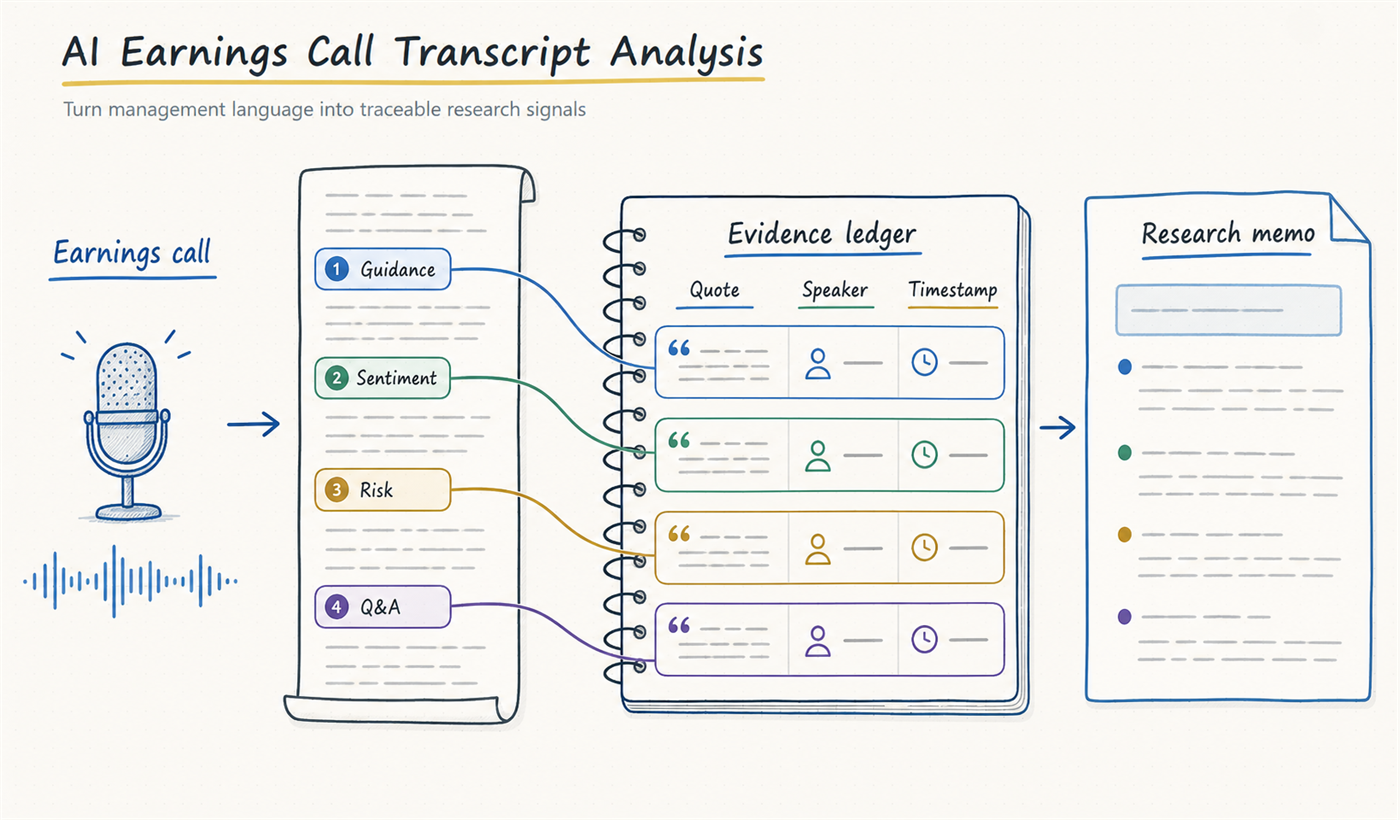
Why Earnings Call Transcript Analysis Has Search Intent 为什么财报电话会文本分析有明确搜索意图
Investors, analysts, and quant teams do not read earnings calls only to know what management said. They read transcripts to detect guidance changes, margin pressure, product demand, pricing power, and analyst pushback. That makes earnings call transcript analysis a high-intent financial research topic. 投资者、分析师和量化团队阅读财报电话会,不只是为了知道管理层说了什么。他们真正关心的是指引变化、利润率压力、产品需求、定价能力和分析师追问。因此,财报电话会文本分析是一个高意图的金融研究主题。
The related QVeris blog shows how a transcript can become a full-context research pack. The goal is not a generic summary. The goal is to turn language into evidence-backed signals that can be reviewed by humans or downstream agents. QVeris 相关博客展示了如何把 transcript 转成完整上下文研究包。目标不是普通摘要,而是把语言转成带证据的信号,供人类或下游 Agent 复核。
Four Signals to Extract from Earnings Calls 从财报电话会中提取四类信号
A strong transcript workflow separates theme detection from final interpretation. The assistant should mark what changed, attach the source text, then connect the theme to financial data or market movement. 强的 transcript 工作流会把主题识别和最终解释分开。助手应先标记变化,附上原文证据,再把主题连接到财务数据或市场表现。
Look for upgrades, cuts, cautious phrasing, and timeline shifts. 关注上调、下调、谨慎措辞和时间线变化。
Track comments on costs, pricing, mix, inventory, and operating leverage. 追踪成本、定价、产品结构、库存和经营杠杆。
Separate actual order trends from broad optimism or one-time effects. 区分真实订单趋势、宽泛乐观表述和一次性因素。
Repeated questions often reveal what the market still does not trust. 反复追问常常暴露市场仍不信任的部分。
Build an Evidence Ledger, Not Just a Summary 建立证据账本,而不只是摘要
Example: From Management Quote to Research Signal 示例:从管理层表述到研究信号
Management sounded optimistic about demand and expects margins to improve. 管理层听起来对需求乐观,并预计利润率改善。
Demand language improved, but margin comments remain cautious. Verify with gross margin trend, inventory, and post-call price reaction. 需求表述改善,但利润率措辞仍谨慎。需要用毛利率趋势、库存和电话会后股价反应验证。
AI Earnings Call Transcript Analysis vs Generic Summaries AI 财报电话会分析与普通摘要的区别
| Dimension 维度 | Generic summary 普通摘要 | QVeris-style signal workflow QVeris 信号工作流 |
|---|---|---|
| Output 输出 | Condensed call notes. 压缩后的会议笔记。 | Themes, evidence, source links, and next data checks. 主题、证据、来源链接和下一步数据验证。 |
| Traceability 可追溯性 | Often loses the original quote. 常常丢失原文证据。 | Keeps the transcript sentence attached to the signal. 把 transcript 原句和信号绑定。 |
| Market link 市场关联 | Rarely checks price, news, or filing context. 很少检查价格、新闻或文件背景。 | Routes to market data, filings, news, and fundamentals. 路由到市场数据、文件、新闻和基本面。 |
How QVeris Connects Transcript Signals to Data QVeris 如何连接 transcript 信号与数据
QVeris can help an AI agent move beyond text-only transcript review. The agent can discover the right data capability, inspect the inputs, and call market data, filing, financial, or news tools to validate whether a transcript theme is material. QVeris 可以帮助 AI Agent 超越纯文本 transcript 阅读。Agent 可以发现合适的数据能力、检查输入参数,并调用市场数据、文件、财务或新闻工具,验证 transcript 主题是否真正重要。
That makes the workflow useful for research teams, earnings-season monitoring, quant feature generation, and fintech products that need explainable summaries rather than black-box conclusions. 这使该工作流适合研究团队、财报季监控、量化特征生成,以及需要可解释摘要而不是黑箱结论的金融科技产品。
A Repeatable Earnings Call Analysis Workflow一套可重复执行的财报电话会分析流程
A high-quality workflow does more than summarize a transcript. It preserves the source, separates management claims from analyst interpretation, and connects each important statement to the financial or market evidence needed to test it.
高质量流程不只是总结电话会文本,而是保留原始来源,区分管理层陈述与分析师解释,并把每个重要说法连接到可用于验证的财务或市场证据。
Collect the current transcript, prepared remarks, Q&A, earnings release, guidance, and the prior comparable call. Resolve speaker names and sections so every extracted statement can be traced to the right person and moment.
收集本期 transcript、管理层陈述、问答、财报新闻稿、业绩指引和上一可比季度电话会,并解析发言人和章节,让每条提取内容都能追溯到正确的人与位置。
Tag guidance, demand, pricing, margins, costs, inventory, capital allocation, and risk. Record the exact quote, whether the language became stronger or weaker, and whether the statement appeared in prepared remarks or under analyst questioning.
标记指引、需求、定价、利润率、成本、库存、资本配置和风险,记录原文、语气变强或变弱,以及该说法出现在准备稿中还是分析师追问中。
Compare the statement with reported metrics, filings, segment data, price and volume, peer commentary, and relevant news. Keep “management said,” “the data shows,” and “the analyst infers” as separate fields.
把相关说法与已披露指标、公告、分部数据、价格与成交量、同业表述和相关新闻比较,并把“管理层所说”“数据所示”和“分析师推断”分成不同字段。
How to Compare Earnings Calls Over Time如何跨季度比较财报电话会
The most useful transcript signal is often a change in language, not a sentence viewed in isolation. Comparison needs a stable taxonomy and a consistent observation window.
最有价值的 transcript 信号往往不是某一句话本身,而是语言相较以往发生了什么变化。跨期比较需要稳定的主题体系和一致的观察窗口。
| Compare比较内容 | What to record需要记录 | Why it matters为什么重要 |
|---|---|---|
| Guidance业绩指引 | Range, midpoint, horizon, assumptions, confidence, and whether management raised, cut, or reaffirmed it区间、中点、时间范围、核心假设、信心水平,以及管理层是上调、下调还是维持指引 | A repeated number can still carry a different risk profile when assumptions or confidence change即使数字不变,只要假设或信心变化,风险含义也可能不同 |
| Operating themes经营主题 | Demand, pricing, mix, costs, hiring, inventory, capacity, and region or segment differences需求、定价、产品结构、成本、招聘、库存、产能,以及地区或分部差异 | Theme direction shows whether a one-quarter result is becoming a durable trend主题方向能够帮助判断单季度现象是否正在变成持续趋势 |
| Q&A pressure问答压力 | Repeated questions, avoided answers, new disclosures, and differences between prepared remarks and responses重复追问、回避回答、新增披露,以及准备稿与即兴回答之间的差异 | Analyst friction often reveals the assumptions the market trusts least分析师的持续追问往往暴露市场最不信任的假设 |
| Outcome后续结果 | Actual metrics, later filings, revisions, price reaction, and whether the claimed catalyst materialized实际指标、后续公告、修正数据、股价反应,以及管理层所称催化因素是否兑现 | Outcome tracking tests management credibility and improves future signal weighting追踪结果可以检验管理层可信度,并改进未来信号权重 |
Failure Modes and Review Checks常见失败方式与复核检查
Transcript analysis can sound precise while resting on weak evidence. The review process should make common errors visible before a theme reaches a research memo, alert, or model feature.
电话会分析可能听起来非常精确,底层证据却很薄弱。主题进入研究备忘录、预警或模型特征之前,复核流程应主动暴露常见错误。
Keep the preceding question, speaker, section, and nearby qualifiers. A confident sentence in prepared remarks and a cautious response under questioning should not receive the same interpretation.
保留前置问题、发言人、章节和附近限定语。准备稿中的自信陈述,与追问下的谨慎回应,不应被赋予相同含义。
Seasonality, acquisitions, currency, accounting changes, and segment reclassification can make sequential comparisons misleading. State why the selected prior call is comparable.
季节性、并购、汇率、会计变化和分部重分类都可能让环比失真,应明确说明为什么选择的上一期电话会具有可比性。
Tone and sentiment are model interpretations. Preserve the quote and confidence score, then validate material claims with financial data or documents before treating them as research signals.
语气和情绪属于模型解释。应保留原文与置信度,并用财务数据或文件验证重大说法,再把它们视为研究信号。
Require human review when the transcript is incomplete, speaker attribution is uncertain, metrics conflict, or a conclusion could materially affect an investment or client-facing report.
当 transcript 不完整、发言人归属不确定、指标冲突,或结论可能显著影响投资与客户报告时,应要求人工复核。
Earnings Call Transcript Analysis FAQ财报电话会文本分析常见问题
Extract the exact quote, speaker, topic, direction of change, confidence, relevant period, and the next evidence needed. Common themes include guidance, demand, pricing, margins, costs, inventory, capital allocation, and risk.
No. Positive or negative tone can be a useful feature, but it should not replace claim extraction, prior-quarter comparison, source quotes, reported metrics, and follow-up validation. Tone without context is especially fragile in scripted prepared remarks.
Require every factual claim to link to a transcript passage or structured data field, separate quotes from interpretation, expose missing evidence, and stop or request review when the source is incomplete or contradictory.
QVeris helps an agent discover and call the filings, fundamentals, prices, news, and other capabilities needed to test transcript-derived themes. It complements transcript retrieval and language analysis rather than replacing them.
至少提取原文、发言人、主题、变化方向、置信度、对应期间和下一步验证证据。常见主题包括指引、需求、定价、利润率、成本、库存、资本配置和风险。
不足。正面或负面语气可以作为一个特征,但不能替代说法提取、跨季度比较、原文引用、已披露指标和后续验证。准备稿中的语气尤其容易脱离背景。
要求每个事实性说法链接到 transcript 片段或结构化数据字段,区分引用与解释,显式展示缺失证据,并在来源不完整或互相矛盾时停止或请求人工复核。
QVeris 帮助 Agent 发现并调用公告、基本面、价格、新闻和其他能力,用于验证从电话会中提取的主题。它补充 transcript 获取与语言分析,而不是替代它们。