
AI Finance Agent Cost:
API Bills and Savings
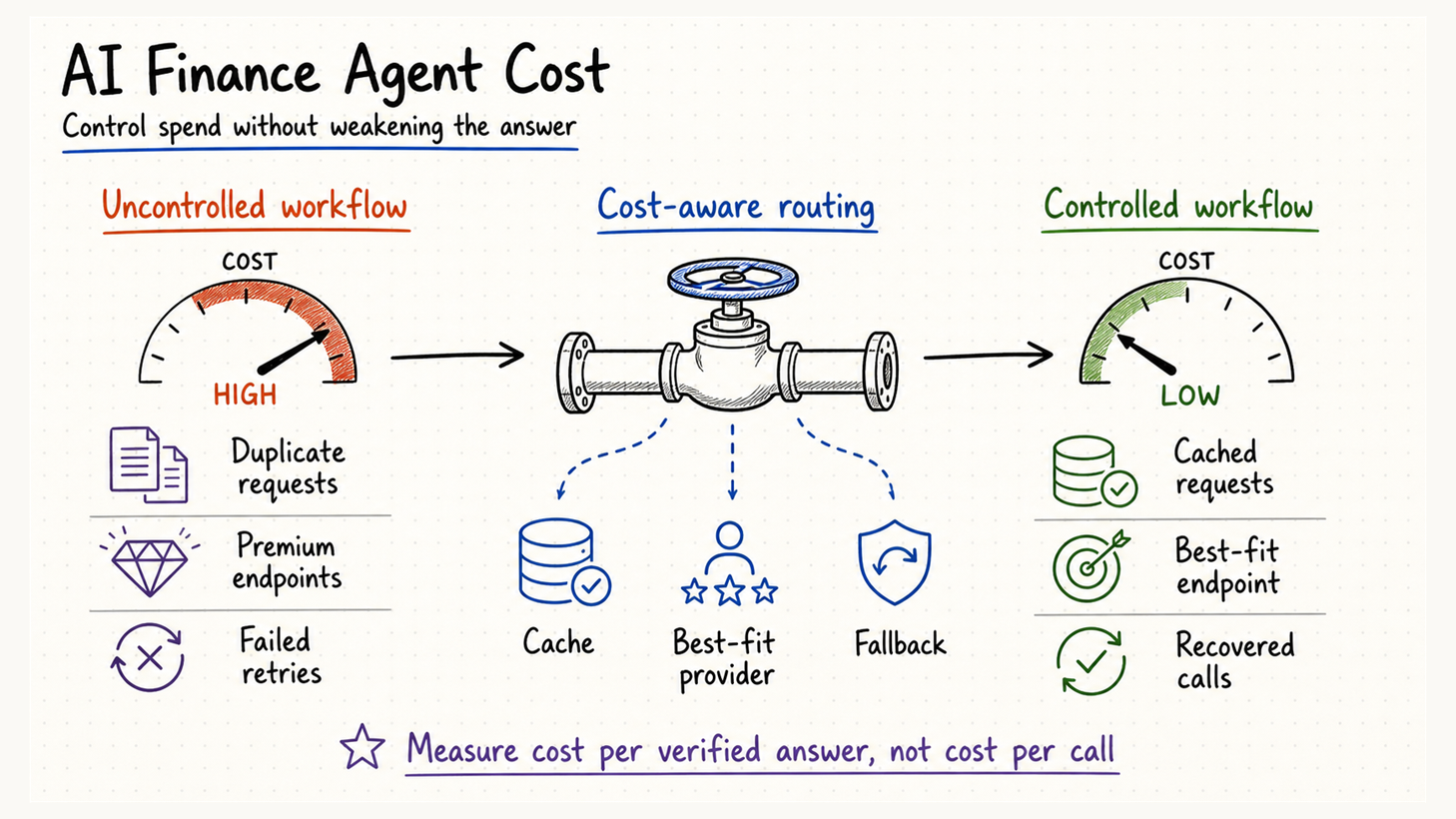
Why AI Finance Agent Cost Gets Expensive
Finance agents are expensive because they rarely need one lightweight call. A single research request may need a quote, historical prices, fundamentals, SEC filings, earnings data, analyst estimates, news, and macro context. If the agent calls every provider every time, the bill grows faster than the value.
The QVeris billing audit blog frames the issue clearly: a finance agent can burn money on duplicate calls, premium endpoints, and low-value executions. The fix is not simply “use fewer tools.” The fix is to inspect cost and route the right capability for the task.
Where AI Agent API Bills Come From
The most common cost leaks happen before teams notice them in the monthly invoice.
The agent asks for the same quote, filing, or news set multiple times in one workflow.
A high-cost API handles a task that a cheaper capability could answer safely.
The agent executes before checking latency, success rate, coverage, and estimated cost.
A failed provider forces another full workflow instead of a targeted fallback call.
The agent keeps expanding its search without a budget, cache, or stop condition.
The call succeeds technically but does not change the answer or improve evidence quality.
How to Reduce Financial Data API Cost
AI Finance Agent Cost Before and After Routing
| Cost area | Without routing | With QVeris-style routing |
|---|---|---|
| Provider choice | Hardcoded or guessed by the app. | Selected by intent, coverage, success rate, latency, and cost. |
| Repeated facts | The agent may pay again for data it already fetched. | The workflow can reuse or route only the missing evidence. |
| Premium data | Called too early, even for exploratory tasks. | Reserved for tasks where better data changes the outcome. |
| Audit trail | Hard to explain where the budget went. | Each call has capability, source, cost, and result metadata. |
How QVeris Helps Control AI Finance Agent Cost
QVeris separates discovery and inspection from execution. Discover and Inspect let an agent understand what it can call, what it costs, and whether it is likely to answer the task before spending credits on execution.
That changes the economics of finance agents. Instead of treating every data source as a static API integration, the workflow can route by value: call free or low-cost capabilities when enough, escalate to premium data when necessary, and keep a trace of why the call happened.
Build a Complete AI Finance Agent Cost Model
Model tokens are only one line item. A useful cost model follows each research task from user request to data retrieval, processing, reasoning, storage, monitoring, and human review.
Count input, output, retries, tool-result payloads, long documents, embeddings, reranking, and summarization passes. Measure cost per completed workflow, not only cost per model call.
Include subscriptions, exchange entitlements, per-call or per-record charges, overage, redistribution rights, and higher-priced real-time tiers. The same endpoint can carry different costs by user or market.
Add queues, databases, vector stores, logs, traces, egress, scheduled jobs, alerting, incident response, and engineering maintenance. Reliability features cost money but prevent much larger failure costs.
Track analyst review time, manual source lookup, exception handling, compliance approval, and rework caused by weak data. A cheaper automated answer is not cheaper if people must rebuild it.
Optimize Cost Without Lowering Research Quality
Cost control should remove unnecessary work while protecting the evidence required for a trustworthy answer. Use a quality floor before optimizing for price.
| Control | Use it for | Guardrail |
|---|---|---|
| Route by task | Use lower-cost models and data sources for classification, formatting, and low-risk lookup | Escalate complex reasoning, material claims, and uncertain evidence |
| Cache by freshness | Reference data, historical filings, resolved identifiers, and repeat document chunks | Never serve cached values beyond the task's freshness requirement |
| Retrieve less | Select relevant document sections and bounded time windows before model analysis | Keep source anchors and allow iterative retrieval when evidence is incomplete |
| Set workflow budgets | Limit retries, parallel calls, provider spend, tokens, and maximum document expansion | Return a visible partial result or request approval instead of silently truncating evidence |
AI Finance Agent Cost FAQ
It depends on the workload. Real-time and licensed data may dominate some systems; long-document reasoning and repeated model calls dominate others. Measure cost per completed, reviewed task to see the true driver.
Yes for stable reference data, historical filings, resolved identifiers, and repeat document content. Quotes, alerts, and other freshness-sensitive workflows require short or policy-driven cache lifetimes.
Set limits by workflow and user: provider spend, model tokens, retries, parallel calls, and maximum latency. Define what the agent should do when the budget is reached—return partial evidence, request approval, or stop.
QVeris can help agents inspect capability metadata and route calls across providers. Cost-aware routing works best when combined with quality, freshness, entitlement, and fallback policies rather than choosing the cheapest source blindly.