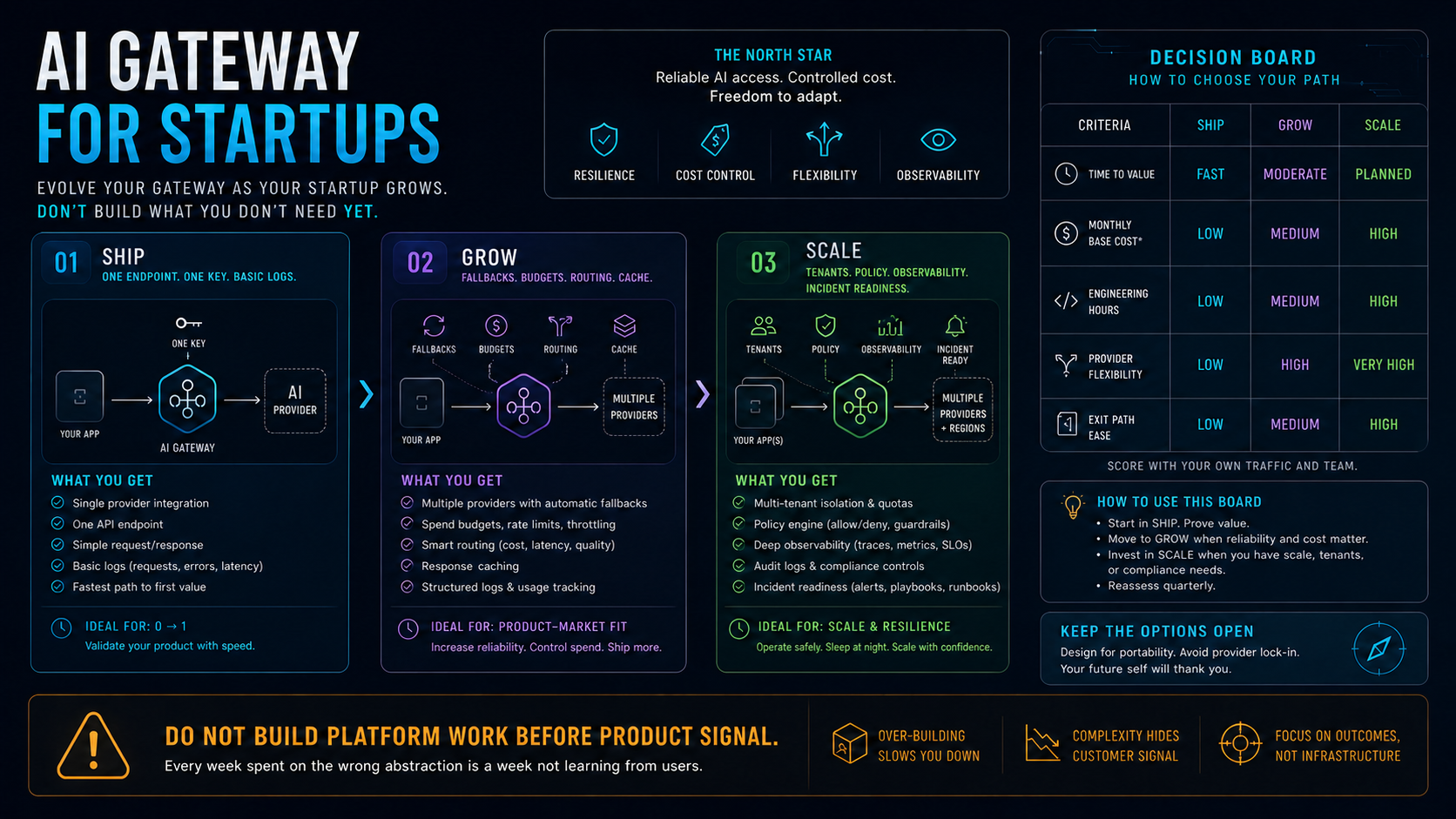
AI Gateway for Startups
When to Add One—and What to Avoid创业团队的 AI 网关
何时需要,又该避免什么
A startup should use an AI gateway only when it removes a measured product constraint. This guide shows what to deploy at each growth stage, how to compare direct, managed, and open-source options, and how to avoid building infrastructure before users need it.
创业团队只有在 AI 网关能够解决真实、可测的问题时,才值得引入。本指南说明不同增长阶段需要什么,如何比较直连、托管与开源方案,以及怎样避免在用户尚未需要时过早建设平台。

TL;DR
Direct answer: most startups do not need a full AI gateway on day one. Start with a direct provider integration and a thin product-owned interface. Add a gateway when a second provider, recurring outages, spend variance, shared credentials, slow diagnosis, or customer governance requirements create measurable pain.
直接答案:大多数创业团队在第一天并不需要完整的 AI 网关。更合适的起点是直连一个供应商,并保留一层轻量、由产品团队掌控的内部接口。当第二个供应商、反复中断、支出波动、多人共用密钥、故障难以定位或客户治理要求带来真实成本时,再引入网关。
The best early stack gets reliable product behavior in front of users quickly while keeping model and provider changes reversible.
Subscriptions, gateway markup, integration, telemetry, upgrades, and on-call work can cost more than the problem before product-market fit.
Introduce fallback after measured failures, budgets after spend variance, deeper traces after diagnosis pain, and tenancy when customers require isolation.
Use stable task aliases, provider conformance tests, configuration export, and a documented direct-provider rollback.
早期技术栈的目标,是尽快把足够可靠的产品交到用户手中,同时保持模型和供应商切换可逆。
在产品市场匹配前,订阅、网关加价、集成、遥测、升级和值班可能比它解决的问题更贵。
出现可测的故障后再加回退,支出波动后再加预算,诊断困难后再补调用链,客户要求隔离时再做租户体系。
使用稳定的任务别名、供应商一致性测试、配置导出,并保留可执行的供应商直连回滚方案。
Does your startup need an AI gateway now?你的创业团队现在需要 AI 网关吗?
Use a gateway when the cost of the current constraint is higher than the cost of another production dependency. This is a measurable decision, not a maturity badge. If one provider works, incidents are rare, spend is predictable, and one team owns the integration, direct access may still be the correct architecture.
只有当现有问题造成的成本高于新增一个生产依赖的成本时,网关才值得引入。这是一个可以衡量的工程决策,不是公司“成熟”的标志。如果单一供应商运行稳定、事故很少、支出可预测,而且只有一个团队维护集成,那么继续直连可能仍是正确架构。
| Observed trigger已经观察到的信号 | Gateway capability that may help可能有帮助的网关能力 | Evidence before building建设前需要的证据 |
|---|---|---|
| Provider outages or rate limits hurt active users供应商中断或限流已经影响活跃用户 | Health-aware fallback, bounded retries, circuit breaking感知健康状态的回退、有限重试与熔断 | Incident frequency, affected sessions, recovery target事故频率、受影响会话与恢复目标 |
| Model spend varies without explanation模型支出波动且无法解释 | Usage attribution, limits, budgets, model routing用量归因、限额、预算与模型路由 | Cost by feature, customer, model, and request class按功能、客户、模型和请求类型拆分的成本 |
| Several services share provider keys多个服务共用供应商密钥 | Central credentials and workload-level access集中凭证与工作负载级访问控制 | Key inventory, owners, rotation time, blast radius密钥清单、责任人、轮换时间与影响范围 |
| B2B customers request isolation or auditB2B 客户要求隔离或审计 | Tenant policy, evidence export, data controls租户策略、证据导出与数据控制 | Signed requirements and revenue at risk已确认的客户要求与受影响收入 |
Wait if: the only reason is “we may need multiple models someday,” or the team cannot name an owner for uptime, configuration, upgrades, security, and incident response.
暂缓引入的情况:唯一理由只是“以后可能会用多个模型”,或者团队还无法明确由谁负责可用性、配置、升级、安全与事故响应。
The minimum useful startup gateway创业团队真正需要的“最小网关”
A startup gateway should begin as a narrow reliability and evidence layer, not a universal AI platform. The minimum useful version authenticates the application, protects provider credentials, applies timeouts, attaches a request ID, records provider/model/usage/latency/error fields, and returns stable errors. Everything else must earn its place.
创业团队的网关应从一层狭窄的可靠性与证据能力开始,而不是一开始就做“万能 AI 平台”。最小可用版本负责认证应用、保护供应商密钥、执行超时、附加请求 ID、记录供应商/模型/用量/延迟/错误,并向应用返回稳定的错误格式。其他功能都需要用实际问题证明其必要性。
Do not confuse a shared HTTP wrapper with a durable product boundary. Product code should call stable task aliases such as support-reply or document-extract, declare required capabilities, and carry timeout, budget, tenant, and trace context. The adapter behind that interface can call a provider directly today and a managed or self-hosted gateway later.
不要把共享的 HTTP 封装误认为稳定的产品边界。产品代码应调用类似 support-reply 或 document-extract 的任务别名,声明所需能力,并传递超时、预算、租户和调用链上下文。接口后的适配器今天可以直连供应商,未来再切换到托管或自托管网关。
Ship, grow and scale require different gateways上线、增长与规模化需要不同网关
At ship stage, one endpoint, one key, basic logs and simple error handling may be enough. During growth, add provider fallback, budgets, rate limits, routing, caching and usage attribution. At scale, add tenants, policy, audit, regional controls and incident readiness.
上线阶段,一个端点、一把密钥、基础日志与简单错误处理可能足够。增长阶段增加供应商回退、预算、限流、路由、缓存与用量归因。规模化阶段再加入租户、策略、审计、区域控制与事故准备。
Managed aggregators and gateways reduce setup. Open-source proxies increase control but consume engineering. Platform-native gateways fit teams already committed to that platform. Re-evaluate quarterly instead of buying the final architecture on day one.
托管聚合器与网关减少设置;开源代理增加控制但消耗工程资源;平台原生网关适合已投入该平台的团队。应季度复评,而不是第一天就采购最终架构。
Choose by startup stage按创业阶段选择
| Stage阶段 | Best fit最适合 | Verify before choosing选择前验证 |
|---|---|---|
| Ship: direct provider上线:直连供应商 | One model/provider proves the product with minimum moving parts and direct feature access.用最少组件与直接功能访问,让单一模型/供应商验证产品。 | Add basic timeout, request IDs, spend alerts and a documented manual fallback before launch.上线前至少增加超时、请求 ID、支出告警与人工回退文档。 |
| Ship: managed aggregator上线:托管聚合器 | Fast broad model access and one billing relationship without operating infrastructure.无需运营基础设施即可快速访问广泛模型,并统一账单关系。 | Verify markup, credits, provider provenance, data terms, supported parameters and direct rollback.验证加价、Credits、供应商来源、数据条款、参数支持与直连回滚。 |
| Grow: managed gateway增长:托管网关 | Routing, fallback, budgets, cache and observability with low platform staffing.以较低平台人力获得路由、回退、预算、缓存与可观测。 | Check base cost, workflow fit, lock-in, retention, exports and whether controls match actual incidents.检查基础成本、工作流适配、锁定、保留、导出以及控制是否匹配真实事故。 |
| Grow: open-source proxy增长:开源代理 | Custom routing and provider keys with portable deployment and no mandatory managed data path.使用自有供应商密钥获得自定义路由与可移植部署,无强制托管数据路径。 | You own upgrades, security, adapters, database, HA, telemetry and on-call.团队承担升级、安全、适配器、数据库、高可用、遥测与值班。 |
| Scale: governed platform规模化:治理平台 | Tenancy, identity, policy, audit, regions, support and reliable change management.获得租户、身份、策略、审计、区域、支持与可靠变更管理。 | Prove enterprise requirements with customer evidence before absorbing the platform and process cost.在承担平台与流程成本前,用客户证据证明企业需求。 |
A startup decision board创业团队决策板
Count setup, SDK changes, keys, model testing, billing, deployment and diagnosis—not only account creation.
Separate subscription, credits, markup, provider use, storage, telemetry, engineering and incident time.
Compare model breadth, native features, routing controls, BYOK, data terms, provider pinning and catalog lifecycle.
Require configuration, usage and trace export, stable internal aliases, conformance tests and direct rollback.
计算设置、SDK 改动、密钥、模型测试、计费、部署与诊断,而不只是注册账户。
区分订阅、Credits、加价、供应商用量、存储、遥测、工程与事故时间。
比较模型广度、原生功能、路由控制、BYOK、数据条款、供应商固定与目录生命周期。
要求配置、用量与调用链导出、稳定内部别名、一致性测试与直连回滚。
Model the full startup cost, including attention创业团队要计算完整成本,也要计算注意力成本
Compare direct, managed, and self-hosted options with the same cost model. Include subscription, minimum commit, request or token markup, provider usage, credits expiration, infrastructure, database, cache, telemetry storage, engineering integration, upgrades, security patches, and on-call time. Founder and senior engineer attention is often the most expensive line before product-market fit.
直连、托管和自托管方案必须用同一套成本模型比较。除了订阅、最低消费、请求或 Token 加价、供应商用量与 Credits 有效期,还要算基础设施、数据库、缓存、遥测存储、工程集成、升级、安全补丁和值班。产品市场匹配之前,创始人和核心工程师的注意力往往才是最昂贵的成本。
| Cost成本项 | Question to ask需要回答的问题 | Common surprise常见意外 |
|---|---|---|
| Base platform cost平台基础费用 | What is paid before one production request?在产生第一条生产请求前要支付多少? | Seats, environments, retention, or support create a monthly floor席位、环境、保留周期或支持形成固定月费 |
| Variable gateway cost网关可变费用 | Is pricing per request, token, spend, or feature?按请求、Token、供应商支出还是功能计费? | Gateway markup compounds as product usage grows产品增长后,网关加价会同步放大 |
| Engineering ownership工程责任 | Who upgrades, patches, scales, and answers incidents?谁负责升级、补丁、扩容和事故响应? | A “free” proxy becomes an internal platform“免费”代理逐渐变成内部平台 |
| Exit cost退出成本 | Can configuration, traces, and provider behavior be reproduced?配置、调用链与供应商行为能否复现? | Applications depend on proprietary model names and errors应用已经依赖专有模型名和错误语义 |
A cost optimization feature is valuable only when its measured savings exceed its fee and complexity. Semantic caching, for example, can reduce repeated work but may introduce stale answers, tenant leakage, difficult invalidation, and quality risk. Start with attribution and simple limits before adding clever optimization.
只有当实测节省高于功能费用与复杂度时,成本优化才真正有价值。例如语义缓存可以减少重复调用,但也可能带来答案过期、租户串数据、失效困难和质量风险。更稳妥的顺序是先做好成本归因与简单限额,再考虑复杂优化。
Fallback helps only when semantics remain acceptable只有语义仍可接受时,回退才有价值
“Supports fallback” is not enough. A replacement model may use different tools, reject different content, support a smaller context, produce another JSON shape, or change user-visible quality. Define eligible alternatives per task, not one global provider order. Test the exact prompt, tools, structured output, safety behavior, latency, and price before enabling automatic fallback.
“支持回退”并不等于回退可靠。替代模型可能使用不同的工具、拒绝不同内容、上下文更短、输出另一种 JSON 结构,或明显改变用户可感知的质量。应按任务定义可接受的替代方案,而不是全产品共用一条供应商顺序。开启自动回退前,要验证真实提示词、工具、结构化输出、安全行为、延迟和价格。
A bounded retry can be safe when no response bytes arrived and the operation has no external side effect. Record attempt count and total deadline.
If users already received output, silently restarting with another model can duplicate or contradict text. Return a clear incomplete state and correlation ID.
Agent tool calls need idempotency keys or explicit recovery. Gateway retries must not create duplicate emails, charges, tickets, or database writes.
Batch evaluation, offline experiments, and internal scripts may not need the same gateway path as customer-facing production.
尚未收到响应字节且操作没有外部副作用时,可以有限重试,但必须记录尝试次数和总截止时间。
用户已经看到部分输出后,静默换模型重启可能造成重复或前后矛盾。应明确返回“结果不完整”并附关联 ID。
智能体工具调用需要幂等键或明确恢复流程。网关重试不能造成重复邮件、扣款、工单或数据库写入。
离线评测、实验和内部脚本未必需要走与客户生产流量相同的关键路径。
Collect the evidence a small team can actually use只收集小团队真正能用上的证据
A startup does not need a giant observability program, but it does need one trace that explains a user-visible failure. Record the product feature, customer or tenant, request ID, task alias, gateway route, native provider and model, attempt count, time to first token, total latency, finish reason, token usage, estimated cost, and stable error category.
创业团队不需要一套庞大的可观测体系,但至少要有一条调用链能够解释用户看见的失败。建议记录产品功能、客户或租户、请求 ID、任务别名、网关路由、原生供应商与模型、尝试次数、首 Token 时间、总延迟、结束原因、Token 用量、估算成本与稳定错误分类。
Do not make raw prompt storage the default. For many support and performance questions, structured metadata and a hashed or short-lived payload reference are enough. If prompt bodies are needed for quality review, define who may see them, how long they remain, how customers opt out, and how deletion propagates to gateway vendors and analytics stores.
不要默认永久保存完整提示词。多数支持与性能问题,结构化元数据加哈希或短期正文引用已经足够。如果质量评审确实需要查看正文,应明确谁可以访问、保留多久、客户如何退出,以及删除如何同步到网关供应商与分析存储。
Use startup-sized security controls with clear ownership采用适合创业阶段、责任明确的安全控制
The first security win is usually removing provider keys from laptops, front-end code, notebooks, and multiple deployment systems. Give each application and environment a distinct gateway identity, keep provider secrets in one approved store, rotate them without changing product code, and alert on unusual model or spend patterns.
对创业团队来说,最先值得解决的安全问题通常是:不要让供应商密钥散落在个人电脑、前端代码、Notebook 与多个部署系统中。每个应用和环境应拥有独立的网关身份,供应商密钥统一存放,并能在不修改产品代码的情况下轮换,同时对异常模型调用和支出模式告警。
For B2B products, connect controls directly to customer promises. If a contract says a tenant’s data is not retained, verify gateway logs, caches, support views, exports, and provider settings—not only your application database. If a customer requires a region, trace the full path through the gateway, model provider, tools, and telemetry.
对于 B2B 产品,安全控制必须直接对应客户承诺。如果合同写明某租户数据不保留,就要核对网关日志、缓存、支持界面、导出与供应商设置,而不能只检查应用数据库。如果客户要求指定区域,还要追踪网关、模型供应商、工具与遥测的完整数据路径。
A lean implementation path from direct call to gateway从直连到网关的精益实施路径
| Step步骤 | Add增加什么 | Do not add yet暂时不要做什么 |
|---|---|---|
| 1. Product boundary1. 产品边界 | Stable task alias, capabilities, timeout, request ID, native provider metadata稳定任务别名、能力要求、超时、请求 ID 与供应商原生元数据 | Universal provider schema covering features you do not use为尚未使用的功能设计万能供应商协议 |
| 2. Basic evidence2. 基础证据 | Model, tokens, latency, finish state, error, feature, customer or tenant模型、Token、延迟、结束状态、错误、功能与客户/租户 | Full prompt logging without retention and access rules在没有保留和访问规则时记录完整提示词 |
| 3. Central access3. 集中访问 | Workload keys or identity, provider secret rotation, rate and spend alerts工作负载密钥或身份、供应商密钥轮换、速率与支出告警 | Complex RBAC copied from an enterprise platform照搬企业平台的复杂 RBAC |
| 4. Targeted routing4. 定向路由 | Per-task eligible routes, fallback semantics, explicit budget and quality thresholds按任务定义合格路由、回退语义以及明确预算与质量阈值 | Opaque “smart routing” without replayable decisions无法复现决策的黑盒“智能路由” |
| 5. Customer controls5. 客户控制 | Tenant isolation, retention modes, regional routes, evidence export租户隔离、保留模式、区域路由与证据导出 | Compliance claims not backed by contracts and operating procedures缺少合同和运营流程支撑的合规承诺 |
Startup AI gateway scorecard创业团队 AI 网关评分表
Score candidates against current constraints, not a hypothetical future company. A provider that solves today’s incident and cost problems with a one-day integration can be a better choice than a broader platform requiring weeks of setup.
候选方案应针对当前约束评分,而不是针对想象中的未来公司。一个能在一天内接入,并解决眼前事故与成本问题的方案,可能比需要数周配置的“大而全”平台更合适。
| Category评分项 | Suggested weight建议权重 | Proof验证证据 |
|---|---|---|
| Time to reliable production value实现可靠生产价值的时间 | 25% | Working integration for the three most important workloads三个最重要负载的实际接入结果 |
| Total cost and attention总成本与注意力消耗 | 20% | Monthly model at current and 10× traffic, including engineering当前与 10 倍流量下包含工程成本的月度模型 |
| Reliability and diagnosis可靠性与诊断 | 20% | Forced timeout, rate limit, partial stream, and provider outage强制超时、限流、流中断与供应商故障 |
| Product compatibility产品兼容性 | 15% | Tools, structured output, streaming, errors, and native parameters工具、结构化输出、流式、错误与原生参数测试 |
| Security and customer requirements安全与客户要求 | 10% | Credential, retention, tenant, and data-path review凭证、保留、租户与数据路径审查 |
| Exit and reversibility退出与可逆性 | 10% | Config export and direct-provider rollback completed by your team由团队独立完成配置导出与供应商直连回滚 |
A one-week startup proof一周创业验证
- Run the three product-critical workloads through direct, managed and open-source candidates.
- Measure accepted quality, TTFT, total latency, retry rate, developer time and total cost—not catalog size.
- Force one outage and one rate limit; verify fallback, user experience, trace clarity and duplicate prevention.
- Change one model, rotate one key, export evidence and execute rollback without vendor help.
- 让三个产品关键负载通过直连、托管与开源候选。
- 测量可接受质量、TTFT、总延迟、重试率、开发时间与总成本,而不是目录大小。
- 强制一次中断与一次限流,验证回退、用户体验、调用链清晰度与防重复。
- 更换一个模型、轮换一把密钥、导出证据,并在无供应商帮助下执行回滚。
Keep a thin product-owned model boundary保持轻量且产品自有的模型边界
Applications should call an internal model interface with stable task aliases, required capability flags, timeout, budget and trace fields. Put direct, aggregator or gateway adapters behind it. Log native provider identifiers and usage. Do not build a universal routing engine until at least two production workloads need different policies.
应用应调用内部模型接口,使用稳定任务别名、所需能力标记、超时、预算与调用链字段;把直连、聚合器或网关适配器放在接口后。记录原生供应商标识与用量。在至少两个生产负载确实需要不同策略前,不要自建通用路由引擎。
Production rule: platform work earns its place only when it removes a measured product, reliability, cost or customer constraint.
生产规则:只有当平台工作消除可测的产品、可靠性、成本或客户约束时,它才值得存在。
Common startup AI gateway mistakes创业团队使用 AI 网关的常见错误
The team pays and builds for regions, tenancy, policy workflows, and model catalogs before any customer or workload requires them.
A long catalog is useless if product-critical streaming, tools, structured output, errors, or model versions are normalized incorrectly.
The gateway treats models as interchangeable and silently changes quality, safety, tool behavior, latency, or cost during an incident.
Prompts and responses enter a third-party dashboard before the startup defines retention, deletion, access, and contractual terms.
An open-source proxy enters production, but nobody owns upgrades, vulnerability response, database recovery, scaling, or after-hours incidents.
The team assumes an OpenAI-compatible endpoint makes migration easy, then discovers proprietary models, routing, errors, and analytics throughout product code.
在没有客户或负载提出需求前,团队就为多区域、租户、策略流程和大型模型目录付费并投入建设。
如果产品关键的流式、工具、结构化输出、错误或模型版本被错误统一,再长的模型目录也没有价值。
网关把不同模型当成可互换资源,在事故时静默改变质量、安全、工具行为、延迟或成本。
团队尚未定义保留、删除、访问与合同条款,提示词和响应就已经进入第三方控制台。
开源代理已经进入生产,但没人负责升级、漏洞响应、数据库恢复、扩容和非工作时间事故。
团队以为 OpenAI 兼容接口天然容易迁移,后来才发现专有模型名、路由、错误与分析逻辑已经散落在产品代码中。
Add real-world capabilities without confusing the gateway增加现实能力,但不要混淆网关
The gateway controls model access. QVeris lets a startup's agent Discover, Inspect and Call external APIs, tools, services and live data. Start with a narrow approved capability set and expand only as customer workflows prove value.
网关控制模型访问;QVeris 让创业团队的智能体发现、检查并调用外部 API、工具、服务与实时数据。先从狭窄获批能力集开始,再随客户工作流证明价值而扩展。
FAQ
No. Direct integration is often the best start. Add a gateway when it removes a measured reliability, cost, security, observability, or integration constraint.
A second production provider, recurring outages or rate limits, unexplained spend, shared credentials, slow incident diagnosis, and customer isolation or audit requirements.
Managed buys speed and reduces operations. Open source provides deployment and policy control but makes your team responsible for the full runtime lifecycle.
Yes, through attribution, limits, caching, and routing—but only if measured savings exceed fees, engineering effort, and quality risk.
After distinct workloads or real provider failures exist and you can define eligible models, quality thresholds, fallback semantics, and evidence.
Keep a product-owned interface, stable task aliases, provider conformance tests, configuration and telemetry exports, and a tested direct-provider rollback.
不需要。直连通常是更好的起点。只有当网关能够解决可测的可靠性、成本、安全、可观测性或集成问题时,才值得引入。
第二个生产供应商、反复中断或限流、无法解释的支出、多人共用密钥、事故难以定位,以及客户提出隔离或审计要求。
托管方案节省时间并减少运维;开源方案提供更多部署和策略控制,但完整的运行生命周期需要由团队自己承担。
可以通过归因、限额、缓存和路由降低成本,但前提是实测节省高于费用、工程投入与质量风险。
当不同负载或真实供应商故障已经出现,并且团队能够定义合格模型、质量阈值、回退语义与所需证据时。
保留产品自有接口、稳定任务别名、供应商一致性测试、配置与遥测导出,并真正演练供应商直连回滚。
Official sources and further reading官方资料与延伸阅读
Pricing, model support, data handling, and limits change frequently. Verify current primary documentation and test the exact features your product uses.
价格、模型支持、数据处理方式与限制会经常变化。选型前应核对最新一手文档,并测试产品实际使用的具体功能。