
AI Gateway for Startups
Ship First, Add Control When Evidence Demands It
创业团队的 AI 网关:先上线,再按证据增加控制
A startup gateway should reduce product risk without creating a platform project. Begin with one reliable endpoint and basic evidence, then add fallback, budgets, routing, tenancy and policy only when traffic and customers justify them.
创业团队的网关应降低产品风险,而不是制造平台项目。先从可靠端点与基础证据开始,再在流量与客户需要时增加回退、预算、路由、租户与策略。
TL;DR
The fastest useful stack makes model access reliable enough to learn from users while keeping model and provider changes reversible.
A feature-rich gateway can be expensive before product-market fit through subscriptions, engineering time, integration and operational attention.
Introduce fallback after real outages, budgets after spend variance, observability after diagnosis pain, and tenancy when customers require isolation.
Keep a thin internal model contract, provider-specific tests, configuration export and direct-provider rollback.
最快的实用技术栈应让模型访问足够可靠,以便从用户反馈学习,同时保持模型与供应商变更可逆。
在产品市场匹配前,功能丰富网关可能通过订阅、工程时间、集成与运营注意力产生高成本。
真实中断后加回退,支出波动后加预算,诊断困难后加可观测,客户需要隔离时加租户。
保持轻量内部模型契约、供应商特定测试、配置导出与供应商直连回滚。
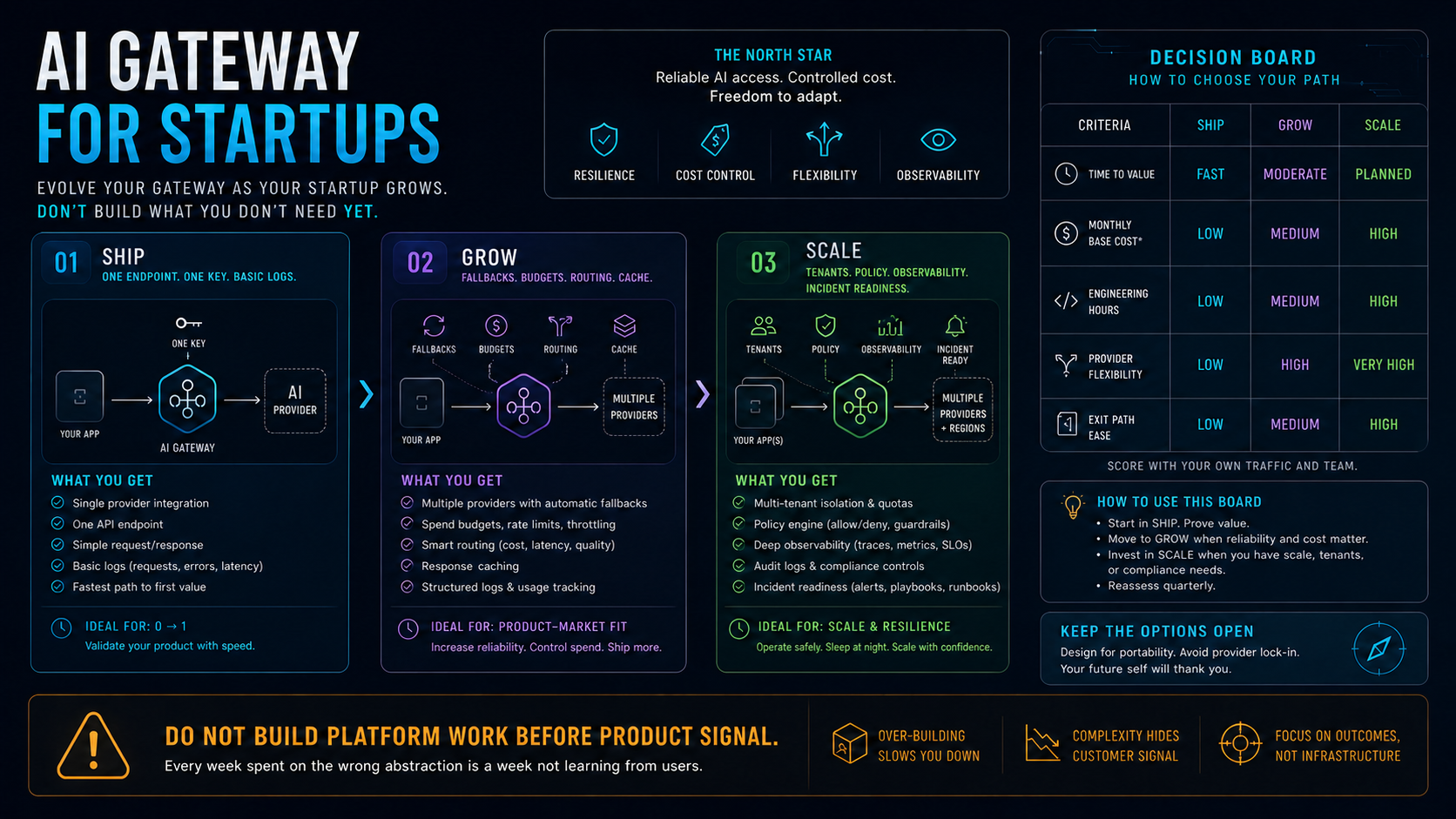
Ship, grow and scale require different gateways 上线、增长与规模化需要不同网关
At ship stage, one endpoint, one key, basic logs and simple error handling may be enough. During growth, add provider fallback, budgets, rate limits, routing, caching and usage attribution. At scale, add tenants, policy, audit, regional controls and incident readiness.
上线阶段,一个端点、一把密钥、基础日志与简单错误处理可能足够。增长阶段增加供应商回退、预算、限流、路由、缓存与用量归因。规模化阶段再加入租户、策略、审计、区域控制与事故准备。
Managed aggregators and gateways reduce setup. Open-source proxies increase control but consume engineering. Platform-native gateways fit teams already committed to that platform. Re-evaluate quarterly instead of buying the final architecture on day one.
托管聚合器与网关减少设置;开源代理增加控制但消耗工程资源;平台原生网关适合已投入该平台的团队。应季度复评,而不是第一天就采购最终架构。
Choose by startup stage 按创业阶段选择
| Stage 阶段 | Best fit 最适合 | Verify before choosing 选择前验证 |
|---|---|---|
| Ship: direct provider 上线:直连供应商 | One model/provider proves the product with minimum moving parts and direct feature access. 用最少组件与直接功能访问,让单一模型/供应商验证产品。 | Add basic timeout, request IDs, spend alerts and a documented manual fallback before launch. 上线前至少增加超时、请求 ID、支出告警与人工回退文档。 |
| Ship: managed aggregator 上线:托管聚合器 | Fast broad model access and one billing relationship without operating infrastructure. 无需运营基础设施即可快速访问广泛模型,并统一账单关系。 | Verify markup, credits, provider provenance, data terms, supported parameters and direct rollback. 验证加价、Credits、供应商来源、数据条款、参数支持与直连回滚。 |
| Grow: managed gateway 增长:托管网关 | Routing, fallback, budgets, cache and observability with low platform staffing. 以较低平台人力获得路由、回退、预算、缓存与可观测。 | Check base cost, workflow fit, lock-in, retention, exports and whether controls match actual incidents. 检查基础成本、工作流适配、锁定、保留、导出以及控制是否匹配真实事故。 |
| Grow: open-source proxy 增长:开源代理 | Custom routing and provider keys with portable deployment and no mandatory managed data path. 使用自有供应商密钥获得自定义路由与可移植部署,无强制托管数据路径。 | You own upgrades, security, adapters, database, HA, telemetry and on-call. 团队承担升级、安全、适配器、数据库、高可用、遥测与值班。 |
| Scale: governed platform 规模化:治理平台 | Tenancy, identity, policy, audit, regions, support and reliable change management. 获得租户、身份、策略、审计、区域、支持与可靠变更管理。 | Prove enterprise requirements with customer evidence before absorbing the platform and process cost. 在承担平台与流程成本前,用客户证据证明企业需求。 |
A startup decision board 创业团队决策板
Count setup, SDK changes, keys, model testing, billing, deployment and diagnosis—not only account creation.
Separate subscription, credits, markup, provider use, storage, telemetry, engineering and incident time.
Compare model breadth, native features, routing controls, BYOK, data terms, provider pinning and catalog lifecycle.
Require configuration, usage and trace export, stable internal aliases, conformance tests and direct rollback.
计算设置、SDK 改动、密钥、模型测试、计费、部署与诊断,而不只是注册账户。
区分订阅、Credits、加价、供应商用量、存储、遥测、工程与事故时间。
比较模型广度、原生功能、路由控制、BYOK、数据条款、供应商固定与目录生命周期。
要求配置、用量与调用链导出、稳定内部别名、一致性测试与直连回滚。
A one-week startup proof 一周创业验证
- Run the three product-critical workloads through direct, managed and open-source candidates.
- Measure accepted quality, TTFT, total latency, retry rate, developer time and total cost—not catalog size.
- Force one outage and one rate limit; verify fallback, user experience, trace clarity and duplicate prevention.
- Change one model, rotate one key, export evidence and execute rollback without vendor help.
- 让三个产品关键负载通过直连、托管与开源候选。
- 测量可接受质量、TTFT、总延迟、重试率、开发时间与总成本,而不是目录大小。
- 强制一次中断与一次限流,验证回退、用户体验、调用链清晰度与防重复。
- 更换一个模型、轮换一把密钥、导出证据,并在无供应商帮助下执行回滚。
Keep a thin product-owned model boundary 保持轻量且产品自有的模型边界
Applications should call an internal model interface with stable task aliases, required capability flags, timeout, budget and trace fields. Put direct, aggregator or gateway adapters behind it. Log native provider identifiers and usage. Do not build a universal routing engine until at least two production workloads need different policies.
应用应调用内部模型接口,使用稳定任务别名、所需能力标记、超时、预算与调用链字段;把直连、聚合器或网关适配器放在接口后。记录原生供应商标识与用量。在至少两个生产负载确实需要不同策略前,不要自建通用路由引擎。
Production rule: platform work earns its place only when it removes a measured product, reliability, cost or customer constraint.
生产规则:只有当平台工作消除可测的产品、可靠性、成本或客户约束时,它才值得存在。
Add real-world capabilities without confusing the gateway 增加现实能力,但不要混淆网关
The gateway controls model access. QVeris lets a startup's agent Discover, Inspect and Call external APIs, tools, services and live data. Start with a narrow approved capability set and expand only as customer workflows prove value.
网关控制模型访问;QVeris 让创业团队的智能体发现、检查并调用外部 API、工具、服务与实时数据。先从狭窄获批能力集开始,再随客户工作流证明价值而扩展。
The Production Operating Model for a startup AI gateway创业团队 AI Gateway的生产运营模型
For AI Gateway for Startups, reliability begins when reliable only when requirements, policy, failure behavior, evidence, and ownership are explicit. Turn the diagram into an operating contract that can be tested before launch and during every change.
针对“创业团队 AI 网关”,只有当需求、策略、失败行为、证据和责任都明确时,架构才会真正可靠。应把架构图转成运营契约,并在上线前和每次变更期间持续测试。
Inventory product-critical workflows, small-team on-call capacity, provider concentration, runway and spend limits, tenant growth, security expectations, and the point at which managed convenience becomes platform dependence. For each workflow, set quality, availability, p50 and tail latency, freshness, privacy, regional, cost, and recovery objectives instead of applying one global policy.
盘点产品关键工作流、小团队值守能力、供应商集中度、现金周期与支出上限、租户增长、安全预期,以及托管便利何时变成平台依赖。为每类工作流分别设置质量、可用性、常规与长尾延迟、新鲜度、隐私、区域、成本和恢复目标,而不是套用一个全局策略。
For AI Gateway for Startups, first reject routes that fail capability, authorization, residency, safety, health, or budget constraints. Only then optimize among eligible candidates. Version the policy and record the reason for every decision and override.
针对“创业团队 AI 网关”,先排除不满足能力、授权、驻留、安全、健康或预算约束的路由,再在合格候选项中优化。版本化策略,并记录每次决策与覆盖的原因。
To validate AI Gateway for Startups, inject rate limits, slow streams, malformed output, stale control data, credential loss, regional failure, quota exhaustion, schema drift, and dependent-tool outages. Verify bounded retries, semantic fallback, partial results, and safe recovery.
验证“创业团队 AI 网关”时,注入限流、慢速流、畸形输出、过期控制数据、凭证丢失、区域故障、配额耗尽、Schema 漂移和依赖工具中断,验证有界重试、语义故障切换、部分结果和安全恢复。
When operating AI Gateway for Startups, trace request, policy version, candidate set, selected route, transformations, attempts, latency, usage, cost, validation, and final task result. Tie alerts to runbooks, assign owners, and use incidents to update tests and acceptance thresholds.
运营“创业团队 AI 网关”时,追踪请求、策略版本、候选集合、所选路由、转换、尝试、延迟、用量、成本、校验和最终任务结果,把告警连接到运行手册,明确负责人,并用事故更新测试与验收门槛。
FAQ
Not always. Use one when it measurably reduces provider risk, spend variance, diagnosis time or integration work.
Managed buys time; open source buys control. Compare engineering opportunity cost and required ownership.
After you have distinct workloads or real provider failures and can define the policy and evidence needed to improve them.
不一定。只有当它可测地降低供应商风险、支出波动、诊断时间或集成工作时才使用。
托管购买时间,开源购买控制;应比较工程机会成本与所需责任。
当出现不同负载或真实供应商故障,并能定义改进所需策略与证据后再增加。