
AI Infrastructure Companies
Across the Modern StackAI 基础设施公司
如何构成现代技术栈
Map the companies behind compute, cloud, models, inference, data, retrieval, orchestration, evaluation, observability, and agent operations—then evaluate them by workload.
梳理算力、云、模型、推理、数据、检索、编排、评测、可观测和 Agent 运维公司,
再按真实工作负载完成选型。
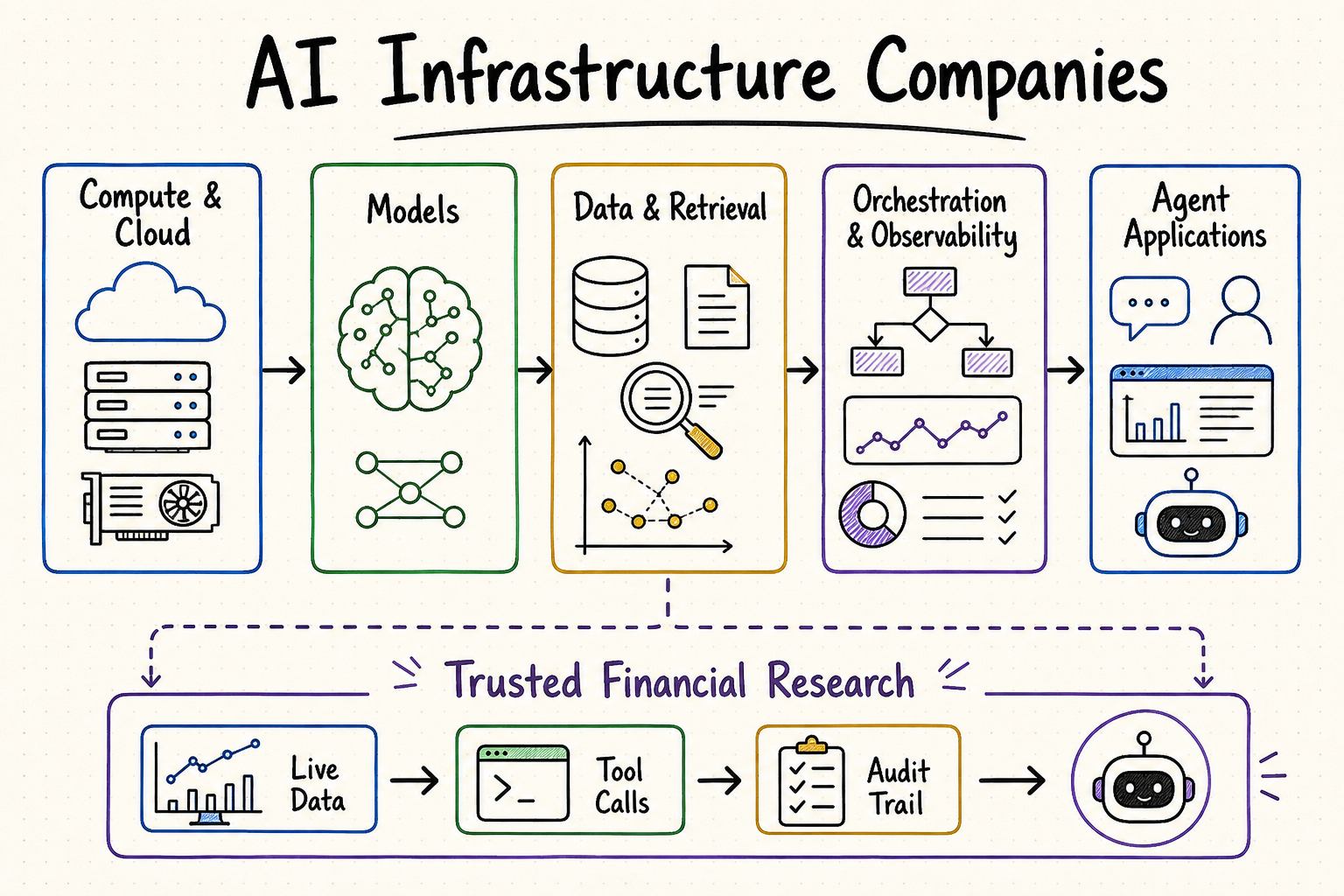
AI infrastructure is a stack, not one vendor categoryAI 基础设施是一套技术栈,不是单一公司类别
AI infrastructure companies sell the foundational capabilities other teams use to build and operate AI products. The market begins with chips, servers, networking, data centers, and cloud capacity; continues through foundation models and inference; then adds data platforms, retrieval, orchestration, evaluation, observability, security, and agent runtimes. A company may span several layers, but buyers should still evaluate each dependency by the specific job it performs.
AI 基础设施公司提供的是其他团队建设和运营 AI 产品所依赖的底层能力。市场从芯片、服务器、网络、数据中心和云容量开始,向上延伸到基础模型与推理,再覆盖数据平台、检索、编排、评测、可观测、安全和 Agent 运行时。一家公司可能横跨多个层级,但采购方仍应围绕每项依赖的具体职责分别评估。
Availability, accelerator fit, networking, utilization, scheduling, energy, region, and price determine whether training or inference can run economically.
Quality varies by task, language, modality, context, tool use, safety policy, latency, and update cadence. A leaderboard cannot represent the full workload.
Storage and retrieval are valuable only when freshness, lineage, access control, deletion, and relevance survive the path into the model.
Evaluation, tracing, routing, policy, incident response, and cost controls determine whether a promising prototype can serve real users.
可用性、加速器匹配、网络、利用率、调度、能耗、区域和价格,共同决定训练或推理能否经济运行。
不同任务、语言、模态、上下文、工具调用、安全策略、延迟和更新节奏下,模型表现都不同,单一榜单无法代表真实负载。
只有新鲜度、血缘、访问控制、删除要求和相关性都能一路保留到模型,存储与检索才真正有价值。
评测、链路追踪、路由、策略、事件响应和成本控制,决定一个亮眼原型能否服务真实用户。
A practical map of AI infrastructure companiesAI 基础设施公司的实用分层
The examples below are representative suppliers, not a universal ranking or investment list. Product boundaries and availability change quickly, so shortlist companies only after defining the workload and checking current official documentation.
下列公司用于说明各层代表性供应商,不构成统一排名或投资名单。产品边界与可用性变化很快,应该先定义工作负载,再依据最新官方资料筛选。
| Layer层级 | What companies provide主要能力 | Representative suppliers代表性供应商 | Primary evaluation核心评估项 |
|---|---|---|---|
| Accelerators and systems加速器与系统 | GPUs, interconnect, drivers, scheduling, partitioning, and validated enterprise stacks.GPU、互连、驱动、调度、切分和经过验证的企业软件栈。 | NVIDIA and cloud silicon vendors.NVIDIA 及云厂商自研芯片。 | Workload fit, availability, utilization, network, software support.负载匹配、供给、利用率、网络和软件支持。 |
| AI cloudAI 云 | Managed capacity, clusters, networking, storage, deployment, and enterprise controls.托管算力、集群、网络、存储、部署与企业控制。 | AWS, Google Cloud, Microsoft Azure, CoreWeave.AWS、Google Cloud、Microsoft Azure、CoreWeave。 | Regions, quotas, provisioning time, reliability, security, total cost.区域、配额、开通速度、可靠性、安全和总成本。 |
| Models and APIs模型与 API | Foundation models, embeddings, multimodal input, tool use, safety, and managed inference.基础模型、Embedding、多模态输入、工具调用、安全与托管推理。 | Anthropic, OpenAI, hyperscalers, open-model hosts.Anthropic、OpenAI、大型云厂商和开源模型托管平台。 | Task quality, latency distribution, throughput, privacy, price, deprecation.任务质量、延迟分布、吞吐、隐私、价格和下线政策。 |
| Inference platforms推理平台 | Optimized serving, open models, fine-tuning, batching, routing, and dedicated endpoints.优化推理、开源模型、微调、批处理、路由与专用端点。 | Together AI, Fireworks AI, cloud and model providers.Together AI、Fireworks AI,以及云和模型厂商。 | Tokens per second, queueing, cold starts, model fidelity, isolation.每秒 Token、排队、冷启动、模型一致性和隔离。 |
| Data and AI platforms数据与 AI 平台 | Lakehouse or warehouse, governance, pipelines, model development, search, and AI functions.湖仓或数仓、治理、管道、模型开发、搜索与 AI 函数。 | Databricks, Snowflake, major clouds.Databricks、Snowflake 与大型云厂商。 | Lineage, access control, freshness, workload isolation, compute economics.血缘、访问控制、新鲜度、负载隔离和计算成本。 |
| Retrieval检索 | Vector and hybrid search, metadata filters, reranking, connectors, and index operations.向量与混合搜索、元数据过滤、重排、连接器和索引运维。 | Pinecone, Weaviate, database and cloud vendors.Pinecone、Weaviate,以及数据库和云厂商。 | Recall, precision, filtering, freshness, multitenancy, deletion.召回、准确率、过滤、新鲜度、多租户和删除。 |
| Evaluation and observability评测与可观测 | Traces, datasets, experiments, evaluators, production monitoring, and debugging.链路、数据集、实验、评估器、生产监控和调试。 | LangSmith, Arize Phoenix, cloud platforms.LangSmith、Arize Phoenix 与云平台。 | Trace completeness, custom evals, privacy, alert quality, exportability.链路完整性、自定义评测、隐私、告警质量和可导出性。 |
Evaluate suppliers with a workload scorecard用真实工作负载评估供应商
A company can be excellent and still be wrong for your system. Convert requirements into a test set and an operating model before watching demos. Use representative prompts, documents, tool calls, traffic bursts, failure cases, and data classifications. Measure distributions and edge cases rather than one favorable average.
一家优秀公司也可能不适合你的系统。看演示之前,应先把需求转成测试集和运行模型,覆盖有代表性的提示词、文档、工具调用、突发流量、故障场景和数据分类。评估时要观察分布与边界案例,而不是只看一个漂亮的平均值。
| Dimension维度 | Measure衡量内容 | Evidence to request要求证据 |
|---|---|---|
| Quality质量 | Task success, groundedness, retrieval relevance, tool accuracy, regression rate.任务成功、依据性、检索相关、工具准确和回归率。 | Your evaluation set, failure examples, repeat runs, version comparison.自有评测集、失败样例、重复运行和版本对照。 |
| Performance性能 | Time to first token, end-to-end latency, throughput, queueing, cold start.首 Token 时间、端到端延迟、吞吐、排队和冷启动。 | P50/P95/P99 under normal and peak load.正常与峰值负载下的 P50/P95/P99。 |
| Reliability可靠性 | Availability, regional failure, retries, idempotency, recovery, degradation.可用性、区域故障、重试、幂等、恢复和降级。 | SLA wording, incident history, status APIs, tested failover.SLA 条款、事件历史、状态 API 和实测切换。 |
| Security安全 | Identity, tenant isolation, encryption, retention, training policy, audit.身份、租户隔离、加密、保留、训练政策和审计。 | Architecture, control reports, data flow, deletion proof, access logs.架构、控制报告、数据流、删除证明和访问日志。 |
| Economics经济性 | Unit cost, idle cost, storage, egress, observability, support, failed calls.单位成本、闲置、存储、出站、可观测、支持和失败调用。 | A bill modeled from your traffic and retention profile.基于自有流量和保留策略的账单模型。 |
| Portability可迁移性 | API semantics, model behavior, data formats, evals, exports, operational skills.API 语义、模型行为、数据格式、评测、导出和运维技能。 | Exit plan, export test, substitute benchmark, migration estimate.退出方案、导出测试、替代方案基准和迁移估算。 |
Score the system, not the brochure: record the provider version, region, quota, configuration, dataset, test date, and raw results. Re-run the same scorecard before a major upgrade or contract renewal.
评的是系统,不是宣传册:记录供应商版本、区域、配额、配置、数据集、测试日期和原始结果;重大升级或续约前,使用同一份评分表重新测试。
Decide what to build, buy, or keep portable决定哪些自建、采购,哪些必须可替换
Buy where a provider creates scale, expertise, and operational leverage that would be expensive to reproduce. Build where your proprietary data, domain policy, workflow, or evaluation method creates durable differentiation. Keep an abstraction only when it protects a real switching need; a lowest-common-denominator wrapper can hide valuable provider capabilities and add its own failure modes.
供应商在规模、专业能力和运维效率上拥有明显优势,而且自行复制代价很高时,适合采购;当专有数据、领域策略、工作流或评测方法能形成长期差异时,适合自建。只有确实存在切换需求时才增加抽象层;追求最低公分母的统一封装,可能遮蔽供应商优势,还会引入新的故障点。
Assign an owner for compute, model access, data, retrieval, prompts, evaluations, observability, policy, and incident response. “The vendor owns AI” is not an operating model.
Carry request IDs, model and version, retrieval sources, tool calls, latency, token usage, cost, policy decisions, and final outcome through one trace.
Specify what happens when a model, vector index, external tool, region, or evaluator fails. A safe partial answer may be better than invisible fallback with different semantics.
Run a small but real portability exercise before signing a critical contract. Export data, replay evaluations, switch credentials, and measure behavior—not just API compatibility.
为算力、模型访问、数据、检索、提示词、评测、可观测、策略和事件响应指定负责人。“AI 都由供应商负责”不是运行模型。
在一条链路中保留请求 ID、模型与版本、检索来源、工具调用、延迟、Token 用量、成本、策略决定和最终结果。
写明模型、向量索引、外部工具、区域或评估器故障时如何处理。明确的部分答案,往往比语义发生变化却不提示的自动回退更安全。
签订关键合同前,做一次小而真实的迁移演练:导出数据、重放评测、切换凭据,并衡量行为差异,而不只是 API 是否兼容。
Where QVeris fits in the stackQVeris 在技术栈中的位置
QVeris is a capability routing layer for agents, not a substitute for compute, model hosting, or core data infrastructure. This broad market-map topic has no single exact Tool or Provider destination, so the page uses QVeris Docs and the QVeris Playground. In a production agent, QVeris can help discover, inspect, and call external capabilities while preserving provider and execution evidence.
QVeris 是面向智能体的能力路由层,不替代算力、模型托管或核心数据基础设施。这个市场地图主题没有唯一且准确的 Tool 或 Provider 目标,因此页面使用 QVeris 文档和 QVeris Playground。在生产环境的智能体流程中,QVeris 可用于发现、检查和调用外部能力,同时保留供应商与执行记录。
- Keep model, database, and infrastructure credentials separate from capability-call credentials.
- Inspect schemas, quality signals, pricing rules, and provider provenance before execution.
- Record the QVeris search, selected tool, parameters, timestamp, execution ID, and returned source with the agent trace.
- 模型、数据库与基础设施凭据,应和能力调用凭据分开。
- 执行前检查数据结构、质量信号、计费规则和供应商来源。
- 在 Agent 链路中记录 QVeris 检索、所选工具、参数、时间、执行 ID 和返回来源。
AI infrastructure companies FAQAI 基础设施公司常见问题
A core product that helps other teams train, serve, connect data to, evaluate, secure, observe, or operate AI systems belongs in the infrastructure stack.
Often yes when they provide developer APIs, enterprise deployment, safety controls, and operational guarantees used as a production dependency.
Not necessarily. Consolidation can simplify identity and procurement, but it also concentrates failure, pricing, roadmap, and switching risk.
Benchmark the smallest representative workload, prefer managed commodity layers, retain your evaluation assets, and avoid contracts whose minimums exceed validated demand.
Data governance, identity, regions, auditability, contractual controls, recovery, procurement viability, and integration with existing platforms matter alongside quality and cost.
Continuously monitor production, and rerun the formal scorecard before major model versions, architecture changes, capacity commitments, or renewals.
如果核心产品帮助其他团队训练、部署、连接数据、评测、保护、观测或运营 AI 系统,就属于基础设施技术栈。
很多情况下算。只要它通过开发者 API、企业部署、安全控制和运行保障成为生产依赖,就承担基础设施角色。
不一定。整合供应商可以简化身份与采购,但也会集中故障、价格、路线图和切换风险。
先基准测试最小代表性负载,通用层优先使用托管服务,保留自有评测资产,并避免最低承诺超过已验证需求的合同。
除了质量和成本,还要关注数据治理、身份、区域、审计、合同控制、恢复、采购可持续性和现有平台集成。
生产指标应持续监控;重大模型版本、架构变化、容量承诺或续约前,应完整重跑评分表。
References and next steps参考资料与下一步
NVIDIA AI Enterprise
AWS Bedrock
Google Cloud Vertex AI
Microsoft Foundry
Databricks AI and ML
Arize Phoenix
QVeris Docs
QVeris Playground
NVIDIA AI Enterprise
AWS Bedrock
Google Cloud Vertex AI
Microsoft Foundry
Databricks AI 与机器学习
Arize Phoenix
QVeris 文档
QVeris Playground