
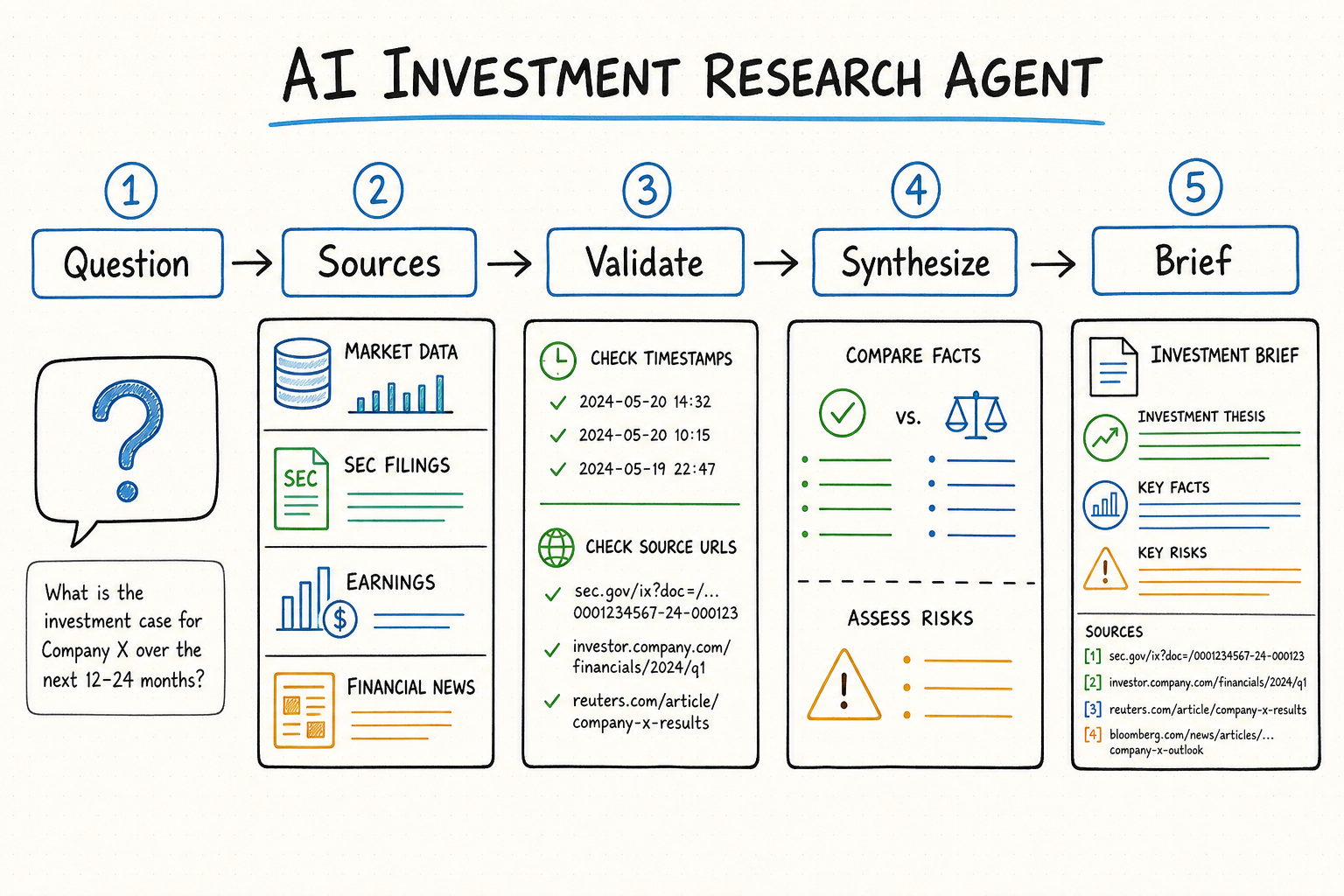
Investment research is an evidence problem before it is a writing problem. Analysts collect regulatory filings, earnings transcripts, price history, company reports, news, competitor information, and macroeconomic context before they can form a defensible view. An AI investment research agent can coordinate that collection and analysis, but only when it has reliable access to the right tools and sources. This guide explains what these agents do, where they help, what infrastructure they require, and how QVeris can support the capability layer behind them. QVeris is not an investment application or stock-picking system. It is infrastructure that helps agents discover, inspect, and call external capabilities through a unified layer.
What Is an AI Investment Research Agent?
An AI investment research agent is a software system that coordinates language models, data sources, analytical tools, and workflow logic to support investment research. Unlike a simple chatbot, an agent can decide which capability it needs, retrieve information, inspect results, perform structured analysis, monitor changes, and produce an output for human review. The final output may be a company brief, risk summary, earnings comparison, event alert, valuation input, or research memo.
Traditional research is labor intensive because evidence is scattered. A single company review may require a 10-K from EDGAR, a recent 10-Q, several 8-K filings, an earnings call transcript, price and volume data, industry news, competitor disclosures, and internal notes. The analyst must reconcile identifiers, reporting periods, currencies, and source quality. Even when each source is available online, moving between them creates delays and makes repeatable analysis difficult.
A well-designed agent automates four parts of that process. It collects evidence from approved sources, analyzes structured and unstructured data, summarizes findings with citations, and monitors new events against defined rules. The agent does not replace investment judgment. It reduces repetitive retrieval and first-pass analysis so researchers can spend more time testing assumptions and interpreting material changes.
The architecture matters. A model that receives copied text can summarize it, but it cannot reliably discover missing evidence, choose between providers, verify current data, or maintain an audit trail. An effective AI financial research agent therefore needs a tool layer, permission controls, source metadata, deterministic calculations, and clear boundaries between retrieved evidence and generated interpretation.
Core Capabilities of Investment Research Agents
Different teams prioritize different workflows, but most investment research automation relies on a common set of capabilities. These capabilities should be modular: the agent selects them when needed rather than loading every possible tool into every request.
SEC Filing Analysis
Retrieve and analyze 10-K, 10-Q, and 8-K filings. Extract risk-factor changes, management guidance, liquidity commentary, accounting policies, and key financial metrics while retaining accession numbers and source links.
Earnings Call Analysis
Process transcripts, separate prepared remarks from questions, identify management commentary, capture forward guidance, compare language with previous periods, and attach evidence to every conclusion.
Financial News Monitoring
Track company announcements, industry news, regulatory developments, and market events. Rank alerts by relevance and novelty instead of forwarding every headline to the research team.
Market Monitoring
Monitor price changes, volatility, volume, market movers, and unusual events. Combine quantitative triggers with contextual evidence before escalating an alert.
Company Research
Aggregate filings, market data, news, company profiles, and comparable-company information into a structured research packet that can be refreshed consistently.
Competitive Intelligence
Track competitor disclosures, product announcements, strategic investments, management changes, market positioning, and changes in risk language across a peer group.
These capabilities become more useful when they work together. For example, an agent may detect an 8-K filing, retrieve the document, identify a debt amendment, fetch recent price movement, gather related news, and prepare an alert containing the filing excerpt and market context. That is different from asking a model to summarize one document in isolation.
An AI stock research agent can use the same modules for ticker-level work: retrieve a filing, compare company metrics, examine recent events, and assemble a cited research packet without treating the generated output as a recommendation.
Teams evaluating broader agent ecosystems can also review QVeris resources on the best AI agent tools and the best MCP tools. The purpose of those resources is not to select one universal stack, but to clarify which layer each product owns.
Investment Research Workflow
A robust research workflow separates source collection, normalization, analysis, and decision support. This separation improves reliability because each stage can be tested independently. The agent should never convert an unverified model statement directly into an investment action.
Retrieve SEC filings, company reports, transcripts, and other authoritative documents. Record identifiers, publication dates, reporting periods, and source URLs.
Fetch relevant prices, volatility, fundamentals, financial news, and industry events. Normalize timestamps so the agent does not mix current and historical context.
Use code for calculations and validation. Use models for classification, comparison, extraction, and explanation where language understanding adds value.
Produce a structured output containing claims, supporting evidence, confidence, open questions, and explicit links back to the source material.
Send high-priority findings to an analyst, update a research database, or trigger a follow-up workflow. Keep investment decisions under appropriate human and compliance controls.
The same architecture supports continuous monitoring. A scheduler or event source detects a new filing, transcript, or market event. The agent retrieves the source, identifies what changed, compares it with prior evidence, and creates a prioritized review item. This turns investment research automation into a repeatable process rather than a collection of isolated prompts.
Best AI Investment Research Tools
There is no single best tool for every research team because products operate at different layers. Some deliver research search and analysis directly to users. Others provide market terminals, conversational research, or infrastructure for developers. A fair comparison begins by identifying the job the product is designed to perform.
A market intelligence and enterprise search product for finding and analyzing company documents, transcripts, expert content, and market information. It is oriented toward research users and organizations seeking a finished research environment.
An investment research platform centered on financial data, company analysis, dashboards, transcripts, and AI-assisted research. It is useful for investors who want an application experience rather than an infrastructure layer.
A general AI research and answer product with web search and cited responses. It can support broad financial questions, but teams should still validate specialist data coverage, licensing, and primary evidence for professional workflows.
A professional financial information environment with extensive market data, news, analytics, messaging, and established institutional workflows. It serves a broad professional use case that extends far beyond agent tool routing.
An infrastructure and capability routing layer for agents. QVeris helps developers discover, inspect, and call provider-backed tools through MCP, REST API, Python SDK, or CLI. It does not provide investment recommendations or replace a research terminal.
A team can integrate every API, parser, database, model, and monitoring service directly. This offers maximum control but creates ongoing work around authentication, schema changes, provider selection, observability, and fallback behavior.
Most research applications focus on the final research output: search results, dashboards, summaries, transcripts, or financial models. QVeris focuses on the infrastructure, integrations, and capability routing that can power those workflows. It is closer to a tool access layer than an analyst-facing research destination.
Teams comparing integration infrastructure may also find the Composio alternatives page useful. Developers looking specifically for a single interface across external tools can review the guide to a unified API for AI tools.
Product scope changes over time. Before choosing a research application, review the official product information from AlphaSense, FinChat, Perplexity, and Bloomberg Professional.
Why Investment Research Agents Need Infrastructure
Data Silos
Filings, transcripts, prices, fundamentals, news, and internal research often live in different systems. Each source has its own identifiers, timestamps, entitlements, and data quality assumptions. An agent needs consistent metadata and a way to combine sources without losing provenance.
Tool Fragmentation
A research agent may require document retrieval, PDF parsing, structured financial facts, news search, entity resolution, market data, and storage. Direct integrations force developers to maintain separate authentication, client libraries, error handling, and schemas. Fragmentation becomes more expensive as providers change or new use cases appear.
Workflow Complexity
Investment research is rarely a single tool call. The agent must sequence retrieval, normalization, calculation, comparison, summarization, citation, and review. It also needs branching behavior: a missing CIK may require entity resolution, while an unusual 8-K may trigger market and news context retrieval.
Capability Discovery
Agents should not receive thousands of tool schemas in every prompt. They need a way to discover relevant capabilities for the current task, inspect the selected contract, and execute only after required inputs are available. This reduces context pressure and creates a clearer audit trail.
How QVeris Powers AI Investment Research
QVeris sits between an agent and external capabilities. It does not decide what to buy or sell. It helps the agent locate and call tools that support a research task. This positioning is important because investment teams may already have models, orchestration frameworks, databases, compliance systems, and user interfaces. They can use QVeris as one infrastructure component rather than adopting a complete research application.
Capability Routing
Capability routing matches a task with available tools. A request for a recent 8-K should route differently from a request for five years of price history or competitor news. Routing can consider task fit, provider metadata, cost, latency, and reliability instead of binding the agent permanently to one endpoint.
Tool Discovery
The agent can describe what it needs in natural language and receive relevant capability matches. It can then inspect the selected capability's inputs and outputs before execution. Discovery keeps the working tool set focused and helps developers avoid maintaining a large static function registry.
MCP Support
MCP provides a standard way for compatible clients to access tools and context. QVeris can expose capabilities through MCP while also supporting REST API, Python SDK, and CLI access. Teams can choose the integration surface that fits their runtime.
Unified Access
A unified layer reduces the number of provider-specific contracts in application code. The agent still needs validation and domain logic, but discovery, inspection, and execution can follow a consistent pattern across different capability categories.
Financial Integrations
Investment workflows may combine market data, company information, filings, financial news, macroeconomic context, document parsing, and search. QVeris is designed to make these capabilities discoverable to agents while preserving provider and execution metadata.
A typical workflow begins with Discover. The agent searches for a capability such as retrieving a company's latest 10-K or monitoring financial news. It then uses Inspect to review required parameters, schema information, cost, and provider details. After validating the arguments, it uses Call to execute the selected capability. The application stores source links and execution metadata before passing the evidence to a reasoning model.
This pattern supports AI-powered investment research without turning the infrastructure layer into an investment adviser. The research team defines approved sources, validation rules, escalation policies, and human review requirements. QVeris supplies tool access and routing; the team's application owns research methodology and governance.
Real-World Use Cases
Equity Research
Collect filings, earnings calls, price history, and company news; compare changes across periods; and generate a cited first-pass company brief for analyst review.
Hedge Funds
Monitor defined universes for new 8-K filings, unusual price activity, guidance changes, or material news. Route high-priority events to analysts with supporting evidence.
Venture Capital
Aggregate company, sector, funding, competitor, and market information into repeatable diligence workflows while maintaining links to the original sources.
Corporate Development
Track strategic announcements, acquisitions, leadership changes, competitor disclosures, and market positioning across a target landscape.
Investment Banking
Accelerate company screening, comparable-company research, filing review, and information gathering while keeping calculations and conclusions under professional oversight.
Family Offices
Create monitored watchlists and structured research packets across public markets, sectors, and macro themes without treating generated summaries as investment advice.
In each case, the most useful system behaves like an AI research assistant for investors rather than an autonomous portfolio manager. It retrieves evidence, performs bounded analysis, explains what changed, and identifies questions that deserve human attention. It should also state when data is incomplete or when a conclusion depends on assumptions.
Limitations and Governance
AI investment research has meaningful limitations. Models can hallucinate, misread tables, confuse reporting periods, or overstate weak evidence. Data providers may have delays, gaps, licensing restrictions, or inconsistent identifiers. News can contain duplication or unverified claims. Historical relationships may fail during novel market conditions.
Teams should require source citations, deterministic calculations, schema validation, access controls, and human review. They should test the agent on known cases, record tool execution metadata, monitor failure rates, and separate factual extraction from interpretive conclusions. Sensitive internal research should be protected according to organizational security and data retention policies.
An agent should never imply certainty that the evidence does not support. Confidence labels should reflect retrieval quality and analytical limits, not just model fluency. Research outputs should also include the date and time of the underlying data so users understand whether the analysis is current.
Frequently Asked Questions
What is an AI investment research agent?
It is software that coordinates models, data sources, and tools to collect evidence, analyze companies, monitor events, and produce structured research outputs for human review.
Can AI analyze SEC filings?
Yes. AI can retrieve and compare 10-K, 10-Q, and 8-K filings, extract risks and metrics, and summarize changes. Reliable workflows preserve source links and require verification.
Can AI summarize earnings calls?
Yes. An agent can segment transcripts, identify guidance, summarize analyst questions, compare management language, and attach transcript evidence to its findings.
How accurate are AI investment research agents?
Accuracy depends on data quality, tool selection, validation, and oversight. Agents perform best when they use primary evidence, deterministic calculations, citations, and explicit uncertainty.
Can AI monitor financial news?
Yes. Agents can monitor company and industry news, rank events by relevance, connect news with market data, and send evidence-backed alerts to analysts.
What data sources do investment research agents use?
Typical sources include SEC filings, earnings transcripts, company reports, market prices, fundamentals, news, macroeconomic data, competitor information, and internal documents.
What are the limitations of AI investment research?
Limitations include stale or incomplete data, hallucinations, licensing constraints, weak citations, model bias, and difficulty interpreting genuinely novel events. Human review remains essential.
How does QVeris support investment research workflows?
QVeris provides capability routing and tool discovery. Agents can discover relevant capabilities, inspect schemas and provider metadata, and call tools through MCP, REST API, Python SDK, or CLI.
Build the Infrastructure Behind Your Research Agent
Use QVeris to give an existing agent discoverable, provider-backed capabilities through a unified routing layer. Keep investment methodology, validation, compliance, and final decisions under your team's control.