
AI Model Aggregator
One API Across Models and Hosting Providers
什么是 AI 模型聚合器?用一个 API 连接模型与托管商
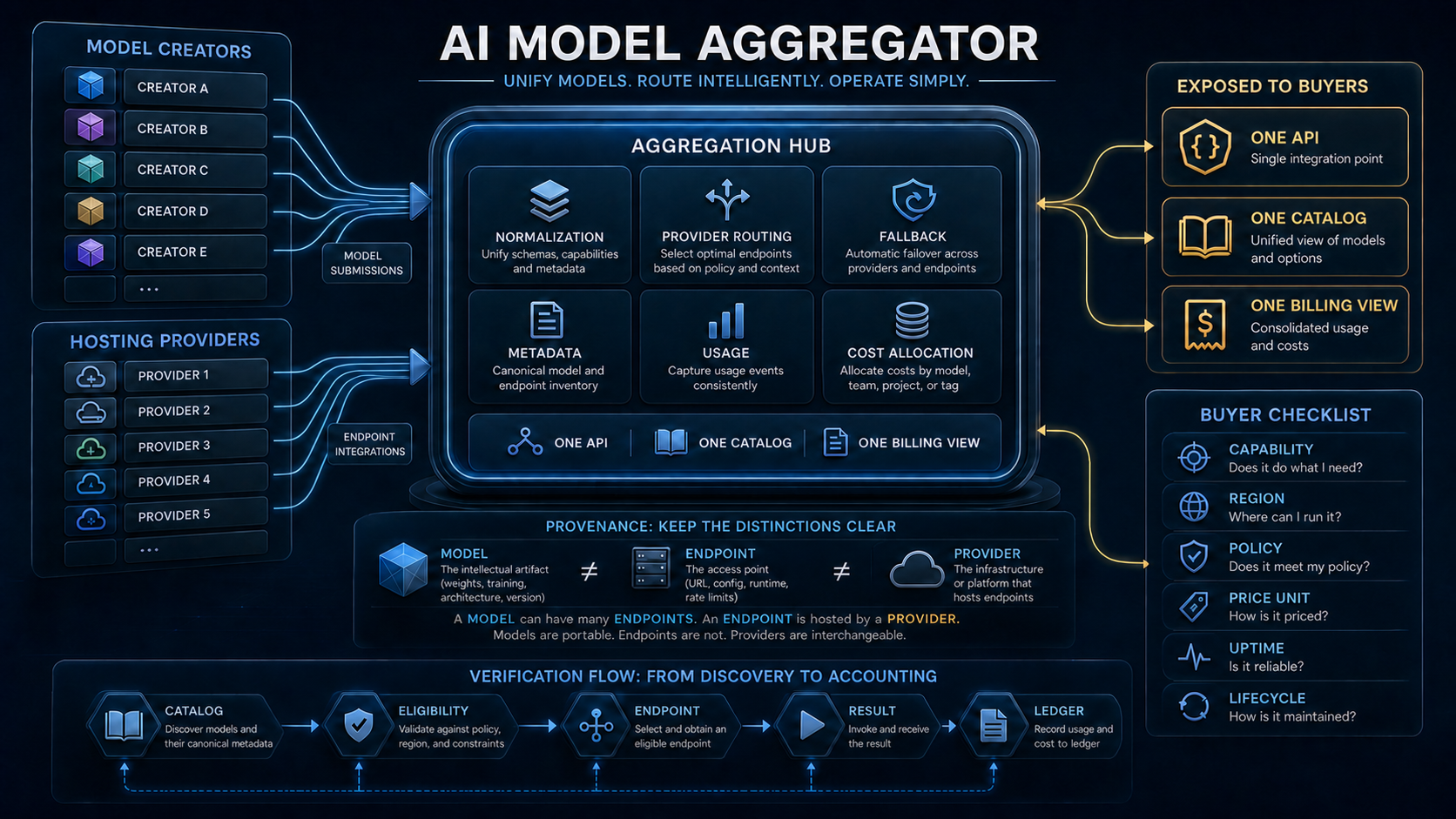
An AI model aggregator combines access to multiple models and hosting providers behind a shared API, catalog and billing layer. Its value comes from normalized operations and provider choice—not from pretending every model or endpoint is identical.
AI 模型聚合器把多个模型与托管供应商的访问组合在共享 API、目录与计费层之后。其价值来自统一运营与供应商选择,而不是假设所有模型或端点完全相同。
TL;DR
The catalog may combine different model creators, hosting providers, endpoint versions, regions and commercial terms.
One authentication, request envelope, catalog, routing policy, usage view and billing relationship reduce integration work.
Model, endpoint and provider are distinct. A trace should identify all three plus version, region, policy and price unit.
The aggregator controls translation, routing, fallback, metering and sometimes billing; each function needs evidence and an exit path.
目录可组合不同模型创建者、托管供应商、端点版本、区域与商业条款。
统一认证、请求封装、目录、路由策略、用量视图与账单关系可减少集成。
模型、端点与供应商不同。调用链应识别三者以及版本、区域、策略与计价单位。
聚合器控制转换、路由、回退、计量,有时还负责计费;每项功能都需要证据与退出路径。
The aggregation flow from catalog to ledger 从目录到账本的聚合流程
The aggregator ingests model and provider metadata, exposes eligible endpoints in a catalog, accepts a normalized request, selects an endpoint, translates the payload, executes the call and records usage. Fallback may try another endpoint for the same model or a different model according to policy.
聚合器导入模型与供应商元数据,在目录中暴露合格端点,接受标准化请求,选择端点,转换请求数据,执行调用并记录用量。回退可按策略尝试同模型另一端点或不同模型。
A robust aggregator retains native request IDs, usage and errors beside normalized evidence. It monitors endpoint health and lifecycle, but does not silently substitute an unapproved provider, model version, data policy or price unit.
健壮聚合器会把原生请求 ID、用量与错误同标准化证据并存。它监控端点健康与生命周期,但不会静默替换未批准的供应商、模型版本、数据策略或计价单位。
Core aggregation functions 核心聚合功能
| Function 功能 | Best fit 最适合 | Verify before choosing 选择前验证 |
|---|---|---|
| Unified API 统一 API | One client contract across models and providers reduces SDK and credential sprawl. 跨模型与供应商使用一个客户端契约,减少 SDK 与凭证蔓延。 | Compatibility is a tested subset; keep capability flags and native parameter escape hatches. 兼容性是经测试的子集;保留能力标记与原生参数出口。 |
| Model catalog 模型目录 | Searchable metadata for models, endpoints, modalities, context, parameters, regions and price. 为模型、端点、模态、上下文、参数、区域与价格提供可搜索元数据。 | Catalog entries must be versioned, sourced, freshness-tagged and verified before routing. 目录项必须版本化、标注来源与新鲜度,并在路由前验证。 |
| Provider routing 供应商路由 | Select among eligible hosting endpoints by policy, price, latency, capacity or privacy. 按策略、价格、延迟、容量或隐私在合格托管端点间选择。 | Record the eligible set, score, selected endpoint, reason and provider identity. 记录合格集合、评分、所选端点、原因与供应商身份。 |
| Fallback 回退 | Retry an allowed alternate endpoint after bounded, eligible failures. 在有边界且符合条件的失败后重试获准备用端点。 | Define deadlines, attempts, substitutions, streams, duplicate risk, charges and final errors. 定义截止时间、尝试、替换、流、重复风险、费用与最终错误。 |
| Usage and billing 用量与计费 | Normalize usage, consolidate invoices and allocate cost by tenant, app, model and provider. 标准化用量、合并账单,并按租户、应用、模型与供应商分配成本。 | Preserve native units, markup, credits, retries and provider receipts for reconciliation. 保留原生单位、加价、Credits、重试与供应商回执供核对。 |
Model aggregation requires provenance 模型聚合需要来源证据
Creator, family, exact version, release, modality, context, capabilities, license and deprecation.
Hosting provider, endpoint version, region, runtime, quantization, capacity, data policy and health.
Policy version, eligible set, scores, route reason, fallback chain, cache and guardrail results.
Native usage, normalized usage, price version, unit, markup, credits, platform fee and final receipt.
创建者、家族、具体版本、发布、模态、上下文、能力、许可与弃用。
托管供应商、端点版本、区域、运行时、量化、容量、数据策略与健康。
策略版本、合格集合、评分、路由原因、回退链、缓存与护栏结果。
原生用量、标准化用量、价格版本、单位、加价、Credits、平台费与最终回执。
Verify the aggregation contract 验证聚合契约
- Pin exact models and endpoints for chat, tools, structured output, streams, embeddings and multimodal workloads.
- Compare aggregator and direct-provider payloads, outputs, events, errors, usage and bills.
- Force provider failure, parameter mismatch, privacy restriction, model retirement and price change.
- Export catalog, routes, usage and traces; canary direct rollback without losing application identity.
- 为对话、工具、结构化输出、流、Embedding 与多模态负载固定具体模型和端点。
- 比较聚合器与供应商直连的请求数据、输出、事件、错误、用量与账单。
- 强制供应商故障、参数不匹配、隐私限制、模型退役与价格变化。
- 导出目录、路由、用量与调用链,并灰度直连回滚,不丢失应用身份。
Keep internal aliases above external aggregation 在外部聚合之上保持内部别名
Applications request a stable internal workload alias and declare required capabilities. Your registry maps it to approved aggregator models and endpoints. The aggregator may route only within that eligible set. Store internal alias, aggregator route and native provider IDs together. This preserves portability without discarding supply flexibility.
应用请求稳定内部工作负载别名并声明所需能力;内部注册表把它映射到获批聚合模型与端点;聚合器只能在该合格集合内路由。同时存储内部别名、聚合器路由与原生供应商 ID,在保留供给灵活性的同时保持可移植性。
Production rule: aggregation is trustworthy when normalization is explicit, provenance survives routing, and billing can be reconciled to native evidence.
生产规则:当标准化显式、来源穿过路由且账单能与原生证据核对时,聚合才可信。
Model aggregation and capability aggregation differ 模型聚合与能力聚合不同
A model aggregator unifies inference supply. QVeris unifies discovery and execution of external capabilities such as APIs, tools, services and live data. In an agent stack, the aggregator supplies reasoning and QVeris supplies governed action.
模型聚合器统一推理供给;QVeris 统一 API、工具、服务与实时数据等外部能力的发现和执行。在智能体技术栈中,聚合器提供推理,QVeris 提供受治理行动。
Define the Production Contract for an AI model aggregator定义AI 模型聚合器的生产契约
For AI Model Aggregator, protocol similarity lowers integration effort, but it does not guarantee behavioral parity. Put a versioned application contract between product code and the provider path so change remains testable and reversible.
针对“AI 模型聚合器”,协议相似可以降低集成工作量,却不能保证行为等价。应在产品代码与供应商路径之间建立版本化应用契约,让变更保持可测试、可回滚。
Document model catalog identity, upstream provider, version pinning, native parameters, routing, price metadata, quota, error semantics, and direct-provider escape paths. Mark each item as required, optional, provider-native, or unsupported, and assign an owner for any transformation that changes its meaning.
记录模型目录身份、上游供应商、版本固定、原生参数、路由、价格元数据、配额、错误语义和直连供应商退出路径。把每一项标记为必需、可选、供应商原生或不支持,并为任何改变语义的转换明确负责人。
To validate AI Model Aggregator, create fixtures for short and long prompts, Unicode, streaming, JSON schema, parallel tools, refusals, cancellation, malformed input, and rate limits. Check required fields and event order instead of accepting one plausible text answer.
验证“AI 模型聚合器”时,为短与长提示词、Unicode、流式、JSON Schema、并行工具、拒绝、取消、畸形输入和限流建立 Fixture,检查必需字段与事件顺序,而不是接受一个看似合理的文本答案。
When operating AI Model Aggregator, trace internal request ID, resolved model and provider, model version, transformations, retries, latency, token classes, cost source, policy result, and output validation. Redact secrets without deleting the context needed to reproduce failure.
运营“AI 模型聚合器”时,追踪内部请求 ID、解析后的模型与供应商、模型版本、转换、重试、延迟、Token 类别、成本来源、策略结果和输出校验,在脱敏密钥的同时保留复现失败所需上下文。
Before rolling out AI Model Aggregator, shadow representative traffic, classify semantic differences, canary by reversible workload, monitor task completion and tail behavior, and keep the previous route available until rollback and return-to-primary have been rehearsed.
上线“AI 模型聚合器”前,运行代表性影子流量,分类语义差异,按可逆工作负载进行金丝雀发布,监控任务完成与长尾行为,并在演练回滚和恢复主路径之前保留原有路由。
FAQ
It combines access to multiple models and often multiple hosting providers behind shared catalog, API, routing, usage and billing functions.
An aggregator emphasizes supply and catalog; a gateway emphasizes traffic control. Many products implement both.
Opaque endpoint substitution that changes capability, policy, quality or cost without sufficient evidence or approval.
把多个模型以及通常多个托管供应商的访问组合在共享目录、API、路由、用量与计费功能之后。
聚合器强调供给与目录,网关强调流量控制;许多产品同时实现两者。
不透明端点替换在证据或审批不足时改变能力、策略、质量或成本。