
Build an Explainable AI
Stock Ranking API
构建可解释的 AI
股票排名 API
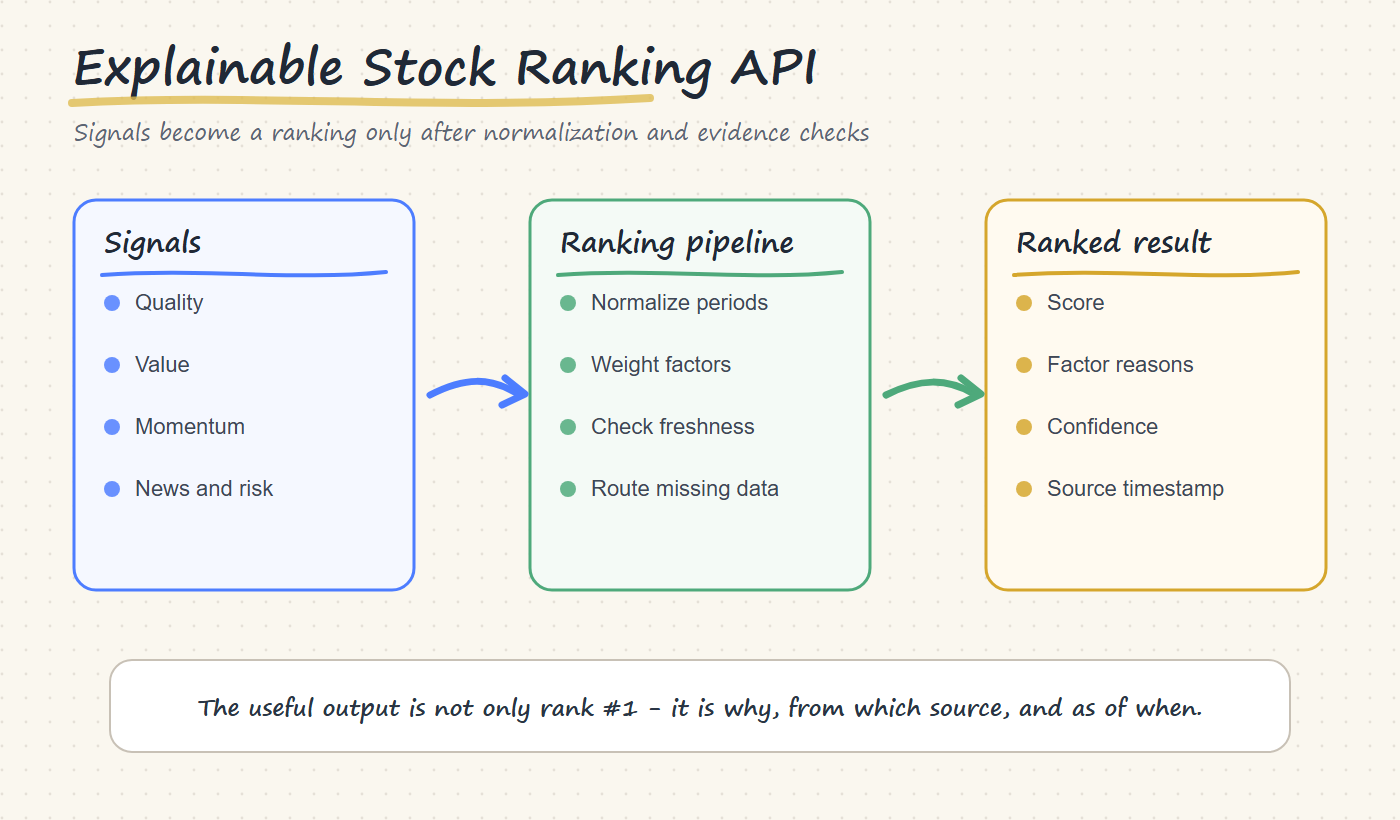
AI stock ranking is not just a black-box score. Useful agents need signals, source context, factor explanations, timestamps, and routing across financial data tools.
AI 股票排名不应只是一个黑盒分数。真正有用的 Agent 需要信号、来源背景、因子解释、时间戳,以及跨金融数据工具的路由能力。
What Is an AI Stock Ranking API? 什么是 AI 股票排名 API?
An AI stock ranking API orders stocks by signals such as fundamentals, valuation, momentum, news, risk, or custom factors. For developers, the best API does more than return a rank. It explains the score, the input data, and the update time.
AI 股票排名 API 会根据基本面、估值、动量、新闻、风险或自定义因子对股票排序。对开发者来说,好的 API 不只是返回排名,还应解释分数、输入数据和更新时间。
What Data a Stock Ranking Agent Needs 股票排名 Agent 需要哪些数据
Margins, revenue growth, free cash flow, return on equity, leverage, and balance sheet strength.
利润率、收入增长、自由现金流、ROE、杠杆和资产负债表强度。
Trend, volatility, volume, relative strength, sector movement, and market session context.
趋势、波动率、成交量、相对强弱、板块变化和交易时段背景。
Filings, earnings, analyst events, news sentiment, risk disclosures, and source citations.
公告、财报、分析师事件、新闻情绪、风险披露和来源引用。
What to Compare Before Choosing an AI Stock Ranking API 选择 AI 股票排名 API 前应该比较什么
| Factor 维度 | Why it matters 为什么重要 |
|---|---|
| Explainability 可解释性 | Agents need reasons, not just a rank, to create trustworthy research output. Agent 需要原因,而不只是排名,才能生成可信研究输出。 |
| Source transparency 来源透明度 | A score should preserve which data, filing, or signal contributed to the result. 分数应保留哪些数据、公告或信号影响了结果。 |
| Update frequency 更新频率 | Rankings can become stale after earnings, filings, price moves, or news events. 财报、公告、价格波动或新闻事件后,排名可能快速过期。 |
| Universe coverage 股票池覆盖 | Screeners need clear market, sector, exchange, and liquidity filters. 筛选器需要明确市场、板块、交易所和流动性过滤条件。 |
Common Ways to Build Stock Rankings 构建股票排名的常见方式
Rank stocks by fixed filters such as revenue growth, margins, valuation, or volume.
按收入增长、利润率、估值或成交量等固定条件对股票排序。
Combine value, quality, momentum, volatility, and risk factors into a weighted score.
把价值、质量、动量、波动率和风险因子组合成加权分数。
Use an agent to gather fundamentals, prices, filings, news, and risk context before ranking.
让 Agent 在排名前收集基本面、价格、公告、新闻和风险背景。
Why AI Stock Ranking Is Hard for Agents 为什么 AI 股票排名对 Agent 很难
A ranking score can look precise while hiding weak sources, stale data, or unexplained assumptions. AI agents need to inspect the data behind the score, validate freshness, and know when to add filings, news, or financial statements before producing a recommendation-like output.
排名分数看起来可能很精确,但背后可能隐藏弱来源、过期数据或不可解释假设。AI Agent 需要检查分数背后的数据、验证新鲜度,并知道何时补充公告、新闻或财务报表,再输出类似推荐的内容。
How QVeris Routes Stock Ranking Workflows QVeris 如何路由股票排名工作流
Search for financial ratios, price momentum, market data, earnings, filings, and news capabilities.
搜索财务比率、价格动量、市场数据、财报、公告和新闻能力。
free discoveryReview parameters, update time, data source, output fields, cost, and latency before calling.
调用前检查参数、更新时间、数据来源、输出字段、成本和延迟。
schema awareReturn structured data that ranking agents, screeners, and research tools can use.
返回排名 Agent、筛选器和研究工具可使用的结构化数据。
agent readyDecision Matrix for AI Stock Ranking APIs AI 股票排名 API 决策矩阵
| If you need... 如果你需要... | Choose... 优先选择... |
|---|---|
| Simple stock filtering 简单股票筛选 | A stock screener API with clear filters 带清晰过滤条件的股票筛选 API |
| Factor-based ranking 因子排名 | A factor data API or custom scoring model 因子数据 API 或自定义评分模型 |
| Explainable AI stock ranking 可解释 AI 股票排名 | Ranking plus filings, fundamentals, news, and source checks 排名加公告、基本面、新闻和来源检查 |
| Production AI agent workflows 生产级 AI Agent 工作流 | QVeris capability routing and fallback QVeris 能力路由和 fallback |
Stock Ranking API Data Contract and Response Design股票排名 API 的数据契约与响应设计
A ranking endpoint should return more than a ticker and score. The response must make the eligible universe, observation time, methodology, exclusions, evidence, and uncertainty explicit enough for an agent to explain and reproduce the result.
排名接口不应只返回股票代码与分数。响应必须明确展示候选范围、观测时间、计算方法、排除项、证据和不确定性,让 Agent 能够解释并复现结果。
Return stable instrument and issuer identifiers, exchange, currency, security type, country, sector, universe membership date, and exclusion reason. Tickers alone are ambiguous and can change after listings, mergers, or venue moves.
返回稳定的证券与发行人标识、交易所、币种、证券类型、国家、行业、成分日期和排除原因。股票代码本身可能歧义,也会因上市、并购或交易场所变更而改变。
Expose when each input became knowable, the ranking’s as-of time, fiscal-period mapping, price session, refresh schedule, and cache age. This prevents an agent from comparing today’s fundamentals with a historical price as if both were contemporaneous.
展示每项输入何时可知、排名生效时点、财务期间映射、价格时段、刷新计划和缓存年龄,防止 Agent 把今天的基本面与历史价格当作同一时点数据比较。
Include raw inputs, winsorization or clipping, peer normalization, factor weights, component contributions, composite score, rank percentile, missing-data treatment, and model version. A score without its calculation contract is not safely reusable.
包含原始输入、缩尾或截断、同业标准化、因子权重、分项贡献、综合得分、排名百分位、缺失值处理和模型版本。没有计算契约的分数无法被安全复用。
For material features, return provider or source identifiers, effective dates, quality flags, and concise reason codes for rank movement. Preserve prior snapshots so the agent can explain whether a stock moved because of new data, a universe change, or model revision.
为重要特征返回供应商或来源标识、生效日期、质量标记和简洁的排名变动原因代码,并保留历史快照,让 Agent 能解释变化来自新数据、范围变化还是模型修订。
How to Validate and Monitor a Stock Ranking API如何验证和监控股票排名 API
Validate both the investment methodology and the API behavior. Historical performance cannot compensate for point-in-time errors, while a technically stable endpoint is not useful if its scores are unexplained or degrade outside the optimized period.
需要同时验证投资方法与 API 行为。历史业绩无法弥补时点数据错误;反过来,一个技术稳定的接口,如果评分不可解释或离开优化区间就失效,同样没有价值。
| Test layer测试层 | What to test测试内容 | Monitor in production生产监控 |
|---|---|---|
| Point-in-time integrity历史时点完整性 | Publication lags, restatements, universe membership, delistings, corporate actions, and absence of future information发布时间差、数据重述、成分范围、退市、公司行动,以及是否排除未来信息 | Late-arriving data, retroactive rank changes, identifier breaks, and source-version drift迟到数据、追溯性排名改变、标识断裂和来源版本漂移 |
| Model robustness模型稳健性 | Holdout periods, multiple regimes, factor sensitivity, turnover, liquidity, costs, and benchmark-relative behavior留出区间、多种市场环境、因子敏感性、换手率、流动性、成本和相对基准表现 | Factor distribution, coverage, concentration, rank stability, realized spread, and unexpected regime exposure因子分布、覆盖率、集中度、排名稳定性、实际收益差和意外环境暴露 |
| API reliabilityAPI 可靠性 | Schema contracts, pagination, filters, invalid inputs, timeouts, rate limits, idempotency, and reproducible snapshotsSchema 契约、分页、过滤、无效输入、超时、限流、幂等和可复现快照 | Availability, p50 and tail latency, error class, stale cache, fallback rate, and cost per completed ranking可用性、常规与长尾延迟、错误类别、过期缓存、降级率和每次完整排名成本 |
| Agent integrationAgent 集成 | Correct parameter construction, explanation fidelity, citation coverage, refusal on unsupported requests, and permission boundaries参数构造正确性、解释忠实度、引用覆盖、对不支持请求的拒绝和权限边界 | Misrouted calls, unsupported conclusions, reviewer overrides, and differences between API reasons and generated prose误路由、无支撑结论、人工覆盖,以及 API 原因代码与生成文字之间的差异 |
AI Stock Ranking API FAQAI 股票排名 API 常见问题
At minimum: stable security identity, universe and as-of time, score and rank, factor contributions, methodology version, missing-data flags, exclusions, source provenance, and reason codes. Responses should support both machine use and human review.
A screener usually filters securities against user-defined conditions. A ranking API orders an eligible universe according to a model or composite score. Many workflows screen first, rank the remaining candidates, then apply portfolio and review constraints.
An LLM can interpret evidence and explain a ranking, but reproducible scores should come from controlled, timestamped data and explicit calculations. Do not rely on model memory or untraceable prose for numerical cross-sectional comparison.
QVeris helps agents discover and inspect capabilities for prices, fundamentals, filings, news, screening, and other inputs, then route selected calls. The application still defines factor methodology, validation, portfolio constraints, and approval.
至少包括稳定证券身份、排名范围与生效时点、分数与名次、因子贡献、方法版本、缺失数据标记、排除项、来源信息和原因代码,同时支持机器使用与人工复核。
筛选器通常根据用户条件过滤证券;排名 API 则按照模型或综合得分,对合格范围排序。很多工作流会先筛选,再排名候选项,最后应用组合与审核约束。
LLM 可以解释证据与排名,但可复现分数应来自受控、带时间戳的数据和显式计算。数值型横截面比较不应依赖模型记忆或无法追溯的文字。
QVeris 帮助 Agent 发现并检查价格、基本面、公告、新闻、筛选等输入能力,再路由选定调用。因子方法、验证、组合约束和审批仍由应用定义。
Build Explainable Stock Ranking with QVeris 用 QVeris 构建可解释股票排名
QVeris is not a black-box AI stock picker. It helps agents assemble ranking workflows from financial capabilities: market data, financial statements, ratios, filings, earnings, and news. For broader market-data context, compare the QVeris stock API guide, official filings from SEC EDGAR, and market data references such as Polygon.io and Alpha Vantage docs.
QVeris 不是黑盒 AI 选股器。它帮助 Agent 从金融能力中组装排名工作流:市场数据、财务报表、财务比率、公告、财报和新闻。更完整的市场数据背景,可参考 QVeris 的 股票 API 指南、SEC EDGAR 官方公告,以及 Polygon.io 和 Alpha Vantage 文档。