
Map issuer, security, listing, exchange, ticker, CIK, LEI, and ISIN where available. Store ticker history instead of treating a symbol as permanent.
AI Stock Research Agent: Architecture, Data Schema & Workflow
Build a research agent that joins prices, fundamentals, and corporate actions without mixing identities, periods, currencies, or observation times—and returns a memo every claim can trace to evidence.
Identityissuer, listing, security
Timeperiod and observed-at
Valuescurrency, units, adjustments
Evidencesource and validation
Direct AnswerResolve identity Separate time axes Preserve provenance
How should an AI stock research agent join financial data?
An AI stock research agent should never join fundamentals, prices, and corporate actions on ticker alone. Resolve a stable issuer and security identity first; keep market observations separate from fiscal-period facts; apply splits only where appropriate; and preserve source, publication time, retrieval time, currency, unit scale, and validation status on every record.
Keep trading timestamp, fiscal period end, filing date, publication time, and retrieval time as distinct fields. They answer different questions.
Attach provider, source URL, raw field, transformation, unit, and validation result so every memo claim can be reconstructed.
直接答案解析身份 分离时间轴 保留来源链
AI 股票研究 Agent 应该如何关联金融数据?
AI 股票研究 Agent 不能只用股票代码关联基本面、价格和公司行动。应先解析稳定的发行人和证券身份,把市场观察与财务期间事实分开,仅在适当场景应用拆股调整,并为每条记录保留来源、发布时间、获取时间、币种、单位和校验状态。
在可用时映射发行人、证券、上市地、交易所、股票代码、CIK、LEI 和 ISIN,并保存代码历史,不能把股票代码当作永久主键。
把交易时间、财务期末、申报日期、发布时间和获取时间保存为不同字段,因为它们回答的是不同问题。
附加服务商、来源 URL、原始字段、转换过程、单位和校验结果,让研究简报中的每条结论都能被重建。
Reference Architecture1. Source adapters 2. Canonical evidence store 3. Validation and answer layer
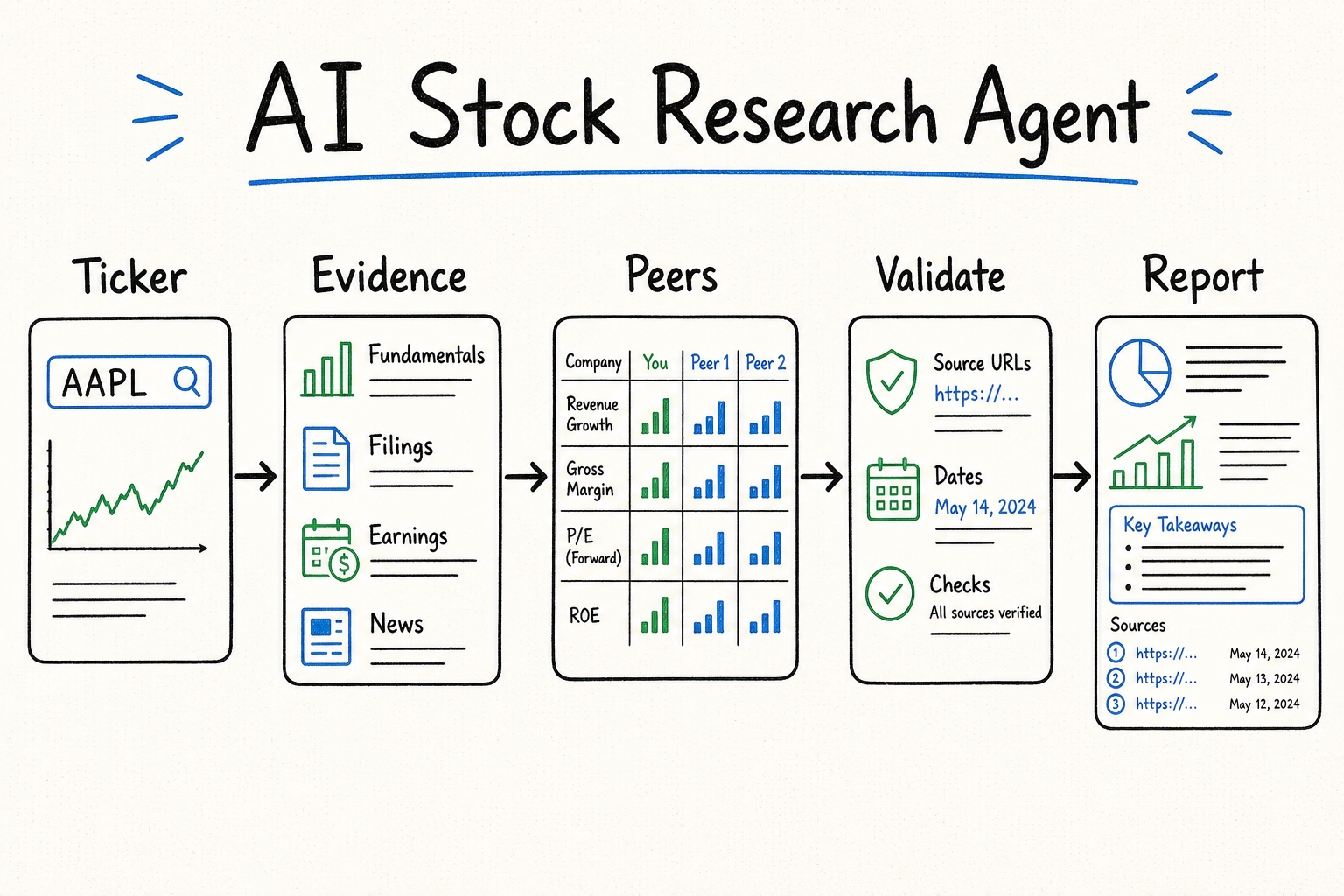
Architecture for an evidence-first AI stock research agent
Use five layers: capability discovery, raw evidence capture, canonical normalization, validation, and memo generation. Keep raw responses immutable; derive normalized facts separately; and let the language model read only records that carry provenance and validation state.
Discover and call quote, filing, fundamentals, corporate-action, transcript, and news capabilities. Record the request, response hash, and retrieval time before transformation.
Normalize identity, time, currency, unit scale, fact type, and source while retaining the provider's original field and value.
Reject incompatible joins, label warnings, compute derived metrics only from accepted inputs, and cite evidence in the final memo.
参考架构1. 数据源适配层 2. 标准化证据库 3. 校验与回答层
证据优先的 AI 股票研究 Agent 架构
建议采用五层:能力发现、原始证据留存、标准化、校验和备忘录生成。原始响应保持不可变;标准化事实单独派生;语言模型只读取带来源信息和校验状态的记录。
发现并调用报价、申报文件、基本面、公司行动、电话会和新闻能力,在转换前记录请求、响应哈希和获取时间。
统一身份、时间、币种、单位尺度、事实类型和来源,同时保留服务商原始字段与原始值。
拒绝不兼容关联,标记警告,只使用已接受输入计算派生指标,并在最终备忘录中引用证据。
Use SEC EDGAR and the SEC EDGAR API documentation as primary references for US filing identity and timestamps.
美国公司文件的身份与时间字段,应优先参考 SEC EDGAR 和 SEC EDGAR API 文档。
Example data schema for prices, fundamentals, and corporate actions
Consider a user asking, “Explain why this stock moved after earnings.” The agent must join a security, a market observation, fiscal-period facts, and any split or dividend that changes comparability. The following sequence prevents a plausible-looking but invalid merge.
Step 01Resolve security identity
Map the user ticker to issuer, security, exchange, listing currency, and stable identifiers. Confirm that each provider refers to the same listing.
Step 02Capture raw evidence
Store quote, filing, statement, corporate-action, estimates, transcript, and news responses with retrieval time and content hash.
Step 03Normalize contracts
Represent market timestamps and fiscal periods separately; standardize currency, unit scale, statement type, and adjustment status.
Step 04Validate the join
Join only compatible identities and periods. Apply splits to per-share and price series according to source methodology, not to reported revenue or cash.
Step 05Derive and answer
Calculate ratios from accepted facts, keep formulas and citations, label uncertainty, and send conflicts or missing primary evidence to human review.
Canonical research bundle
{
  "security": {"issuer_id": "...", "security_id": "...", "ticker": "...", "exchange": "...", "currency": "USD"},
  "market_observation": {"observed_at": "...", "session": "after_hours", "close": 0, "adjustment": "split_adjusted"},
  "fundamental_fact": {"concept": "revenue", "fiscal_period": "FY2026 Q2", "value": 0, "unit": "USD", "scale": 1000000},
  "corporate_actions": [{"type": "split", "ex_date": "...", "ratio": "2:1"}],
  "provenance": {"provider": "...", "source_url": "...", "published_at": "...", "retrieved_at": "...", "raw_hash": "..."},
  "validation": {"status": "accepted", "checks": ["identity_match", "period_match", "currency_match"]},
  "derived_claims": [{"claim": "...", "formula": "...", "evidence_ids": ["..."]}]
}
Join rule
A ticker is a lookup input, not the database key. Use stable issuer and security identifiers, then require compatible periods, currency, unit scale, and observation time. If any join key is unresolved, return a warning instead of manufacturing a complete bundle.
价格、基本面与公司行动的数据 Schema 示例
假设用户提出:“解释这只股票为什么在财报后波动。”Agent 必须关联证券、市场观察、财务期间事实,以及影响可比性的拆股或股息。下面的顺序可避免生成看似合理、实际关联错误的结果。
步骤 01解析证券身份
把用户输入的股票代码映射到发行人、证券、交易所、上市币种和稳定标识,并确认不同服务商指向同一上市证券。
步骤 02留存原始证据
保存行情、申报文件、财报、公司行动、市场预期、电话会和新闻响应,同时记录获取时间与内容哈希。
步骤 03标准化数据契约
分别表达市场时间戳与财务期间,并统一币种、单位尺度、报表类型和调整状态。
步骤 04校验关联
只关联兼容的身份与期间。按照来源方法对每股数据和价格序列应用拆股调整,不能调整已披露收入或现金。
步骤 05派生并回答
仅用已接受事实计算比率,保留公式与引用,标记不确定性,并把冲突或缺失主证据交给人工复核。
标准化研究数据包
{
  "证券": {"发行人ID": "...", "证券ID": "...", "股票代码": "...", "交易所": "...", "币种": "USD"},
  "市场观察": {"观察时间": "...", "交易时段": "盘后", "收盘价": 0, "调整状态": "已复权"},
  "基本面事实": {"指标": "收入", "财务期间": "2026财年第二季度", "数值": 0, "单位": "USD", "尺度": 1000000},
  "公司行动": [{"类型": "拆股", "除权日": "...", "比例": "2:1"}],
  "来源链": {"服务商": "...", "来源URL": "...", "发布时间": "...", "获取时间": "...", "原始哈希": "..."},
  "校验": {"状态": "已接受", "检查项": ["身份匹配", "期间匹配", "币种匹配"]},
  "派生结论": [{"结论": "...", "公式": "...", "证据ID": ["..."]}]
}
关联规则
股票代码只是查询输入,不是数据库主键。应使用稳定的发行人与证券标识,并要求期间、币种、单位尺度和观察时间兼容。只要有一个关联键未解析,就返回警告,不能拼出貌似完整的数据包。
Data Contract
Minimum schema an AI stock research agent should preserve
The exact provider fields can vary, but the canonical layer should preserve enough context to reproduce every join and calculation.
| Entity | Required fields | Validation rule |
|---|---|---|
| Security identity | issuer_id, security_id, exchange, ticker history, CIK/LEI/ISIN when available | Do not join records only because the current ticker matches. |
| Market observation | observed_at, session, currency, price field, adjustment status, source | Never mix delayed, live, regular-session, and after-hours values silently. |
| Fundamental fact | concept, fiscal period, filing date, value, unit, scale, statement type, source | Reject incompatible periods and distinguish reported, estimated, and calculated values. |
| Corporate action | type, announcement date, ex-date, effective date, ratio or amount, source | Apply adjustments only to affected series and retain the unadjusted value. |
| Evidence record | source URL, provider, published_at, retrieved_at, raw hash, validation status | No material claim reaches the memo without at least one evidence ID. |
数据契约
AI 股票研究 Agent 应保留的最小 Schema
不同服务商的字段可以不同,但标准化层必须保留足够上下文,以便重建每次关联和计算。
| 实体 | 必要字段 | 校验规则 |
|---|---|---|
| 证券身份 | 发行人 ID、证券 ID、交易所、代码历史,以及可用的 CIK/LEI/ISIN | 不能仅因当前股票代码相同就关联记录。 |
| 市场观察 | 观察时间、交易时段、币种、价格字段、调整状态与来源 | 不能静默混用延迟、实时、常规交易时段和盘后数据。 |
| 基本面事实 | 指标、财务期间、申报日、数值、单位、尺度、报表类型与来源 | 拒绝不兼容期间,并区分已披露、市场预期和自行计算值。 |
| 公司行动 | 类型、公告日、除权日、生效日、比例或金额与来源 | 只调整受影响序列,并保留未调整原始值。 |
| 证据记录 | 来源 URL、服务商、发布时间、获取时间、原始哈希与校验状态 | 重要结论必须关联至少一个证据 ID 才能进入备忘录。 |
Quality Controls
Validation checklist and common failure modes
Judge the agent on evidence quality and workflow discipline, not on whether a later price move happens to agree with its narrative. Test identity collisions, period mismatches, double-adjusted prices, stale quotes, missing evidence, and look-ahead leakage before production use.
Freshness and point-in-time integrity
Record when every quote, estimate, filing, and news item was observed. Never evaluate an old decision with information that became available later.
Source provenance
Keep provider, source URL, document date, retrieval time, and execution ID. A polished paragraph without provenance is not a research artifact.
Period and unit consistency
Verify fiscal period, currency, split adjustments, per-share definitions, and whether values are reported, estimated, or calculated.
Coverage and missing data
Report which requested evidence was unavailable. Missing consensus or transcript data should remain missing—not silently become zero or “neutral.”
Claim support
Require at least one cited fact for material claims and label interpretation separately. Unsupported causal language should fail review.
Human decision boundary
Use the agent to organize evidence and surface exceptions. Portfolio actions, suitability, and high-impact conclusions remain human responsibilities.
Pass condition: every material number has a period, unit, source, and observation timestamp.
Fail condition: the memo mixes delayed and live data, hides disagreement, or presents interpretation as a verified fact.
Regression test: rerun historical cases with frozen evidence and confirm the output schema and calculations remain stable.
Escalation rule: route conflicting values, missing primary documents, and low-confidence explanations to a reviewer.
质量控制
校验清单与常见失败模式
评估重点应该是证据质量和工作流纪律,而不是后续股价是否碰巧符合 Agent 的解释。投入生产前,应测试身份冲突、期间错配、价格重复复权、行情过期、证据缺失和前视信息泄漏。
数据新鲜度与时间点完整性
记录每个行情、预期、文件和新闻的观察时间,不能用后来才出现的信息评估过去的研究判断。
来源可追溯
保留服务商、来源 URL、文件日期、抓取时间和执行 ID。没有来源信息的流畅文字不能算研究成果。
期间与单位一致
检查财务期间、币种、拆股调整、每股口径,以及数据究竟属于已披露、市场预期还是自行计算。
覆盖范围与缺失数据
明确哪些证据无法获得。缺少市场预期或电话会数据时,应保持缺失状态,不能悄悄写成零或“中性”。
结论支撑
重要结论至少要有一条可引用事实,并把事实和解释分开。没有证据的因果表达应该无法通过复核。
人工决策边界
Agent 用于整理证据和发现异常;组合操作、适当性判断和高影响结论仍应由人负责。
通过条件:每个重要数字都有期间、单位、来源和观察时间。
失败条件:混用延迟与实时数据、隐藏来源冲突,或把解释写成已核实事实。
回归测试:使用冻结的历史证据重复执行,确认输出结构和计算结果保持稳定。
升级规则:遇到冲突数值、缺失主文件或低置信度解释时,交给人工复核。
FAQ
AI stock research agent schema FAQ
What is the minimum data schema for an AI stock research agent?
Separate security identity, market observations, fundamental facts, corporate actions, provenance, and validation. Every material value needs a period or timestamp, currency, unit scale, source, and retrieval time.
Can I join stock prices and fundamentals by ticker?
No. Tickers can change, be reused, or refer to different listings. Resolve a stable issuer and security identity, retain exchange and ticker history, and validate period, currency, unit scale, and adjustment status.
How should an agent handle stock splits and corporate actions?
Store each action separately with announcement, ex-date, effective date, ratio or amount, and source. Adjust only affected price or per-share series and retain the original value and methodology.
How do I prevent look-ahead bias in an AI research agent?
Preserve publication and retrieval timestamps, freeze the evidence available at the decision time, and never use filings, estimates, or news published later to evaluate a historical output.
Where does QVeris fit in the architecture?
QVeris can provide discovery, inspection, and calling across financial and document capabilities. Your application should still own the canonical schema, validation rules, evidence store, licensing checks, and human review boundary.
FAQ
AI 股票研究 Agent 数据 Schema 常见问题
AI 股票研究 Agent 的最小数据 Schema 是什么?
应分离证券身份、市场观察、基本面事实、公司行动、来源链和校验状态。每个重要数值都要带期间或时间戳、币种、单位尺度、来源与获取时间。
可以只用股票代码关联价格和基本面吗?
不可以。代码可能变更、被复用或对应不同上市证券。应解析稳定的发行人和证券身份,保留交易所与代码历史,并校验期间、币种、单位尺度和调整状态。
Agent 应如何处理拆股和公司行动?
应把每项行动单独保存,包含公告日、除权日、生效日、比例或金额与来源;只调整受影响的价格或每股序列,并保留原始值和方法。
如何防止 AI 研究 Agent 出现前视偏差?
保留发布时间和获取时间,冻结决策时点可用证据,不能用后来发布的文件、市场预期或新闻评估历史输出。
QVeris 在架构中负责什么?
QVeris 可负责金融与文档能力的发现、检查和调用。应用仍应自行管理标准化 Schema、校验规则、证据库、许可检查和人工复核边界。
Build a research agent with evidence, not guesses
Use QVeris to discover, inspect, and call financial capabilities before your model writes.
Start Free