
AI Tool Call Reliability
for Production Agents
生产级 Agent 的
AI 工具调用可靠性
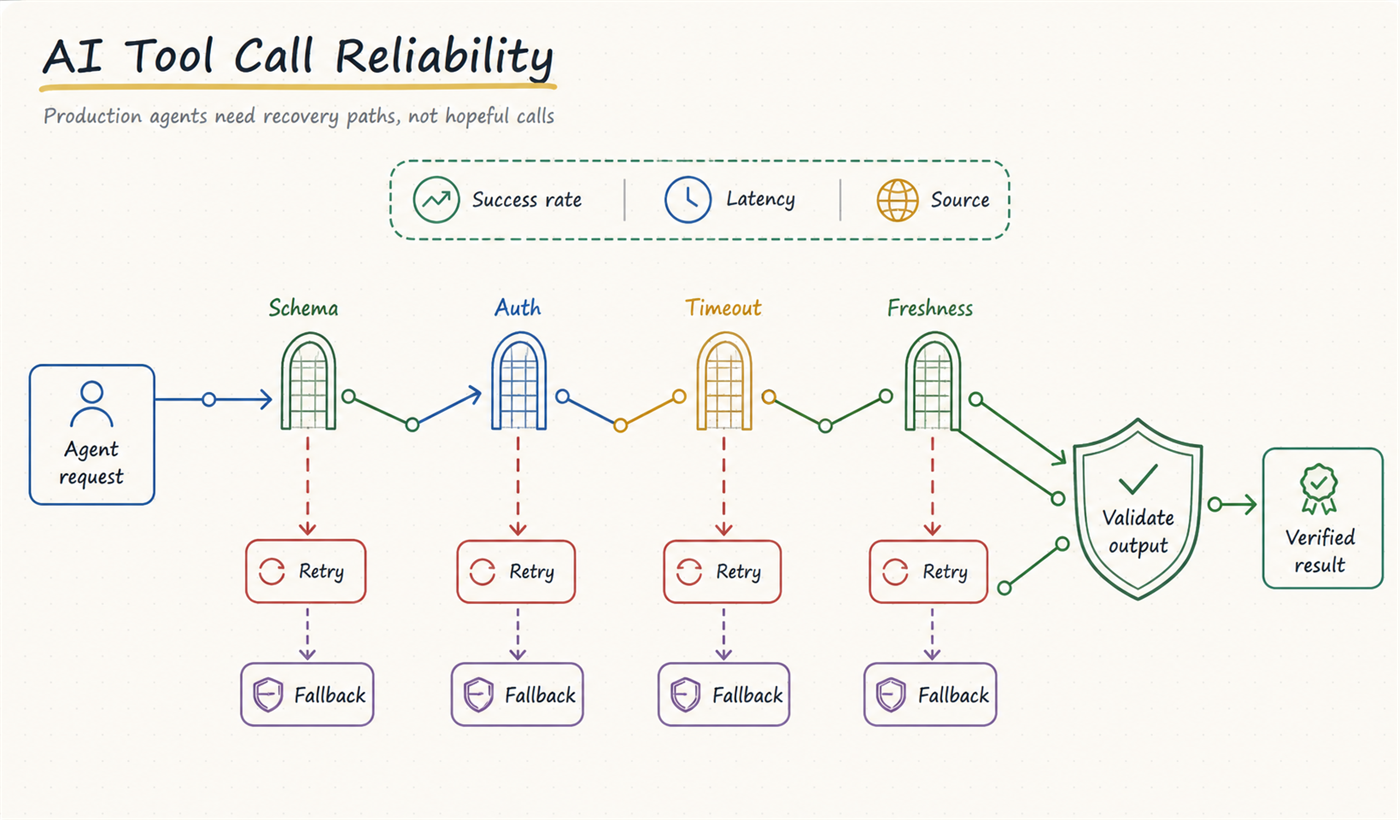
Why AI Tool Calls Fail in Production 为什么生产环境里的 AI 工具调用会失败
Tool calling looks simple when an agent calls one clean API with one known schema. Real production agents face messier conditions: missing parameters, wrong field names, changing provider formats, rate limits, authentication gaps, and tools that sound right but answer the wrong task. 当 Agent 只调用一个 Schema 清晰的 API 时,工具调用看起来很简单。但真实生产环境更混乱:参数缺失、字段名错误、供应商格式变化、速率限制、认证缺口,以及名字看似正确但无法回答任务的工具。
This is why QVeris blog topics around failed tool calls, parameter repair, and choosing the right tool matter. The reliability problem is not only model reasoning; it is also tool discovery, schema inspection, execution routing, and evidence handling. 这也是 QVeris blog 中关于工具调用失败、参数修复、选择正确工具等主题重要的原因。可靠性问题不只是模型推理问题,也包括工具发现、Schema 检查、执行路由和证据处理。
Common AI Agent Tool Call Failure Modes 常见 AI Agent 工具调用失败模式
Before improving reliability, teams need a practical failure map. These patterns show up across finance agents, research agents, coding assistants, and MCP tool workflows. 在提升可靠性之前,团队需要一张实用的失败地图。这些模式会出现在金融 Agent、研究 Agent、编码助手和 MCP 工具工作流里。
The model selects a tool whose name sounds relevant but whose output cannot answer the task. 模型选择了名字相关的工具,但返回结果并不能回答任务。
The call uses symbol when the schema expects ticker, or omits a required date range. 调用使用了 symbol,但 Schema 需要 ticker,或遗漏必填日期范围。
The first provider fails and the agent has no ranked second option. 第一个供应商失败后,Agent 没有排序后的备用选项。
The agent gets data but loses timestamps, provider notes, or source URLs before writing. Agent 拿到了数据,但在写作前丢失了时间戳、供应商说明或来源 URL。
The agent calls a premium API when a lower-cost capability could handle the task. 任务本可用低成本能力完成,Agent 却调用了高成本 API。
The call succeeds technically but returns stale, delayed, partial, or non-citable data. 调用技术上成功了,但返回的是过期、延迟、部分或不可引用的数据。
How to Improve AI Tool Call Reliability 如何提升 AI 工具调用可靠性
Example: Reliable Tool Calling Flow 示例:可靠工具调用流程
A production agent should not blindly call a tool because the name matches. It should inspect, repair, and route before execution. 生产级 Agent 不应该因为工具名称匹配就盲目调用。它应该先检查、修复和路由,再执行。
# User asks for a finance brief with fresh data
intent = "summarize latest AAPL earnings and price reaction"

candidate_tools = qveris.discover(intent)
schema = qveris.inspect("market.earnings_snapshot")

params = repair_params(
    schema=schema,
    user_input={"company": "Apple"},
    required=["symbol", "period"]
)

result = qveris.call(
    capability="market.earnings_snapshot",
    params=params,
    fallback=["filings.latest_10q", "news.company_events"]
)

agent.answer(result, require_sources=True)
Reliable Tool Calling vs Basic Function Calling 可靠工具调用与基础 Function Calling 的区别
| Dimension 维度 | Basic function calling 基础 Function Calling | Reliable tool calling 可靠工具调用 |
|---|---|---|
| Tool choice 工具选择 | Usually predefined in the prompt or app code. 通常预先写在提示词或应用代码里。 | Discovered and ranked based on task intent and quality signals. 根据任务意图和质量信号发现并排序。 |
| Input quality 输入质量 | The model may guess missing or mismatched parameters. 模型可能猜测缺失或不匹配的参数。 | Inputs are checked and repaired before execution. 输入在执行前被检查和修复。 |
| Failure handling 失败处理 | Often returns an error or forces custom code paths. 通常返回错误,或依赖自定义代码路径。 | Fallback tools can be routed when the first call fails. 第一个调用失败时,可以路由到备用工具。 |
| Auditability 可审计性 | Execution details may disappear from the final answer. 执行细节可能从最终回答中消失。 | Result includes source, latency, provider, and execution notes. 结果包含来源、延迟、供应商和执行说明。 |
How QVeris Supports AI Tool Call Reliability QVeris 如何支持 AI 工具调用可靠性
QVeris helps agents move from hardcoded tool lists to capability routing. Discover finds candidate capabilities from intent, Inspect checks parameters and provider signals, and Call executes through a unified interface with structured output. QVeris 帮助 Agent 从硬编码工具列表走向能力路由。Discover 根据意图找到候选能力,Inspect 检查参数和供应商信号,Call 通过统一接口执行并返回结构化输出。
For financial agents, this matters because every answer needs evidence. A reliable workflow can choose a better data source, reject a weak call, or attach source metadata before the model writes the final analysis. 对金融 Agent 来说,这一点尤其重要,因为每个答案都需要证据。可靠工作流可以选择更好的数据源、拒绝薄弱调用,或在模型写最终分析前附上来源元数据。
The Production Tool-Call Reliability Contract生产级工具调用的可靠性契约
Reliability is not a single success-rate number. A production agent needs an explicit contract for what it may call, how inputs are validated, what happens after uncertainty or failure, and which evidence must be retained for review.
可靠性不是一个孤立的成功率数字。生产级 Agent 需要明确约定:允许调用什么、如何校验输入、遇到不确定性或失败时怎样处理,以及复核时必须保留哪些证据。
Validate required fields, types, ranges, enumerations, units, dates, identifiers, and mutually dependent parameters before sending a request. Resolve ambiguous entities and show the model the smallest relevant schema instead of an entire catalog.
请求发出前校验必填字段、类型、范围、枚举值、单位、日期、标识符和相互依赖的参数。先消除实体歧义,并只向模型展示最相关、最精简的 Schema,而不是整个工具目录。
Retry transient network and rate-limit failures with bounded backoff. For payments, messages, orders, file writes, or other side effects, require idempotency keys or an explicit state check so a timeout cannot silently create duplicate actions.
对临时网络错误和限流采用有上限的退避重试;对于付款、消息、订单、文件写入等有副作用的动作,则必须使用幂等键或显式状态检查,避免超时后悄悄产生重复操作。
A fallback should satisfy the same user intent and minimum evidence standard. If no equivalent source exists, return a partial result with a clear limitation or escalate to a human instead of substituting a superficially similar tool.
降级工具应满足同一用户意图和最低证据标准。若不存在等价来源,应返回带明确限制的部分结果或升级人工处理,而不是换用一个表面相似的工具。
Log intent, candidate tools, selection reason, schema version, normalized arguments, latency, provider response, validation outcome, retry path, cost, and final answer citation. Redact secrets and sensitive fields while preserving enough context to reproduce failures.
记录意图、候选工具、选择理由、Schema 版本、规范化参数、延迟、供应商响应、校验结果、重试路径、成本和最终答案引用;同时脱敏密钥与敏感字段,并保留足以复现故障的上下文。
A Practical Tool-Call Reliability Test Matrix一套实用的工具调用可靠性测试矩阵
Happy-path demos hide the failures that matter most. Evaluate routing and execution with representative, adversarial, stale, incomplete, and side-effecting tasks before trusting aggregate success rates.
顺利路径的演示会隐藏最关键的失败。应使用有代表性的、对抗性的、过期的、不完整的以及带副作用的任务来评估路由与执行,而不是只相信汇总成功率。
| Test family测试类别 | What to inject注入条件 | Passing behavior通过标准 |
|---|---|---|
| Selection工具选择 | Overlapping names, irrelevant popular tools, missing capability, and conflicting metadata名称重叠、热门但无关的工具、能力缺失和元数据冲突 | The agent selects by intent and constraints, or states that no safe match existsAgent 根据意图与约束选择,或明确说明不存在安全匹配项 |
| Arguments参数 | Missing fields, wrong units, invalid dates, ambiguous tickers, extreme values, and schema drift字段缺失、单位错误、日期无效、代码歧义、极端值和 Schema 漂移 | Invalid input is repaired with evidence, clarified with the user, or rejected before execution无效输入在执行前基于证据修正、向用户澄清或被拒绝 |
| Provider failure供应商故障 | Timeouts, throttling, malformed output, partial data, stale records, and conflicting sources超时、限流、响应畸形、数据不完整、记录过期和来源冲突 | Retries are bounded, fallbacks are justified, and uncertainty remains visible in the answer重试次数受控、降级选择有依据,并在答案中保留不确定性 |
| Side effects副作用 | Duplicate delivery, delayed acknowledgement, permission loss, cancellation, and replay重复投递、延迟确认、权限丢失、取消和请求重放 | The action is authorized, idempotent, auditable, and confirmed before the agent reports completion动作经过授权、具备幂等性和审计记录,并在 Agent 宣布完成前得到确认 |
AI Tool-Call Reliability FAQAI 工具调用可靠性常见问题
A reliable call selects an appropriate capability, supplies validated arguments, executes under the right permissions, verifies the response, handles failure predictably, and leaves an auditable trace. A technically successful API response is not reliable if it answers the wrong intent or returns stale evidence.
No. Retry only failures likely to be transient and cap the attempt count. Validation errors need repaired input; authorization failures need a permission decision; side-effecting operations need idempotency and state verification before any retry.
Track correct-tool selection, argument validity, evidence freshness, end-to-end task completion, p50 and tail latency, fallback quality, duplicate side effects, cost per completed task, escalation rate, and the share of answers with traceable sources.
QVeris separates capability discovery, schema inspection, and execution. That pattern helps an agent narrow candidates before exposing parameters, route by provider and quality signals, and call through a more consistent interface while keeping the application’s own policy and review controls in place.
可靠调用需要选择合适能力、提供通过校验的参数、在正确权限下执行、验证响应、可预测地处理失败,并留下可审计轨迹。即使 API 技术上返回成功,如果回答错了意图或证据已经过期,也不能算可靠。
不应该。只重试可能属于临时性的错误,并限制次数。参数校验错误需要修复输入,授权错误需要重新判断权限,带副作用的操作则必须先检查幂等性和当前状态。
应追踪工具选择正确率、参数有效率、证据新鲜度、端到端任务完成率、常规与长尾延迟、降级质量、重复副作用、每个完成任务的成本、人工升级率和带可追溯来源的答案占比。
QVeris 将能力发现、Schema 检查和执行分开,帮助 Agent 在暴露参数前缩小候选范围,依据供应商与质量信号进行路由,并通过更一致的接口调用,同时保留应用自身的策略和复核控制。