
What is an algorithmic trading API?什么是算法交易API
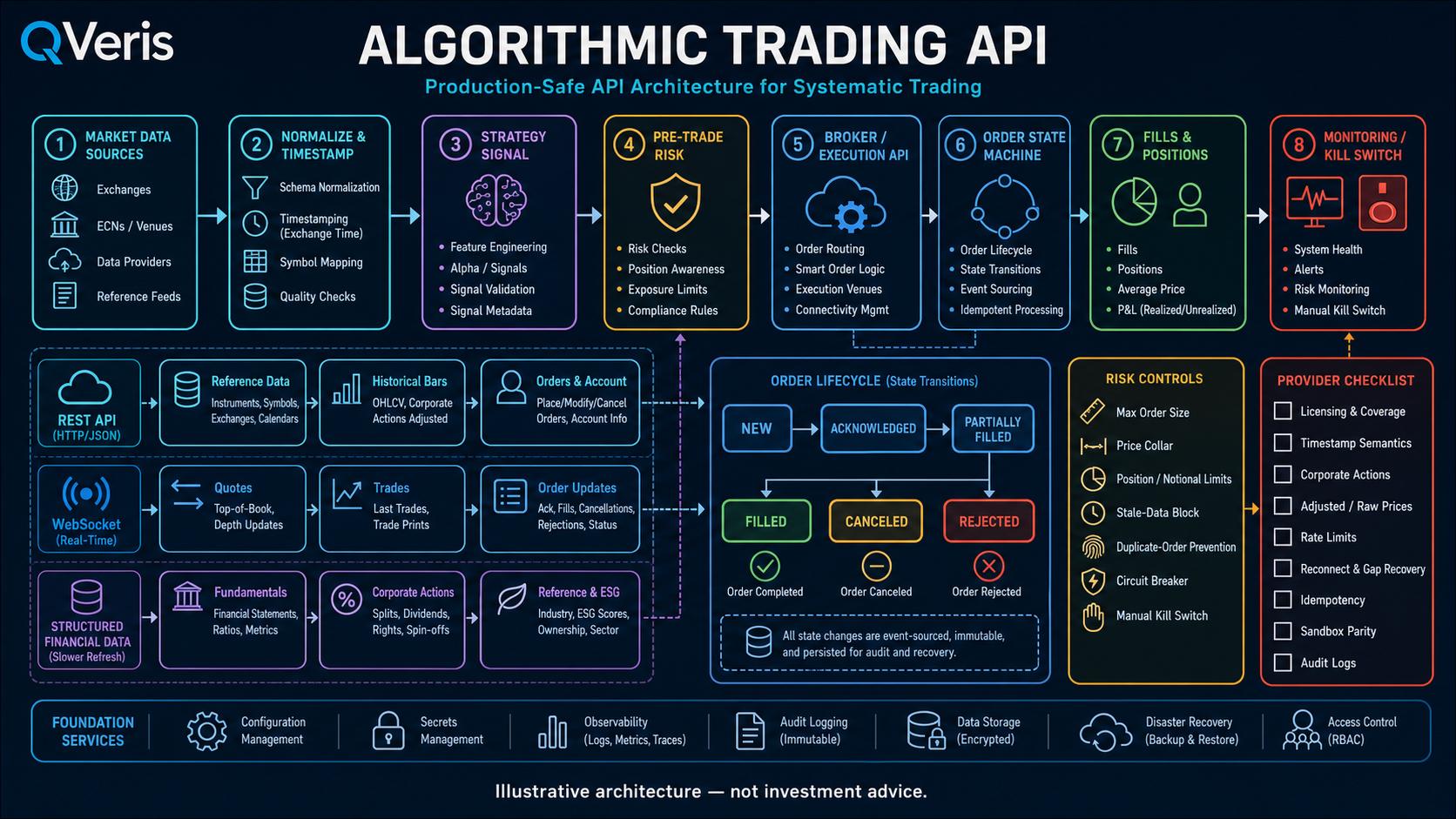
An algorithmic trading API is a programmatic interface used by systematic strategies to obtain data, manage accounts and submit or monitor orders. In practice, one vendor rarely covers every need. Research may use historical bars and fundamentals, live decisions may use streaming quotes or trades, and execution requires a broker or venue API with authenticated order and position events.
算法交易API是系统化策略用于获取数据、管理账户以及提交或监控订单的程序接口。现实中很少有单一供应商覆盖所有需求:研究可能使用历史K线与基本面数据,实时决策可能使用流式报价或成交,而执行则需要提供认证订单、成交与持仓事件的券商或交易场所API。
REST APIREST API
Reference data, historical bars, corporate actions, account snapshots and order commands. Request-response is simple, but polling can be stale and rate-limited.适合参考数据、历史K线、公司行动、账户快照和订单指令。请求响应模式简单,但轮询可能滞后并受到速率限制。
WebSocket streamWebSocket流
Quotes, trades, depth and asynchronous order updates. Production clients need heartbeat, sequence tracking, reconnect and gap recovery.适合报价、成交、深度和异步订单更新。生产客户端需要心跳、序号跟踪、重连和缺口恢复。
Structured research data结构化研究数据
Financial statements, ratios, company reference data and other slower-changing inputs for screening, features and risk context—not execution.财务报表、比率、公司参考数据及其他低频输入,可用于筛选、特征和风险背景,而不是直接执行订单。
Algorithmic trading API architecture算法交易API系统架构
Separate research, paper trading and production分离研究、模拟交易与生产环境
Use separate credentials, accounts, endpoints, queues and data stores. Sandbox behavior may not reproduce production rejections, partial fills, halts, auction states, market-impact constraints or exchange throttles. Promotion should be an explicit change-controlled process with approvals, versioned configuration and rollback.
研究、模拟和生产应使用独立凭据、账户、端点、队列和数据存储。沙箱未必能复现生产环境中的拒单、部分成交、停牌、集合竞价状态、市场冲击约束或交易所限流。上线应通过明确的变更控制流程,包含审批、版本化配置和回滚方案。
How to choose an API for algorithmic trading如何选择算法交易API
| Criterion标准 | Questions to verify需要核实的问题 | Why it matters重要性 |
|---|---|---|
| Market and license市场与许可 | Which venues, asset classes, regions and user types are covered?覆盖哪些场所、资产类别、地区和用户类型? | Data and redistribution rights differ.数据使用与再分发权利不同。 |
| Timestamp semantics时间戳语义 | Exchange, vendor or processing time? What precision and timezone?交易所、供应商还是处理时间?精度与时区如何? | Prevents look-ahead and misleading latency.防止前视偏差与错误延迟判断。 |
| Adjustments复权处理 | Are raw and adjusted prices available with corporate-action history?是否同时提供原始与复权价格及公司行动历史? | Backtests and live signals must use consistent definitions.回测与实盘信号需要一致口径。 |
| Rate limits速率限制 | Requests, weights, connections, subscriptions and order messages?请求、权重、连接、订阅和订单消息如何计数? | Limits shape caching, queues and backoff.决定缓存、队列和退避设计。 |
| Streaming recovery流恢复 | Heartbeats, sequence numbers, snapshots and replay?是否提供心跳、序号、快照和重放? | Reconnect without silent data gaps.避免重连后出现静默数据缺口。 |
| Order semantics订单语义 | Idempotency, client IDs, replace rules, rejects and partial fills?幂等性、客户端ID、改单规则、拒单和部分成交? | Prevents duplicate or lost orders.防止重复订单或状态丢失。 |
| Operations运维能力 | Status page, maintenance notice, audit export and support?状态页、维护通知、审计导出和支持如何? | Enables incident response and reconciliation.支持事故响应与对账。 |
Measure end-to-end behavior yourself自行测量端到端行为
Published labels such as “real time” or “low latency” do not establish suitability. Capture exchange time where available, vendor time, client receive time, strategy decision time, order-send time, acknowledgement and fill events. Interpret the distribution under normal, volatile and disconnected conditions without turning a small test into a universal performance claim.
“实时”或“低延迟”等标签不能证明适用性。应记录可用的交易所时间、供应商时间、客户端接收时间、策略决策时间、发单时间、确认与成交事件,并观察正常、波动和断连条件下的分布,不能把小规模测试扩大为普遍性能结论。
Model the complete order lifecycle完整建模订单生命周期
An HTTP success only means the request was accepted at one layer; it may not mean the broker accepted the order or the venue received it. Treat broker and venue events as the authoritative state transitions. Persist the original client order ID, provider order ID, timestamps, requested terms, fills, fees, rejects and every replace or cancel attempt.
HTTP成功通常只表示某一层接受了请求,不代表券商已经接受订单或交易场所已经收到。应把券商与交易场所事件视为权威状态变化,并保存原始客户端订单ID、供应商订单ID、时间戳、请求条件、成交、费用、拒单以及每次改单或撤单尝试。
| Failure故障 | Unsafe response不安全处理 | Safer pattern更安全模式 |
|---|---|---|
| Timeout after submit提交后超时 | Blindly submit again直接重复提交 | Query by idempotent client ID before retry按幂等客户端ID查询后再重试 |
| Stream disconnect流连接断开 | Assume no fills occurred假设没有成交 | Recover snapshot and reconcile event gap恢复快照并核对事件缺口 |
| Partial fill部分成交 | Treat order as open at full size仍按全部数量未成交处理 | Update remaining quantity and exposure atomically原子更新剩余数量与敞口 |
| Cancel race撤单竞态 | Mark canceled on request发出撤单即标记取消 | Wait for authoritative cancel or fill event等待权威取消或成交事件 |
Pre-trade risk controls for an algorithmic trading API算法交易API的预交易风险控制
Applicable laws, rules and supervisory obligations depend on jurisdiction, firm type, market, instrument and activity. Risk controls should be designed with qualified compliance, legal, trading and engineering stakeholders; this guide does not determine regulatory obligations.
适用法律、规则和监督义务取决于司法管辖区、机构类型、市场、工具和活动。风险控制应由合规、法律、交易和工程专业人员共同设计;本文不判断具体监管义务。
Algorithmic trading API launch checklist算法交易API上线检查清单
- Document data licenses, entitlements, venues, delays and redistribution rights.记录数据许可、权限、场所、延迟与再分发权利。
- Reconcile raw versus adjusted prices, symbols, calendars and corporate actions.核对原始与复权价格、标的代码、日历与公司行动。
- Test rate limits, backoff, reconnect, sequence gaps and replay.测试速率限制、退避、重连、序列缺口与重放。
- Exercise acknowledgements, rejects, partial fills, cancel races and duplicate prevention.测试确认、拒单、部分成交、撤单竞态与重复防护。
- Run pre-trade limits, circuit breakers and the manual kill switch in a controlled test.在受控测试中运行预交易限额、熔断与人工停止开关。
- Verify audit logs, clock synchronization, incident alerts, backups and recovery.验证审计日志、时钟同步、事故告警、备份与恢复。
- Approve production configuration through change control and start with bounded exposure.通过变更控制批准生产配置,并以受限敞口启动。
Use QVeris and FMP in an algorithmic trading API workflow在算法交易API流程中使用QVeris与FMP
Where your FMP subscription and data rights permit, QVeris can help an agent discover and call FMP endpoints for historical market data, company information, financial statements, ratios and other available research inputs. Those datasets can support screening, backtests, features and slower portfolio processes.
在FMP订阅和数据权利允许的情况下,QVeris可以帮助智能体发现并调用FMP端点,获取历史市场数据、公司信息、财务报表、比率及其他可用研究输入。这些数据可支持筛选、回测、特征构建和较低频的组合流程。
Do not treat QVeris or FMP research-data access as a broker execution connection unless the current authorized tool and provider explicitly support that action. Order submission, custody, balances and execution controls belong to the broker or venue API. Endpoint availability, timeliness, fields, rate limits and licensing must be confirmed in current documentation.
除非当前授权工具与供应商明确支持相关动作,否则不要把QVeris或FMP研究数据访问视为券商执行连接。订单提交、托管、余额与执行控制属于券商或交易场所API。端点可用性、时效、字段、速率限制和许可必须以当前文档为准。
Historical market data for backtesting回测历史市场数据 · Financial data APIs for AI agents面向AI智能体的金融数据API · QVeris documentationQVeris文档
Algorithmic trading API FAQ算法交易API常见问题
What is an algorithmic trading API?什么是算法交易API?
It is a programmatic interface for market or research data, account information, order submission and execution events used by systematic trading software.
它是系统化交易软件用于市场或研究数据、账户信息、订单提交与执行事件的程序接口。
REST or WebSocket for algorithmic trading?算法交易应该使用REST还是WebSocket?
REST suits requests and commands; WebSocket suits streaming quotes, trades and order updates. Production systems often use both with reconciliation.
REST适合查询与指令,WebSocket适合流式报价、成交和订单更新。生产系统通常同时使用并进行对账。
How do API rate limits affect a trading strategy?API速率限制如何影响交易策略?
They constrain polling, subscriptions and order messages, shaping queues, caching, batching, backoff and whether the strategy is feasible.
它限制轮询、订阅和订单消息,进而影响队列、缓存、批处理、退避以及策略是否可行。
What happens if an order request times out?订单请求超时怎么办?
Do not blindly resubmit. Reconcile using a durable idempotent client order ID and authoritative broker state before retrying.
不要直接重复提交。应使用持久幂等客户端订单ID和权威券商状态核对后再重试。
Can a market data API execute trades?市场数据API能执行交易吗?
Not necessarily. Market and research data APIs may not provide brokerage, custody or order-routing capabilities.
不一定。市场与研究数据API可能不提供券商、托管或订单路由能力。
What risk controls should an automated trading system have?自动交易系统需要哪些风险控制?
Typical controls include order and exposure limits, price collars, stale-data blocks, duplicate prevention, circuit breakers, monitoring and a tested manual kill switch.
常见控制包括订单和敞口限额、价格区间、过期数据阻断、重复防护、熔断、监控和经过测试的人工停止开关。
References and methodology sources参考资料与方法来源
- FINRA — Algorithmic trading controls and supervision
- FIA — Automated trading risk controls and safeguards
- FMP — Financial data API documentation
Educational content only; not investment, legal or compliance advice. Automated trading can cause rapid losses and operational incidents.本文仅供教育用途,不构成投资、法律或合规建议。自动交易可能快速造成损失与运行事故。