
Alpha Vantage Pricing in 2026:
Plans & Limits & Alternatives
- Verified pricing: Alpha Vantage documents a free allowance of up to 25 requests per day. Monthly premium plans cost $49.99, $99.99, $149.99, $199.99, and $249.99 for 75, 150, 300, 600, and 1,200 requests per minute.
- Important qualification: A premium API key and a US market-data entitlement are separate concerns. Realtime and 15-minute delayed US data require the applicable entitlement flow; commercial use requires provider confirmation.
- Decision rule: Choose with peak requests per minute, data freshness, endpoint coverage, licensing rights, and total cost. Monthly call volume alone cannot identify the correct plan or alternative.
How much does Alpha Vantage cost per month?
Alpha Vantage offers free access to most datasets for up to 25 API requests per day. Its five monthly premium plans are $49.99 for 75 requests/min, $99.99 for 150, $149.99 for 300, $199.99 for 600, and $249.99 for 1,200, with no daily request limit. Realtime or 15-minute delayed US market data also requires the appropriate entitlement, so the subscription price is not the complete production cost.
To inspect the available Alpha Vantage capabilities before choosing a plan, open the exact Alpha Vantage Provider profile in QVeris or review the Retrieve Daily Time Series tool, including its parameters, call cost, and current execution quality.
The monthly subscription and maximum requests per minute.
That premium plans remove the standard 25-request daily ceiling.
That annual billing is available with two months of stated savings.
Whether a workload's measured peak fits a published request-rate tier.
Which endpoints are free, premium-only, or subject to separate data rights.
Realtime, delayed, personal-use, commercial-display, and redistribution entitlements.
Peak concurrency, retry behavior, caching policy, and error handling.
Whether one provider covers the full workflow or a multi-source layer is needed.
Alpha Vantage Pricing Plans Breakdown (2026)
The current Alpha Vantage premium page lists five monthly plans, differentiated by requests per minute. It also offers annual billing at the equivalent of ten monthly payments. The free service is documented separately on the support page as access to most datasets for up to 25 requests per day.
| Plan | Monthly price | Published capacity | Daily limit | Best planning use |
|---|---|---|---|---|
| Standard free access | $0 | Use the verified daily allowance for planning | Up to 25 requests/day | Endpoint and schema evaluation |
| 75 requests/min | $49.99 | 75 requests/min | No daily API limit | Small production workloads with measured peaks |
| 150 requests/min | $99.99 | 150 requests/min | No daily API limit | Moderate concurrency |
| 300 requests/min | $149.99 | 300 requests/min | No daily API limit | Parallel research or batch jobs |
| 600 requests/min | $199.99 | 600 requests/min | No daily API limit | High-throughput applications |
| 1,200 requests/min | $249.99 | 1,200 requests/min | No daily API limit | Largest published self-serve capacity |
Reading the table correctly: “No daily limit” does not mean unlimited throughput, guaranteed realtime rights, or unrestricted redistribution. The request-per-minute ceiling still applies, and US market-data freshness and commercial usage can require separate entitlement steps.
Alpha Vantage Free API Limit: What 25 Requests per Day Can Support
Alpha Vantage says the majority of its datasets can be accessed free for up to 25 API requests per day. That is useful for learning the response schema, validating symbol coverage, testing one endpoint at a time, and running a very small scheduled workflow. It is not enough information to describe the free service as “five requests per minute” or to promise a specific intraday freshness level across every endpoint.
- Good fit: tutorials, notebooks, endpoint discovery, daily portfolio snapshots, and lightweight academic prototypes.
- Likely bottleneck: multi-symbol agents, parallel tool calls, intraday monitoring, large backfills, evaluation suites, and repeated retries.
- Count the whole workflow: one user question can create several upstream calls for prices, fundamentals, news, indicators, and validation. Budget requests per completed task, not per chat message.
- Handle limit responses explicitly: inspect the API response before parsing time-series fields, cache immutable data, queue non-urgent work, and avoid automatic retry storms.
A free key can still be the right choice when the workload genuinely stays below 25 daily requests. Upgrade decisions should follow measured demand, required endpoints, and data rights—not a blanket assumption that every prototype needs a paid plan.
Is Alpha Vantage Realtime? Data Freshness and Licensing Explained
“Premium” and “realtime” should not be treated as interchangeable labels. Alpha Vantage's official market-data policy says realtime and 15-minute delayed US market data are exchange-regulated. Personal, non-commercial users subscribe to premium and complete the applicable data-entitlement process through Alpha X Terminal. Business and commercial users are instructed to contact Alpha Vantage for onboarding.
Endpoint: confirm that the exact function supports the required entitlement parameter or freshness.
Audience: distinguish private analysis from customer-facing display, commercial use, or redistribution.
Asset class: equities, options, forex, crypto, commodities, and macro data can have different rules.
A higher request-rate tier does not by itself prove that every endpoint becomes realtime.
A “free realtime API” claim does not prove exchange licensing or commercial display rights.
API access, market-data entitlement, and permission to redistribute are separate checks.
For trading-adjacent agents, persist the provider timestamp, retrieval timestamp, market status, entitlement used, and source in the output. If freshness is insufficient, the agent should state that limitation instead of presenting a stale value as live.
Alpha Vantage API Pricing vs Pay-Per-Call: The Cost Model Tradeoff
Alpha Vantage uses fixed subscription tiers with published request-per-minute ceilings. QVeris uses usage-based execution pricing alongside capability discovery and inspection. Neither model is universally cheaper: the result depends on the current per-call price, peak request rate, cache hit rate, failed-call policy, required sources, and whether separate data entitlements are needed.
Subscription Model (Alpha Vantage)
- You pay for capacity, not usage: $49.99-$249.99/month regardless of whether you make 10 calls or 10,000 calls.
- Reserved capacity: The subscription price stays fixed when usage falls, but can be economical when a team consistently uses the included capacity.
- Rate-limit ceiling: When your AI Agent bursts above the per-minute limit, requests are throttled — even on days when overall volume is low.
Pay-Per-Call Model (QVeris)
- You pay for execution: Usage-based cost follows the number and type of calls actually made; capability discovery and inspection can be evaluated separately.
- Variable workloads: Low-traffic and intermittent agents avoid paying for idle subscription capacity.
- Budget controls still matter: retries, fan-out, provider fallback, and unbounded tool loops can increase usage-based cost unless the workflow sets limits.
Break-Even Analysis
Use the current QVeris pricing page rather than a hard-coded estimated rate. A simple cost break-even is Alpha Vantage monthly price ÷ QVeris cost per successful call, but that calculation is only valid after confirming both choices supply equivalent data, freshness, licensing, and reliability. Separately, use measured peak requests per minute to test whether an Alpha Vantage tier can serve the workload at all.
Alpha Vantage Alternatives: Match the Provider to the Workload
Searches for an “Alpha Vantage alternative” often hide different requirements. Some users need a larger free allowance, others need WebSocket streaming, broader fundamentals, brokerage execution, official MCP access, or a multi-provider abstraction. Compare providers by the missing capability rather than replacing one REST endpoint with another by default.
| Primary need | Providers to evaluate | What to verify |
|---|---|---|
| Low-cost learning and prototypes | Twelve Data, Finnhub, Marketstack, Alpha Vantage free | Daily/minute limits, delayed data, endpoint exclusions |
| US market depth and streaming | Massive, Alpaca, Finnhub | WebSocket messages, SIP/IEX coverage, exchange rights |
| Fundamentals and financial statements | Financial Modeling Prep, EODHD, Tiingo | Historical depth, restatements, point-in-time behavior |
| Brokerage-adjacent agents | Alpaca developer documentation and broker-native APIs | Paper trading, order controls, account permissions |
| One-provider MCP access | Alpha Vantage official MCP server | Supported tools, API-key usage, client compatibility |
| Multi-source agent routing | QVeris financial capabilities | Capability coverage, provider choice, per-call cost, output contract |
Run the same acceptance test against every shortlist candidate: request a representative symbol set, compare timestamps and corporate-action adjustments, force an invalid symbol, trigger the documented rate limit, inspect error payloads, and confirm that the intended display or redistribution is permitted.
Alpha Vantage Pricing Scenarios: Apply the Limits Correctly
Scenario 1: A daily research notebook
- Workload: five symbols, one daily endpoint per symbol, no intraday monitoring.
- Planning result: the request count can fit the documented 25-request daily allowance if retries and extra endpoints remain controlled.
- Check next: whether the required endpoint and historical depth are available to the free key.
Scenario 2: An agent that researches 20 companies on demand
- Workload: quote, overview, earnings, and news calls fan out after one user request.
- Planning result: daily volume and one-minute peak both matter. A low monthly total can still exceed 75 requests in one burst.
- Check next: serialize calls, cache reference data, or select a tier with enough measured peak headroom.
Scenario 3: A customer-facing realtime dashboard
- Workload: US market data displayed to external users during trading hours.
- Planning result: request capacity is only one cost. The team must also confirm realtime entitlement, commercial display rights, caching, and permitted redistribution.
- Check next: obtain written provider guidance before treating the checkout price as the full production price.
Scenario 4: A multi-provider financial agent
- Workload: Alpha Vantage for time series, another source for filings, and a third for brokerage actions.
- Planning result: provider subscription prices do not include the engineering cost of tool discovery, authentication, schema normalization, fallback, and audit logs.
- Check next: compare direct integrations with a multi-source routing layer such as QVeris using the same acceptance tests.
Pattern: Alpha Vantage is easy to evaluate when its data scope fits and request peaks are predictable. Alternatives become more relevant when the workload requires streaming, different licensing, broader fundamentals, brokerage execution, or unified access to multiple providers.
Alpha Vantage Plan Decision Framework
Use this order: confirm the data scope, measure peak requests per minute, verify freshness and licensing, and only then compare monthly cost. Reversing that order can produce a cheap plan that cannot legally or technically serve the intended product.
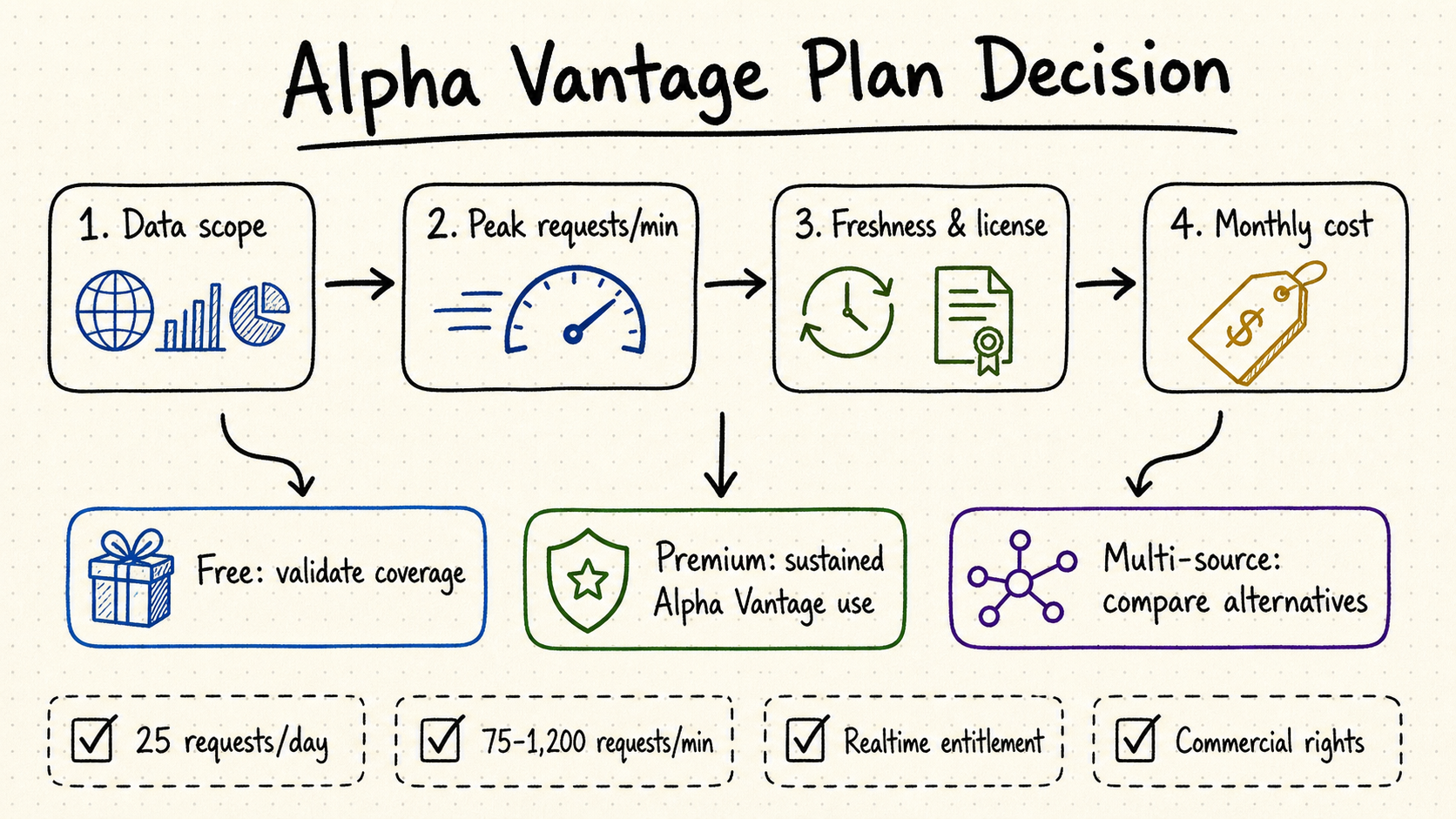
Quick takeaway: The free service validates coverage. A premium Alpha Vantage plan fits sustained use of Alpha Vantage endpoints when its rate and rights are sufficient. A broader alternative evaluation is appropriate when the missing requirement is outside Alpha Vantage's data or delivery model.
Alpha Vantage vs QVeris: Side-by-Side Comparison
| Dimension | Alpha Vantage | QVeris |
|---|---|---|
| Commercial model | Fixed monthly or annual request-rate tiers | Usage-based capability execution; check current pricing |
| Free evaluation | Most datasets, up to 25 requests/day | Capability discovery and inspection |
| Capacity model | Published 75–1,200 requests/min premium tiers | Depends on the selected capability and provider path |
| Data scope | Alpha Vantage financial-data catalog | Routes across multiple tools and providers |
| Realtime rights | Separate entitlement considerations apply | Underlying provider rights still apply |
| Interfaces | REST API and official MCP server | Agent-oriented discovery, inspection, and calling interfaces |
| Best fit | Teams committed to Alpha Vantage coverage with predictable peaks | Agents that need provider choice or multi-source routing |
What About the Alpha Vantage MCP Server?
Alpha Vantage provides an official MCP server for exposing its financial-data APIs to compatible AI clients. A premium API key can be attached to the MCP connection when higher API capacity or premium functions are required.
MCP improves tool discovery and invocation, but it does not remove the underlying API quota, market-data entitlement, or commercial-use terms. Production agents should still validate tool schemas, handle provider error payloads, log source timestamps, and cap retries.
Choose the official Alpha Vantage MCP server when Alpha Vantage's catalog is the intended source. Compare a multi-provider layer when the agent must discover and route across several data vendors without maintaining a separate MCP connection and normalization contract for each one.
For implementation details, read the QVeris MCP Server documentation and the exact Call a capability API reference.
Enter average daily calls, active days, and the measured one-minute peak. The peak selects the smallest published Alpha Vantage tier; daily volume determines whether the free allowance is viable.
Estimated Monthly Cost
Alpha Vantage (75/min): $49.99/month
Usage-based comparison: $110.00
How to Evaluate an Alpha Vantage Alternative Safely
Do not begin by swapping endpoint URLs. First define an output contract and test both systems against the same symbols, timestamps, failures, and licensing requirements.
Include a liquid US stock, a less common symbol, a corporate action, an invalid symbol, a historical request, and the freshness level the product promises.
Map provider responses to stable fields such as symbol, value, currency, market timestamp, retrieved_at, source, adjustment status, and error class.
Keep the existing integration active while comparing coverage, latency, freshness, rate-limit behavior, cost, and answer quality. Migrate only after the candidate passes the acceptance threshold.
Python Pattern: Treat Limit Messages as Structured Errors
Alpha Vantage can return an informational or error object instead of the expected time-series fields. Validate the envelope before passing data to an agent, and do not let generic retries consume the remaining daily allowance. Confirm endpoint-specific fields against the official Alpha Vantage API documentation.
import requests

response = requests.get(
    "https://www.alphavantage.co/query",
    params={
        "function": "GLOBAL_QUOTE",
        "symbol": "IBM",
        "apikey": api_key,
    },
    timeout=15,
)
response.raise_for_status()
payload = response.json()

if "Error Message" in payload:
    raise ValueError(payload["Error Message"])
if "Note" in payload or "Information" in payload:
    raise RuntimeError(payload.get("Note") or payload.get("Information"))
if "Global Quote" not in payload:
    raise RuntimeError("Unexpected Alpha Vantage response schema")
Compare the Data Contract Before Rewriting the Agent
After inspecting the provider and tool contract above, test the workflow with representative symbols, expected parameters, and bounded call behavior before changing the agent.
Try This Finance Workflow in QVeris →FAQ: Alpha Vantage Cost and Alternatives
About this Comparison
Pricing checked: July 24, 2026
Methodology: Monthly and annual plan options were checked against the Alpha Vantage premium checkout page. The 25-request daily free allowance, data-entitlement language, and commercial-use guidance were checked against official Alpha Vantage support and market-data policy pages. No provider performance ranking is presented without a reproducible benchmark.
Disclosure: QVeris is included as a multi-provider routing option. Product claims should be verified against current documentation and a workload-specific acceptance test.
Update cadence: Reviewed quarterly. Pricing and feature data refreshed every 90 days.