
Define the evidence contract定义证据契约
Specify the minimum fields required for the decision: source URL, timestamp, record ID, status, and confidence limitations.明确决策所需的最少字段,例如来源 URL、时间戳、记录 ID、状态与置信度限制。
DeepSeek supplies reasoning; external APIs supply current facts, private context, and real-world actions. Build the smallest evidence pipeline that closes the model’s capability gap—then put deterministic controls around every call.DeepSeek 负责推理,外部 API 提供实时事实、私有上下文与真实操作。先用最小证据链补齐模型能力缺口,再为每次调用加上确定性控制。
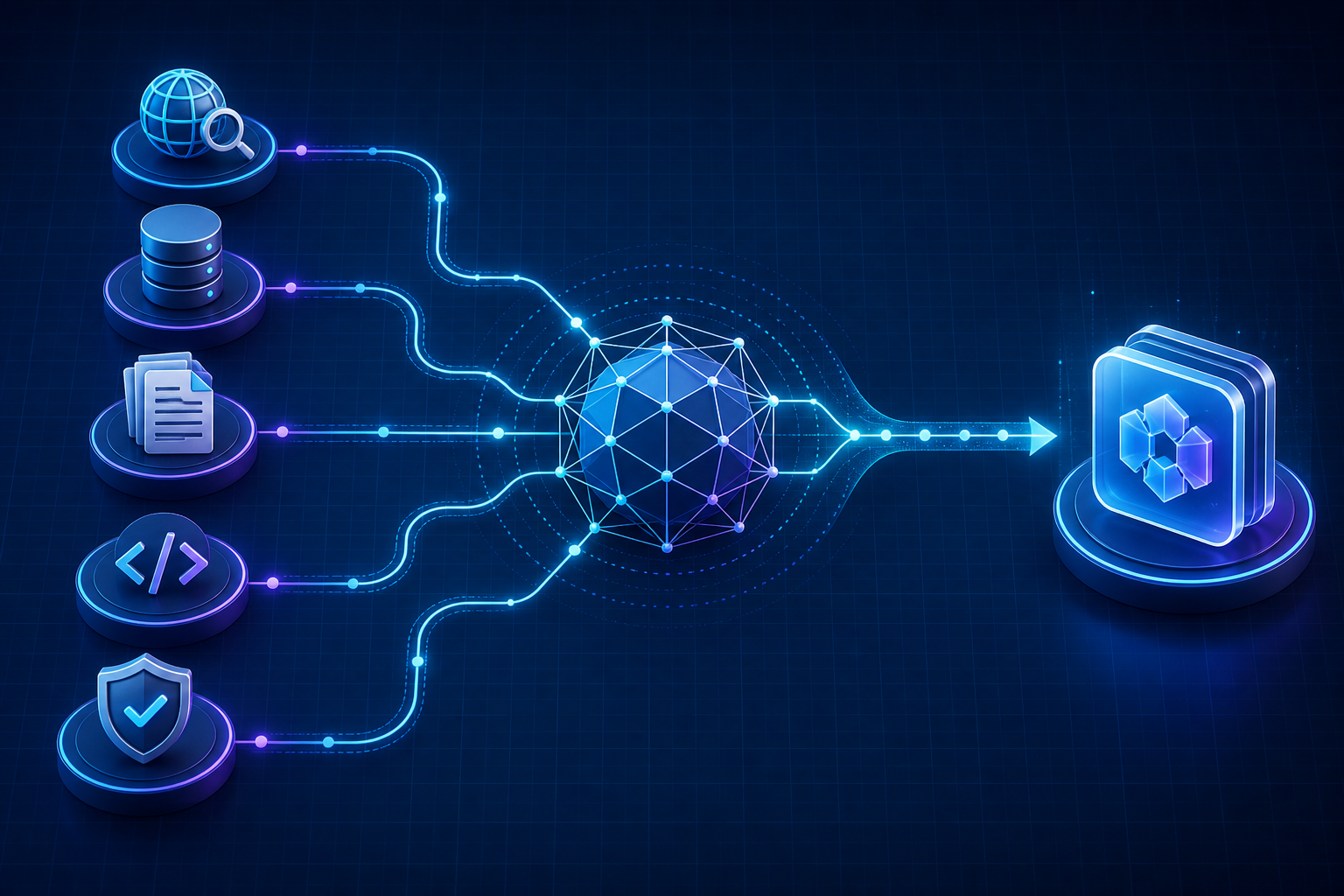
For live web research, use an AI-oriented search API such as Tavily or Exa. For application records, start with your existing database API—often Supabase. For grounded answers over private documents, use a retrieval layer backed by a vector database such as Pinecone or Qdrant. Add GitHub for code workflows, and Slack only when a reviewed result must reach a team. DeepSeek’s tool calling can choose a declared function and produce arguments; your application must still validate and execute it.实时网页研究可优先考虑 Tavily 或 Exa 这类面向 AI 的搜索 API;应用记录应优先复用现有数据库 API,常见选择是 Supabase;私有文档问答需要检索层,可由 Pinecone 或 Qdrant 等向量数据库支撑;代码流程接 GitHub,只有审核后的结果确实需要通知团队时才加 Slack。DeepSeek 的 Tool Calls 可以选择已声明函数并生成参数,但参数校验与真正执行仍由你的应用负责。
This is a fit guide, not a benchmark. Provider limits, prices, data policies, and features change; verify them in the linked official documentation before production use.这是一份适配指南,不是性能榜单。服务商限额、价格、数据政策和功能都会变化;生产使用前请在对应官方文档中核实。
| API / category | Best DeepSeek job最适合的 DeepSeek 任务 | Why it earns a place为何值得接入 | Safe first scope安全起步范围 | Official reference官方资料 |
|---|---|---|---|---|
|
Tavily / Exa WEB EVIDENCE |
Current research, source discovery, page extraction最新资料研究、来源发现、网页提取 | Returns retrieval-oriented results that can be normalized before they enter the prompt.提供面向检索的结果,进入 Prompt 前可先做标准化。 | Search only; approved domains; capped results仅搜索;限定域名;限制结果数 | Tavily · Exa |
| Supabase BUSINESS DATA |
Querying application records with row-aware access按行级权限查询应用数据 | A familiar Postgres-backed interface for structured, filterable facts.以 Postgres 为基础,适合提供结构化、可筛选事实。 | Read-only view plus Row Level Security只读视图配合 Row Level Security | Data API docs |
|
Pinecone / Qdrant PRIVATE RETRIEVAL |
RAG over policies, manuals, cases, and product knowledge针对政策、手册、案例与产品知识的 RAG | Retrieves small, relevant passages instead of sending an entire corpus.只检索少量相关片段,无需把整个语料库塞入上下文。 | One collection; metadata filters; source IDs单一集合;元数据过滤;保留来源 ID | Pinecone · Qdrant |
|
GitHub REST API CODE CONTEXT |
Issue triage, repository evidence, PR preparationIssue 分诊、仓库证据与 PR 准备 | Exposes traceable artifacts—commits, checks, diffs, and issues.可提供 Commit、检查、Diff 与 Issue 等可追溯对象。 | Read one repository; draft output locally只读一个仓库;先在本地生成草稿 | REST API docs |
|
Slack Web API TEAM HANDOFF |
Delivering approved summaries and escalation notices发送已审核的摘要与升级通知 | Closes the workflow loop where the team already works.在团队现有协作场所闭环,而不是新建孤立界面。 | Draft first; fixed channel; human approval先生成草稿;固定频道;人工批准 | Web API docs |
|
QVeris CAPABILITY ROUTING |
Finding and testing changing API capabilities without hard-wiring discovery into the prompt发现并测试持续变化的 API 能力,避免在 Prompt 中硬编码服务商 | Useful when the requirement starts as a capability and the provider may change.适合从“需要什么能力”出发、且服务商可能变化的工作流。 | Inspect tools, test non-sensitive inputs, then integrate先检查工具,再用非敏感输入测试,最后集成 | QVeris tools |
DeepSeek documents tool calls and structured JSON output. These are interfaces for orchestration—not permission systems. Keep credentials, policy, execution, and audit outside the model conversation.DeepSeek 官方提供 Tool Calls 与结构化 JSON 输出,但它们是编排接口,并不是权限系统。凭据、策略、执行和审计都应置于模型对话之外。
Read DeepSeek’s official tool-calling guide阅读 DeepSeek 官方 Tool Calls 指南
Specify the minimum fields required for the decision: source URL, timestamp, record ID, status, and confidence limitations.明确决策所需的最少字段,例如来源 URL、时间戳、记录 ID、状态与置信度限制。
Prefer search_approved_sources over a generic
HTTP client, and get_order_status over
arbitrary SQL.优先提供 search_approved_sources,而不是通用
HTTP 客户端;优先提供
get_order_status,而不是任意 SQL。
Apply JSON Schema, allowlists, length limits, tenant checks, and authorization after the model returns a tool call.模型返回工具调用后,再执行 JSON Schema、白名单、长度、租户与授权校验。
Strip active markup, cap payloads, preserve provenance, and make external instructions inert before returning data to DeepSeek.去除活动标记、限制 Payload、保留来源,并让外部内容中的指令失效后再返回 DeepSeek。
Require preview and approval for messages, writes, payments, deletion, account changes, and any action that is difficult to reverse.消息发送、写入、支付、删除、账户变更及其他难以撤销的动作,都应要求预览和批准。
This hypothetical function is intentionally smaller than the underlying search provider. It limits scope before DeepSeek sees the tool.下面是假设示例,函数范围刻意小于底层搜索服务商:在 DeepSeek 看到工具之前,应用就已收紧能力边界。
DeepSeek strict mode currently does not support
maxLength or maxItems. Enforce query
length, domain count, call budgets, secret redaction, and compact
result limits in application code; keep the tool schema to
supported constraints such as required fields, enums, and
additionalProperties: false.DeepSeek strict mode 目前不支持 maxLength 和
maxItems。查询长度、域名数量、调用预算、密钥脱敏与结果大小应由应用代码强制执行;工具
Schema 只使用已支持的必填字段、enum 与
additionalProperties: false 等约束。
Search approved sources, extract only relevant passages, ask DeepSeek to synthesize with citations, then reject claims that lack a source ID. Use this for policy updates, technical documentation, and market monitoring—not for open-ended browsing with write access.检索获准来源,只提取相关段落,让 DeepSeek 带引用综合回答,并拒绝没有来源 ID 的结论。适合政策更新、技术文档和市场监测,不适合同时拥有写权限的开放式浏览。
Retrieve policy passages first, fetch the customer’s permitted case fields second, and let DeepSeek draft a response that separates policy from account facts. Never embed sensitive records into a shared vector index; enforce tenant boundaries at retrieval.先检索政策片段,再读取该客户获准访问的工单字段,由 DeepSeek 起草回复并区分政策与账户事实。不要把敏感记录写入共享向量索引,并在检索阶段执行租户边界。
Read failing checks, verify upstream changes against official docs, and draft a risk summary. A reviewer approves the final Slack post. Keep code changes and public comments out of the first pilot so a weak inference remains reversible.读取失败检查,对照官方文档核实上游变化,并起草风险摘要;最终 Slack 消息由审核者批准。首次试点不要自动改代码或发公开评论,让错误推断始终可撤销。
Decide which facts need live retrieval and which stable facts can use cached context.明确哪些事实必须实时检索,哪些稳定内容可以复用缓存上下文。
Search allowed domains, cap results, and store URLs plus timestamps.仅搜索允许域名,限制结果数,并保存 URL 与时间戳。
Ask for claims mapped to evidence IDs and an explicit “insufficient evidence” state.要求每项结论映射证据 ID,并允许明确返回“证据不足”。
Reject missing citations, stale records, schema failures, and unauthorized actions.拒绝缺少引用、记录过期、Schema 失败或未授权的动作。
Can one endpoint materially improve a named outcome, or is the integration merely impressive in a demo?某个端点是否能显著改善明确结果,还是只在 Demo 中显得炫目?
Use workflow-specific identities, read-only scopes first, short-lived credentials where possible, and no secrets in prompts.使用工作流专用身份,从只读权限开始,尽量采用短期凭据,并禁止密钥进入 Prompt。
Reject unknown fields, oversized strings, ambiguous identifiers, and model-selected destinations.拒绝未知字段、超长字符串、含糊标识符与由模型自由选择的目标地址。
Treat pages, issues, messages, and retrieved documents as untrusted data that cannot alter tool policy.把网页、Issue、消息与检索文档视为不可信数据,不允许其改变工具策略。
Cap calls, records, retries, and wall-clock time. Cache stable prefixes and provider results only where policy permits.限制调用、记录、重试与总耗时;只在政策允许时缓存稳定前缀与服务商结果。
A timeout is an unknown state. Reconcile by request ID before retrying any consequential operation.超时代表状态未知。任何高影响操作重试前,都应按请求 ID 核对远端状态。
Preview messages and diffs; require approval for writes, payment, deletion, deployment, and external communication.先预览消息与 Diff;写入、支付、删除、部署与对外沟通必须经过批准。
Record tool, normalized arguments, policy decision, result ID, source, timestamp, and reviewer action—without secrets.记录工具、标准化参数、策略决策、结果 ID、来源、时间戳与审核动作,同时排除密钥。
Choose this for one stable provider with strict latency, schema, or compliance requirements. Your application owns authentication, retries, normalization, monitoring, and version changes.适合单一稳定服务商,且对延迟、Schema 或合规有严格要求的场景。认证、重试、标准化、监控与版本变化都由应用负责。
Choose MCP when the same narrowly defined tools should be reusable across compatible AI clients. It standardizes discovery and invocation, but does not replace provider authorization or business policy.当同一组边界清晰的工具需要在多个兼容 AI 客户端复用时选择 MCP。它统一发现与调用方式,但不能替代服务商授权和业务策略。
Choose capability routing when you know the job but may not know—or want to hard-code—the provider. Inspect matching tools in the QVeris tool directory, then test non-sensitive inputs in the Playground.当你明确任务,却不确定或不想硬编码服务商时,可采用能力路由。先在 QVeris 工具目录检查匹配能力,再用 Playground 的非敏感输入进行测试。
DeepSeek can return a tool call with structured arguments for a function you declared. Your application normally validates those arguments, executes the external API request, and returns the result to the model. A tool call is a proposal, not authorization.DeepSeek 可以针对你声明的函数返回带结构化参数的工具调用。通常由应用校验参数、执行外部 API 请求,再把结果返回模型。工具调用只是提议,并不等于授权。
Choose one read-only API that supplies evidence the model cannot reliably know, such as current official documentation or a narrowly scoped internal record. It should improve a measurable task without creating an external side effect.选择一个只读 API,为模型提供其无法可靠掌握的证据,例如最新官方文档或范围明确的内部记录。它应改善可衡量任务,同时不产生外部副作用。
Do not assume chat-product features and developer API features are identical. For a production workflow, declare and control a search tool explicitly, and verify current DeepSeek capabilities in the official API documentation.不要假设聊天产品与开发者 API 的能力完全相同。生产工作流应显式声明并控制搜索工具,同时在 DeepSeek 官方 API 文档中核实当前能力。
No. Wrap broad provider APIs in a small set of task-specific functions. A smaller tool surface improves selection clarity, limits accidental access, and makes evaluation practical.不应该。应把宽泛的服务商 API 包装成少量任务专用函数。更小的工具面能提升选择清晰度、减少意外访问,并让评测更可行。
No. Direct REST or SDK integration is often simplest for one application-owned provider. MCP becomes useful when the same model-facing tools must be reusable across compatible clients. In either case, authorization and business rules remain your responsibility.不必须。对单一、由应用长期维护的服务商,REST 或 SDK 直连往往更简单。当同一组模型工具需要跨兼容客户端复用时,MCP 更有价值。无论哪种方式,授权和业务规则都仍由你负责。
Describe the missing capability, inspect matching tools, test with non-sensitive data, and measure whether the final decision improves. Add a second API only when the first workflow exposes a specific new gap.先描述缺失能力,检查匹配工具,用非敏感数据测试,并衡量最终决策是否改善。只有第一条工作流暴露了明确的新缺口时,才加入第二个 API。