
Best Dividend APIs for Developers in 2026Best Dividend APIs 2026 2026 年最佳分红 API
There is no single best dividend API for every application. Through the tested QVeris Access Paths, Alpha Vantage, Twelve Data, EODHD, and Massive returned the required ex-dividend date and single-event amount for the fixed AAPL sample. Their published facts do not independently prove that each response identified AAPL, so production identity validation remains necessary. Hang Seng's tested QVeris Access Path passed the representative mainland China sample with a response security code that matched the request.
This dividend API comparison treats a successful response as only the starting point. A dividend data API must let your application verify the security identity, ex-dividend date, and cash amount per share for one event. Among the US samples, Alpha Vantage and Massive exposed the broadest event-date sets, while Twelve Data and Massive explicitly returned currency. The iFinD Native MCP returned an annual cumulative per-unit dividend, but not a dated, single Dividend Event.
We made 102 live calls across two test suites, including invalid-symbol controls and representative symbols from US, HK, CN, JP, DE, FR, BR, IN, and ES. These representative market sample results are not claims about every security, date range, entitlement, or market a provider covers.
Quick recommendation: Through the tested QVeris Access Paths, start by reproducing Alpha Vantage, Twelve Data, EODHD, or Massive for basic US Dividend Events. For broader representative-market results, EODHD passed 7 markets and Twelve Data passed 6. Alpha Vantage passed all 4 markets that QVeris marked applicable; we did not spend calls retesting the other 5 explicitly unsupported markets.
Results at a glance
The baseline test ran on August 11, 2026. Each applicable Access Path had one positive security sample and one invalid-symbol negative control, each repeated three times: 36 live calls. The market test ran on August 12, 2026. It included 27 applicable positive cells plus one negative control for each of the six paths, repeated twice: 66 live calls. The two Releases remain separate and are not combined into a score.
| Provider and Access Path | Dividend Event sample result | Median QVeris gateway latency / public QVeris Inspect price | Native official pricing | 9 representative market samples |
|---|---|---|---|---|
| Hang Seng (QVeris) · Try it in QVeris | CN sample passed: both rounds returned a verifiable security identity, ex-dividend date, and single-event amount | 623 ms / 1 credit/call | No public standard price; contact sales | CN passed (2/2); other 8 not tested: explicitly not applicable |
| iFinD (Native MCP) | Sample did not pass: no single-event date, and the annual cumulative value cannot establish the amount for one event | Not applicable; Native MCP is excluded from QVeris metrics | Personal CNY 40/month for 5,000 requests | US, HK, and CN samples did not pass (0/2); other 6 not tested: explicitly not applicable |
| Alpha Vantage (QVeris) · Try it in QVeris | Sample passed: both the AAPL sample and invalid-symbol control met the contract in all three rounds | 576 ms / 1 credit/call | Premium from USD 49.99/month; free tier 25 requests/day | 4 applicable markets passed (2/2); 5 not tested: explicitly not applicable |
| Twelve Data (QVeris) · Try it in QVeris | Sample passed: AAPL returned an ex-dividend date and single-event amount in all three rounds; the invalid symbol produced no fabricated event | 491 ms / 2.37 credits/call | Grow from USD 29/month; free tier 800 credits/day | 6 markets passed (2/2); HK, CN, and ES samples did not pass (0/2) |
| EODHD (QVeris) · Try it in QVeris | Sample passed: both the AAPL sample and invalid-symbol control met the contract in all three rounds | 779 ms / 2.81 credits/call | All-in-One USD 99.99/month | 7 markets passed (2/2); JP and IN samples did not pass (0/2) |
| Massive (QVeris) · Try it in QVeris | Sample passed: both the AAPL sample and invalid-symbol control met the contract in all three rounds | 861 ms / 1 credit/call | Stocks Basic Free; Dividend endpoint included in all Stocks plans | US passed (2/2); other 8 not tested: explicitly not applicable |
These four public states describe evidence, not a final procurement decision:
- Sample passed: every frozen round completed the task defined by this benchmark.
- Sample did not pass: live calls completed, but the result lacked required fields or business meaning.
- Evidence insufficient: the published evidence cannot support either conclusion; this does not mean the provider lacks the capability.
- Not tested: explicitly not applicable: QVeris or the Access Path contract explicitly excludes the market, so we did not spend calls probing it again.
“Sample passed” is not a production SLA and does not establish support for every security, market, date range, or licensing scenario.
How developers should choose
You only need a US ex-dividend date and single-event amount
The tested QVeris Access Paths for Alpha Vantage, Twelve Data, EODHD, and Massive should be on the first reproduction shortlist. Then compare three engineering dimensions: the fields your product needs, the QVeris list price per call, and P95/P99 latency measured again from your deployment region.
You need declaration, record, and payment dates
For US workflows, reproduce the tested QVeris Access Paths for Alpha Vantage and Massive first because those fields appeared in the published samples. For mainland China, Hang Seng's tested sample exposed the same additional date types. A field appearing once does not mean every historical record is complete, so production acceptance should also measure missing-field rates and historical depth.
Currency must be explicit in the response
Start with the tested QVeris Access Paths for Twelve Data and Massive. Both explicitly returned currency in this sample. When another path omits it, leave it null or enrich it from a separately sourced dataset—do not silently infer it from the exchange.
Your primary use case is mainland China dividends
Hang Seng's tested QVeris Access Path passed both representative CN rounds and is the first candidate to reproduce. The iFinD Native MCP still lacked a single-event date and amount meaning in both CN rounds.
You want one key for several data sources
A QVeris Access Path reduces authentication and protocol differences. One key does not standardize provider semantics, so security identity, dates, and amounts still need the same CAP checks across every path.
Evidence and provider differences
Why a Dividend Event is harder than “get dividends”
A machine-usable event must answer four questions: which security, what ex-dividend date, what cash amount per share for this event, and whether an empty response means “no event” or “request failed.” Declaration, record, and payment dates are valuable extensions, but they cannot replace the ex-dividend date. Currency must not be inferred from the market when it is absent.
The same security may appear as AAPL, 600519.SH, or a provider-specific identifier. Even plausible dates and amounts are unsafe if the returned security cannot be tied back to the requested one.
Core usability versus field richness
Core fields determine whether a record can enter a business system: security identity, ex-dividend date, and single-event amount are all required. Currency, declaration date, record date, and payment date enrich an event model, but a field appearing in a sample does not guarantee it is present on every record. Validate core usability first, then compare optional fields required by your application.
Observed latency and public QVeris list price
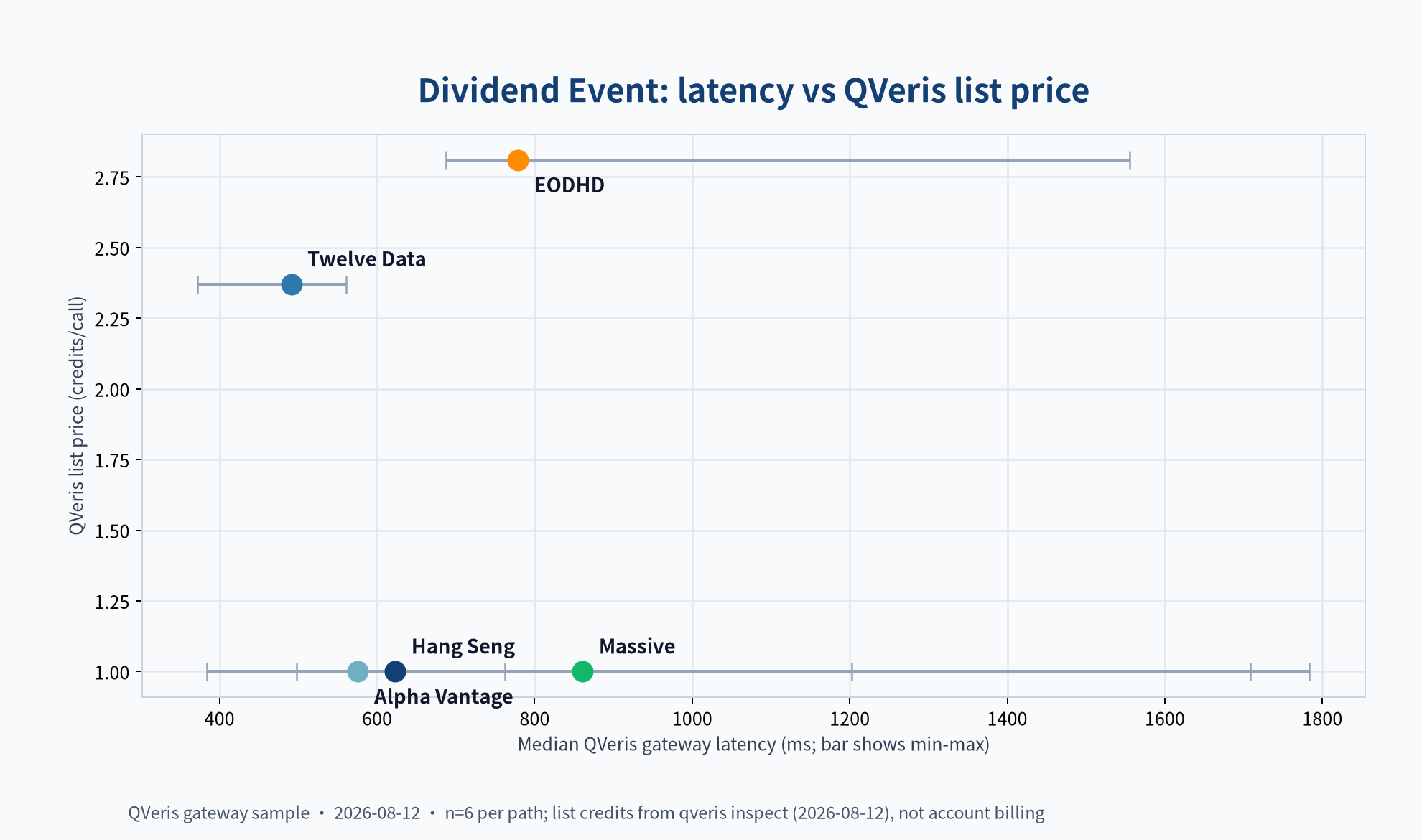
The x-axis is median QVeris gateway latency; each horizontal bar spans the observed minimum to maximum across six calls. The y-axis is the public list price returned by qveris inspect, not the actual charge to the test account. Because that account receives a discount, this article does not use account billing in its tables or charts.
Twelve Data had the lowest median latency in this sample. Alpha Vantage, Hang Seng, and Massive shared the lowest Inspect price at 1 credit/call. EODHD had both the highest list price and highest observed median latency. Six calls can prioritize a reproduction test; they cannot predict regional performance, P95/P99, or a provider's Native API SLA.
Native plans and QVeris credits are different prices
| Provider / Access Path | Free or trial entry | Paid entry | Scope of price evidence |
|---|---|---|---|
| Hang Seng / QVeris | Not published for this snapshot. |
Commercial; see product page. |
Provider product page; QVeris list price comes from the Inspect snapshot |
| iFinD / Native MCP | New accounts receive 2,000 trial requests |
Personal CNY 40/month for 5,000 requests; Enterprise CNY 5,000/month for 1,000,000 requests |
Native MCP only |
| Alpha Vantage / QVeris | 25 API requests per day |
Premium from USD 49.99/month |
Provider-wide official price; QVeris price verified per Tool |
| Twelve Data / QVeris | Basic with 8 API credits per minute and 800 per day |
Grow from USD 29/month |
Provider-wide official price; QVeris price verified per Tool |
| EODHD / QVeris | 20 API calls per day |
All-in-One USD 99.99/month |
Provider-wide official price; QVeris price verified per Tool |
| Massive / QVeris | Stocks Basic Free |
Stocks Starter USD 29/month |
Official documentation includes Dividends in all Stocks plans; QVeris price verified per Tool |
Provider subscriptions, QVeris credits, and actual test-account charges are three different facts. Plans may also differ by real-time access, exchange fees, caching, and redistribution rights, so monthly price alone is not enough for procurement.
Representative samples across nine markets
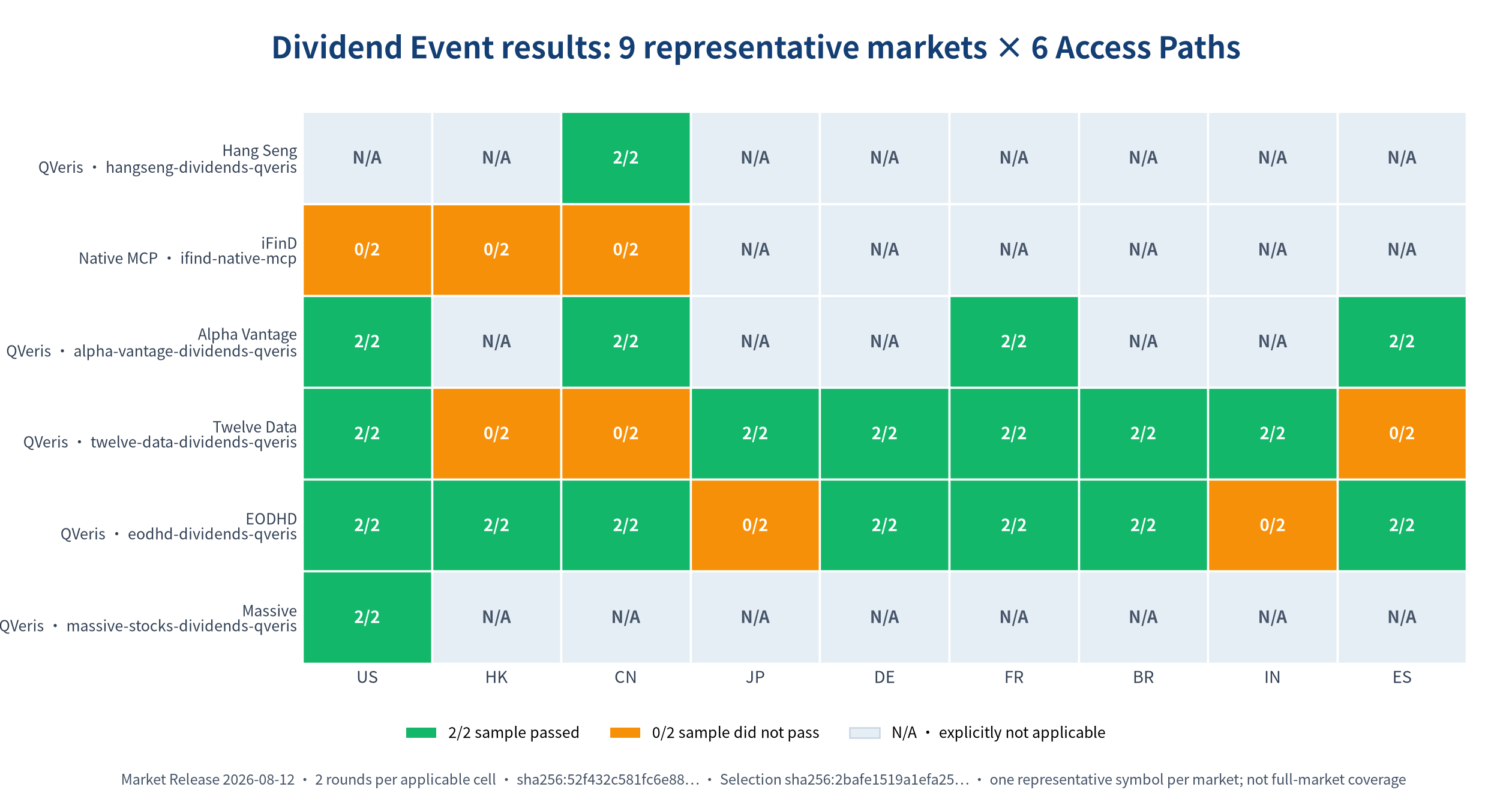
Green means the fixed representative symbol returned a verifiable security identity, ex-dividend date, and single-event cash amount in both rounds. Orange means both calls ran but did not produce a valid Dividend Event. Gray means QVeris or the Access Path contract explicitly marked the market not applicable, so we did not probe it again.
| Provider / Access Path | Representative markets passed (2/2) | Representative sample did not pass (0/2) | Not tested: explicitly not applicable |
|---|---|---|---|
| Hang Seng / QVeris | CN | — | US, HK, JP, DE, FR, BR, IN, ES: contract limited to mainland China exchanges |
| iFinD / Native MCP | — | US, HK, CN: no single-event date or amount meaning | JP, DE, FR, BR, IN, ES: contract declares only US/HK/CN |
| Alpha Vantage / QVeris | US, CN, FR, ES | — | HK, JP, DE, BR, IN: explicitly unsupported by QVeris |
| Twelve Data / QVeris | US, JP, DE, FR, BR, IN | HK, CN, ES | — |
| EODHD / QVeris | US, HK, CN, DE, FR, BR, ES | JP, IN | — |
| Massive / QVeris | US | — | HK, CN, JP, DE, FR, BR, IN, ES: Stocks Access Path applies to US equities |
2/2 is repeatability evidence, not statistical certification of an entire market. 0/2 means only that the selected symbol and window failed the task in both rounds; it does not prove that the provider does not support the market. Before production, rerun the same checks with your symbols, permissions, date ranges, and licensing requirements.
The market Release contains 120 planned test cells. All 66 applicable cells have sanitized public evidence, while the other 54 retain an explicit not-applicable reason. Unknown states, temporary failures, and missing evidence cannot be relabeled as not applicable.
Provider-by-provider analysis
Hang Seng: representative CN sample passed
The representative CN sample returned a verifiable security identity, ex-dividend date, and single-event amount in both rounds. It is a priority candidate for reproducing mainland China dividend events with your own symbols, date range, and permissions.
iFinD: an annual cumulative value is not a single event
The iFinD Native MCP returned an annual cumulative per-unit dividend in all three baseline rounds but no verifiable ex-dividend date. That value cannot establish the amount of one event, so it does not satisfy this article's event-calendar, ex-date backtest, or price-adjustment use cases. We tested only the official Native MCP and do not provide a QVeris CTA for iFinD.
Alpha Vantage: richer event dates in the sample
In addition to the required fields, the sample included declaration, record, and payment dates. This makes Alpha Vantage a priority reproduction candidate for multi-stage event models, but it does not prove those fields are complete across all records.
Twelve Data: direct core fields with explicit currency
The AAPL sample returned effective_date, amount, and currency, making it a reproduction candidate for basic US dividend calendars and notifications. We did not measure pagination limits, complete market scope, or plan quotas.
EODHD: core fields in a compact shape
The public facts include ex-dividend date, amount, and event count. We did not infer currency or additional dates. EODHD is a candidate for normalized core events; applications that require declaration date, payment date, or currency should add those fields to their own acceptance tests.
Massive: rich fields with a clear Stocks plan entry point
The sample included currency, declaration date, record date, ex-dividend date, and payment date. Massive's official documentation lists the Dividends endpoint in all Stocks plans, so individual developers can begin with Stocks Basic Free. Through QVeris, the corresponding Tool's Inspect price was 1 credit/call.
What AI Agent builders should verify
We did not run an Agent Trial and do not publish an aggregate Agent rating. For an Agent, field count is not enough: identity provenance, error meaning, and missing-value handling are common sources of silent failure.
| Provider and Access Path | Required event fields | Security identity | Invalid symbol | Currency in response | Additional event dates |
|---|---|---|---|---|---|
| Hang Seng (QVeris) | CN sample 2/2 | Returned security code matched the requested symbol | Handled correctly 3/3 | Not returned in this sample | Declaration, record, and payment dates |
| iFinD (Native MCP) | Missing single-event amount meaning and ex-dividend date | No response security code was available to cross-check | Handled correctly 3/3 | Not published in this sample | No single-event date set |
| Alpha Vantage (QVeris) | 3/3 | Published sample does not prove the response identified AAPL |
Handled correctly 3/3 | Not returned in this sample | Declaration, record, and payment dates |
| Twelve Data (QVeris) | 3/3 | Published sample does not prove the response identified AAPL |
Handled correctly 3/3 | USD |
Only ex-dividend date in this sample |
| EODHD (QVeris) | 3/3 | Published sample does not prove the response identified AAPL |
Handled correctly 3/3 | Not returned in this sample | Only ex-dividend date in this sample |
| Massive (QVeris) | 3/3 | Published sample does not prove the response identified AAPL |
Handled correctly 3/3 | USD |
Declaration, record, and payment dates |
Evaluate parameter clarity, schema stability, error recovery, pagination, identity provenance, and single-tool completion separately. The current Releases sufficiently observe required fields and invalid-symbol handling. Parameter clarity, pagination, and Agent Trial behavior remain unmeasured rather than being collapsed into a subjective score.
A symbol copied from the request cannot prove that the response belongs to the same security. Production validation should preserve the identifier returned by the provider and its mapping to the requested symbol. Likewise, correct invalid-symbol handling in three rounds says nothing about rate limits, timeouts, expired authentication, or server failures.
Method, reproduction, and contribution
How we tested
- Positive samples:
AAPLfor the US baseline paths and600519.SHfor mainland China, with a frozen historical window. - Minimum contract: verifiable security identity plus
effective_dateand a numeric, single-event cashamountper share. - Negative control: an explicitly invalid symbol may produce an empty result or attributable provider rejection, but never a fabricated event.
- Baseline repeatability: three rounds per applicable case; Direct Test is mandatory.
- Market extension: one representative symbol for each of nine markets, with two rounds per applicable cell.
- Evidence handling: raw responses remain private by default; only sanitized, license-cleared terminal facts and digests are public.
Two market rounds measure repeatability for a deterministic API on a fixed sample; they do not establish complete market coverage. Explicitly unsupported markets are not probed again. A market cannot be marked not applicable merely because evidence is missing.
No key required: replay the public Releases offline
Offline replay verifies the run plan, terminal cells, public terminals, suite fingerprint, and Release bytes. It proves that the publication has not been silently rewritten; it does not prove that a provider returns the same data today.
uv sync --locked --all-groups
uv run qveris-bench release replay releases/dividend-events-2026-q3-v1 \
  --expected-digest sha256:ff44f0d4aa72553949d93910c78af57c29bf46dc39a206aacb97956a081049e0
uv run qveris-bench release replay \
  releases/dividend-events-market-coverage-2026-q3-v1 \
  --expected-digest sha256:52f432c581fc6e8868e9070be21ad1b210b59238fb4c26d252f2a13a2d93f70e
Open the public benchmark repository on GitHub only if you want to audit or reproduce the results. It contains the immutable Releases, Selection Snapshot, sanitized evidence, and replay instructions behind this article. Ordinary API selection does not require reading those files; every green or orange market cell is already digest-bound to a public terminal.
If you are integrating these results into an Agent workflow, read Capability Discovery for AI Agents before choosing a Tool. For command-line reproduction, use the QVeris CLI guide.
With a key: rerun the live calls
The Dividend Events live workflow runs three baseline rounds. The Market workflow runs two rounds for each applicable market binding:
- five QVeris Access Paths use
QVERIS_API_KEY; - iFinD uses only
IFIND_MCP_API_KEYthrough its Native MCP; - credentials must come from environment variables or GitHub Actions secrets, never fixtures, logs, Issues, or PRs.
A new live run does not overwrite a historical Release. Changes to inputs, rules, or outcomes produce a new version that preserves the previous digest.
How providers and developers can participate
Providers can submit a Provider submission describing the Provider, Access Path, official interface, authorization scope, and requested capability. API keys and private responses must not appear in an Issue or PR; credentials are handled through a secure channel.
Developers can propose CAP methods and cases, including boundary cases, negative controls, field rules, and licensable sources. To dispute a result, file a Result challenge with the Release digest and counter-evidence. Providers may correct facts but cannot purchase inclusion, conclusions, or ranking.
Limitations, disclosures, and corrections
- This article tests only Dividend Events, not a provider's overall financial-data quality.
- Baseline samples cover only
AAPL,600519.SH, and an invalid symbol; each market extension uses one representative symbol. 2/2and3/3are fixed-sample repeatability, not full-universe coverage or a statistical confidence interval.- Explicitly inapplicable markets were not called again; unknown states, temporary failures, and missing evidence cannot be relabeled not applicable.
- QVeris gateway latency describes this Access Path sample and cannot be attributed to a provider's Native API.
- QVeris credits are the public Inspect prices observed on August 12, 2026; discounted test-account charges are excluded from the comparison.
- Native plans come from official provider pages. Before procurement, verify quotas, real-time access, exchange fees, caching, and redistribution rights.
- QVeris operates some tested Access Paths, but the rules, terminal evidence, and reproduction entry points are public. This article does not accept paid ranking.
- Hang Seng's representative CN sample was 2/2. This does not establish support for every mainland China security or historical interval.
The public evidence, test rules, and reproduction entry points are available from the GitHub repository linked in the reproduction section above.
FAQ
Which dividend API is best for developers?
There is no context-free winner. For a US ex-dividend date and single-event amount, reproduce the tested QVeris Access Paths for Alpha Vantage, Twelve Data, EODHD, and Massive first. Among the US samples, Alpha Vantage and Massive exposed the fuller date sets. For explicit currency, start with the tested QVeris Access Paths for Twelve Data or Massive.
Does “sample passed” mean the data is completely reliable?
No. It means only that the frozen symbol, time window, and rounds completed the current Dividend Event task. Full historical coverage, all securities, and continuous SLA require separate evidence.
Does 0/2 mean the provider does not support that market?
No. It means the selected representative symbol did not produce a valid event in either fixed-window round. Possible causes include true lack of coverage, a different symbol dialect, permissions, or window-specific behavior. We use “not applicable” only when an official or Access Path contract says so explicitly.
Why did iFinD not pass if it returned an annual cumulative dividend?
This CAP measures a single Dividend Event. An annual cumulative per-unit dividend neither establishes one event's amount nor supplies its ex-dividend date, so it is unsafe for ex-date backtests, price adjustment, and event notifications.
Can I compare the latency values directly?
Use them only to prioritize reproduction within the same QVeris gateway boundary and observation window. A six-call median is not a Native API performance ranking or SLA. Production selection should measure P95/P99 under your target region and concurrency.
Can I reproduce the test with my own API key?
Yes. QVeris-integrated providers use one QVERIS_API_KEY; iFinD uses its own Native MCP key. Keep the same inputs, rules, and round counts, and publish a new Release if results change instead of overwriting old evidence. Start from the reproduction section above, replay the Releases offline, then rerun the live workflow before committing to a provider.
结论先行
不存在适合所有项目的“唯一最佳”分红 API。通过本次测试所使用的 QVeris 接入路径,Alpha Vantage、Twelve Data、EODHD 和 Massive 均能在固定的 AAPL 样本中返回所需的除息日与单次分红金额。不过,公开证据并不能单独证明每一条返回记录都明确标识为 AAPL,因此生产系统仍需完成证券身份校验。恒生聚源的 QVeris 接入路径也通过了代表性的中国内地样本,返回的证券代码与请求标的一致。
本次比较没有把“请求成功”当作终点。一个可供业务系统使用的分红数据 API,至少要让应用确认三个核心事实:证券身份、除息日,以及某一次事件的每股现金分红金额。在美国市场样本中,Alpha Vantage 和 Massive 返回的事件日期字段更完整;Twelve Data 与 Massive 明确返回了币种。iFinD 原生 MCP 虽然返回了年度累计每单位分红,但无法给出带日期的单次分红事件,因此不满足本文定义的事件数据合同。
两套测试共执行 102 次实时调用,包含无效代码负向控制,以及美国、中国香港、中国内地、日本、德国、法国、巴西、印度和西班牙的代表性证券。这里的结果只说明固定样本与固定时间窗口下的表现,不能外推为供应商对所有证券、日期范围、权限或市场的完整覆盖。
快速建议: 如果只需基础的美国股票分红事件,可优先复现 Alpha Vantage、Twelve Data、EODHD 或 Massive 的受测 QVeris 接入路径。若关注代表性市场覆盖,EODHD 在 9 个市场样本中通过 7 个,Twelve Data 通过 6 个。Alpha Vantage 在 QVeris 标记为适用的 4 个市场中全部通过;其余 5 个已明确不支持,因此没有浪费调用额度重复测试。
结果概览
基线测试于 2026 年 8 月 11 日执行。每条适用接入路径分别设置一个正向证券样本和一个无效代码负向控制,各重复三轮,共 36 次实时调用。市场覆盖测试于 2026 年 8 月 12 日执行,包含 27 个适用的正向测试单元,以及六条路径各自的一个负向控制,每项重复两轮,共 66 次实时调用。两次 Release 的目的不同,结果保持独立,不合并成一个总分。
| 供应商与接入路径 | 分红事件样本结果 | QVeris 网关延迟中位数 / 公开 Inspect 价格 | 官方原生套餐 | 9 个代表性市场样本 |
|---|---|---|---|---|
| 恒生聚源(QVeris)· 在 QVeris 中查看 | **中国内地样本通过:**两轮均返回可核验的证券身份、除息日和单次分红金额 | 623 ms / 1 积分/次 | 未公开标准价格,需联系销售 | 中国内地通过(2/2);其余 8 个市场明确不适用,未测试 |
| iFinD(原生 MCP) | **样本未通过:**缺少单次事件日期,年度累计值无法证明某一次事件的金额 | 不适用;原生 MCP 不计入 QVeris 指标 | 个人版 40 元/月,5,000 次请求 | 美国、中国香港和中国内地均未通过(0/2);其余 6 个市场明确不适用,未测试 |
| Alpha Vantage(QVeris)· 在 QVeris 中查看 | **样本通过:**AAPL 正向样本和无效代码控制均连续三轮满足数据合同 | 576 ms / 1 积分/次 | 高级版 49.99 美元/月起;免费版每天 25 次请求 | 4 个适用市场通过(2/2);5 个市场明确不支持,未测试 |
| Twelve Data(QVeris)· 在 QVeris 中查看 | **样本通过:**AAPL 连续三轮返回除息日和单次金额;无效代码未生成虚假事件 | 491 ms / 2.37 积分/次 | Grow 29 美元/月起;免费版每天 800 积分 | 6 个市场通过(2/2);中国香港、中国内地和西班牙未通过(0/2) |
| EODHD(QVeris)· 在 QVeris 中查看 | **样本通过:**AAPL 正向样本和无效代码控制均连续三轮满足数据合同 | 779 ms / 2.81 积分/次 | All-in-One 99.99 美元/月 | 7 个市场通过(2/2);日本和印度未通过(0/2) |
| Massive(QVeris)· 在 QVeris 中查看 | **样本通过:**AAPL 正向样本和无效代码控制均连续三轮满足数据合同 | 861 ms / 1 积分/次 | Stocks Basic 免费;所有 Stocks 套餐均含 Dividends 端点 | 美国通过(2/2);其余 8 个市场明确不适用,未测试 |
本文使用四种证据状态,它们不是最终采购结论:
- **样本通过:**冻结的全部测试轮次完成了本文定义的任务。
- **样本未通过:**调用完成,但返回结果缺少必需字段或无法满足业务语义。
- **证据不足:**公开材料不足以支持通过或未通过;这不代表供应商没有该能力。
- **明确不适用,未测试:**QVeris 或接入路径合同明确排除了该市场,因此不再重复消耗调用额度。
“样本通过”不等于生产 SLA,也不能证明该路径支持所有证券、市场、日期范围或许可场景。
开发者应该如何选择
只需要美国股票的除息日和单次分红金额
可先复现 Alpha Vantage、Twelve Data、EODHD 与 Massive 的受测 QVeris 接入路径,再比较三个工程指标:产品实际需要的字段、QVeris 每次调用的公开价格,以及从部署区域重新测得的 P95/P99 延迟。
还需要公告日、登记日与派息日
美国市场工作流可优先复现 Alpha Vantage 和 Massive,因为这些扩展日期字段出现在公开样本中。中国内地场景中,恒生聚源样本也返回了这些日期。字段在一次样本中出现,并不意味着所有历史记录都完整;生产验收还应统计缺失率与历史深度。
返回结果必须明确包含币种
可先测试 Twelve Data 与 Massive,这两个路径在样本中明确返回 currency。如果其他路径没有返回币种,应保留为空,或从独立且可追溯的数据源补充,不能仅凭交易所默认推断。
主要需求是中国内地股票分红
恒生聚源的受测 QVeris 接入路径连续两轮通过代表性中国内地样本,适合作为首批复现候选。iFinD 原生 MCP 在两轮中国内地样本中仍缺少单次事件日期和明确的单次金额语义。
希望用一个 Key 接入多个数据源
QVeris 接入路径可以减少认证方式和协议层面的差异,但一个 Key 不会自动统一各供应商的数据语义。无论选哪条路径,都应执行相同的证券身份、日期与金额校验。
证据与供应商差异
为什么“获取分红”并不等于得到可用的分红事件
一条机器可用的事件必须回答四个问题:对应哪只证券、除息日是什么、该次事件每股派发多少现金,以及空结果究竟代表“没有事件”还是“请求失败”。公告日、登记日和派息日是有价值的扩展字段,但不能替代除息日;响应缺少币种时,也不能根据市场自行补猜。
同一只证券可能写成 AAPL、600519.SH,也可能采用供应商自有标识。即使日期与金额看起来合理,只要无法把返回证券与请求标的可靠关联,结果仍然不安全。
先验证核心可用性,再比较字段丰富度
证券身份、除息日和单次事件金额决定一条记录能否进入业务系统,三者缺一不可。币种、公告日、登记日与派息日可以丰富事件模型,但样本中出现某字段,不代表每条记录都具备该字段。应先验收核心合同,再按产品需要比较扩展字段。
实测延迟与 QVeris 公开价格
横轴为 QVeris 网关延迟中位数,横线表示六次调用中的最小值到最大值;纵轴来自 qveris inspect 返回的公开积分价格,并非测试账户的实际扣费。测试账户存在折扣,因此本文不把账户账单用于表格或图表。
在本次样本中,Twelve Data 的延迟中位数最低;Alpha Vantage、恒生聚源和 Massive 的公开 Inspect 价格同为 1 积分/次;EODHD 的公开价格与延迟中位数均最高。六次调用只足以帮助安排后续复现顺序,不能预测不同地区的性能、P95/P99 或供应商原生 API 的 SLA。
原生套餐价格与 QVeris 积分不是同一种价格
| 供应商 / 接入路径 | 免费或试用入口 | 付费起点 | 价格证据范围 |
|---|---|---|---|
| 恒生聚源 / QVeris | 本次快照未发现公开标准价格 | 商业服务,见产品页 | 供应商产品页;QVeris 价格来自 Inspect 快照 |
| iFinD / 原生 MCP | 新账户赠送 2,000 次试用 | 个人版 40 元/月(5,000 次);企业版 5,000 元/月(1,000,000 次) | 仅适用于原生 MCP |
| Alpha Vantage / QVeris | 每天 25 次 API 请求 | 高级版 49.99 美元/月起 | 供应商官方通用价格;QVeris 价格按 Tool 核验 |
| Twelve Data / QVeris | Basic 每分钟 8 个积分、每天 800 个积分 | Grow 29 美元/月起 | 供应商官方通用价格;QVeris 价格按 Tool 核验 |
| EODHD / QVeris | 每天 20 次 API 调用 | All-in-One 99.99 美元/月 | 供应商官方通用价格;QVeris 价格按 Tool 核验 |
| Massive / QVeris | Stocks Basic 免费 | Stocks Starter 29 美元/月 | 官方文档说明所有 Stocks 套餐均含 Dividends;QVeris 价格按 Tool 核验 |
供应商订阅费、QVeris 积分与测试账户实际扣费是三件不同的事。不同套餐还可能在实时权限、交易所费用、缓存和再分发权利上存在差异,因此不能只看月费做采购决定。
9 个市场的代表性样本
绿色表示固定代表性证券连续两轮返回可核验的身份、除息日和单次现金金额;橙色表示调用完成,但两轮均未形成有效分红事件;灰色表示 QVeris 或接入路径合同明确标记为不适用,因此没有继续探测。
| 供应商 / 接入路径 | 代表性市场通过(2/2) | 代表性样本未通过(0/2) | 明确不适用,未测试 |
|---|---|---|---|
| 恒生聚源 / QVeris | 中国内地 | — | 美国、中国香港、日本、德国、法国、巴西、印度、西班牙:合同仅覆盖中国内地交易所 |
| iFinD / 原生 MCP | — | 美国、中国香港、中国内地:缺少单次事件日期或金额语义 | 日本、德国、法国、巴西、印度、西班牙:合同仅声明支持美国、中国香港和中国内地 |
| Alpha Vantage / QVeris | 美国、中国内地、法国、西班牙 | — | 中国香港、日本、德国、巴西、印度:QVeris 明确标记不支持 |
| Twelve Data / QVeris | 美国、日本、德国、法国、巴西、印度 | 中国香港、中国内地、西班牙 | — |
| EODHD / QVeris | 美国、中国香港、中国内地、德国、法国、巴西、西班牙 | 日本、印度 | — |
| Massive / QVeris | 美国 | — | 中国香港、中国内地、日本、德国、法国、巴西、印度、西班牙:Stocks 接入路径仅适用于美国股票 |
2/2 只是固定样本下的重复性证据,不是对整个市场的统计认证。0/2 仅表示所选证券和时间窗口在两轮中都没有完成任务,不足以证明供应商完全不支持该市场。生产接入前,应使用自己的证券、权限、日期范围和许可要求重跑相同检查。
市场 Release 共规划 120 个测试单元,其中 66 个适用单元具有经过脱敏的公开证据,其余 54 个保留了明确的不适用原因。未知状态、临时故障或证据缺失都不能被重新标成“不适用”。
逐家分析
恒生聚源:代表性中国内地样本通过
代表性中国内地样本连续两轮返回可核验的证券身份、除息日和单次分红金额。若业务重点在 A 股分红事件,可将其列为首批候选,并使用自己的证券、日期范围和权限重新测试。
iFinD:年度累计值不能替代单次事件
iFinD 原生 MCP 在三轮基线测试中均返回年度累计每单位分红,却没有可核验的除息日。该值无法证明某一次事件的金额,不能安全用于除息日回测、价格复权或事件通知。本文只测试官方原生 MCP,因此不提供 iFinD 的 QVeris 调用入口。
Alpha Vantage:样本中的事件日期更完整
除核心字段外,样本还包含公告日、登记日和派息日,适合作为多阶段事件模型的优先复现候选。但一次样本无法证明所有历史记录的这些字段都完整。
Twelve Data:核心字段直接,并明确返回币种
AAPL 样本返回 effective_date、amount 和 currency,适合复现基础的美国股票分红日历和通知流程。本次测试没有测量分页上限、完整市场范围或套餐配额。
EODHD:紧凑的核心事件结构
公开证据包含除息日、金额和事件数量,但本文没有推断币种或额外日期。EODHD 可作为标准化核心事件的候选;如果应用必须使用公告日、派息日或币种,应将这些字段加入自己的验收用例。
Massive:字段较丰富,Stocks 套餐入口清楚
样本包含币种、公告日、登记日、除息日与派息日。Massive 官方文档说明所有 Stocks 套餐都包含 Dividends 端点,个人开发者可以从 Stocks Basic 免费版开始。通过 QVeris 调用时,对应 Tool 的 Inspect 公开价格为 1 积分/次。
AI Agent 开发者需要验证什么
本次没有执行 Agent Trial,因此不发布汇总的 Agent 评分。对智能体而言,字段数量并不足够;身份来源、错误含义和缺失值处理更容易造成静默错误。
| 供应商与接入路径 | 必需事件字段 | 证券身份 | 无效代码 | 响应币种 | 额外事件日期 |
|---|---|---|---|---|---|
| 恒生聚源(QVeris) | 中国内地样本 2/2 | 返回证券代码与请求标的一致 | 3/3 正确处理 | 样本未返回 | 公告日、登记日与派息日 |
| iFinD(原生 MCP) | 缺少单次金额语义与除息日 | 没有可供交叉核验的返回证券代码 | 3/3 正确处理 | 样本未公布 | 没有单次事件日期集 |
| Alpha Vantage(QVeris) | 3/3 | 公开样本不足以证明响应明确标识为 AAPL |
3/3 正确处理 | 样本未返回 | 公告日、登记日与派息日 |
| Twelve Data(QVeris) | 3/3 | 公开样本不足以证明响应明确标识为 AAPL |
3/3 正确处理 | USD |
本次样本只有除息日 |
| EODHD(QVeris) | 3/3 | 公开样本不足以证明响应明确标识为 AAPL |
3/3 正确处理 | 样本未返回 | 本次样本只有除息日 |
| Massive(QVeris) | 3/3 | 公开样本不足以证明响应明确标识为 AAPL |
3/3 正确处理 | USD |
公告日、登记日与派息日 |
参数是否清晰、Schema 是否稳定、错误能否恢复、分页是否可靠、身份来源是否可追踪,以及单个 Tool 能否完成任务,都应分开测试。当前 Release 足以观察必需字段与无效代码处理;参数清晰度、分页和 Agent Trial 仍属于“尚未测量”,不应被压缩成主观总分。
把请求中的 symbol 原样复制到输出,不能证明响应确实属于同一只证券。生产校验应保留供应商返回的标识及其与请求 symbol 的映射。同样,三轮无效代码测试正确,也不代表系统已经覆盖限流、超时、凭据过期或服务端故障。
测试方法、复现与参与方式
如何测试
- **正向样本:**美国基线路径使用
AAPL,中国内地使用600519.SH,并冻结历史时间窗口。 - **最低数据合同:**可核验的证券身份,加上
effective_date与数值型单次每股现金amount。 - **负向控制:**明确无效的 symbol 可以返回空结果或可归因的供应商拒绝,但不能生成虚假事件。
- **基线重复性:**每个适用用例执行三轮,并强制进行 Direct Test。
- **市场扩展:**九个市场各选一个代表性证券,每个适用测试单元执行两轮。
- **证据处理:**原始响应默认保持私有,只公开经过脱敏且许可允许的终端事实和摘要。
固定样本执行两轮可以观察确定性 API 的重复性,但不能证明完整市场覆盖。明确不支持的市场不会重复调用;仅凭证据缺失,不得把某市场标为“不适用”。
无需 API Key:离线重放公开 Release
离线重放会核验运行计划、终态单元、公开终端、测试套件指纹与 Release 字节,能够证明发布内容没有被静默改写,但不能证明供应商今天仍返回完全相同的数据。
uv sync --locked --all-groups
uv run qveris-bench release replay releases/dividend-events-2026-q3-v1 \
  --expected-digest sha256:ff44f0d4aa72553949d93910c78af57c29bf46dc39a206aacb97956a081049e0
uv run qveris-bench release replay \
  releases/dividend-events-market-coverage-2026-q3-v1 \
  --expected-digest sha256:52f432c581fc6e8868e9070be21ad1b210b59238fb4c26d252f2a13a2d93f70e
只有在需要审计或复现结果时,才需要打开 GitHub 上的公开基准仓库。仓库包含本文所依据的不可变 Release、Selection Snapshot、脱敏证据和重放说明;普通 API 选型无需逐个阅读这些文件,因为每个绿色或橙色测试单元都已通过摘要与公开终端绑定。
若要把结果接入智能体工作流,可先阅读面向 AI Agent 的能力发现;如需通过命令行复现,请查看 QVeris CLI 指南和官方 CLI 文档。
使用 Key:重新执行实时调用
分红事件实时工作流执行三轮基线测试,市场覆盖工作流则为每个适用市场绑定执行两轮:
- 五条 QVeris 接入路径使用
QVERIS_API_KEY; - iFinD 仅通过原生 MCP 使用
IFIND_MCP_API_KEY; - 凭据只能来自环境变量或 GitHub Actions Secrets,不能写入 fixture、日志、Issue 或 PR。
新的实时运行不会覆盖历史 Release。只要输入、规则或结果发生变化,就应生成新版本,并保留旧版本摘要。
供应商和开发者如何参与
供应商可提交 Provider submission,说明供应商、接入路径、官方接口、授权范围与希望验证的能力。API Key 与私有响应不得出现在 Issue 或 PR 中,凭据需通过安全渠道处理。
开发者可以提出 CAP 方法与用例,补充边界场景、负向控制、字段规则与可公开使用的来源。若对结果有异议,可通过 Result challenge提交 Release 摘要与反证。供应商可以更正事实,但不能购买收录、结论或排名。
局限、披露与更正
- 本文只测试分红事件,不代表供应商整体金融数据质量。
- 基线样本仅覆盖
AAPL、600519.SH与一个无效代码;市场扩展也只为每个市场选择一个代表性证券。 2/2与3/3是固定样本重复性,不是全市场覆盖,也不是统计置信区间。- 明确不适用的市场没有再次调用;未知状态、临时故障和证据缺失不能被改写为“不适用”。
- QVeris 网关延迟只描述本次接入路径样本,不能归因于供应商原生 API。
- QVeris 积分为 2026 年 8 月 12 日观察到的公开 Inspect 价格;测试账户折扣后的实际扣费不参与比较。
- 原生套餐价格来自供应商官方页面。采购前仍需确认配额、实时权限、交易所费用、缓存与再分发权利。
- QVeris 运营部分受测接入路径,但测试规则、终端证据和复现入口公开;本文不接受付费排名。
- 恒生聚源的代表性中国内地样本为 2/2,这不代表覆盖所有内地证券或全部历史区间。
公开证据、测试规则与复现入口均可从上文链接的 GitHub 仓库获取。
常见问题
开发者应该选择哪款分红 API?
没有脱离场景的唯一答案。如果只需要美国股票的除息日和单次金额,可先复现 Alpha Vantage、Twelve Data、EODHD 与 Massive 的受测 QVeris 接入路径。Alpha Vantage 和 Massive 在美国样本中返回了更完整的日期字段;若必须明确获得币种,可优先测试 Twelve Data 或 Massive。
“样本通过”是否意味着数据完全可靠?
不是。它只表示冻结的证券、时间窗口和测试轮次完成了当前分红事件任务。完整历史覆盖、全部证券和持续 SLA 都需要额外证据。
0/2 是否意味着供应商不支持该市场?
不是。它只说明所选代表性证券在固定时间窗口内连续两轮未形成有效事件,原因可能是确实没有覆盖、symbol 写法不同、权限不足,或时间窗口不合适。只有官方文档或接入路径合同明确排除时,本文才使用“不适用”。
iFinD 返回了年度累计分红,为什么仍未通过?
本次 CAP 衡量的是单次分红事件。年度累计每单位分红既不能证明某一次事件的金额,也没有除息日,因此不适合除息日回测、价格复权和事件通知。
可以直接比较这些延迟吗?
这些数字只适合在相同 QVeris 网关边界和观察窗口内安排复现优先级。六次调用的中位数不是供应商原生 API 的性能排名或 SLA;生产选型应在目标部署区域与并发条件下测量 P95/P99。
可以使用自己的 API Key 复现吗?
可以。QVeris 集成路径统一使用 QVERIS_API_KEY,iFinD 使用原生 MCP Key。请保持输入、规则与轮次一致;如果结果变化,应发布新的 Release,而不是覆盖旧证据。先按上文离线重放 Release,再执行实时工作流,最后再决定是否用于生产。