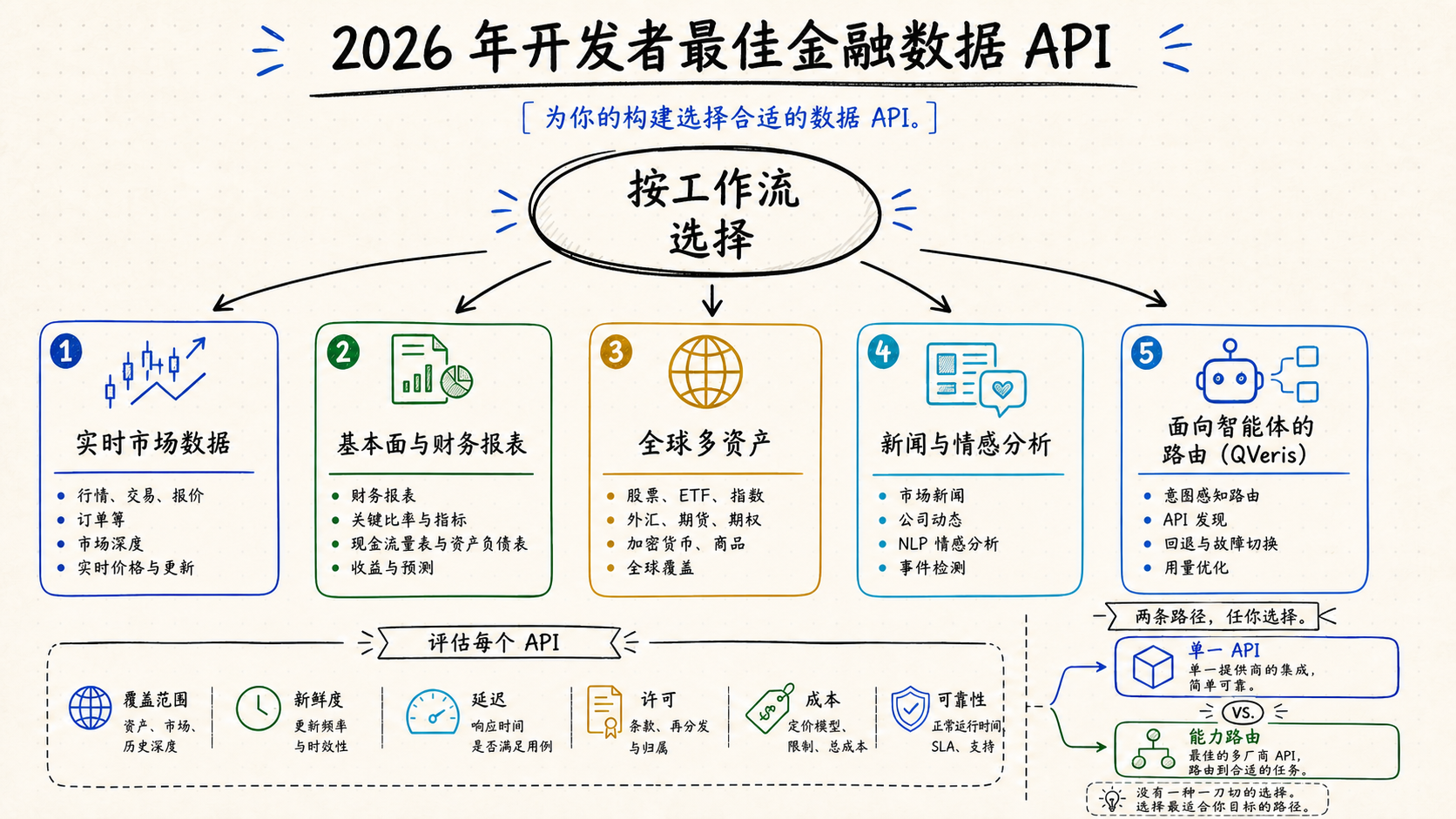
- Problem: Providers package real-time access, history, fundamentals, WebSockets, and commercial rights differently. A low starting price does not prove that the plan supports your intended product.
- Solution: Compare seven APIs by documented coverage, freshness, public entry price, free limits, development experience, licensing, and AI readiness. No unrepeatable latency score is used as a buying shortcut.
- Result: You will leave with a defensible shortlist and a validation checklist for symbols, entitlements, rate limits, streaming recovery, data quality, and total cost.
What are the best financial data APIs in 2026?
Massive is a strong self-serve option for US market data; FMP is suited to financial statements and screening; Twelve Data covers multi-asset workflows; Finnhub supports quick prototypes; Alpha Vantage works for learning and scheduled jobs; EODHD emphasizes international history; and QVeris helps agents discover and call capabilities across providers. The right choice depends on the exact endpoint, entitlement, latency, license, and workload.
Why Finding the Best Financial Data API Is Harder Than It Should Be
Financial data providers optimize for different slices of the stack. A real-time financial data API comparison reveals a fragmented landscape where no single provider dominates across all dimensions:
- Coverage fragmentation: Massive emphasizes US market data, while EODHD publishes broad international coverage. A provider that is strong in prices may not offer the statements, news, corporate actions, or exchange rights your product needs.
- Pricing opacity: Entry-level tiers look affordable ($19-$49/mo), but production-scale costs vary 10x between providers. Most hide enterprise pricing behind sales calls. Rate-limit upgrades often cost more than the data itself.
- Hidden switching costs: Each API uses different symbol formats, date conventions, data normalization rules, and authentication methods. Moving from one provider to another typically requires rewriting every data-fetching layer in your application.
- AI-readiness gap: As of 2026, only a handful of financial data APIs support MCP (Model Context Protocol) or provide SDKs optimized for AI agent workflows. Most still assume a human-in-the-loop making REST calls.
If your application needs data from more than one category — say, real-time prices plus fundamentals plus news sentiment — you face 3x the integration work and 3x the vendor management overhead. For a financial data API for fintech startups looking to move fast, this friction is often the bottleneck that slows your first launch.
How We Selected and Evaluated These APIs
We compared 15+ financial data API providers against six practical criteria using published documentation and product information. Use the same filter with your own workload:
- Data coverage: Does the API cover the asset classes and geographies it claims? Compare advertised exchange lists and cross-reference symbol availability with representative tickers.
- Freshness and reliability: Does the provider publish update frequency, rate limits, streaming behavior, service status, and retry guidance clearly enough for developers to assess production fit? 时效与可靠性:提供商是否清楚公布更新频率、速率限制、流式传输行为、服务状态和重试指引,让开发者能够判断其是否适合生产环境?
- Pricing transparency: Can a developer estimate monthly cost without a sales call? Providers with published pricing scored higher. Enterprise-only pricing was noted but not penalized for mid-market use.
- Developer experience: Documentation quality, SDK availability, code example clarity, and time-to-first-successful-call from signup.
- AI / MCP readiness: Does the provider offer an MCP server, function-calling SDK, or natural-language query interface? This is a 2026 differentiator.
- Data quality: Split/dividend adjustment accuracy, corporate actions handling, and data freshness. Review the provider's adjustment methodology and validate representative tickers against a trusted market source before production use.
Providers outside the final shortlist did not fit the scope or current public-product criteria used for this guide. Confirm live coverage, limits, service guarantees, and pricing with each provider before production use. 未进入最终名单的提供商,不符合本指南的评估范围或当前公开产品标准。用于生产前,请直接向各提供商确认最新覆盖范围、使用限制、服务保证和价格。
Quick Comparison Table
Last verified: . Pricing and plan entitlements can change; verify the provider's current terms before purchasing. For a deeper real-time financial data API comparison, see the individual provider sections below. 最后核验时间:。价格与套餐权益可能变化,购买前请核对提供商的当前条款。更深入的实时金融数据 API 对比请参阅下方各提供商章节。
| Provider | Starting Price | Real-Time | Global Coverage | Fundamentals | WebSocket | MCP / AI Ready | Free Tier |
|---|---|---|---|---|---|---|---|
| Polygon.io | Free; paid from $29/mo | Advanced plan | US+ | ✗ | ✓ | ✗ | 5 calls/min; EOD |
| FMP | Free; paid from $22/mo annual | Paid plans | ✓ | ✓ | ✗ | ✗ | 250 calls/day |
| Twelve Data | Free; paid from $29/mo | ✓ | ✓ | ✗ | ✓ | ✗ | 8 credits/min; 800/day |
| Finnhub | Free; paid data varies | ✓ | US+ | Basic | ✓ | ✗ | 60 req/min |
| Alpha Vantage | Free; premium from $49.99/mo | Premium entitlement | ✓ | Basic | ✗ | ✗ | Up to 25 req/day for most datasets |
| QVeris | Free; Pro $19 | Via called capability | Via called capability | Via called capability | Via called capability | ✓ | 1,000 signup + 100 daily login |
| EODHD | Free; EOD from $19.99/mo | Plan/add-on dependent | ✓ | ✓ | ✓ | ✗ | 20 calls/day |
1. Polygon.io (Massive) — Best for Real-Time US Trading
Polygon.io, now branded Massive, offers separate market-data products for stocks, options, indices, forex, and crypto. For US stocks, the free Basic plan is end-of-day; real-time access appears on the Advanced individual plan, while business use has separate licensing and pricing.
Strengths
- Latency: Validate REST and WebSocket latency with a representative workload in your deployment region; published figures may not match your network or request mix.
- Plan ladder: The public Stocks plans progress from end-of-day data to delayed WebSockets, trades, quotes, and real-time access. This makes freshness and history depth visible before an individual developer subscribes.
- WebSocket reliability: Review documented reconnection behavior and test recovery from disconnects, rate limits, and stale messages before production use.
Limitations
- US-first equity product: Teams needing broad international equity coverage should compare a global provider rather than assume the US Stocks plan includes other exchanges.
- Fundamentals are not the core purchase: If normalized statements, ratios, or transcripts drive the product, compare a fundamentals-focused provider alongside it.
- Entitlements matter: Individual Stocks plans are publicly listed at $0, $29, $79, and $199 per month, but business use, display, redistribution, and exchange rights may require a separate agreement.
2. Financial Modeling Prep — Best for Fundamentals & Financial Statements
Financial Modeling Prep (FMP) combines company fundamentals, financial statements, ratios, market prices, news, and reference data. Its current public plan ladder separates a small free test tier from US-focused Starter access, broader Premium coverage, and global Ultimate coverage.
Strengths
- Financial statement depth: Income statements, balance sheets, cash-flow statements, ratios, and company reference endpoints support research, screening, and modeling.
- Valuation models: DCF calculations, discounted earnings models, and historical valuation percentiles — pre-computed and served through REST endpoints. No spreadsheet work required.
- Published individual pricing: Basic is free with 250 calls per day. When billed annually, Starter is listed at $22 per month, Premium at $59, and Ultimate at $149, with increasing history, geography, and rate limits.
Limitations
- Plan-dependent market access: The free Basic plan is end-of-day, while FMP lists real-time access on paid individual plans. Verify the exact exchange and endpoint entitlement before relying on it for a live product.
- Geography is tiered: Starter is US-focused; Premium adds UK and Canada coverage; global coverage is listed on Ultimate. The cheapest paid tier is not a global plan.
- Licensing needs a separate check: FMP states that displaying or redistributing its data requires a specific data display and licensing agreement.
3. Twelve Data — Best for Global Multi-Asset Coverage
Twelve Data provides a consistent API across equities, ETFs, forex, crypto, indices, and other market-data categories. Its free Basic plan is useful for testing a limited set of markets; paid tiers expand API credits, market access, and WebSocket capacity.
Strengths
- Multi-asset surface: A shared API model across several asset classes can reduce the amount of provider-specific parsing in a global charting or analytics product.
- Technical indicators: 100+ built-in indicators (VWAP, Ichimoku, Elliott Wave) computed server-side. This saves your team from maintaining a technical-analysis library.
- Integration extras: Google Sheets and Excel plug-ins included on paid plans. Useful for teams that blend programmatic access with spreadsheet analysis.
Limitations
- Credit-based capacity: Basic includes 8 API credits per minute and 800 per day. Paid individual plans are publicly listed from $29 per month, but capacity depends on both endpoint credit cost and symbol count.
- Fundamentals require endpoint-level review: Do not infer complete statement, filing, or transcript coverage from the market-data catalog; check every required dataset.
- Free tier is narrow: Basic lists real-time US equities and ETFs, forex, and crypto, but limits users to three markets and only trial WebSocket credits. Full WebSocket access starts higher in the plan ladder.
4. Finnhub — Best for Fast Prototyping & News Sentiment
Finnhub exposes market data, company fundamentals, filings, news, sentiment, and WebSocket feeds through a developer-friendly API. Its public free plan is for personal use and lists 60 API calls per minute plus WebSocket access for up to 50 symbols.
Strengths
- News and sentiment endpoints: These can support watchlists, event summaries, and research workflows without a separate news integration. Validate symbol and market coverage with your own test set.
- Low-friction evaluation: A documented REST surface, free personal-use allowance, and WebSocket trial make it practical to validate a prototype before discussing commercial rights.
- WebSocket on the free plan: The public pricing page lists up to 50 symbols. Confirm exchange entitlements and allowed use before treating this as production market data.
Limitations
- Commercial pricing can be segmented: Data packages and market rights can be priced separately. Estimate the complete production bundle, not only the free request rate.
- Dataset depth varies: Compare statement history, normalization, transcripts, and filing fields against a fundamentals specialist if those are core requirements.
- Sentiment is not a trading guarantee: Treat scores as contextual features. Backtest coverage, timestamp alignment, and predictive value on your own universe before using them in a signal.
5. Alpha Vantage — Best Free Tier for Learning & Prototyping
Alpha Vantage is an accessible starting point for tutorials, personal research, and low-frequency prototypes. Its catalog includes time series, technical indicators, fundamentals, commodities, economic indicators, forex, and crypto, but the free allowance is intentionally small.
Strengths
- Technical indicator library: Over 50 built-in indicators with configurable parameters. SME, STOCH, SAR, and custom period windows — all computed server-side.
- Learning resources: Straightforward HTTP examples and broad community usage make it easy to understand request parameters and prototype a scheduled workflow.
- Broad catalog: Stocks, forex, crypto, commodities, macroeconomic indicators, fundamentals, news, and analytics are discoverable from one documentation surface.
Limitations
- Rate limits: Alpha Vantage's official support guidance states up to 25 free requests per day for most datasets. That is suitable for tutorials and scheduled checks, not continuous monitoring. Verify paid throughput and premium endpoint access on the live pricing and support pages before designing production capacity. 速率限制:Alpha Vantage 官方支持说明称,多数数据集的免费额度最高为每天 25 次请求。这适合教程和定时检查,不适合持续监控。规划生产容量前,请在实时价格页和支持页面核对付费吞吐量与高级端点权限。
- Market freshness is entitlement-based: Alpha Vantage says real-time and 15-minute delayed US stock data are premium and regulated by exchanges. Check entitlement requirements before building a live display.
- No native streaming shortcut: If your product needs persistent WebSocket feeds, verify whether another provider better matches the architecture.
6. QVeris — Best Unified Gateway for Multi-Source Financial Data
QVeris is a capability router rather than a financial data origin. Agents can discover and inspect tools for free, then call a chosen capability through one access layer. This is useful when a workflow spans quotes, filings, news, document parsing, or other providers and services instead of depending on one market-data API.
Strengths
- Discovery before execution: Search for a capability by intent, inspect parameters, latency, success rate, and price, and pay only when the agent makes a call.
- Agent-oriented access: QVeris documents REST, SDK, CLI, and MCP paths, so an agent can work with typed tool schemas instead of scraping provider pages.
- Multi-capability workflow: One agent can combine data retrieval and document or analysis tools while keeping discovery and inspection consistent.
- Cost control: Signup includes 1,000 credits; daily login adds 100 credits that reset each day. Pro is $19 for 10,000 credits, and calls cost 1–100 credits depending on the capability.
Limitations
- Not a data origin: QVeris does not create the underlying market data. Coverage, quality, freshness, and usage rights still depend on the called capability and source.
- Extra layer for simple use cases: A team that needs one stable endpoint from one provider may prefer a direct contract. QVeris becomes more useful as capability discovery and cross-tool orchestration matter.
7. EOD Historical Data (EODHD) — Best for International Exchange Coverage
EODHD provides end-of-day, intraday, fundamental, options, news, macroeconomic, forex, and crypto datasets. Its public materials emphasize 60+ exchanges, 150,000+ tickers, and long historical coverage, making it a practical candidate for international research and backtesting.
Strengths
- Exchange breadth: EODHD publishes coverage across more than 60 exchanges. Validate the actual symbols, history start dates, corporate actions, and freshness required by your product.
- Dataset breadth: Price history can be paired with fundamentals, options, news, calendars, macroeconomic data, and technical endpoints under one vendor catalog.
- Published personal pricing: Free includes 20 calls per day. EOD Historical Data All World is $19.99 per month, EOD plus intraday is $29.99, Fundamentals is $59.99, and All-in-One is $99.99; paid plans list 100,000 calls daily.
Limitations
- Freshness varies by feed: End-of-day, delayed, one-minute-delayed, and real-time/WebSocket products have different coverage and add-ons. Verify the required exchange rather than treating the catalog as uniformly real-time.
- Calls have different costs: Many endpoints use one call, while heavier intraday, news, fundamentals, and options requests can consume more. Capacity planning must use the endpoint-specific call cost.
- Commercial rights are separate: Public personal plans are not a substitute for commercial display or redistribution rights. EODHD publishes separate B2B plans.
How to Choose the Right Financial Data API for Your Stack
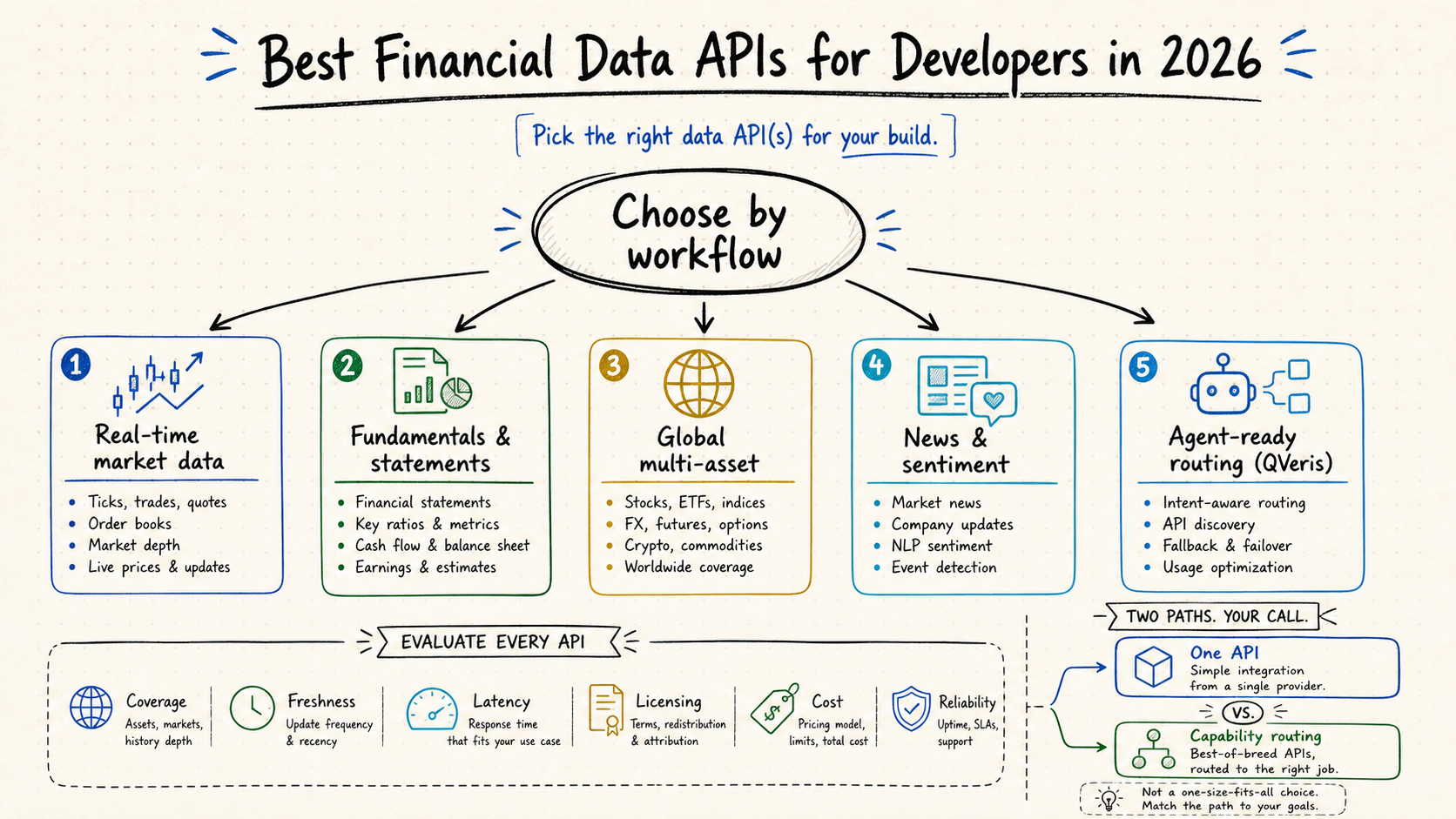
Quick Start: Simplify API Management with QVeris
If your application needs data from multiple providers on this list, QVeris lets an agent discover, inspect, and call financial-data capabilities through one access layer. Keep the source provider's entitlements and licensing in the decision:
Sign up at qveris.ai to receive 1,000 signup credits. QVeris also lists 100 daily-login credits that reset each day. Create an API key and choose REST, SDK, CLI, or MCP based on your agent runtime.
Search by intent, such as a live quote, company fundamentals, or financial news. Inspect candidate schemas, parameters, success rate, latency, and credit price before the agent calls one.
Call the selected capability with explicit symbol, exchange, currency, freshness, and output requirements. Log the source, retrieval time, units, and entitlement so downstream answers can be audited.
One API to connect them all
Discover and inspect for free. Start with 1,000 signup credits and pay only when your agent calls a capability.
Get Started →FAQ
About this Guide
Last updated:
Methodology: Each API was evaluated against published documentation, pricing, coverage, authentication, rate limits, and developer tooling. Validate latency and streaming behavior with a representative workload in your own deployment region before production use.
Key sources:
Update cadence: Reviewed quarterly. Pricing and feature data refreshed every 90 days. Last refreshed: 2026-08-03.