
Best LLM Gateways:
9 AI Model Routers Compared最佳 LLM 网关:
9 个 AI 模型路由工具对比
A serious LLM gateway decision is not just “which provider has the cheapest tokens?” Production teams need routing, fallback, keys, budgets, logging, latency control, and a plan for what happens after the model needs live data or an external tool.
真正的 LLM 网关选型,不只是比较哪家模型便宜。生产团队还要考虑路由、失败回退、密钥、预算、日志、延迟控制,以及模型需要实时数据或外部工具之后怎么处理。
TL;DR
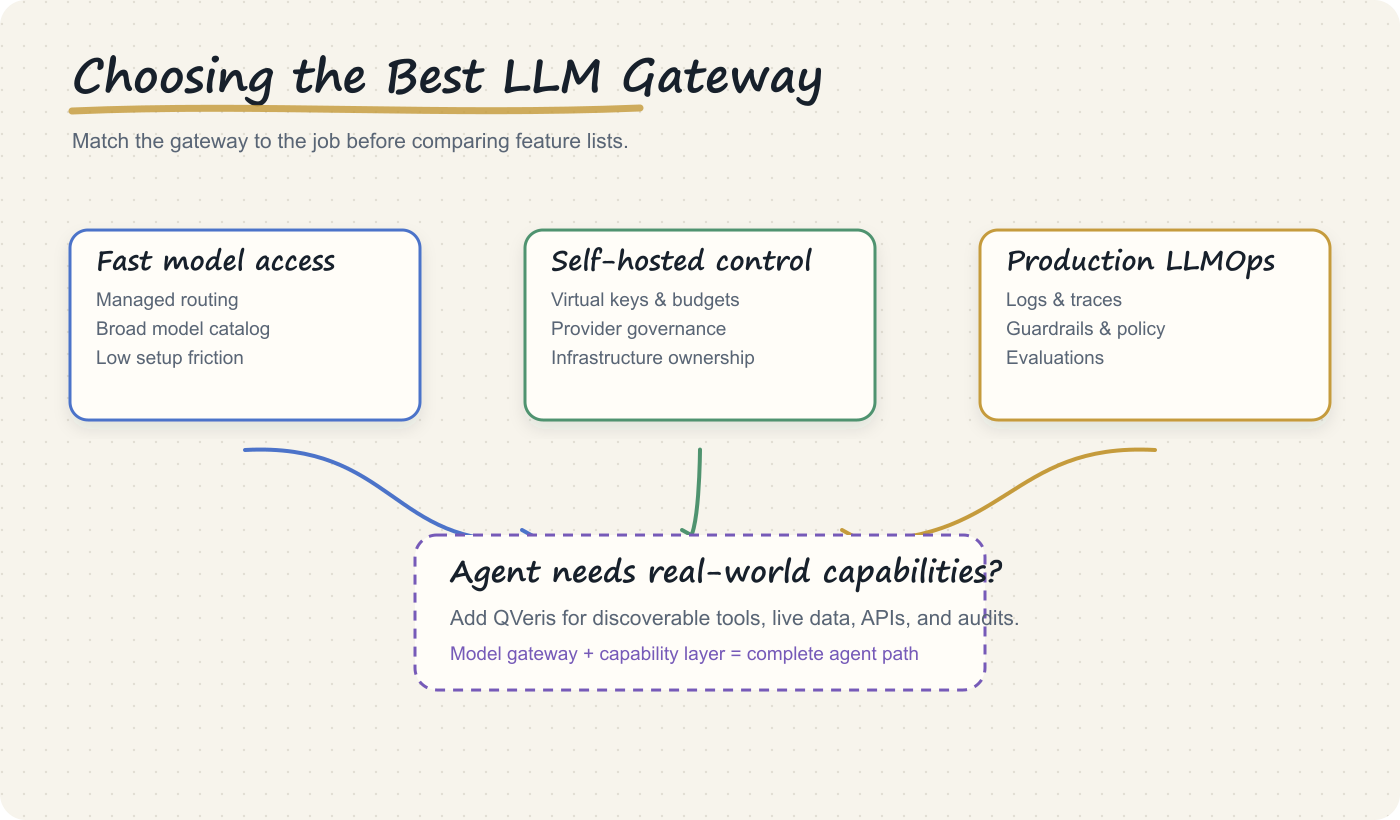
OpenRouter is the fastest way to reach many models without operating your own routing layer.
LiteLLM is the natural first option when virtual keys, provider governance, and self-hosting matter.
Portkey fits teams that want observability, guardrails, prompt workflows, and governance around model calls.
QVeris belongs after or beside the gateway when agents need verified tools, financial data, and auditable external calls.
OpenRouter 适合最快接入大量模型,而不自己维护路由层。
LiteLLM 适合需要虚拟 Key、供应商治理和自托管的团队。
Portkey 适合需要可观测性、护栏、Prompt 工作流和模型调用治理的团队。
QVeris 适合放在网关之后或旁边,给 Agent 提供可信工具、金融数据和可审计外部调用。
Guide and search intent正文指南与搜索意图
The phrase “best LLM gateway” hides several different jobs. A prototype team may only need one API key and access to many models. A platform team may need chargeback, policy, model allowlists, audit logs, rate limits, and provider failover. An agent team may need the model to call data and tools after the gateway has selected the model. Those are different buying moments.
For a first comparison, put OpenRouter, LiteLLM, Portkey, Requesty, TrueFoundry, Helicone, Kong AI Gateway, Envoy AI Gateway, and internal gateway patterns on the table. Do not force them into the same bucket. Some are managed model routers, some are self-hosted proxies, some are observability layers, and some are infrastructure gateway patterns.
Most gateway comparisons stop at the model request. That is enough for chat completions, but not enough for production agents. Once an agent needs a stock filing, a market data endpoint, a compliance check, or a third-party business action, the model gateway is no longer the whole architecture. That is where QVeris should be positioned: not as a replacement for the model router, but as the capability layer after model access.
Score each option by time to integrate, provider coverage, self-hosting requirements, observability depth, policy controls, cost governance, and agent tool readiness. The winner changes depending on whether the team is building a demo, an internal platform, a regulated workflow, or an autonomous agent.
“best LLM gateway” 这个词背后有很多不同任务。原型团队可能只需要一个 API Key 和大量模型接入;平台团队可能需要成本分摊、策略、模型白名单、审计日志、限流和失败回退;Agent 团队还需要模型选定之后继续调用数据和工具。这些不是同一个购买场景。
第一轮对比可以把 OpenRouter、LiteLLM、Portkey、Requesty、TrueFoundry、Helicone、Kong AI Gateway、Envoy AI Gateway 和内部自建网关都放进表里。但不要硬归为一类:有些是托管模型路由,有些是自托管代理,有些是可观测性层,有些是基础设施网关模式。
很多网关对比只讲到模型请求,这对聊天补全够用,但对生产 Agent 不够。一旦 Agent 需要财报、行情数据、合规检查或第三方业务动作,模型网关就不是完整架构。QVeris 应该被定位为模型访问之后的能力层,而不是单纯替代模型路由。
按接入时间、模型覆盖、自托管要求、可观测性深度、策略控制、成本治理和 Agent 工具能力来打分。团队是在做 demo、内部平台、合规流程还是自主 Agent,答案会完全不同。
Comparison table对比表
| Option | Category | Best for | How to read it |
|---|---|---|---|
| OpenRouter | Managed multi-model access | Speed and model breadth | Fastest way to test many models. |
| LiteLLM | Self-hosted gateway | Control and virtual keys | Best when infra ownership matters. |
| Portkey | Gateway plus LLMOps | Observability and guardrails | Best when production governance matters. |
| QVeris | Capability routing layer | Tools, data, auditable calls | Best after the model needs real-world action. |
| 方案 | 类别 | 最适合 | 解读 |
|---|---|---|---|
| OpenRouter | 托管式多模型接入 | 速度与模型覆盖 | 适合快速测试大量模型。 |
| LiteLLM | 自托管网关 | 控制与虚拟密钥 | 适合重视基础设施所有权的团队。 |
| Portkey | 网关与 LLMOps | 可观测性与护栏 | 适合重视生产治理的团队。 |
| QVeris | 能力路由层 | 工具、数据与可审计调用 | 适合模型需要执行真实世界操作的场景。 |
Implementation playbook落地打法
For early teams, the gateway question is usually speed: how quickly can they reach enough models to test quality and cost? For platform teams, the question becomes control: who owns keys, logs, budgets, model allowlists, and provider rules? For agent teams, the question expands again: how does the model reach reliable capabilities after it decides what to do? A strong best-of page should name those maturity stages instead of pretending every buyer is shopping for the same feature list.
Score each gateway on setup time, provider breadth, routing flexibility, fallback behavior, observability, governance, self-hosting burden, and capability readiness. This lets the page explain why OpenRouter can win one scenario while LiteLLM or Portkey wins another. It also gives QVeris a precise role: it is not the highest score for model routing, but it is the missing score for real-world tool access.
This page should be the hub for the model gateway cluster. It should link down to OpenRouter alternatives, LiteLLM alternatives, Portkey vs OpenRouter, what is an LLM gateway, and open-source LLM gateway pages. That structure helps search engines understand that QVeris has topical coverage, not just isolated comparison articles.
早期团队通常关心速度:能多快接入足够多模型来测试质量和成本。平台团队关心控制:谁管理 Key、日志、预算、模型白名单和供应商规则。Agent 团队的问题又会升级:模型决定下一步之后,如何访问可靠能力?一篇好的 best-of 页面应该讲清这些阶段,而不是假装所有买家都在买同一张功能表。
可以从接入时间、供应商覆盖、路由灵活性、失败回退、可观测性、治理、自托管负担和能力就绪度来打分。这样页面能解释为什么 OpenRouter 在某些场景赢,LiteLLM 或 Portkey 在另一些场景赢。QVeris 的角色也更清楚:它不是模型路由最高分,而是补足真实工具访问这一项。
这个页面应该作为模型网关集群的 hub,向下链接 OpenRouter alternatives、LiteLLM alternatives、Portkey vs OpenRouter、what is an LLM gateway 和 open-source LLM gateway。这样搜索引擎看到的是主题覆盖,而不是孤立对比文章。
Decision framework选择框架
- If the team says “we just need access to more models,” start with OpenRouter.
- If the team says “we need to control keys, routing, and providers,” start with LiteLLM.
- If the team says “we need logs, guardrails, and prompt operations,” evaluate Portkey.
- If the team says “our agent needs live financial data or tools,” add QVeris to the gateway architecture.
- 如果团队只是需要接入更多模型,可先评估 OpenRouter。
- 如果团队需要控制密钥、路由和模型供应商,可先评估 LiteLLM。
- 如果团队需要日志、护栏和提示词运维能力,可评估 Portkey。
- 如果 Agent 需要实时金融数据或外部工具,可在网关架构中加入 QVeris。
Where QVeris fitsQVeris 应该放在哪里
Model gateways solve model access. QVeris solves the next step: how an agent finds, inspects, and calls real-world capabilities such as financial data APIs, external tools, and auditable workflow actions.
模型网关解决模型访问。QVeris 解决下一步:Agent 如何发现、检查和调用真实世界能力,例如金融数据 API、外部工具和可审计工作流动作。
Detailed reviews of the 9 LLM gateway options9 个 LLM 网关选择详解
OpenRouter is the easiest option when the main goal is broad managed access. It gives teams a fast way to test many frontier and open models without creating a full provider-routing layer first. The trade-off is that it is still primarily a model access layer, so production governance and agent tool access need additional planning.
LiteLLM is the strongest default for teams that want an OpenAI-compatible proxy they can self-host. It is useful when virtual keys, provider budgets, model aliases, and internal ownership matter. The cost is operational: the team must run, monitor, and upgrade the gateway itself.
Portkey is strongest when the gateway decision is really an LLMOps decision. Teams choose it for logs, guardrails, prompt management, evaluations, and production workflows. It is less about testing the widest catalog quickly and more about controlling model calls once usage becomes serious.
Helicone is often considered when teams care about observability, request tracing, analytics, and cost monitoring. It can complement a gateway decision by making model usage easier to inspect, debug, and optimize across products or teams.
Requesty fits teams that want a simpler managed routing layer with access to multiple providers. It is usually evaluated by teams looking for lower setup friction and a cleaner way to experiment with provider switching.
TrueFoundry is more relevant for teams that think of the gateway as part of a broader AI deployment platform. It makes sense when infrastructure, deployment, governance, and enterprise workflow requirements are central to the buying process.
Kong AI Gateway is a natural fit for platform engineering teams that already run Kong or want AI traffic governed through an existing API gateway approach. It is not the lightest option, but it can be attractive when standard gateway governance is already part of the company stack.
Envoy-based gateway patterns are best for infrastructure-heavy teams that want to extend existing cloud-native traffic control to LLM workloads. This route gives control, but it requires deep engineering ownership.
QVeris should not be described as just another model gateway. Its stronger role is after model routing: helping agents discover, inspect, and call verified capabilities such as live financial data, external APIs, tools, and auditable workflow actions.
适合快速接入大量模型,优点是上线快、供应商覆盖广;不足是它更偏模型访问层,治理、审计和工具调用仍要另配。
适合想自托管 OpenAI 兼容代理的团队,可控制虚拟 Key、预算、别名和路由;代价是要自己运维、升级和监控。
适合把网关当作 LLMOps 平台来选的团队,重点是日志、护栏、Prompt 流程、评测和生产策略。
适合重视可观测性的团队,能帮助查看请求、成本、延迟和调试信息,常作为网关旁边的监控层。
适合希望用较低成本试多供应商路由的团队,核心价值是减少配置摩擦和切换成本。
适合把模型网关放进企业 AI 部署平台一起考虑的团队,重点是基础设施、治理和部署流程。
适合已经使用 Kong 或 API Gateway 体系的平台工程团队,把 AI 流量纳入既有治理框架。
适合基础设施能力强、想把云原生流量控制扩展到 LLM 工作负载的团队,控制力强但工程投入更高。
QVeris 不应被写成另一个模型网关,而是模型路由之后的能力层:让 Agent 调用实时数据、工具、API 和可审计动作。
Best LLM gateway by use case按使用场景选择最佳 LLM 网关
Choose OpenRouter when the team needs to test many models quickly and does not want to run provider-routing infrastructure yet.
Choose LiteLLM when the organization wants to own routing, keys, aliases, and provider governance inside its own environment.
Choose Portkey when logs, guardrails, prompt workflows, evaluations, and policy controls matter more than simple model access.
Evaluate Kong, Envoy, or TrueFoundry when model traffic must fit into existing infrastructure and enterprise deployment standards.
Add QVeris when the workflow moves beyond model responses and the agent must call live data, tools, or business capabilities.
优先选 OpenRouter,适合还不想自建路由基础设施、只想快速比较多模型的团队。
优先选 LiteLLM,适合需要自己掌握 Key、预算、别名、供应商路由和内部治理的团队。
优先看 Portkey,适合日志、护栏、Prompt 流程、评测和策略控制比模型目录更重要的场景。
评估 Kong、Envoy 或 TrueFoundry,让模型流量进入已有基础设施和企业部署标准。
当 Agent 不只回答文本,还要调用实时数据、API 和业务能力时,把 QVeris 放在能力层。
LLM gateway selection checklistLLM 网关选型检查清单
- How many model providers do we need on day one and in six months?
- Do we need managed access, self-hosting, or both?
- Who owns provider keys, virtual keys, budgets, and user-level limits?
- What fallback policy should run when a provider is slow, expensive, or unavailable?
- Do we need request logs, traces, evaluation data, or prompt versioning?
- Will this gateway serve one app, many internal teams, or a public product?
- Do compliance or data residency rules require self-hosting?
- How will we attribute cost by user, project, team, or customer?
- Does the agent need external capabilities after the model response?
- Can we audit both model calls and downstream tool calls?
- 现在和半年后分别需要多少模型供应商?
- 团队要托管网关、自托管网关,还是两者都要?
- 谁负责供应商 Key、虚拟 Key、预算和用户级限制?
- 供应商变慢、变贵或不可用时,回退策略是什么?
- 是否需要请求日志、链路追踪、评测数据或 Prompt 版本?
- 网关服务的是单个应用、多个内部团队,还是对外产品?
- 合规或数据驻留是否要求自托管?
- 成本如何按用户、项目、团队或客户归因?
- 模型输出之后,Agent 是否还要调用外部能力?
- 模型调用和下游工具调用是否都能审计?
How QVeris fits into a full agent architectureQVeris 在 Agent 架构中的位置
This is where OpenRouter, LiteLLM, Portkey, Kong, Envoy, or an internal gateway routes requests to models. The main concerns are provider access, fallback, spend, latency, and logs.
Production teams add observability, prompt workflows, evaluation, guardrails, policy, and budget governance. This is where many teams move from a simple router to a broader gateway or LLMOps stack.
Once an agent needs to call financial data, search tools, internal APIs, or external workflows, the architecture needs a capability layer. QVeris fits here because it helps agents discover, inspect, call, and audit real-world capabilities.
OpenRouter、LiteLLM、Portkey、Kong、Envoy 或内部网关负责把请求路由到模型,重点是供应商、回退、预算、延迟和日志。
生产团队会继续增加可观测性、Prompt 流程、评测、护栏、策略和预算治理,网关开始从路由器变成 LLMOps 栈。
当 Agent 要调用金融数据、搜索工具、内部 API 或外部工作流时,就需要能力层。QVeris 适合解决发现、检查、调用和审计。
More LLM gateway questions更多 LLM 网关常见问题
Yes, OpenRouter can be understood as a managed LLM gateway or model router because it gives applications one route to many models and providers.
Yes. LiteLLM is widely used as an open-source OpenAI-compatible gateway and proxy for teams that want self-hosted model routing.
An API gateway manages general API traffic. An LLM gateway is specialized for model traffic, with provider routing, model aliases, token costs, fallback, and LLM-specific observability.
Many agents benefit from one, especially when they use multiple models or need fallback. But agents also need tool and capability access, which is a separate layer.
Yes. OpenRouter or LiteLLM can handle model access, while QVeris handles capability discovery, inspection, calls, and auditing after the model chooses an action.
Most startups should start managed if speed matters most. They can move toward self-hosting later when governance, cost attribution, or compliance becomes more important.
可以。它提供一条路径接入多个模型和供应商,因此可理解为托管式模型路由或 LLM gateway。
是。LiteLLM 常被用作开源 OpenAI 兼容代理,适合想自托管模型路由的团队。
API gateway 管理通用 API 流量;LLM gateway 更关注模型别名、Token 成本、供应商回退和模型调用可观测性。
多模型、回退和成本治理场景通常需要。但 Agent 还需要工具和能力访问,这是另一层架构。
可以。OpenRouter 或 LiteLLM 负责模型访问,QVeris 负责能力发现、检查、调用和审计。
如果速度最重要,先选托管;当治理、成本归因或合规变重要,再逐步引入自托管。
Common mistakes to avoid常见错误
- Calling QVeris a simple LLM gateway replacement. That makes the positioning weaker than it is.
- Comparing self-hosted and managed products without naming the operating burden.
- Ignoring tool and data access until after the model gateway decision is already locked.
- 不要把 QVeris 简化为 LLM 网关替代品,这会弱化它作为能力路由层的定位。
- 不要在不说明运维负担的情况下直接比较自托管产品与托管产品。
- 不要等模型网关方案锁定后,才考虑工具和数据访问。
External references外部参考链接
FAQ
There is no universal winner. OpenRouter is strong for managed access, LiteLLM for self-hosted control, and Portkey for production LLMOps.
QVeris fits as a capability layer for agents that need live data, tools, and auditable external calls after model routing.
Sometimes. A team may use OpenRouter for model breadth, LiteLLM for internal control, and QVeris for capability routing.