
Best LLM Router
Match the Route to the Workload
最佳 LLM 路由器:让路由策略匹配工作负载
A router that minimizes cost can reduce quality; a quality router can miss regional or privacy constraints; a fallback router can hide duplicate work. Choose the decision policy, evidence, and ownership model before choosing a product.
最低成本路由可能降低质量,质量路由可能忽视区域或隐私约束,回退路由可能隐藏重复工作。应先选择决策策略、证据与责任模型,再选择产品。
TL;DR
Provider routing chooses a host for one model; model routing chooses among models; workload routing classifies the task before either decision.
Privacy, region, parameter support, context, safety, modality and contract restrictions must filter candidates before cost or latency optimization.
Record policy version, eligible set, scores, selected route, fallback reason, retries, usage, price, latency, quality signal and final outcome.
No router wins every workload. Evaluate support, extraction, coding, long context, tools, multimodal and batch jobs separately.
供应商路由为同一模型选择托管方;模型路由在模型间选择;工作负载路由先对任务分类。
隐私、区域、参数支持、上下文、安全、模态与合同限制必须在成本或延迟优化前过滤候选。
记录策略版本、合格集合、评分、所选路由、回退原因、重试、用量、价格、延迟、质量信号与最终结果。
没有路由器能赢下所有负载;应分别评估客服、抽取、编码、长上下文、工具、多模态与批处理。
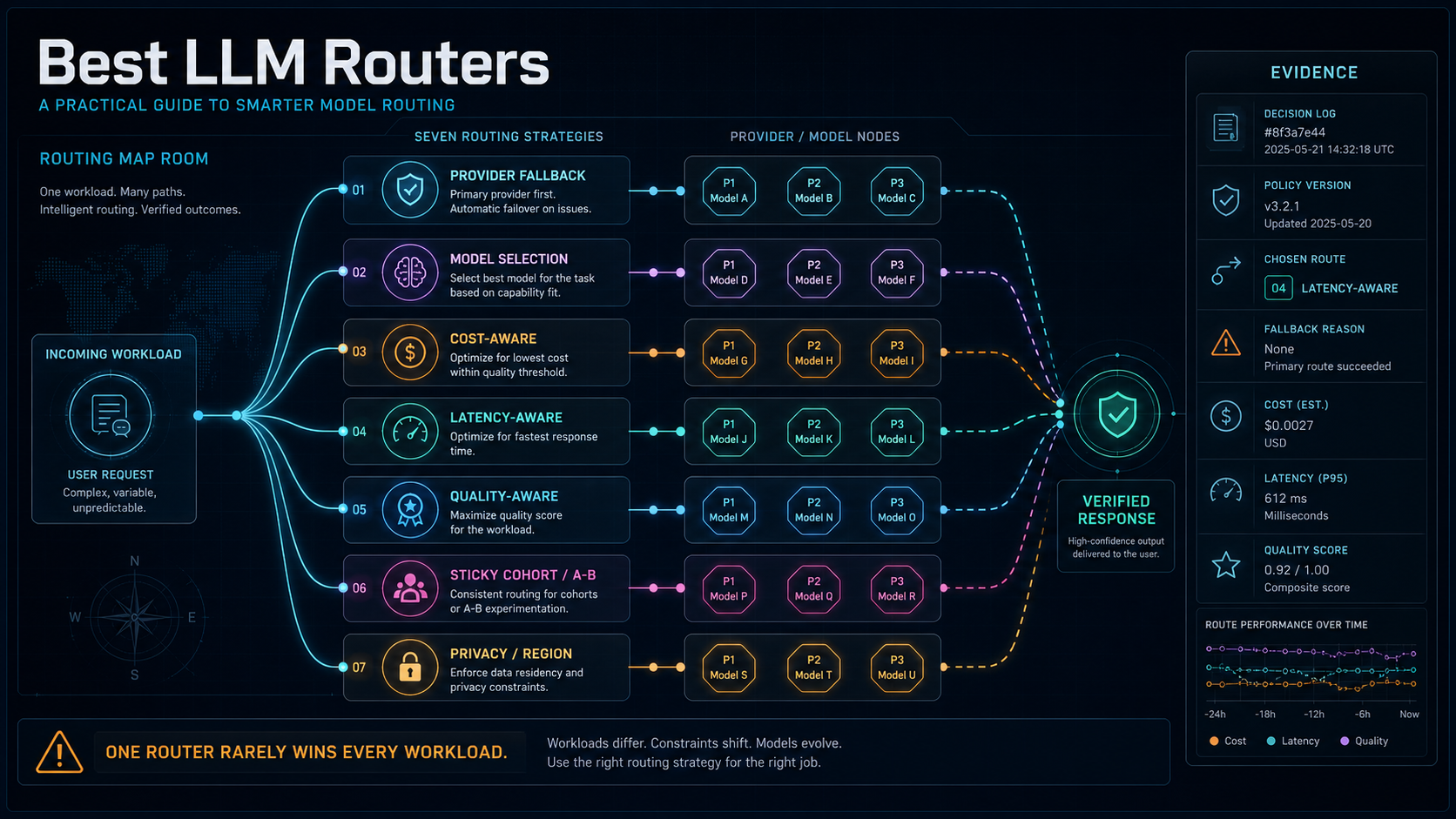
Seven routing strategies solve different failure modes 七种路由策略解决不同故障
Provider fallback improves availability for the same logical model. Model selection trades quality, latency and price across models. Cost-aware and latency-aware strategies optimize measurable resources, while quality-aware routing needs reliable task-specific evaluators.
供应商回退提升同一逻辑模型的可用性;模型选择在不同模型间权衡质量、延迟与价格;成本/延迟感知策略优化可测资源,质量感知路由则需要可靠的任务特定评估器。
Sticky routing keeps a user or experiment cohort stable. Privacy and region routing enforce eligibility. In production these become a pipeline: filter ineligible routes, score the remainder, choose, execute, observe, and update evidence without silently changing policy.
粘性路由保持用户或实验分组稳定;隐私/区域路由强制资格约束。生产中它们应形成管线:过滤不合格路由、为剩余候选评分、选择、执行、观测,并在不暗改策略的前提下更新证据。
Router options by operating model 按运营模型比较路由器
| Router 路由器 | Best fit 最适合 | Verify before choosing 选择前验证 |
|---|---|---|
| LiteLLM Router LiteLLM 路由器 | Self-hosted or embedded routing across broad providers, with retries, fallbacks, budgets and a Python-oriented ecosystem. 跨广泛供应商的自托管或嵌入式路由,含重试、回退、预算与 Python 生态。 | Validate deployment health, provider adapters, policy behavior, telemetry, databases, HA and upgrade ownership. 验证部署健康、供应商适配器、策略行为、遥测、数据库、高可用与升级责任。 |
| Portkey Configs Portkey Configs | Governed gateway routing with retries, fallbacks, load balancing, caching, conditional policy, budgets and guardrails. 受治理网关路由,包含重试、回退、负载均衡、缓存、条件策略、预算与护栏。 | Test config precedence, synchronous guardrails, data path, evidence export, edition scope and operating cost. 测试 Config 优先级、同步护栏、数据路径、证据导出、版本范围与运营成本。 |
| Bifrost Routing Bifrost Routing | Self-hosted provider/model routing, automatic failover, load balancing, virtual-key policy and Go integration. 自托管供应商/模型路由、自动回退、负载均衡、虚拟密钥策略与 Go 集成。 | Verify protocol and provider coverage, cluster failure behavior, scoring flexibility, support and team readiness. 验证协议/供应商覆盖、集群故障行为、评分灵活性、支持与团队准备度。 |
| Kong AI Routing Kong AI Routing | AI routing inside an enterprise gateway and plugin model with identity, governance and broader API controls. 在企业网关与插件模型内实现 AI 路由,并结合身份、治理与更广 API 控制。 | Map plugin and edition requirements, route types, configuration complexity, data-plane latency and control-plane dependency. 核对插件与版本要求、路由 Type、配置复杂度、数据平面延迟与控制平面依赖。 |
| OpenRouter OpenRouter | Managed model and provider aggregation with provider ordering, fallbacks and filters for parameters, price, latency and privacy. 托管模型/供应商聚合,可按顺序、回退及参数、价格、延迟、隐私过滤路由。 | Verify provider provenance, model endpoint differences, parameter fidelity, data policy, billing and lock-in. 验证供应商来源、模型端点差异、参数保真度、数据策略、计费与锁定。 |
| Requesty Requesty | Managed cost and model routing with budgets, BYOK, sticky cohorts, experiments, observability and provider resilience. 托管成本/模型路由,包含预算、BYOK、粘性分组、实验、可观测性与供应商韧性。 | Test scoring policy, cohort identity, fallback semantics, data handling, evidence export and real-traffic economics. 测试评分策略、分组身份、回退语义、数据处理、证据导出与真实流量经济性。 |
| Vercel AI Gateway Vercel AI 网关 | Managed provider and model fallback with catalog metadata, routing controls, budgets and AI SDK integration. 托管供应商/模型回退,结合目录元数据、路由控制、预算与 AI SDK 集成。 | Verify current model/provider availability, supported protocol surfaces, policy depth, data terms and platform coupling. 验证当前模型/供应商可用性、协议面、策略深度、数据条款与平台耦合。 |
A router policy should be explainable 路由策略必须可解释
Remove routes that fail modality, context, parameter, region, privacy, contract, safety, capacity or budget constraints.
Use explicit weights for predicted quality, cost, first-token latency, total latency, throughput, availability and cache value.
Add hysteresis, minimum dwell time, sticky cohorts and versioned policies so small metric noise does not cause route thrashing.
Define eligible errors, attempt count, total deadline, model-change rules, streaming behavior, duplicate risk and final failure semantics.
Track schema validity, task quality, user acceptance, escalation, retries and cost per accepted result—not just tokens or HTTP 200.
Preserve provider-specific parameters and pinned routes for workloads whose critical capabilities do not survive normalization.
先排除不满足模态、上下文、参数、区域、隐私、合同、安全、容量或预算约束的路由。
对预测质量、成本、首 Token 延迟、总延迟、吞吐、可用性与缓存价值使用明确权重。
加入迟滞、最短驻留时间、粘性分组与版本化策略,避免细小指标噪声导致路由抖动。
定义可回退错误、尝试次数、总截止时间、模型变更规则、流式行为、重复风险与最终失败语义。
跟踪结构定义有效性、任务质量、用户接受、升级、重试与每个可接受结果成本,而非只看 Token 或 HTTP 200。
为关键能力无法经受标准化的负载保留供应商特定参数与固定路由。
Build a route-decision benchmark 构建路由决策基准
- Label representative workloads with hard constraints, accepted-quality thresholds, latency SLOs and maximum cost.
- Run pinned baselines for every candidate model/provider before evaluating dynamic routing.
- Simulate price change, latency degradation, capacity saturation, provider outage, evaluator drift and region restriction.
- Verify decision logs can reproduce the eligible set, scores, chosen route, fallback chain and bill.
- Canary by workload, enforce rollback thresholds, and compare cost per accepted outcome for at least two weeks.
- 为代表性负载标注硬约束、可接受质量阈值、延迟 SLO 与最高成本。
- 在评估动态路由前,为每个候选模型/供应商运行固定基线。
- 模拟价格变化、延迟劣化、容量饱和、供应商中断、评估器漂移与区域限制。
- 验证决策日志能重现合格集合、评分、所选路由、回退链与账单。
- 按工作负载灰度,设置回滚阈值,并至少两周比较每个可接受结果成本。
Route with a deterministic evidence pipeline 用确定性证据管线路由
Separate the router into candidate catalog, hard eligibility filters, scoring policy, execution adapter, telemetry and evaluation feedback. Version catalog metadata and policy inputs. At request time, freeze the eligible set and score vector into the trace so later metric changes cannot rewrite history. Use online signals for health, but promote quality changes through reviewed policy versions.
把路由器分为候选目录、硬资格过滤、评分策略、执行适配器、遥测与评估反馈。对目录元数据与策略输入版本化;请求时把合格集合与评分向量冻结到调用链,避免后续指标变化改写历史。在线信号可用于健康状态,但质量变化应通过评审后的策略版本发布。
Production rule: a route decision you cannot reproduce is not governed, even if its average benchmark score looks good.
生产规则:无法重现的路由决策就不受治理,即使平均基准分数很好。
Model routing and capability routing are sequential 模型路由与能力路由是连续决策
An LLM router chooses how the agent reasons. QVeris chooses which external API, tool, service or live dataset can complete the intended action through Discover, Inspect and Call. Keep their catalogs, policies and retry semantics separate, then join evidence in one workflow trace.
LLM 路由器决定智能体如何推理;QVeris 通过 Discover、Inspect、调用选择哪个外部 API、工具、服务或实时数据集完成预期行动。两者的目录、策略与重试语义应分开,再在同一工作流调用链中连接证据。
The Production Operating Model for a best-fit LLM router最适合工作负载的 LLM Router的生产运营模型
For Best LLM Router, reliability begins when reliable only when requirements, policy, failure behavior, evidence, and ownership are explicit. Turn the diagram into an operating contract that can be tested before launch and during every change.
针对“最佳 LLM 路由器”,只有当需求、策略、失败行为、证据和责任都明确时,架构才会真正可靠。应把架构图转成运营契约,并在上线前和每次变更期间持续测试。
Inventory task classes, required capabilities, quality thresholds, context, structured output, tools, regions, safety, latency objectives, budgets, and explainable route reasons. For each workflow, set quality, availability, p50 and tail latency, freshness, privacy, regional, cost, and recovery objectives instead of applying one global policy.
盘点任务类别、必需能力、质量门槛、上下文、结构化输出、工具、区域、安全、延迟目标、预算和可解释路由原因。为每类工作流分别设置质量、可用性、常规与长尾延迟、新鲜度、隐私、区域、成本和恢复目标,而不是套用一个全局策略。
For Best LLM Router, first reject routes that fail capability, authorization, residency, safety, health, or budget constraints. Only then optimize among eligible candidates. Version the policy and record the reason for every decision and override.
针对“最佳 LLM 路由器”,先排除不满足能力、授权、驻留、安全、健康或预算约束的路由,再在合格候选项中优化。版本化策略,并记录每次决策与覆盖的原因。
To validate Best LLM Router, inject rate limits, slow streams, malformed output, stale control data, credential loss, regional failure, quota exhaustion, schema drift, and dependent-tool outages. Verify bounded retries, semantic fallback, partial results, and safe recovery.
验证“最佳 LLM 路由器”时,注入限流、慢速流、畸形输出、过期控制数据、凭证丢失、区域故障、配额耗尽、Schema 漂移和依赖工具中断,验证有界重试、语义故障切换、部分结果和安全恢复。
When operating Best LLM Router, trace request, policy version, candidate set, selected route, transformations, attempts, latency, usage, cost, validation, and final task result. Tie alerts to runbooks, assign owners, and use incidents to update tests and acceptance thresholds.
运营“最佳 LLM 路由器”时,追踪请求、策略版本、候选集合、所选路由、转换、尝试、延迟、用量、成本、校验和最终任务结果,把告警连接到运行手册,明确负责人,并用事故更新测试与验收门槛。
FAQ
It selects a model, provider endpoint or fallback path for a request using policy and operational signals.
Fallback is one reactive strategy after failure. Routing can proactively filter and score candidates before the first attempt.
A classifier or evaluator can help, but it needs hard constraints, calibration, drift monitoring, versioned policy and deterministic overrides.
Use hysteresis, minimum sample sizes, dwell time, sticky cohorts, health windows and reviewed policy promotion.
它使用策略与运行信号,为请求选择模型、供应商端点或回退路径。
回退是失败后的反应式策略之一;路由可在首次尝试前主动过滤并评分候选。
分类器或评估器可以辅助,但必须配合硬约束、校准、漂移监控、版本化策略与确定性覆盖。
使用迟滞、最小样本量、驻留时间、粘性分组、健康窗口与经评审的策略发布。