
Best Stock API for AI Agents:
2026 Guide
Compare stock APIs for quotes, history, filings, news, fundamentals, and production-ready AI agent workflows.
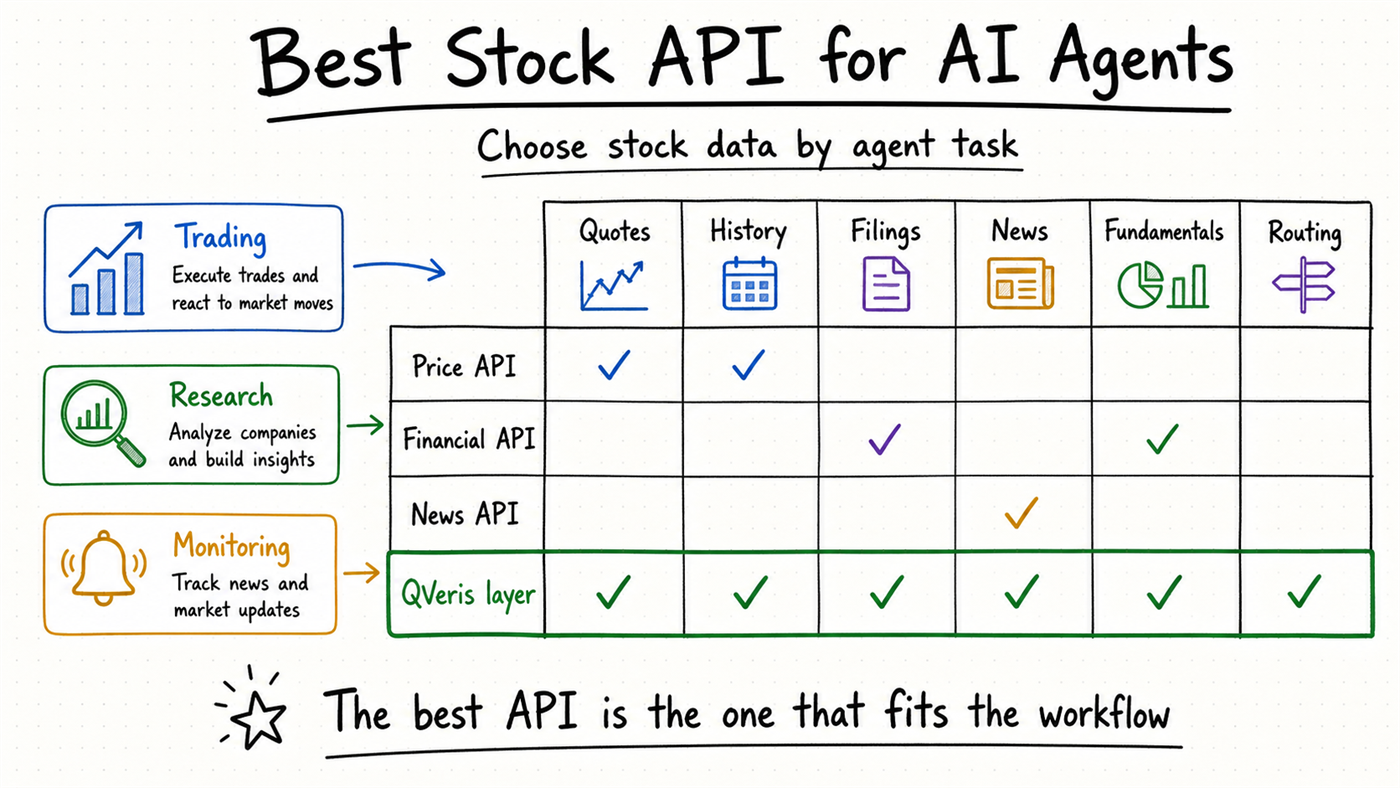
What Makes the Best Stock API for AI Agents Different
A human dashboard can tolerate a narrow stock API. An AI agent cannot. A production agent must decide which data to fetch, inspect whether the data is fresh enough, cite where it came from, and combine market data with news, filings, fundamentals, and historical context before it writes an answer.
That is why a strong stock API strategy for agents is not only about price or request limits. It is about source coverage, schema clarity, latency, fallback options, and whether the result can be used safely by a model that may act autonomously.
Best Stock API Selection Criteria for AI Agents
Use these criteria before choosing a provider. The same stock API can be excellent for a chart app and weak for an agent that needs to explain, monitor, and cite.
Check exchange coverage, delay rules, intraday updates, market hours, and whether the API returns timestamps.
Agents often need prior ranges, volatility, volume baselines, splits, dividends, and adjusted prices.
For research agents, quotes are not enough. They need revenue, margins, cash flow, valuation, and company profiles.
A price move is usually explained by news, earnings, guidance, macro events, or analyst actions.
Agents need traceable filings, dates, accession numbers, source links, and risk-factor sections.
Clear parameters, structured JSON, error messages, and fallback metadata matter more than a long endpoint list.
Best Stock API Options for AI Agents in 2026
There is no single best stock API for every agent. The best provider depends on whether the agent is building a quote snapshot, a research brief, a market monitor, a trading workflow, or a compliance-aware data pipeline.
| Option | Best for | Agent limitation |
|---|---|---|
| Polygon.io | Real-time and historical market data with strong developer APIs. | Agents still need news, filings, fundamentals, and routing logic around the raw data. |
| Alpha Vantage | Accessible financial data endpoints and developer experimentation. | Rate limits, coverage depth, and production reliability must be evaluated carefully. |
| Financial Modeling Prep | Fundamentals, financial statements, company profiles, ratios, and market data. | Agents may need additional real-time, filings, news, or cross-provider fallback logic. |
| Finnhub | Market data, company news, estimates, transcripts, and sentiment-oriented workflows. | Agent workflows still need schema inspection and source-aware routing across tasks. |
| QVeris | Agent workflows that need to discover, inspect, and call the right financial capability. | Best used as the routing layer across data providers, not as a narrow single-source API. |
Free Stock API vs Paid Stock API for AI Agents
Free stock APIs are excellent for prototypes, demos, and low-volume research. They help developers validate the agent workflow before paying for production data. But production agents often hit limits quickly: delayed quotes, narrow exchange coverage, missing fundamentals, unavailable filings, or strict request ceilings.
The best approach is layered. Start with a free stock API comparison to understand the baseline, then route higher-value tasks to paid capabilities when freshness, coverage, or source quality matters. This page should sit next to the high-performing QVeris guide on free stock API options, not replace it.
Stock API Use Cases for AI Agents
Combines quotes, history, fundamentals, earnings, filings, and news into a cited research brief.
Watches unusual price, volume, sector, or news changes and routes alerts to the right workflow.
Uses market data for research, risk checks, and monitoring. It should not act without guardrails.
Compares reported results, analyst expectations, price movement, guidance, and news context.
Monitors exposure, correlations, drawdowns, volatility, macro events, and company-specific risk.
Keeps timestamps, source URLs, and provider metadata so analysts can audit the answer.
How QVeris Routes Stock APIs for AI Agents
Example Stock API Workflow for an AI Agent
The agent should not call a random quote endpoint and then guess the rest. It should inspect what the task requires, pull the right data types, and keep source evidence attached.
# User asks: "Why did NVDA move today?"
intent = "latest NVDA price move with news and historical context"

tools = qveris.discover(intent)

quote_schema = qveris.inspect("market.real_time_quote")
news_schema = qveris.inspect("news.company_events")
history_schema = qveris.inspect("market.historical_prices")

quote = qveris.call("market.real_time_quote", {"symbol": "NVDA"})
news = qveris.call("news.company_events", {"symbol": "NVDA", "lookback": "24h"})
history = qveris.call("market.historical_prices", {"symbol": "NVDA", "range": "30d"})

agent.write_brief(
    data=[quote, news, history],
    require_sources=True,
    include_uncertainty=True
)
Best Stock API Comparison for Agent Workflows
| Agent need | What to check | Why it matters |
|---|---|---|
| Real-time answer | Delay, exchange, timestamp, market hours, and quote freshness. | A stale quote can produce a confident but wrong market explanation. |
| Research brief | Financials, estimates, filings, news, and source links. | Agents need evidence before producing an investment research narrative. |
| Alerting workflow | Rate limits, webhooks, polling cost, duplicate suppression, and fallback. | Poor alert design can create high API bills and noisy signals. |
| Compliance review | Source URLs, provider notes, timestamps, and auditability. | Analysts need to verify where an agent got its claims. |
Best Stock API Mistakes to Avoid
Free tiers are useful, but production agents also need coverage, freshness, and fallback.
If the model cannot cite a timestamp or source URL, the answer becomes harder to trust.
Quotes, filings, news, and fundamentals often come from different best-fit sources.
Agents fail when they guess parameters instead of inspecting expected inputs.
Repeated stock API calls can create waste when the agent lacks caching and routing rules.
Agents should support research and monitoring with guardrails, not produce unverified trading advice.
When QVeris Is the Better Layer
If your application only needs a single quote widget, a direct stock price API may be enough. If your AI agent needs to decide which data source to call, explain market moves, compare providers, cite sources, and control cost, QVeris is better used as the routing layer above stock APIs.
This page is designed to support the broader QVeris stock API cluster. It should link to the high-performing free stock API comparison, the real-time stock price API guide, and related market data pages so Google sees a coherent topic network.