
COMPETITOR COMPARISON
Bifrost AI Gateway Alternatives: Beyond Headline Speed
Evaluate Bifrost AI Gateway for routing control, compatibility, observability, and operating cost.
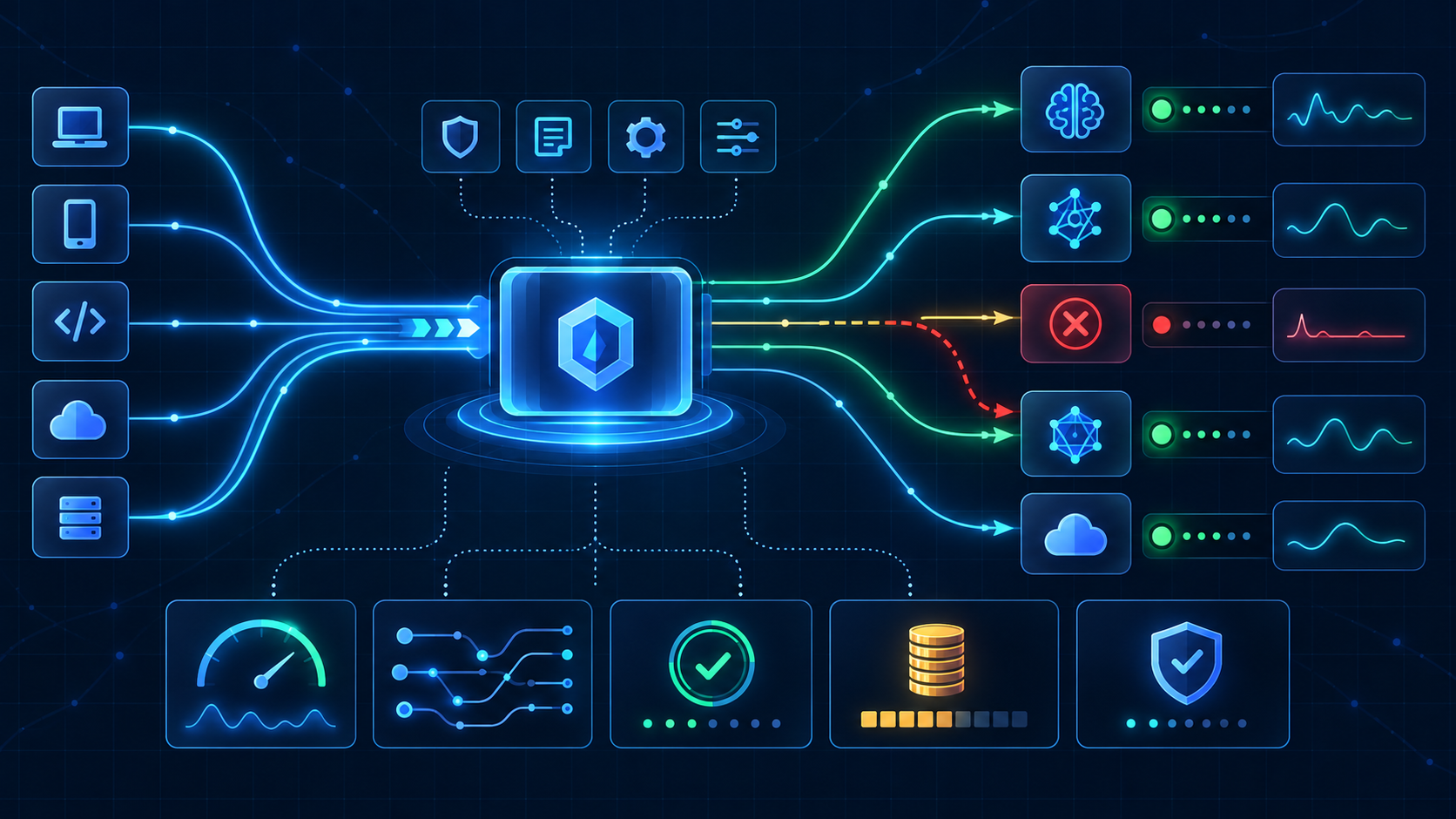
TL;DR
Bifrost is compelling when your team wants an OpenAI-compatible gateway, automatic failover, load balancing, caching, and direct control of the runtime.
Proxy-only latency tests omit provider time, streaming, retries, policy plugins, telemetry, and the staff required to operate the service.
Portkey, Requesty, Cloudflare, and hosted enterprise platforms reduce gateway operations, but change data, pricing, and deployment boundaries.
Use it beside a gateway when agents need discoverable APIs, financial data, and auditable real-world tool calls.
What Bifrost is optimized to do
Bifrost's official repository describes a high-performance AI gateway that unifies more than twenty providers behind one OpenAI-compatible API. Its product promise centers on low proxy overhead, failover, load balancing, semantic caching, and an operator-facing web UI. That combination is most relevant to teams willing to own the gateway as infrastructure.
Important distinction: gateway processing time is only one part of end-to-end latency. Model queueing, network distance, time to first token, output length, retries, and observability exporters can dominate the user experience.
The four trade-offs hidden by a speed headline
A fast proxy still needs deterministic timeout budgets, retry limits, fallback ordering, idempotency rules, and clear responses when every provider fails.
Ask whether model allowlists, virtual keys, per-team budgets, content guardrails, regional routing, and audit exports match your governance model.
Self-hosting moves upgrades, capacity, secrets, cluster health, incident response, and telemetry storage to your team. The software license is not the whole cost.
A model gateway routes inference. It does not automatically discover domain APIs or enforce permissions for the external tools an agent invokes.
Eight Bifrost alternatives by operating model
| Option | Best fit | Key trade-off |
|---|---|---|
| LiteLLM | Broad open-source provider compatibility and configuration control | A Python-centered proxy with a different performance and operations profile. |
| Portkey | Managed gateway, observability, virtual keys, and guardrails | Less data-plane ownership in exchange for a managed control plane. |
| Requesty | Managed routing, fallback, caching, and multi-model access | Convenience and pass-through service boundaries replace self-operation. |
| Kong AI Gateway | Existing enterprise API management and plugin governance | A larger platform footprint than a focused lightweight gateway. |
| TrueFoundry | Enterprise LLM, MCP, budget, access, and observability control | Broader platform scope and enterprise adoption work. |
| Cloudflare AI Gateway | Teams already operating on Cloudflare's edge network | Strong ecosystem fit, but a different portability boundary. |
| OpenRouter | Hosted catalog access and consolidated model purchasing | Model access is central; owning gateway infrastructure is not. |
| QVeris | External APIs, financial data, and auditable agent tools | Complementary capability layer, not a drop-in inference proxy. |
A production benchmark that answers the right question
Benchmark with your workload rather than repeating a vendor's headline. Replay a sanitized request set that includes short chat, long context, streaming, structured output, embeddings, tool calls, provider errors, and concurrent bursts. Run the same region, machine class, telemetry, and provider credentials for every candidate.
Averages hide the tail latency that users experience during bursts and provider degradation.
Record time inside the gateway, time to provider connection, time to first token, and full completion time.
Confirm the backup preserves tools, response schemas, safety settings, and token limits rather than merely returning text.
Include on-call work, upgrades, telemetry storage, security review, and capacity headroom in total cost.
Migration sequence for a gateway data plane
- Freeze the current routing, retry, timeout, and budget policy as an auditable baseline.
- Run shadow traffic with provider calls disabled, then replay known responses to validate transformation logic.
- Canary one low-risk workload and compare request IDs, costs, tokens, errors, and latency distributions.
- Exercise provider outages before expanding traffic, including the case where every fallback fails.
- Retain rollback configuration until alerts, dashboards, and billing reconciliation agree.
Pair the gateway with a capability layer
Bifrost and its direct alternatives govern model traffic. QVeris begins where inference routing ends: an agent discovers a real-world capability, inspects its schema, calls it with controlled credentials, and keeps an auditable result.
- Use the gateway for model aliases, provider credentials, load balancing, fallback, and token-level telemetry.
- Use QVeris for financial data, domain APIs, tool discovery, and controlled capability calls.
- Propagate one correlation ID across both layers so incidents can be reconstructed end to end.
FAQ
Its maintainers publish strong proxy-overhead claims, but your decision should use the same hardware, policies, telemetry, providers, and workload for every candidate.
Prefer it when its provider ecosystem, configuration model, community, and Python-based operations fit your team better than Bifrost's profile.
Managed service is attractive when gateway uptime, upgrades, analytics, and policy operations should not consume your platform team's capacity.
No. Bifrost routes model inference; QVeris complements it with discoverable and auditable external capabilities for agents.