
Cheapest DeepSeek API
Verify the Route, Measure Accepted Work
最便宜的 DeepSeek API:核对路由,测量有效工作量
DeepSeek pricing, models and availability can change. Compare exact authorized routes using current official sources, native usage and the same workload acceptance gate.
DeepSeek 的价格、模型与可用性会变化。应使用当前官方来源、原生用量与相同负载验收门禁比较准确的授权路由。
TL;DR
Record model ID, version or alias resolution, thinking mode, endpoint and date.
Use the current provider or platform page, not an old article or screenshot.
Separate cache hit and miss, input, output, failed calls and every attempt.
Apply one quality, schema and latency gate before calculating true cost.
记录模型 ID、Version 或别名 Resolution、Thinking Mode、端点与日期。
使用当前供应商或平台页面,而不是旧文章或截图。
区分缓存 Hit/Miss、输入、输出、失败调用与每次尝试。
先应用统一质量、结构定义与延迟门禁,再计算真实成本。
DeepSeek access routes are not identical DeepSeek 接入路由并不相同
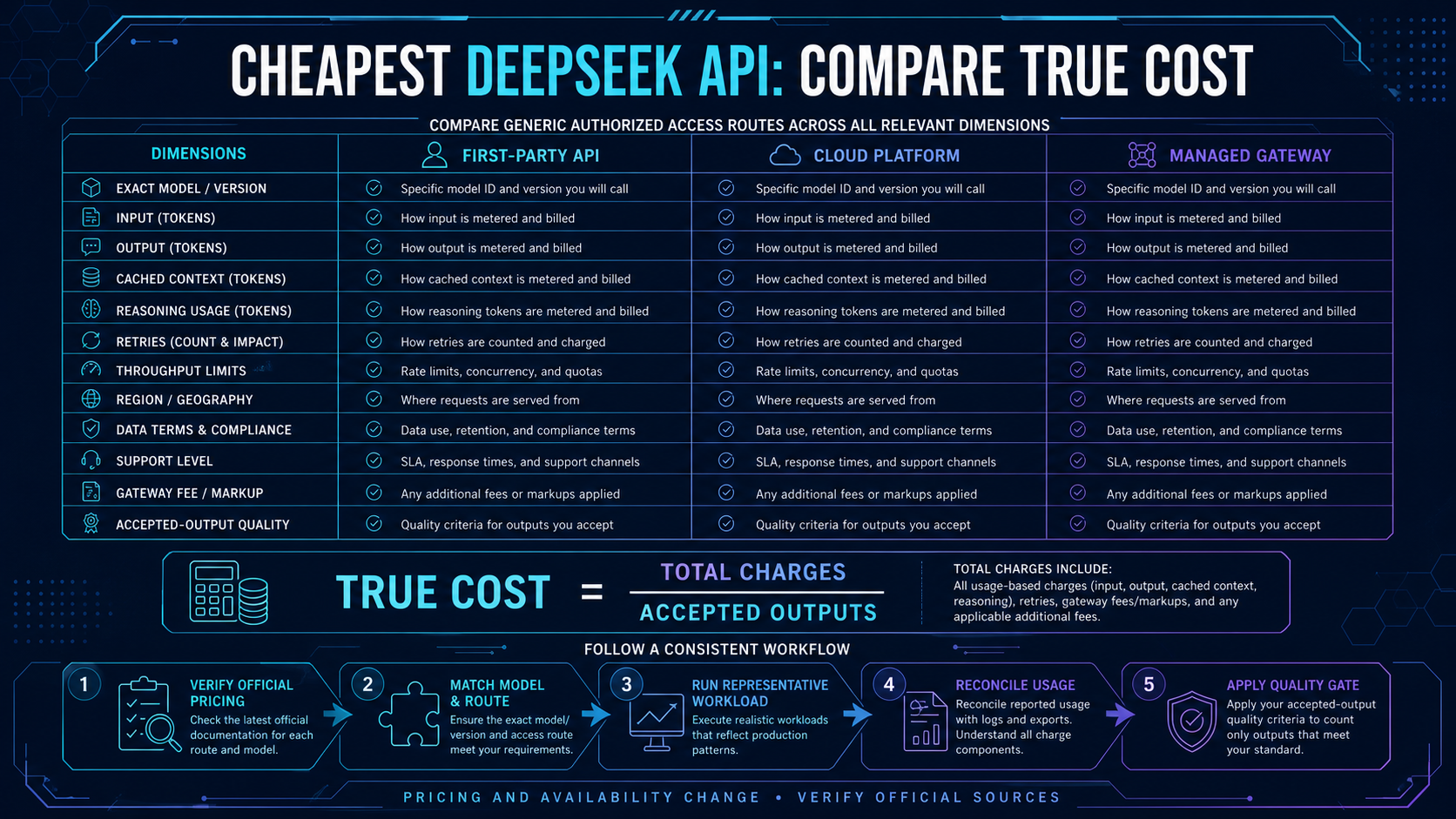
A first-party API, cloud model platform and managed gateway can differ in model version, protocol, context, cache behavior, tools, concurrency, region, data terms, support and commercial treatment.
一方 API、Cloud 模型 Platform 与 Managed 网关可能在模型版本、协议、上下文、缓存、工具、并发、区域、数据条款、支持与商业处理上不同。
Compare only like-for-like routes. When a platform serves a different snapshot or adds services, keep those differences visible and evaluate the total workload outcome rather than a single token rate.
只比较同口径路由。当平台提供不同 Snapshot 或附加服务时,应明确差异并评估完整负载结果,而不是只看某个 Token 单价。
DeepSeek route comparison DeepSeek 路由对比
| Route 路由 | Best fit 最适合 | Verify before choosing 选择前验证 |
|---|---|---|
| First-party API 一方 API | Direct service, current native docs and billing fit the workload. 直连服务、当前原生文档与账单适合负载。 | Exact model, base URL, cache rules, limits, support and data terms. 核对准确模型、基础地址(Base URL)、缓存规则、限制、支持与数据条款。 |
| Cloud model platform Cloud 模型 Platform | Cloud identity, region, procurement or operations are decisive. 云身份、区域、采购或运营是关键。 | Snapshot, provider of record, protocol, feature parity and platform price. 核对 Snapshot、合同供应方、协议、功能等价与平台价格。 |
| Managed gateway Managed 网关 | Unified policy, telemetry or multi-provider routing adds value. 统一策略、遥测或多供应商路由有价值。 | Markup, data path, adapter behavior, retries and provider evidence. 核对加价、数据路径、适配器行为、重试与供应商证据。 |
| Self-hosted weights 自托管权重 | License and operations permit control of the serving stack. License 与运营允许控制 Serving Stack。 | Hardware, utilization, engineering, model identity, updates and security. 核对硬件、利用率、工程、模型身份、更新与安全。 |
True-cost dimensions 真实成本维度
Input, cache status, output, reasoning or intermediate usage when exposed.
Retries, queueing, timeouts, rejected output and human review.
Gateway fee, cloud charges, currency, tax, commitments and support.
Throughput, latency, region, data policy, observability and recovery.
输入、缓存状态、输出,以及公开时的推理或中间用量。
重试、排队、超时、未通过输出与人工审查。
网关费、Cloud Charge、币种、税费、承诺与支持。
吞吐、延迟、区域、数据策略、可观测性与恢复。
Run a dated comparison 运行带日期的比较
- Snapshot official model, pricing, limits and terms pages for each route.
- Replay the same prompt distribution and acceptance criteria.
- Reconcile native usage, cache, retries and route charges to invoices.
- Repeat after any model, price, alias, endpoint or workload change.
- 为每条路由保存官方模型、价格、限制与条款页面快照。
- 回放相同提示词分布与验收标准。
- 把原生用量、缓存、重试与路由费用对账到账单。
- 模型、价格、别名、端点或负载变化后重新比较。
Separate pricing snapshots from measured usage 分离价格快照与实测用量
A source registry records the official URL, retrieval time, model and route. A workload runner captures native request IDs, usage, cache status, attempts and acceptance. The cost layer applies the dated price snapshot and reports total charges per accepted output.
Source 注册表记录官方 URL、获取时间、模型与路由;工作负载 Runner 捕获原生请求 ID、用量、缓存状态、尝试与验收;成本层应用带日期的价格快照并报告每个有效输出的总费用。
Production rule: never label a DeepSeek API route cheapest without an exact model, route, workload, date and acceptance method.
生产规则:未说明准确模型、路由、负载、日期与验收方法时,绝不能把某条 DeepSeek API 路由标为最便宜。
Keep capability calls outside the model price 将能力调用与模型价格分开
QVeris complements DeepSeek inference with governed external APIs, tools, services and live data. Record those calls in their native units and join them only when calculating the parent workflow's end-to-end cost.
QVeris 通过治理化外部 API、工具、服务与实时数据补充 DeepSeek 推理。用原生单位记录这些调用,只在计算父工作流端到端成本时合并。
Current DeepSeek V4 prices and migration note 当前 DeepSeek V4 价格与迁移提示
Official DeepSeek prices verified July 21, 2026, in USD per 1 million tokens. DeepSeek documents that deepseek-chat and deepseek-reasoner are scheduled for deprecation on July 24, 2026; use the exact V4 model IDs and rerun capability tests before that date.
以下 DeepSeek 官方价格于 2026 年 7 月 21 日核验,单位为美元/百万 Token。DeepSeek 文档说明 deepseek-chat 与 deepseek-reasoner 计划于 2026 年 7 月 24 日弃用;应切换到准确 V4 模型 ID,并在此前重新执行能力测试。
| Model or route 模型或路由 | Input / cost 输入/成本 | Output 输出 | Scope 适用范围 |
|---|---|---|---|
| DeepSeek V4 Flash | $0.14 cache miss / $0.0028 hit | $0.28 | Concurrency limit shown as 2,500 文档并发限制 2,500 |
| DeepSeek V4 Pro | $0.435 cache miss / $0.003625 hit | $0.87 | Concurrency limit shown as 500 文档并发限制 500 |
When evaluating Cheapest DeepSeek API, verify the linked official pricing source immediately before a buying decision. Model quality, output length, cacheability, retries, tools, service tier, region, taxes, and discounts can reverse a token-price comparison.
评估“最便宜的 DeepSeek API”时,采购决策前务必立即核验页面所链接的官方定价来源。模型质量、输出长度、可缓存性、重试、工具、服务层、区域、税费与折扣都可能逆转 Token 单价比较。
Build an Effective Cost Model for the cheapest DeepSeek API route为成本最低的 DeepSeek API 路径建立有效成本模型
When evaluating Cheapest DeepSeek API, list price is an input, not the decision. Compare the cost of an accepted production outcome after quality, retries, latency, operational work, and non-token charges are included.
评估“最便宜的 DeepSeek API”时,目录价只是输入,而不是最终决策。应在计入质量、重试、延迟、运营工作和非 Token 费用后,比较获得一个合格生产结果的成本。
Sample production-shaped tasks and record DeepSeek model versions, cached versus uncached input, reasoning output, context length, provider replicas, regional reach, and capacity stability. Use percentiles and task classes rather than one average prompt so long-context and output-heavy requests remain visible.
抽取接近生产形态的任务,并记录DeepSeek 模型版本、缓存与未缓存输入、推理输出、上下文长度、供应商副本、区域覆盖和容量稳定性。使用分位数和任务类别,而不是单个平均提示词,确保长上下文与高输出请求不会被隐藏。
When evaluating Cheapest DeepSeek API, measure completion, rubric score, structured-output validity, tool accuracy, retry rate, and human-review time. Divide total run cost by accepted outcomes, not by raw requests.
评估“最便宜的 DeepSeek API”时,对每个模型与路由衡量完成率、评分标准得分、结构化输出有效率、工具准确率、重试率和人工复核时间,并用总运行成本除以合格结果,而不是原始请求数。
When evaluating Cheapest DeepSeek API, add gateway or aggregator fees, storage, egress, cache writes, evaluations, observability, support, engineering, incident handling, reserved capacity, unused credits, taxes, and the business cost of latency or failed work.
评估“最便宜的 DeepSeek API”时,加入网关或聚合费用、存储、流量、缓存写入、评估、可观察性、支持、工程、事故处理、预留容量、未用额度、税费,以及延迟或任务失败的业务成本。
When evaluating Cheapest DeepSeek API, store source URL, retrieval date, currency, region, service tier, thresholds, discounts, and model version. Recompute scenarios when a catalog changes and alert when observed invoice cost diverges from the estimate.
评估“最便宜的 DeepSeek API”时,保存来源链接、获取日期、币种、区域、服务层级、阈值、折扣和模型版本。目录变化时重新计算情景,并在实际发票成本偏离估算时发出告警。
FAQ
It depends on the exact model, platform, region and workload; verify current sources.
Only after recording which exact version each alias resolved to during the test.
Yes. Measure real hit and miss behavior rather than assuming a cache ratio.
取决于准确模型、平台、区域与负载;请核对当前来源。
只有记录测试时每个别名解析到的准确版本后才可以。
会。应测量真实 Hit/Miss 行为,而不是假设缓存比例。