
COMPETITOR COMPARISON
Cloudflare AI Gateway Alternatives 7 Options Compared
Screen Cloudflare AI Gateway options by routing control, compatibility, observability, and operating cost.
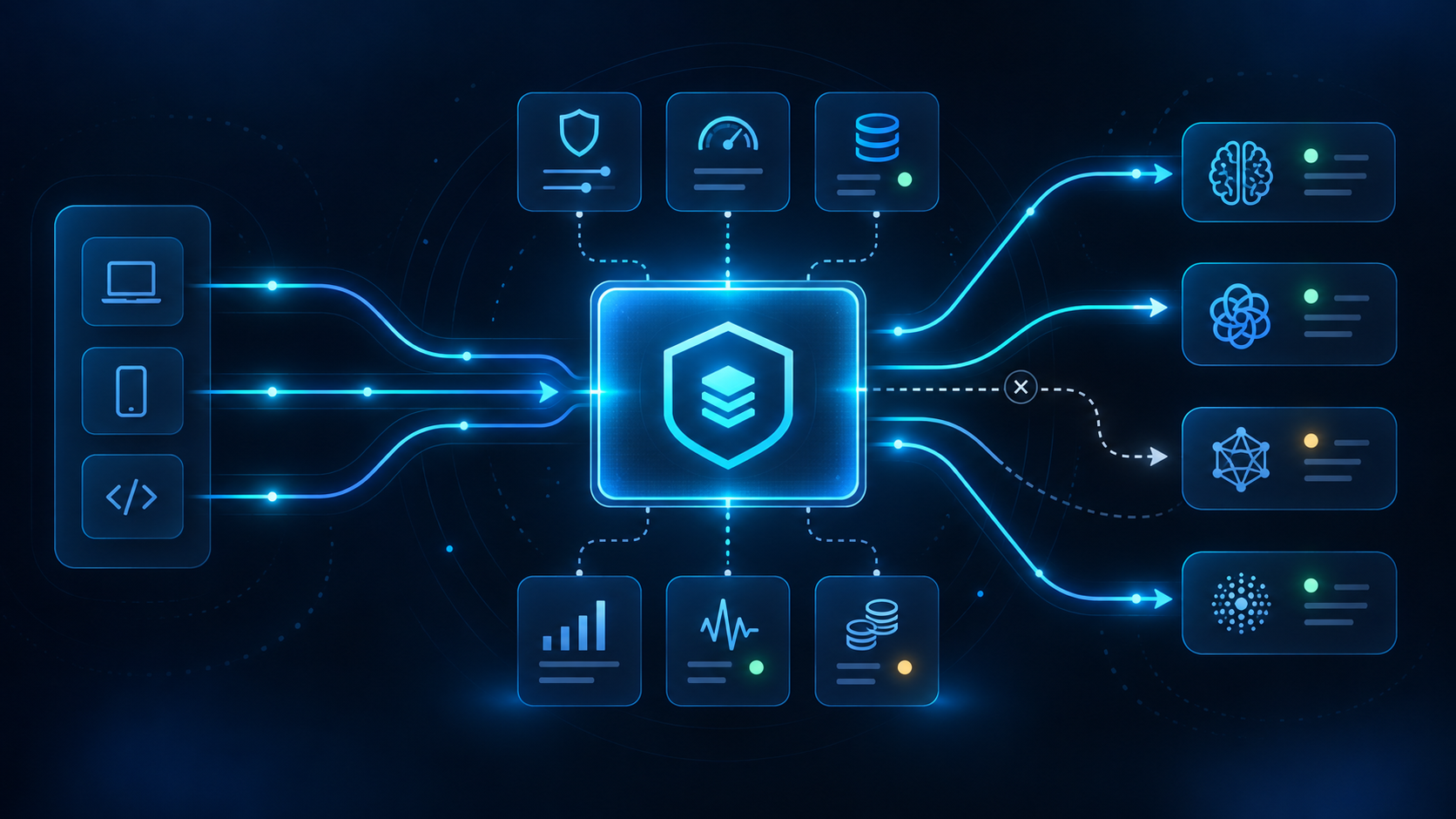
TL;DR
Portkey is the closest managed replacement when teams want routing, observability, guardrails, and production controls in one platform.
LiteLLM is the strongest fit for teams that want an OpenAI-compatible proxy, broad provider support, and infrastructure ownership.
OpenRouter is the fastest path to a broad model catalog and managed provider routing without operating a gateway service.
QVeris does not replace model traffic governance; it adds discoverable financial data, tools, and auditable capability calls for agents.
Why teams look for Cloudflare AI Gateway alternatives
Cloudflare AI Gateway is a practical choice when an application already runs close to the Cloudflare stack. Its official documentation emphasizes analytics, logging, caching, rate limiting, retries, and model fallback. The important question is therefore not whether it works, but whether its operating model matches the control plane your team needs.
A search for an alternative usually signals one of five gaps: the team wants to self-host the gateway, needs richer LLM-specific guardrails, prefers a model marketplace, requires deployment outside a single edge ecosystem, or is trying to connect model output to real data and tools. Those are different jobs and should not be collapsed into one feature checklist.
Treat this page as a migration decision guide. Score candidates against the reason for switching, the traffic path you want to own, and the operational burden you are willing to carry.
The seven alternatives and where each one wins
| Alternative | Best for | Deployment | Key trade-off |
|---|---|---|---|
| Portkey | Managed gateway plus guardrails | Managed or self-hosted gateway | More platform surface to govern |
| LiteLLM | Infrastructure ownership | Self-hosted proxy or SDK | Your team owns operations |
| OpenRouter | Fast multi-model access | Managed API | Less infrastructure control |
| Helicone | Observability-first workflows | Cloud or self-hosted | Routing depth depends on setup |
| Kong AI Gateway | Existing API platform teams | Gateway infrastructure | Heavier platform operation |
| Envoy AI Gateway | Kubernetes-native control | Self-managed | Requires platform engineering |
| QVeris | Agent data and tool capabilities | Complementary capability layer | Not a model-gateway replacement |
Migration checklist: preserve behavior before changing vendors
List provider endpoints, headers, retry rules, cache keys, rate limits, log fields, budget rules, and fallback order. A one-line endpoint swap can hide many policy differences.
Replay representative streaming, tool-use, image, structured-output, timeout, and provider-error cases. Compare status codes and response shapes, not only successful text output.
Mirror a small percentage of non-sensitive requests to the new path, compare latency and output metadata, then increase traffic gradually with a documented rollback trigger.
Keep provider routing in the gateway. Route live financial data, tools, and external actions through a capability layer with its own discovery and audit controls.
Architecture choices that change the answer
Cloudflare remains compelling when Workers, edge caching, and existing Cloudflare policy are central to the application.
LiteLLM, Envoy, or Kong becomes more attractive when the infrastructure team must control deployment, networking, data paths, and upgrades.
OpenRouter reduces integration work when breadth of models and provider fallback matter more than owning gateway infrastructure.
A gateway controls model traffic. Add QVeris when agents must discover and call live datasets, financial APIs, or external tools with auditability.
Common mistakes when replacing Cloudflare AI Gateway
A vendor grid is useful only after the team defines deployment, privacy, observability, routing, and ownership requirements.
Compatible request shapes do not guarantee identical streaming events, tool schemas, errors, retries, or provider-specific parameters.
Preserve project, customer, environment, and model tags so the new gateway can explain spend from day one.
Model routing and real-world capability access are separate architecture layers with different reliability and audit needs.
Which alternative fits each Cloudflare migration scenario?
Prioritize Portkey when the product team wants routing, guardrails, observability, and policy workflows without owning every backing service. Validate log retention, redaction, regional requirements, and the exact plan needed for production controls before committing.
Prioritize LiteLLM, Envoy AI Gateway, or Kong when deployment, networking, data paths, upgrades, and incident response must remain under internal control. The deciding factor is often the platform team's existing Kubernetes, proxy, database, and observability maturity.
Prioritize OpenRouter when fast access to a broad catalog and managed provider routing matter more than infrastructure ownership. Review provider-selection policy, privacy controls, fees, budgets, version pinning, and how the application behaves when the preferred route is unavailable.
Keep a model gateway for inference and add QVeris for capability discovery, inspection, and calls. This is an architecture composition rather than a replacement decision: the gateway controls model traffic while the capability layer controls external data and actions.
Security, privacy, and procurement questions to ask
Ask where prompts, responses, metadata, cache entries, logs, traces, and evaluation datasets are processed and stored. Include the underlying model provider, not only the gateway vendor, and document every retention period and regional transfer.
Test how the product separates organizations, projects, customers, environments, and human operators. Confirm key rotation, revocation, least-privilege roles, service accounts, audit logs, and whether a compromised project key can cross a tenant boundary.
Compare support response, uptime commitments, breach notification, subprocessor disclosure, data-processing terms, export rights, termination assistance, and enterprise minimums. A technically cheaper gateway can become expensive when legal or support requirements appear late.
Before signing, export representative logs and configuration, rotate credentials, and move one route to a direct provider or another gateway. Record the time, missing metadata, application changes, and vendor assistance required to complete the exercise.
Migration evidence to collect before switching
Capture a privacy-safe sample of streaming, structured output, tool calls, long context, and failure cases. Replay it through each candidate so the decision reflects your workload rather than a vendor feature matrix.
Inventory Workers bindings, analytics exports, cache behavior, authentication, and network policy tied to Cloudflare. Separate portable gateway logic from edge-specific conveniences before estimating migration effort.
Test timeout, 429, provider 5xx, broken streaming, and exhausted-budget behavior. Record retry ownership, fallback order, error normalization, alert timing, and what users see when every route fails.
Keep aliases, keys, configs, logs, and dashboards exportable. A migration is ready only when the team can shift a small traffic slice, compare outcomes, and return to the previous route without losing traceability.
Where QVeris fits: capability routing after model routing
A model gateway and QVeris solve adjacent problems. The gateway governs inference traffic: provider credentials, model selection, retries, budgets, rate limits, and logs. QVeris governs the next step when an agent needs a real capability: discovering a suitable tool or dataset, inspecting its contract, calling it, and keeping an auditable record.
For a financial research agent, the gateway might route a planning prompt to the right model. QVeris can then expose the market data, filings, fundamentals, news, or external tools required to complete the plan. This separation keeps model policy and capability policy understandable instead of forcing one gateway to pretend it owns every external action.
The recommended architecture is model gateway plus QVeris, not model gateway versus QVeris. Keep each layer responsible for the traffic it can govern well, then connect them with explicit identity, budget, trace, and audit metadata.
- Send inference requests through the selected gateway or aggregator.
- Attach project, customer, environment, and trace identity to every route.
- Use QVeris discovery and inspection before an agent calls a live capability.
- Measure model cost and capability cost separately, then report the complete task cost.
FAQ
Portkey is the closest managed all-round alternative; LiteLLM is stronger for self-hosting; OpenRouter is simpler for broad model access. The best choice depends on why you are leaving Cloudflare.
Cloudflare documents AI Gateway as available on all plans, with plan-specific gateway, logging, and request limits. Verify the current limits in the official documentation before production planning.
It can replace many proxy, routing, fallback, budget, and logging functions when your team is prepared to operate the service and supporting data stores.
No. QVeris is positioned as a complementary capability layer for discoverable tools and data. Use a gateway for model traffic and QVeris for agent capabilities.
Test streaming, structured output, tool calling, provider errors, timeouts, fallbacks, cache behavior, rate limits, usage attribution, and log redaction.
The answer depends on deployment, retention, regional routing, contractual controls, and the exact provider path. A self-hosted option can improve control but also increases operational responsibility.
Sources, methodology, and update policy
This guide uses public product documentation and a workload-based decision framework. Product limits, pricing, supported models, and plan boundaries change frequently; verify current terms directly with each provider before procurement or production migration.
QVeris is the publisher of this guide and is described only in its intended complementary role. The comparisons distinguish model-inference routing from agent capability routing so the commercial relationship is visible rather than hidden inside a generic ranking.