
Earnings call sentiment analysis: what it measures财报电话会情绪分析衡量什么
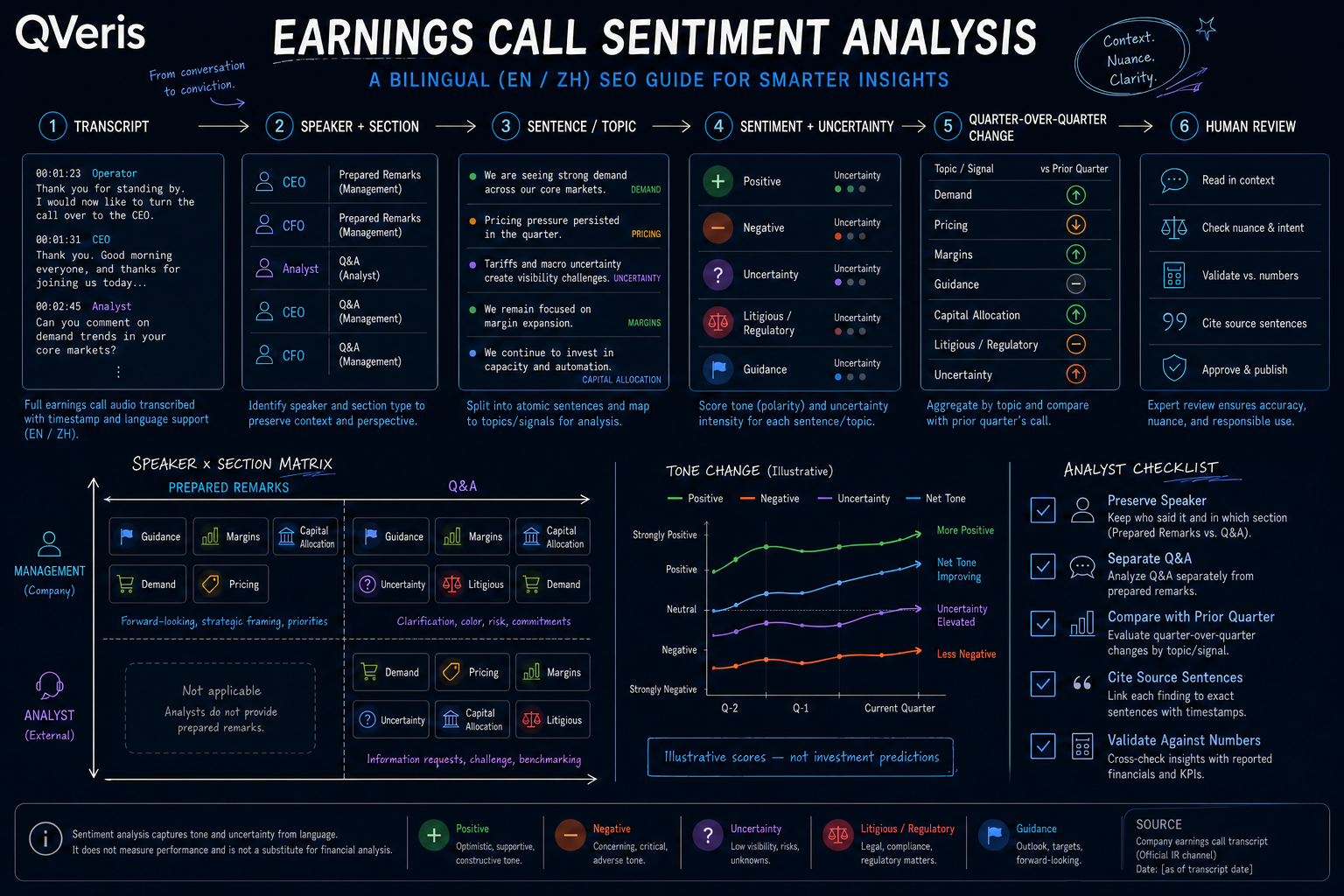
Earnings call sentiment analysis applies financial-language methods to management remarks and analyst Q&A. The useful output is not a single mood label. It is a structured record of who spoke, in which section, about which topic, with what polarity and uncertainty, and how that language changed from a comparable prior call.
财报电话会情绪分析把金融语言方法应用于管理层陈述和分析师问答。真正有用的结果并非单一的“乐观/悲观”标签,而是一套结构化记录:谁说了什么、位于哪个段落、针对哪个主题、情绪极性和不确定性如何,以及与可比上期电话会相比发生了什么变化。
A six-step earnings call sentiment analysis workflow六步财报电话会情绪分析流程
1. Preserve source and metadata1. 保留来源与元数据
Store company, fiscal period, call date, transcript provider, language, timestamps when available, and retrieval date. Keep the raw text immutable. Corrections to names, punctuation or speaker labels should be versioned so an analyst can reproduce the result.
保存公司、财务期间、电话会日期、逐字稿提供方、语言、可用时间戳和抓取日期。原始文本应保持不可变;姓名、标点或说话人标签的修正需要版本化,使分析师能够复现结果。
2. Segment before scoring2. 先切分,再评分
Separate operator instructions, prepared management remarks and Q&A. Resolve speakers and split long turns into sentences or compact passages. Topic tags should support multi-label cases: one answer can discuss demand, price and margin simultaneously.
分离主持人口播、管理层准备稿和问答环节,识别说话人,并把长段发言切分为句子或紧凑段落。主题标签要支持多标签情形,因为同一回答可能同时涉及需求、价格和利润率。
3. Score with a finance-aware method3. 使用金融领域方法评分
General sentiment models can misread financial language. “Liability,” “tax,” or “decline” may be factual rather than emotional; “challenging comparison” may carry caution without a negative adjective. Use a finance lexicon or domain model, document its version, and retain sentence-level outputs instead of only an aggregate.
通用情绪模型容易误读金融语言。“负债”“税项”或“下降”可能只是事实描述;“比较基数具有挑战”即使没有负面形容词,也可能传达谨慎。应使用金融词典或领域模型,记录模型版本,并保存句子级结果,而不是只保留汇总分数。
Prepared remarks vs Q&A sentiment管理层准备稿与问答情绪的区别
Prepared remarks管理层准备稿
Usually scripted, reviewed and organized around strategy, achievements and guidance. Track emphasis, omissions, newly introduced risks and changes in forward-looking language.
通常经过撰写与审核,并围绕战略、业绩和指引展开。重点观察强调内容、被省略内容、新出现风险及前瞻性措辞变化。
Analyst Q&A分析师问答
More interactive and less uniform. Track question pressure, answer specificity, follow-up frequency, topic switching, uncertainty and whether management addresses the actual question.
互动性更强、格式更不统一。重点观察问题压力、回答具体程度、追问频率、主题转移、不确定性,以及管理层是否真正回应了问题。
Do not average the two sections before inspection. A stable prepared tone with deteriorating Q&A tone can be more informative than a mildly negative whole-call score. Speaker weighting should be a declared methodological choice, not an invisible model assumption.
不要在检查之前把两个环节简单平均。准备稿语气稳定、问答语气恶化,往往比整个电话会“轻微负面”的单一分数更有信息量。说话人权重必须是明确披露的方法选择,而不是模型中的隐含假设。
Signals worth extracting from earnings call transcripts值得从财报电话会逐字稿提取的信号
Measure by sentence and topic, not only call-wide.按句子和主题衡量,而非只看整场。
Track risk, conditionality and unknowns separately.分别跟踪风险、条件限制与未知因素。
Specific answers are easier to verify later.具体回答更便于后续验证。
Compare remarks with filings, releases and guidance.与监管文件、新闻稿和指引比较。
Absence can matter, but requires human review.主题缺席可能重要,但需人工复核。
Flag redirection; do not infer deception.标记转移回答,但不要推断欺骗。
How to interpret earnings call sentiment change如何解读财报电话会情绪变化
Compare like with like: the same company, similar fiscal season, the same transcript sections, model version and topic taxonomy. A tone change may reflect real operating conditions, a new executive, an acquisition, unusual analyst questions, legal review or simply a different transcript quality.
比较必须口径一致:同一公司、相近财务季节、相同逐字稿环节、模型版本和主题分类。语气变化可能来自真实经营环境,也可能来自新任高管、并购、异常分析师提问、法律审核或逐字稿质量差异。
| Pattern模式 | Possible reading可能解读 | Required validation必须验证 |
|---|---|---|
| Demand tone improves需求语气改善 | Management sees firmer conditions管理层观察到经营环境增强 | Orders, backlog, volume and guidance订单、在手订单、销量与指引 |
| Margin uncertainty rises利润率不确定性上升 | Cost or pricing visibility weakened成本或定价可见度下降 | Gross margin, input costs, price realization毛利率、投入成本与价格实现 |
| Q&A becomes less specific问答变得不具体 | Visibility may be lower—or disclosure policy changed可见度可能下降,或披露政策改变 | Guidance format, filings and later outcomes指引格式、监管文件与后续结果 |
| Prepared tone stable, Q&A weakens准备稿稳定、问答转弱 | Analyst pressure exposed unresolved topics分析师压力暴露未解决问题 | Read full question and answer in context完整阅读问题和回答上下文 |
Use an evidence ladder, not a conclusion shortcut使用证据阶梯,不要跳到结论
- Source sentence:来源原句: retain the exact passage and speaker.保留准确段落与说话人。
- Model label:模型标签: record polarity, uncertainty, topic and confidence.记录极性、不确定性、主题和置信度。
- Comparable change:可比变化: measure against a consistent baseline.相对一致基线衡量。
- Financial cross-check:财务交叉检查: test against reported data and guidance.对照已披露数据和指引。
- Human interpretation:人工解读: state alternatives, caveats and what remains unknown.说明其他解释、限制与尚未确认事项。
Build an auditable transcript workflow with QVeris and FMP用QVeris与FMP建立可审计的逐字稿流程
Where an authorized FMP endpoint and your subscription provide earnings call transcripts, QVeris can help an agent discover the relevant API, call it with explicit company and period parameters, preserve returned metadata, and pass the transcript into a controlled analysis pipeline. Endpoint availability, fields, history and entitlements must be confirmed in current FMP documentation.
当获得授权的FMP端点和您的订阅提供财报电话会逐字稿时,QVeris可以帮助智能体发现相关API,以明确的公司和期间参数发起调用,保留返回元数据,并把逐字稿传入受控分析流程。端点可用性、字段、历史范围和权限必须以当前FMP文档为准。
A defensible workflow stores the raw response, normalized speaker turns, model version, prompts or rules, sentence-level classifications, citations and review decisions. QVeris is an orchestration and discovery layer; it does not guarantee transcript completeness, model accuracy, investment performance or future outcomes.
可辩护的流程需要保存原始响应、标准化说话轮次、模型版本、提示词或规则、句子级分类、引用和复核决定。QVeris是编排与发现层,不保证逐字稿完整性、模型准确性、投资表现或未来结果。
Financial data APIs for AI agents面向AI智能体的金融数据API · Revenue growth analysis收入增长分析 · QVeris documentationQVeris文档
Earnings call sentiment analysis FAQ财报电话会情绪分析常见问题
What is earnings call sentiment analysis?什么是财报电话会情绪分析?
It is the structured analysis of tone, uncertainty and topic language in prepared remarks and analyst Q&A, with source sentences and metadata retained for review.
它是对管理层准备稿和分析师问答中的语气、不确定性与主题语言进行结构化分析,并保留来源原句和元数据供复核。
Should prepared remarks and Q&A be scored separately?管理层准备稿与问答应该分开评分吗?
Usually yes. Prepared remarks are more scripted, while Q&A is interactive. Separate scoring exposes section-level differences that a whole-call average can hide.
通常应该。准备稿更具脚本性,问答更具互动性;分开评分能暴露整场平均值可能掩盖的段落差异。
Can sentiment predict stock price?情绪能预测股价吗?
No reliable prediction should be assumed. Sentiment can add qualitative context, but market reactions depend on expectations, valuation, numeric surprises, liquidity and many other factors.
不能假设它能可靠预测。情绪可补充定性背景,但市场反应还取决于预期、估值、数字超预期程度、流动性等大量因素。
Why use a finance-specific sentiment model?为什么要使用金融领域情绪模型?
Financial terms are often neutral in context, and cautious corporate phrasing can be subtle. Domain methods reduce—but do not eliminate—misclassification.
金融术语在上下文中经常是中性的,而企业谨慎表达可能很微妙。领域方法可以降低误判,但无法完全消除误判。
How do you compare sentiment across quarters?如何跨季度比较情绪?
Use the same sections, model version, taxonomy and aggregation rules, then compare by topic and speaker. Review material differences against the full transcript and financial disclosures.
使用相同段落、模型版本、分类体系和汇总规则,再按主题与说话人比较;重大变化需要回到完整逐字稿和财务披露中复核。
What data should an auditable result retain?可审计结果需要保留哪些数据?
Retain transcript source, date, speaker, section, exact sentence, topic, scores, model or lexicon version, comparison baseline and human-review notes.
应保留逐字稿来源、日期、说话人、段落、准确原句、主题、评分、模型或词典版本、比较基线和人工复核记录。
References and methodology sources参考资料与方法来源
- Loughran–McDonald financial sentiment word lists
- SEC — Beginner's guide to financial statements
- FMP — Financial data API documentation
Educational content only; not investment advice. Sentiment labels are model outputs requiring context and human review.本文仅供教育用途,不构成投资建议。情绪标签属于模型输出,必须结合上下文并经过人工复核。