
EBITDA vs Net Income
Formula, Differences & UsesEBITDA与净利润
公式、差异与使用方法
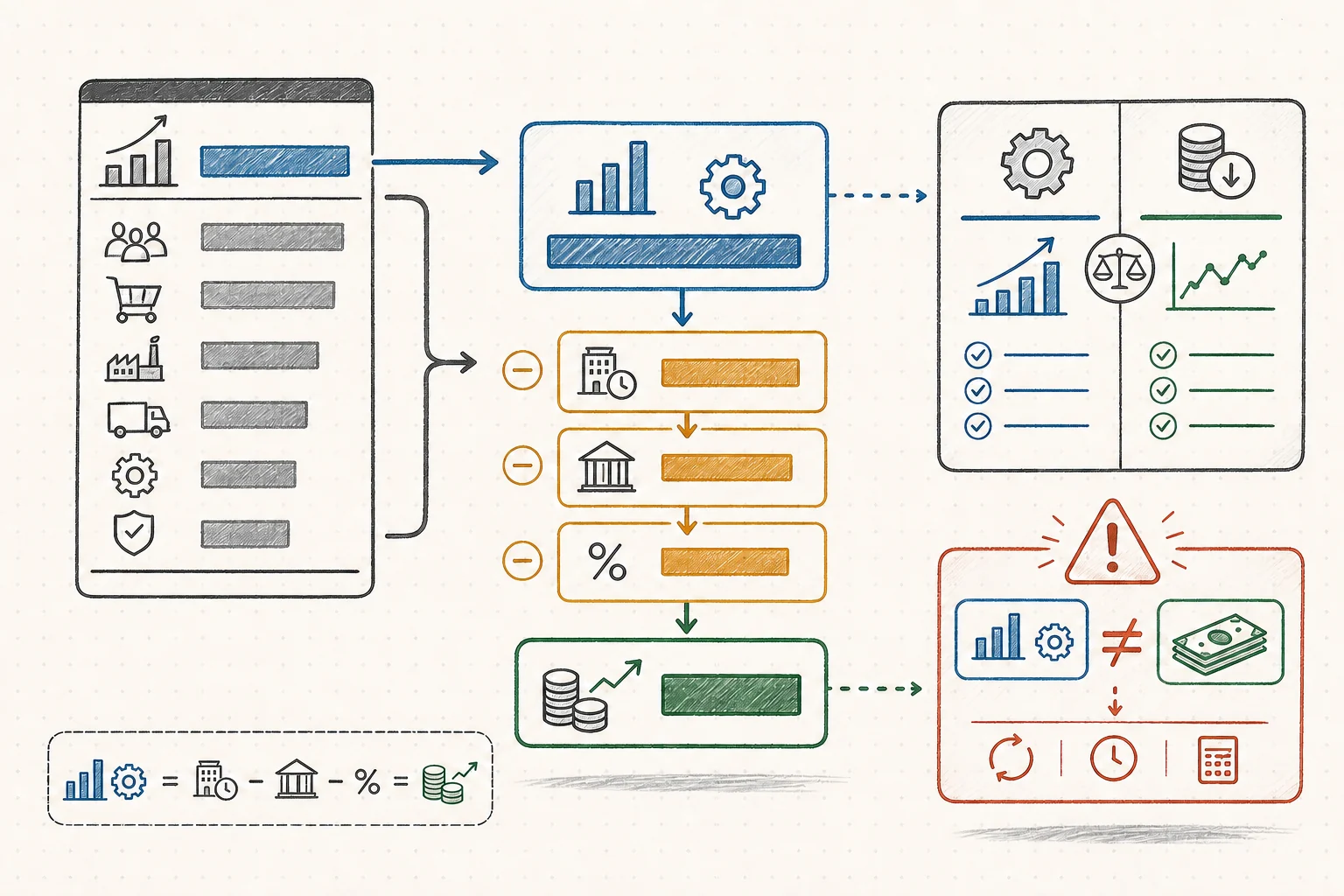
EBITDA vs net income compares operating earnings before financing and non-cash charges with the bottom-line profit left after the full income statement.
EBITDA和净利润的区别,在于一个观察融资、税费和折旧摊销前的经营成果,
另一个反映利润表最终确认的底线利润。
TL;DR
Different questions
EBITDA asks how the operating business performed before capital structure, taxes, depreciation, and amortization. Net income asks what accounting profit remained after recognized income and expenses.
Direct bridge
A common reconciliation starts with net income and adjusts net interest, taxes, depreciation, and amortization. Use the issuer’s disclosed definition and signs rather than assuming every item is an expense.
Neither is cash flow
EBITDA omits working capital, capital expenditure, cash interest, and cash taxes. Net income also includes non-cash accruals. Use the cash-flow statement for cash generation.
Use both, with context
EBITDA can improve operating comparability; net income captures financing, taxes, asset consumption, and non-operating effects. A serious analysis reconciles both and reads the notes.
回答的问题不同
EBITDA观察资本结构、税费、折旧和摊销前的经营成果;净利润回答确认全部收入和费用后还剩多少会计利润。
可以直接桥接
常见方法从净利润出发,调节净利息、所得税、折旧和摊销。应使用公司披露的定义和正负号,不能假设每一项都是费用。
都不等于现金流
EBITDA没有考虑营运资本、资本开支、现金利息和现金税;净利润也包含非现金应计项目。现金生成能力要看现金流量表。
结合使用更可靠
EBITDA有利于经营比较,净利润则包含融资、税费、资产消耗和非经营影响。严谨分析需要把两者调节起来并阅读附注。
What EBITDA and net income actually measureEBITDA是什么意思,净利润又衡量什么
Both metrics describe profitability, but they sit at different levels of the income statement. EBITDA is designed to remove four categories that can obscure operating comparison. Net income preserves the period’s full recognized economics under the applicable accounting framework. Neither number is automatically “better”; usefulness depends on the question, the business model, and the quality of the reconciliation.
两者都描述盈利能力,但位于利润表的不同层级。EBITDA剔除四类可能影响经营可比性的项目;净利润保留适用会计准则下当期确认的完整经济结果。没有哪个数字天然“更好”,价值取决于分析问题、商业模式和调节质量。
EBITDA: operating earnings before four categoriesEBITDA:四类项目之前的经营盈利
EBITDA means earnings before interest, taxes, depreciation, and amortization. It is commonly used to compare businesses with different debt structures, tax profiles, and asset ages. In the United States, EBITDA is a non-GAAP financial measure rather than a standardized line item on a GAAP income statement. “Adjusted EBITDA” may exclude additional items and therefore requires even closer inspection.
EBITDA是息税折旧摊销前利润,常用于比较负债结构、税务状况和资产年限不同的企业。在美国,EBITDA属于非GAAP财务指标,而不是GAAP利润表上的标准项目。“经调整EBITDA”还可能排除更多项目,因此更需要检查定义。
Net income: the accounting bottom line净利润:会计口径的底线结果
Net income is revenue and other recognized income minus operating costs, depreciation and amortization, interest, taxes, and other recognized expenses or losses. Analysts must distinguish consolidated net income from net income attributable to the parent or common shareholders. The denominator used for EPS and P/E normally relates to earnings attributable to common equity, not an arbitrary EBITDA figure.
净利润等于收入及其他确认收益,减去经营成本、折旧摊销、利息、税费和其他确认费用或损失。分析时要区分合并净利润、归属于母公司所有者的净利润和普通股股东口径。EPS与市盈率通常对应普通股权益口径的盈利,而不是任意定义的EBITDA。
The basic EBITDA and net income relationshipEBITDA与净利润关系的基本公式
EBITDA = net income + net interest expense + income tax expense + depreciation + amortization is a useful starting formula. Real statements may contain interest income, tax benefits, discontinued operations, noncontrolling interests, or classification differences. When those items are benefits rather than expenses, the bridge may require subtraction rather than a blind add-back.
EBITDA = 净利润 + 净利息费用 + 所得税费用 + 折旧 + 摊销是常用起点。真实报表还可能包含利息收入、所得税收益、终止经营、少数股东损益或分类差异。当某项是收益而非费用时,桥接可能需要减去,不能机械全部加回。
Terminology check: “net profit” usually means net income in this search context, but local reporting terminology can vary. Confirm whether the source means consolidated profit, profit attributable to owners, or adjusted profit.
术语检查:本搜索语境中的net profit通常指净利润,但不同市场的披露术语可能不同。应确认来源指合并利润、归母净利润还是经调整利润。
EBITDA vs net income: the side-by-side differencesEBITDA和净利润的区别:逐项对比
| Dimension维度 | EBITDA | Net income净利润 | Why it matters分析意义 |
|---|---|---|---|
| Position利润层级 | Before interest, tax, depreciation, and amortization利息、税、折旧和摊销之前 | After recognized income and expenses确认全部收入和费用之后 | Explains why EBITDA is usually higher解释EBITDA为何通常更高 |
| Accounting status会计属性 | Non-GAAP in U.S. reporting; definition may vary美国披露中为非GAAP指标,定义可能不同 | GAAP/IFRS statement result, subject to exact scopeGAAP/IFRS报表结果,需确认具体口径 | Comparability depends on reconciliation可比性依赖调节表 |
| Capital structure资本结构 | Removes net interest effect剔除净利息影响 | Includes borrowing cost and interest income包含借款成本和利息收入 | Debt can widen the gap materially债务可能显著扩大差距 |
| Asset consumption资产消耗 | Adds back depreciation and amortization加回折旧和摊销 | Recognizes D&A expense确认折旧摊销费用 | Critical for asset-heavy businesses对重资产企业尤其关键 |
| Tax所得税 | Before income tax expense or benefit所得税费用或收益之前 | After current and deferred tax effects包含当期及递延所得税影响 | Jurisdiction and tax assets change net income税区和递延税项会改变净利润 |
| Common valuation pairing常见估值配对 | Enterprise value / EBITDA | Price / earnings | Match enterprise earnings with EV and equity earnings with price企业层盈利配企业价值,股东层盈利配股权价格 |
| Cash-flow proxy?是否等于现金流 | No; omits CapEx, working capital, cash interest and tax不是;遗漏资本开支、营运资本、现金利息和税 | No; includes accruals and non-cash items不是;包含应计和非现金项目 | Use operating cash flow and free cash flow separately应单独分析经营现金流和自由现金流 |
EBITDA vs net income example: a complete bridgeEBITDA与净利润计算案例:完整桥接
Consider a fictional company reporting the following simplified annual amounts in millions of dollars. The example is intentionally clean so the arithmetic is visible; real filings may split depreciation across cost of revenue and operating expenses, disclose amortization separately, or include other non-operating items.
假设一家虚构公司披露以下简化年度数据,单位为百万美元。案例刻意简化以展示计算逻辑;真实财报可能把折旧分散在营业成本和经营费用中,单独披露摊销,或包含其他非经营项目。
| Income-statement item利润表项目 | Amount金额 | Running result累计结果 |
|---|---|---|
| Revenue营业收入 | $1,000 | $1,000 |
| Cash operating costs, excluding D&A不含折旧摊销的现金经营成本 | ($730) | EBITDA $270 |
| Depreciation and amortization折旧和摊销 | ($70) | Operating income $200营业利润 $200 |
| Net interest expense净利息费用 | ($35) | Pre-tax income $165税前利润 $165 |
| Income tax expense所得税费用 | ($41) | Net income $124净利润 $124 |
Step 1: calculate EBITDA from operations步骤1:从经营数据计算EBITDA
$1,000 revenue − $730 operating costs before D&A = $270 EBITDA. EBITDA margin is $270 ÷ $1,000 = 27.0%.
$1,000收入 − $730折旧摊销前经营成本 = $270 EBITDA。EBITDA利润率为$270 ÷ $1,000 = 27.0%。
Step 2: calculate net income from the bottom line步骤2:得到净利润
$270 EBITDA − $70 D&A − $35 net interest − $41 tax = $124 net income. Net income margin is $124 ÷ $1,000 = 12.4%.
$270 EBITDA − $70折旧摊销 − $35净利息 − $41所得税 = $124净利润。净利率为$124 ÷ $1,000 = 12.4%。
Step 3: reconcile net income back to EBITDA步骤3:从净利润反推EBITDA
$124 net income + $35 net interest + $41 tax + $70 D&A = $270 EBITDA. The $146 gap is not “missing profit”; it represents expenses intentionally excluded from EBITDA.
$124净利润 + $35净利息 + $41所得税 + $70折旧摊销 = $270 EBITDA。两者相差$146并不是“利润消失”,而是EBITDA有意剔除的费用。
Do not mix periods or units. Quarterly net income plus annual depreciation does not produce meaningful EBITDA; neither does combining values reported in thousands with values reported in millions.
不要混用期间或单位。季度净利润加年度折旧得不到有意义的EBITDA;把“千元”与“百万元”口径混在一起同样会造成严重错误。
Why EBITDA is usually higher than net income为什么EBITDA通常高于净利润
In a conventional profitable company, EBITDA is usually higher because it is measured before four deductions. The size and persistence of the gap are more informative than the direction alone. A widening gap can reflect heavier borrowing, a larger depreciable asset base, acquisitions with intangible amortization, higher tax expense, or a combination of those factors.
对于常规盈利企业,EBITDA通常更高,因为它位于四类扣减之前。真正有信息量的是差距大小及其持续性,而不只是方向。差距扩大可能来自更高债务、更大的折旧资产基础、并购形成的无形资产摊销、更高税费或多项因素叠加。
Debt and interest债务与利息
Two companies with similar operations can report similar EBITDA but very different net income if one carries substantially more debt.
经营相似的公司可能拥有接近的EBITDA,但高负债公司会因利息费用而呈现明显更低的净利润。
Asset intensity资产密集度
Telecom, manufacturing, transport, and infrastructure businesses may have large depreciation charges that widen the gap.
电信、制造、运输和基础设施企业可能承担较大折旧,从而扩大两个指标的差距。
Acquisition amortization并购摊销
Acquired customer relationships, technology, and other intangibles can create amortization that reduces net income but not EBITDA.
并购形成的客户关系、技术和其他无形资产会产生摊销,降低净利润但不降低EBITDA。
Tax profile税务状况
Tax rates, deferred taxes, valuation allowances, credits, and jurisdiction mix affect net income while EBITDA is measured before income tax.
税率、递延所得税、估值备抵、抵免和地区组合会改变净利润,而EBITDA位于所得税之前。
Non-operating gains and losses非经营收益与损失
Investment results, asset sales, impairments, and foreign-exchange effects can move net income without representing recurring operations.
投资结果、资产处置、减值和汇兑影响可能改变净利润,但未必代表经常性经营。
Adjusted EBITDA choices经调整EBITDA口径
Stock compensation, restructuring, litigation, or acquisition costs may be excluded by management, making the adjusted gap larger and less comparable.
管理层可能再剔除股权激励、重组、诉讼或并购成本,使经调整差距更大、公司间可比性更弱。
Can net income be higher than EBITDA?净利润可以高于EBITDA吗
Yes, although it is less common. The simple “add back four expenses” intuition assumes those categories are positive expenses and that other income does not dominate. Net income may exceed EBITDA when a company reports significant net interest income, an income-tax benefit, gains on asset or investment sales, fair-value gains, equity-method earnings, or other non-operating income that is not part of the EBITDA definition.
可以,但较少见。“加回四项费用”的直觉假设这些项目都是正费用,且其他收益没有占主导。当公司出现大量净利息收入、所得税收益、资产或投资处置收益、公允价值收益、权益法投资收益或其他不进入EBITDA的非经营收入时,净利润可能高于EBITDA。
Positive EBITDA and negative net incomeEBITDA为正、净利润为负
This pattern says the pre-D&A operating result is positive, but the excluded charges and other losses exceed it. It can indicate heavy debt service, high asset consumption, acquisition amortization, taxes, impairments, or other losses. It does not prove that the business is healthy or that cash flow is positive.
这说明折旧摊销前经营结果为正,但被剔除的费用及其他损失超过了它。原因可能是高额利息、资产消耗、并购摊销、税费、减值或其他损失。这并不能证明企业健康,也不能证明现金流为正。
Negative EBITDA and positive net incomeEBITDA为负、净利润为正
This unusual result typically requires substantial non-operating income or benefits—such as a large disposal gain, investment gain, tax benefit, or net interest income—to offset weak operations. Analysts should test whether the source is repeatable.
这种少见结果通常需要大量非经营收益或利益,例如重大处置收益、投资收益、所得税收益或净利息收入,以抵消经营亏损。分析重点是这些来源能否持续。
When to use EBITDA vs net income分析公司时应该使用EBITDA还是净利润
Choose the metric that matches the claim. If the question concerns operating comparison before financing and asset-age effects, EBITDA can be useful. If the question concerns earnings available to equity holders after the complete income statement, net income is closer. For solvency, liquidity, or intrinsic value, neither number alone is enough.
指标必须与结论匹配。比较融资结构和资产年限影响之前的经营表现时,EBITDA更有用;关注完整利润表之后归属于股东的盈利时,净利润更接近目标。分析偿债、流动性或内在价值时,任何单一指标都不够。
| Analysis question分析问题 | Primary metric优先指标 | Required companion check必须配套检查 |
|---|---|---|
| Compare core operations across similar companies比较相似公司的核心经营表现 | EBITDA / EBITDA margin | Same definition, industry, leases, CapEx and period同一定义、行业、租赁、资本开支和期间 |
| Evaluate bottom-line profitability for common equity评价普通股股东的底线盈利 | Net income attributable to common shareholders归属于普通股股东的净利润 | EPS, share count, one-offs and OCIEPS、股数、一次性项目和其他综合收益 |
| Enterprise valuation comparison企业价值估值比较 | EV / EBITDA | Net debt, leases, pension deficits, normalized EBITDA净债务、租赁、养老金缺口和正常化EBITDA |
| Equity valuation comparison股权价值估值比较 | P / E | Earnings quality, cyclicality, dilution and leverage盈利质量、周期性、稀释和杠杆 |
| Assess debt repayment capacity评估偿债能力 | Debt/EBITDA plus cash-flow coverage债务/EBITDA结合现金流覆盖 | Cash interest, maturities, covenants and CapEx现金利息、到期结构、契约和资本开支 |
| Assess cash generation评估现金生成 | Operating cash flow and free cash flow经营现金流和自由现金流 | Working capital, CapEx, cash tax and interest营运资本、资本开支、现金税和利息 |
Valuation consistency rule: pair enterprise-value numerators with pre-debt earnings measures such as EBITDA, and equity-value numerators with earnings attributable to equity such as net income. Mixing EV with net income or market capitalization with EBITDA creates a mismatched multiple.
估值一致性规则:企业价值分子应配债务前盈利指标,如EBITDA;股权价值分子应配归属于股权的盈利,如净利润。用企业价值除以净利润,或用市值除以EBITDA,都会造成层级错配。
Limitations, adjusted EBITDA, and SEC reconciliationEBITDA的局限、经调整口径与SEC调节要求
The U.S. Securities and Exchange Commission states that “earnings” in EBITDA means GAAP net income and that EBITDA presented as a performance measure should be reconciled to GAAP net income. The SEC also requires non-GAAP measures to be accompanied by the most directly comparable GAAP measure and a quantitative reconciliation when applicable. See the SEC’s Non-GAAP Financial Measures interpretations and Regulation G release.
美国证券交易委员会说明,EBITDA中的“earnings”指GAAP净利润,作为业绩指标披露的EBITDA应调节至GAAP净利润。适用时,非GAAP指标还应同时提供最直接可比的GAAP指标和定量调节。可参考SEC的非GAAP财务指标解释和Regulation G发布文件。
EBITDA can ignore real economic costsEBITDA可能忽略真实经济成本
Depreciation is non-cash in the current period, but assets often require replacement. Interest is a real cost for a leveraged company. Taxes can require cash. EBITDA can therefore overstate sustainable cash available to owners.
折旧在当期不是现金流出,但资产通常需要更新;利息是高杠杆公司的真实成本;税费也可能需要现金支付。因此EBITDA可能高估可持续、可归属于所有者的现金。
Adjusted EBITDA is company-defined经调整EBITDA由公司自行定义
A recurring charge can be labeled “one-time” repeatedly. Stock compensation, restructuring, acquisition, litigation, and impairment adjustments may improve the narrative while reducing comparability. Read every adjustment and compare it with cash flow and prior periods.
某项费用可能连续多年被称为“一次性”。剔除股权激励、重组、并购、诉讼和减值能够改善表面结果,却降低可比性。应逐项阅读并与现金流及历史期间对照。
Net income also needs quality checks净利润同样需要质量检查
Net income can be affected by estimates, accruals, tax benefits, asset sales, fair-value movements, impairments, and discontinued operations. GAAP status does not make every period equally representative of recurring economics.
净利润会受到估计、应计、所得税收益、资产处置、公允价值变动、减值和终止经营影响。属于GAAP指标并不代表每一期都能同样反映经常性经济状况。
How to calculate EBITDA from financial-statement data如何从财务报表数据计算EBITDA
A reliable calculation is a data-lineage problem as much as a formula problem. A financial statements API may expose net income, interest, taxes, depreciation, and amortization under different field names or statements. Before automating the bridge, verify the scope and provenance of every component.
可靠计算既是公式问题,也是数据血缘问题。财务报表API可能在不同字段或不同报表中提供净利润、利息、所得税、折旧和摊销。自动化桥接之前,必须验证每个组成项的范围和来源。
1. Match company, period, currency, and scale1. 对齐公司、期间、币种和单位
Confirm fiscal year or quarter, restatement status, reporting currency, and whether values are reported in units, thousands, or millions. Keep annual, quarterly, and trailing-twelve-month calculations separate.
确认财年或季度、重述状态、报告币种,以及数值是元、千元还是百万元。年度、季度和滚动十二个月计算必须分开。
2. Select the correct net-income scope2. 选择正确的净利润口径
Identify consolidated net income, continuing operations, and amounts attributable to the parent or noncontrolling interests. Do not switch scopes midway through the bridge.
识别合并净利润、持续经营损益、归属于母公司及少数股东的金额,桥接过程中不能中途更换口径。
3. Find D&A across statements and notes3. 在报表与附注中寻找折旧摊销
D&A may be embedded in cost of revenue and operating expenses, combined in the cash-flow statement, or separated in footnotes. Avoid double counting when an API supplies both a combined value and individual depreciation and amortization fields.
折旧摊销可能嵌入营业成本和经营费用、合并出现在现金流量表,或拆分披露在附注中。当API同时提供合计字段与折旧、摊销分项时,要避免重复计算。
4. Preserve signs and net-versus-gross definitions4. 保留正负号及净额/总额定义
Interest expense, interest income, tax expense, and tax benefit may be separate. Store the source sign and definition instead of converting everything into a positive add-back.
利息费用、利息收入、所得税费用和所得税收益可能分别披露。应保留来源正负号和定义,不能把所有项目都转成正数加回。
5. Compare calculated and reported EBITDA5. 对比计算值与公司披露值
If management reports EBITDA or adjusted EBITDA, compare your mechanical result with its reconciliation. Investigate differences such as other income, discontinued operations, equity earnings, stock compensation, restructuring, or issuer-specific adjustments.
如果管理层披露EBITDA或经调整EBITDA,应把机械计算结果与公司调节表对照,并调查其他收益、终止经营、权益法收益、股权激励、重组或公司特定调整造成的差异。
How QVeris supports an EBITDA vs net income workflowQVeris如何支持EBITDA与净利润分析工作流
QVeris does not replace accounting judgment and does not certify an EBITDA calculation. It provides a capability layer through which an application or AI agent can discover, inspect, call, and audit external financial-data tools. For this comparison, the useful role is connecting the calculation to inspectable statement fields and preserving execution evidence.
QVeris不替代会计判断,也不认证某个EBITDA计算。它为应用或AI智能体提供发现、检查、调用和审计外部金融数据工具的能力层。在本对比中,合理作用是把计算连接到可检查的报表字段,并保留执行证据。
Discover an appropriate statement-data capability发现适合的财务报表数据能力
Locate an income-statement or filing capability before hardcoding a provider. The financial statements API for AI agents guide explains the broader data architecture.
在硬编码供应商之前,先发现利润表或财报能力。更完整的数据架构可参考面向AI智能体的财务报表API指南。
Inspect schemas before mapping fields字段映射前检查数据模式
Review provider identity, field definitions, period parameters, units, currency, error behavior, and whether D&A is combined or separated. If using FMP data, the Financial Modeling Prep API guide provides provider-specific context.
检查供应商身份、字段定义、期间参数、单位、币种、错误行为,以及折旧摊销是合并还是拆分。如果使用FMP数据,可参考Financial Modeling Prep API指南了解供应商口径。
Call through a controlled calculation boundary通过受控计算边界调用
Retrieve source values with explicit parameters, then calculate with deterministic code. The language model can explain the bridge, but it should not invent missing values or silently change signs.
使用明确参数检索来源数值,再通过确定性代码计算。语言模型可以解释桥接过程,但不能编造缺失数据或静默改变正负号。
Audit the evidence, not only the final number审计证据,而不只是最终数字
Retain company, period, source capability, input fields, units, timestamps, formula version, results, and exceptions. This trail helps a reviewer reproduce the bridge but does not replace filing review or professional accounting advice.
保留公司、期间、来源能力、输入字段、单位、时间戳、公式版本、结果和异常。该轨迹有助于复核者重建计算,但不能替代财报审阅或专业会计意见。
QVeris boundary: discoverable capability access and auditable execution context. QVeris does not guarantee third-party data, choose an issuer’s non-GAAP definition, provide investment advice, or make valuation decisions.
QVeris边界:可发现的能力访问与可审计执行上下文。QVeris不保证第三方数据,不替公司选择非GAAP定义,不提供投资建议,也不作出估值决策。
FAQ
What is the difference between EBITDA and net income?EBITDA和净利润有什么区别?
EBITDA excludes net interest, income taxes, depreciation, and amortization to emphasize operating performance before those items. Net income includes them, along with other recognized income and expenses, and represents the accounting bottom line for the stated scope.
EBITDA剔除净利息、所得税、折旧和摊销,强调这些项目之前的经营表现;净利润包含它们及其他确认收入费用,是指定口径下的会计底线结果。
Is EBITDA the same as net income or net profit?EBITDA是净利润吗?
No. Net profit often means net income, while EBITDA sits above interest, tax, depreciation, and amortization. An EBITDA figure should not be relabeled as net profit.
不是。net profit通常指净利润,而EBITDA位于利息、所得税、折旧和摊销之前,不能把EBITDA改称净利润。
How do you calculate EBITDA from net income?EBITDA怎么从净利润计算?
Start with the correct net-income scope and add net interest expense, income tax expense, depreciation, and amortization. Reverse the sign for interest income or tax benefits, and reconcile issuer-specific differences rather than forcing the formula.
从正确的净利润口径出发,加回净利息费用、所得税费用、折旧和摊销。若出现利息收入或所得税收益,应按符号反向处理,并调节公司特定差异,不能强套公式。
Is EBITDA always higher than net income?EBITDA一定高于净利润吗?
No. It is usually higher when interest, taxes, depreciation, and amortization are positive expenses. Net interest income, tax benefits, disposal gains, or other non-operating income can produce the opposite result.
不一定。当利息、税费、折旧和摊销都是正费用时通常更高;净利息收入、所得税收益、处置收益或其他非经营收入可能让净利润反而更高。
What does positive EBITDA but negative net income mean?EBITDA为正、净利润为负说明什么?
Core operations before D&A may be profitable, but depreciation, amortization, interest, taxes, impairments, or other losses exceed that result. Check cash flow, leverage, capital needs, and whether losses recur.
折旧摊销前经营可能盈利,但折旧、摊销、利息、税费、减值或其他损失超过了该结果。需要检查现金流、杠杆、资本需求和亏损是否持续。
Is EBITDA the same as cash flow?EBITDA能代表现金流吗?
No. It omits changes in working capital, capital expenditures, cash interest, cash taxes, and other cash movements. Compare EBITDA with cash flow from operations and free cash flow before drawing a cash-generation conclusion.
不能。它遗漏营运资本变化、资本开支、现金利息、现金税和其他现金流动。判断现金生成前,应把EBITDA与经营现金流和自由现金流对照。
Which metric is better for valuation?EBITDA和净利润哪个更适合估值?
Neither is universally better. EV/EBITDA compares enterprise value with pre-debt earnings; P/E compares equity value with earnings attributable to equity. Industry, leverage, asset intensity, growth, and earnings quality determine usefulness.
没有普遍更好的指标。EV/EBITDA把企业价值与债务前盈利配对;P/E把股权价值与归属于股权的盈利配对。适用性取决于行业、杠杆、资产密集度、增长和盈利质量。