
Eden AI Alternatives
Beyond Model Count
Eden AI 替代方案:别只看模型数量
A unified API can accelerate multimodal experiments, but model access, price ownership, data boundaries, and native feature parity decide whether aggregation remains the right production architecture.
统一 API 能加速多模态实验,但模型访问、价格归属、数据边界与原生功能一致性,决定聚合模式是否适合长期生产。
TL;DR
Its current documentation describes one API for hundreds of models and dozens of providers across text, image, video, audio, and document workloads.
You gain one integration and consolidated access, but introduce another commercial, availability, and data-processing relationship.
Test the exact parameters, files, streaming behavior, callbacks, safety controls, and error semantics your application uses.
It helps agents discover and call external data and tools; it is not a marketplace for inference models.
其当前文档描述了一个统一 API,可访问数百个模型和数十家供应商,覆盖文本、图像、视频、音频与文档任务。
你得到一个集成和统一访问,但同时增加一层商业、可用性与数据处理关系。
必须验证应用实际使用的参数、文件、流式行为、回调、安全控制和错误语义。
它帮助智能体发现并调用外部数据与工具,并不是推理模型市场。
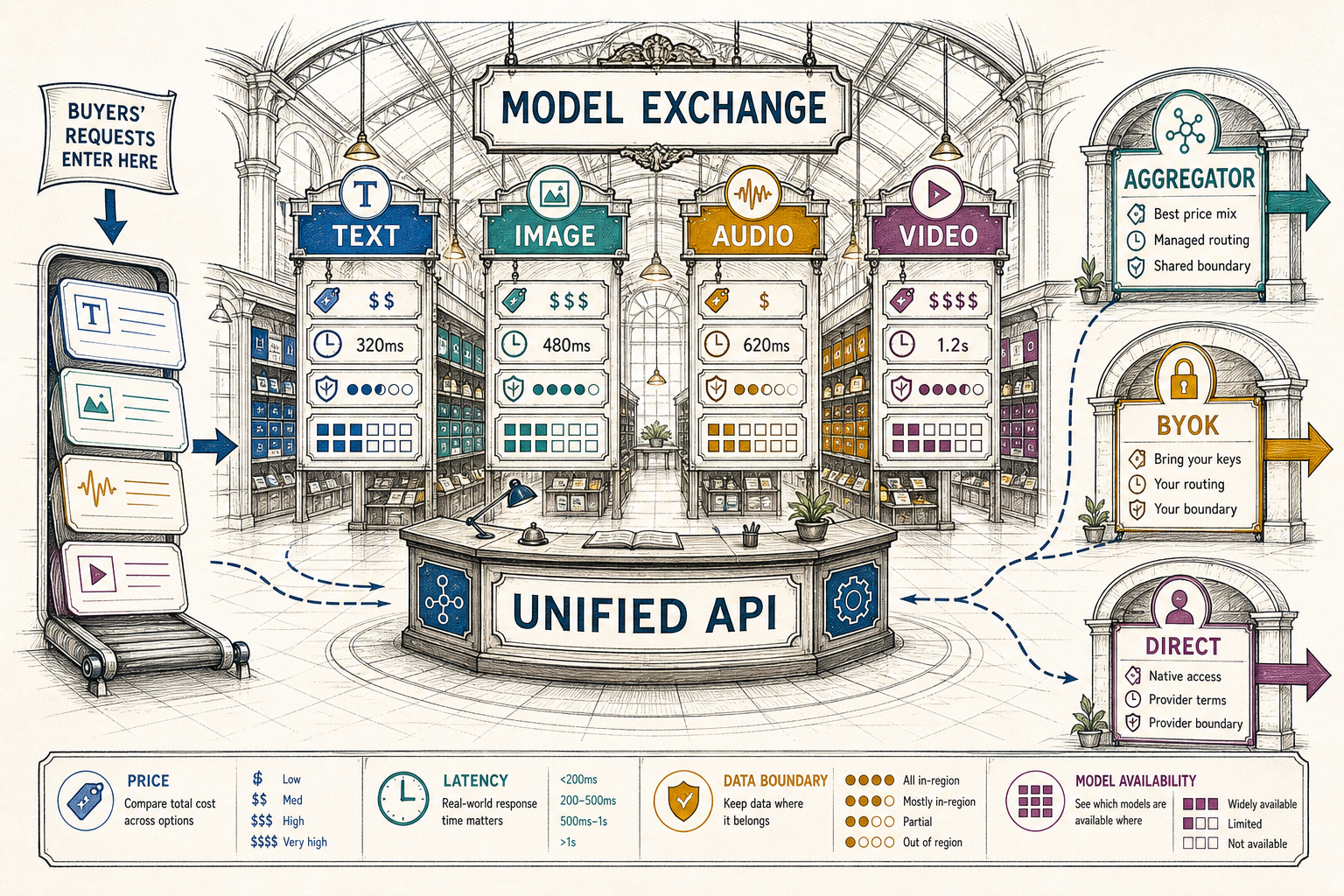
Choose the buying model before the vendor 先选采购模式,再选供应商
One account and API expose many providers. Best for discovery and portfolio breadth; validate markup, pass-through terms, regional processing, and provider lag.
A routing or normalization layer uses your provider contracts. You retain vendor relationships, but still depend on the intermediary's schema and runtime.
Maximum native feature access and commercial control, at the cost of separate SDKs, credentials, quotas, invoices, and reliability logic.
Run normalization yourself. This improves architectural control but assigns availability, upgrades, security, and support to your team.
用一个账户和 API 访问多家供应商,适合发现与扩展覆盖;要验证加价、转售条款、区域处理与新模型上架延迟。
路由或标准化层使用你的供应商合同。你保留直接关系,但仍依赖中间层的结构定义与运行时。
原生功能和商业控制最强,但要分别管理 SDK、凭证、配额、账单与可靠性逻辑。
自行运行标准化服务,架构控制更强,但可用性、升级、安全和支持均由团队承担。
Nine Eden AI alternatives by procurement job 按采购任务划分的 9 个 Eden AI 替代方案
| Option 选项 | Strongest fit 最强适用点 | Validate first 优先验证 |
|---|---|---|
| AIMLAPI | Broad text, image, video, music, voice, and 3D catalog 文本、图像、视频、音乐、语音和 3D 广覆盖 | Exact model availability and commercial terms 具体模型可用性与商业条款 |
| OpenRouter | Large language-model marketplace and routing 大型语言模型市场与路由 | Multimodal scope beyond LLMs LLM 之外的多模态覆盖 |
| Replicate | Hosted open models and reproducible versions 托管开源模型与可复现版本 | Cold starts, hardware pricing, and version lifecycle 冷启动、硬件价格与版本生命周期 |
| fal | Media generation workloads and fast inference 媒体生成与快速推理 | Breadth outside generative media 生成媒体之外的覆盖范围 |
| Hugging Face Inference Providers | Open model discovery with provider choice 开源模型发现与供应商选择 | Per-model provider support and quotas 逐模型的供应商支持和配额 |
| LiteLLM | Self-hosted provider abstraction and BYOK 自托管供应商抽象与 BYOK | Operations and non-LLM media workflows 运维与非 LLM 媒体工作流 |
| Portkey | Production gateway, policy, and observability 生产网关、策略与可观测性 | Catalog breadth for specialized media models 专业媒体模型的目录广度 |
| Direct provider APIs | Native features, contracts, and data control 原生功能、合同与数据控制 | Integration and reliability engineering cost 集成与可靠性工程成本 |
| QVeris | External data and tool capabilities for agents 面向智能体的外部数据与工具能力 | Complementary to model inference, not a substitute 与模型推理互补,并非替代 |
Compare total economics, not listed token price 比较总经济性,而不是挂牌 Token 价
Build one bill for the same 30-day workload. Include inference and media units, aggregator or platform fees, failed requests, retries, storage, egress, webhook processing, minimum commitments, support, and the engineering time used to integrate and operate each option. Separate quoted provider price from the amount actually invoiced by the intermediary.
用同一份 30 天工作负载计算总账单:推理和媒体计量、聚合或平台费用、失败请求、重试、存储、出站流量、Webhook 处理、最低承诺、支持,以及集成和运营所需工程时间。要区分供应商报价与中间层实际开票金额。
Do not assume a universal markup. Pricing models and plan terms change. Capture the dated plan, contract, model, region, and unit used for every comparison.
不要假设统一加价比例。定价与套餐会变化;每次比较都记录日期、套餐、合同、模型、区域与计量单位。
A multimodal production test plan 多模态生产测试计划
- Use five real requests per modality, including large files, unusual aspect ratios, long audio, and asynchronous video jobs.
- Compare native and normalized parameters, output fidelity, seed behavior, safety metadata, and callback signatures.
- Force rate limits, provider downtime, invalid inputs, callback loss, and long-running job cancellation.
- Record time to first result, total completion time, failure rate, charged units, and regional data path.
- 每种模态使用 5 个真实请求,包括大文件、特殊画幅、长音频与异步视频任务。
- 比较原生与标准化参数、输出保真度、Seed 行为、安全元数据与回调签名。
- 主动触发限流、供应商中断、非法输入、回调丢失和长任务取消。
- 记录首结果时间、总完成时间、失败率、计费单位与区域数据路径。
Avoid the lowest-common-denominator migration 避免迁移到“最小公分母”
Create a capability manifest for every production workflow: accepted files, parameter ranges, moderation, output schema, asynchronous state, callbacks, retries, idempotency, model version, region, and retention. Put provider-specific features behind explicit adapters instead of silently dropping them into a generic schema. Dual-run representative jobs and reconcile both output and billed units.
为每个生产工作流建立能力清单:输入文件、参数范围、审核、输出结构定义、异步状态、回调、重试、幂等、模型版本、区域与保留策略。供应商专属功能应放在显式适配器后面,不要无声丢入通用结构定义。双轨运行代表性任务,同时核对输出和计费单位。
Model access and capability access are different 模型访问与能力访问并不相同
Eden AI and its closest alternatives answer “which model performs this inference or generation?” QVeris answers “which external data source, API, or operational tool can the agent use next?” A production agent may need both layers, joined through one identity and trace context.
Eden AI 及其最接近的替代方案回答“哪个模型执行这次推理或生成”;QVeris 回答“智能体下一步可以使用哪个外部数据源、API 或运营工具”。生产智能体可能同时需要两层,并用统一身份与调用链上下文连接。
A Production Evaluation Plan for Eden AI alternativesEden AI 替代方案的生产评估方案
A feature table can identify candidates, but it cannot prove operational fit. Evaluate Eden AI alternatives with the workloads, policies, failure conditions, and evidence requirements that the team will actually own after migration.
功能表可以帮助筛选候选方案,却无法证明生产适配性。评估Eden AI 替代方案时,应使用团队迁移后真正需要承担的工作负载、策略、失败条件和证据要求。
Inventory representative requests and record multi-service coverage, modality-specific schemas, asynchronous jobs, output assets, provider choice, and billing reconciliation. Include volumes, tail latency, quality thresholds, regulated data, operator steps, monthly spend, and the incidents the current system already knows how to handle.
盘点有代表性的请求,并记录多服务覆盖、模态专属 Schema、异步任务、输出资产、供应商选择和账单核对。同时纳入流量、长尾延迟、质量门槛、受监管数据、人工步骤、月度支出,以及现有系统已经能够处理的事故类型。
To validate Eden AI Alternatives, replay saved cases against each candidate. Compare accepted parameters, streaming events, structured output, tool calls, error classes, usage accounting, and source metadata. Mark every difference as required, adaptable, or a migration blocker.
验证“Eden AI 替代方案”时,用保存的案例重放每个候选方案,比较参数、流式事件、结构化输出、工具调用、错误类别、用量计量和来源元数据,并将差异标记为必须保留、可以适配或阻断迁移。
To validate Eden AI Alternatives, measure end-to-end task completion, output quality, p50 and tail latency, availability, retry amplification, fallback behavior, and accepted-result cost. Include rate limits, malformed responses, regional loss, schema drift, and provider outages.
验证“Eden AI 替代方案”时,衡量端到端任务完成率、输出质量、常规与长尾延迟、可用性、重试放大、故障切换行为和合格结果成本,并加入限流、畸形响应、区域丢失、Schema 漂移与供应商中断。
Before rolling out Eden AI Alternatives, version routing and policy outside the vendor, preserve trace identifiers, stage read-only traffic first, define rollback signals, and retain a direct-provider or previous-platform path until evidence meets the acceptance threshold.
上线“Eden AI 替代方案”前,在供应商之外版本化路由与策略,保留追踪标识,先迁移只读流量,定义回滚信号,并在证据达到验收门槛前保留直连供应商或原平台路径。
FAQ
AIMLAPI is a relevant broad-catalog comparison; Replicate, fal, and Hugging Face are stronger comparisons for specific open-model or media workflows.
No. Your commercial account may be direct, while request schemas, telemetry, availability, and data transit still depend on the intermediary.
Only when operational simplicity outweighs losing or delaying provider-native features. Many teams use a common core plus explicit specialist adapters.
No. QVeris focuses on discoverable and auditable external capabilities for agents rather than multimodal inference procurement.
AIMLAPI 是广目录的重要比较项;Replicate、fal 与 Hugging Face 更适合特定开源模型或媒体工作流。
不等于。商业账户可以直接,但请求结构定义、遥测、可用性和数据传输仍依赖中间层。
只有当运营简化的价值高于原生功能损失或延迟时才适合。很多团队采用统一核心加专用适配器。
不聚合。QVeris 聚焦智能体可发现、可审计的外部能力,而非多模态推理采购。