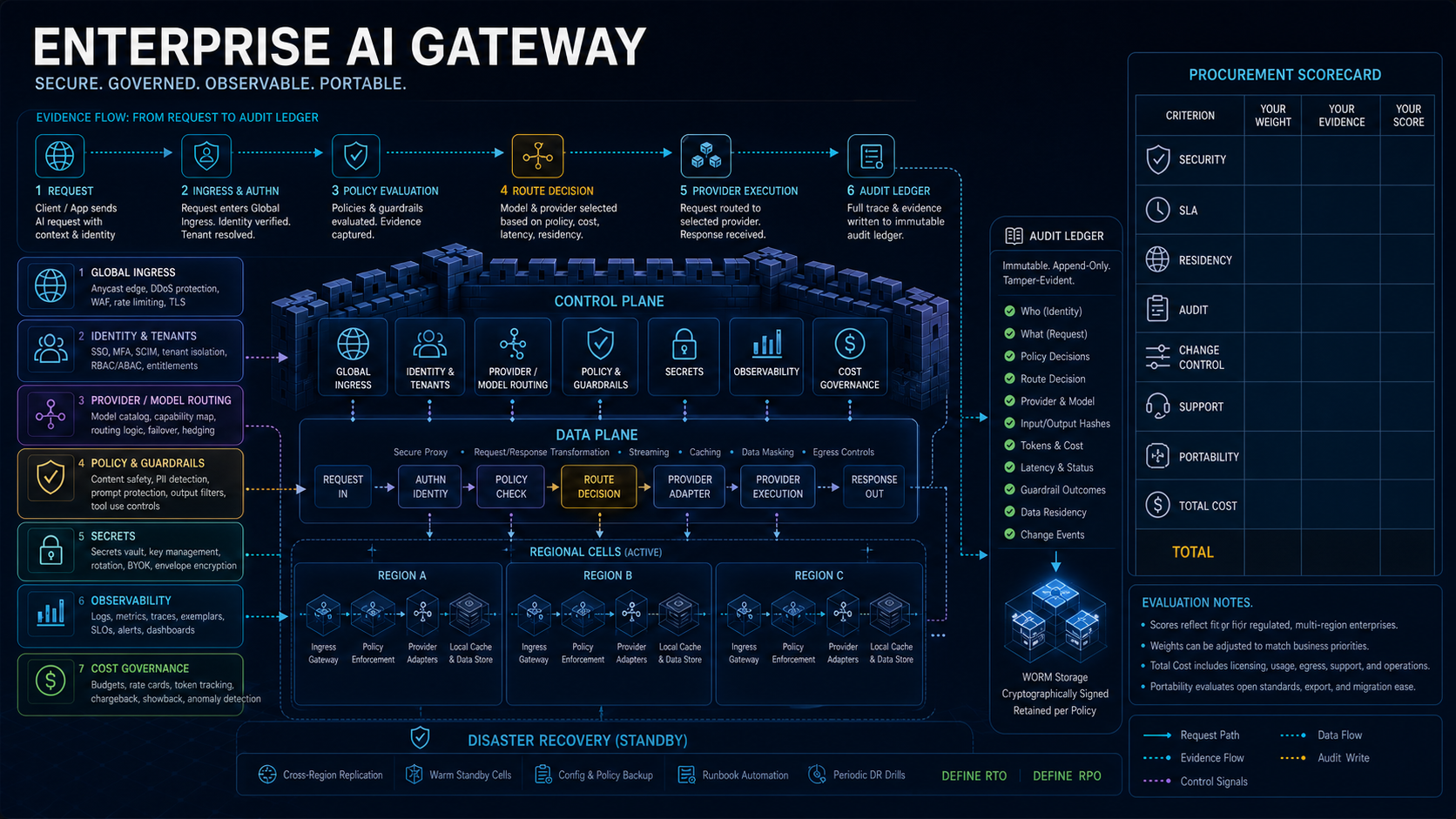
Enterprise AI Gateway
Architecture, Security, and Selection企业 AI 网关
架构、安全与选型指南
An enterprise AI gateway gives every team one governed path to models and AI tools. This guide explains the architecture, controls, operating model, evaluation criteria, and rollout plan required beyond a basic LLM proxy.
企业 AI 网关为各业务团队提供访问模型与 AI 工具的统一受控通道。本指南解释它与普通 LLM 代理的区别,以及企业落地所需的架构、控制措施、运营模式、选型标准与上线步骤。

TL;DR
Direct answer: an enterprise AI gateway is a shared, model-aware policy and traffic layer between an organization’s applications, agents, models, and AI tools. It centralizes identity, approved routes, data controls, safety checks, budgets, reliability, telemetry, and audit evidence across business units.
直接答案:企业 AI 网关位于组织内的应用、智能体、模型与 AI 工具之间,是一个理解模型语义的共享策略与流量控制层。它把身份、获批路由、数据控制、安全检查、预算、可靠性、遥测与审计证据统一起来,供不同业务部门共同使用。
The gateway is not just a proxy URL. It becomes the place where platform, security, finance, privacy, and application teams agree on runtime policy.
A dashboard claim is not enough. Each decision needs exportable evidence linking identity, policy version, route, model, data treatment, usage, cost, and outcome.
Managed, self-hosted, hybrid, edge, and private data-plane designs produce different residency, failure, support, and ownership obligations.
Reject options that fail identity, networking, residency, retention, recovery, or contractual requirements before comparing convenience features.
企业 AI 网关不只是一个代理地址,而是平台、安全、财务、隐私和应用团队共同制定运行策略的位置。
供应商在演示中说“支持”还不够。每次决策都应留下可导出的身份、策略版本、路由、模型、数据处理、用量、成本与结果记录。
托管、自托管、混合、边缘和私有数据平面在数据驻留、故障、支持与责任边界上并不相同。
凡是不满足身份、网络、驻留、保留、恢复或合同要求的方案,应先淘汰,再比较易用性功能。
What makes an AI gateway enterprise-grade?什么样的 AI 网关才算企业级?
A normal AI gateway can normalize provider APIs, hold credentials, route requests, and collect basic usage. An enterprise AI gateway must do those jobs consistently across many applications, teams, regions, environments, and risk classes. It also needs administrative separation, policy approval, evidence retention, disaster recovery, vendor support, and a documented exit path.
普通 AI 网关可以统一供应商接口、保管密钥、转发请求并收集基本用量;而企业 AI 网关必须把这些能力稳定地提供给多个应用、团队、区域、环境和风险等级。除此之外,它还要具备管理职责分离、策略审批、证据保留、灾难恢复、供应商支持与明确的退出路径。
The word “enterprise” should therefore describe operating discipline, not a pricing tier. A platform is not enterprise-ready merely because it offers SSO or an annual contract. It must remain understandable during an incident, enforce policy under load, preserve tenant boundaries, recover from component failure, and produce evidence that security and audit teams can independently verify.
因此,“企业级”描述的应当是运营纪律,而不是价格档位。仅有 SSO 或年度合同,并不能证明平台适合企业生产。真正的企业级网关应在事故期间仍然可理解,在高负载下继续执行策略,守住租户边界,在组件故障后恢复,并输出安全与审计团队能够独立核验的证据。
Useful test: if the gateway disappears for one hour, can teams explain which applications stop, which continue safely, what policy remains active, and how every affected request will be reconstructed?
实用判断题:如果网关中断一小时,团队能否明确说明哪些应用会停止、哪些可以安全继续、哪些策略仍然有效,以及事后如何还原每个受影响的请求?
Enterprise gateways follow four operating models企业网关有四类运营模型
Managed suites combine gateway, policy, observability and support. Self-hosted gateways maximize runtime control. Enterprise API platforms extend existing identity and governance. Edge platforms place data planes near users and regional workloads.
托管套件组合网关、策略、可观测性与支持;自托管网关最大化运行控制;企业 API 平台扩展既有身份与治理;边缘平台把数据平面靠近用户与区域负载。
Products such as Portkey, LiteLLM, Bifrost, Kong, Cloudflare and Vercel span these models in different ways. Compare the exact edition, topology and contract; do not infer enterprise capability from a product family name.
Portkey、LiteLLM、Bifrost、Kong、Cloudflare 与 Vercel 以不同方式跨越这些模型。应比较具体版本、拓扑与合同,不要从产品家族名称推断企业能力。
Enterprise shortlist by architecture按架构筛选企业候选
| Architecture架构 | Best fit最适合 | Verify before choosing选择前验证 |
|---|---|---|
| Managed gateway suite托管网关套件 | Fast deployment, integrated policy, observability, administration and vendor-backed operations.快速部署、集成策略、可观测、管理与供应商支持的运营。 | Verify data path, residency, retention, SLA exclusions, support response, export, pricing and exit terms.验证数据路径、驻留、保留、SLA 排除项、支持响应、导出、价格与退出条款。 |
| Self-hosted gateway自托管网关 | Organizations needing private networking, runtime control, custom policy and infrastructure portability.需要私有网络、运行控制、自定义策略与基础设施可移植性的组织。 | Own HA, database, scaling, upgrades, CVEs, backups, DR, telemetry and incident response.承担高可用、数据库、扩缩、升级、CVE、备份、灾备、遥测与事故响应。 |
| Enterprise API platform企业 API 平台 | Teams extending mature API identity, ingress, policy-as-code, plugins and governance into AI traffic.把成熟 API 身份、Ingress、策略即代码、插件与治理扩展到 AI 流量。 | Check AI protocol depth, licensing, plugin versions, configuration complexity and model-specific evidence.检查 AI 协议深度、许可、插件版本、配置复杂度与模型特定证据。 |
| Edge AI gateway边缘 AI 网关 | Global workloads needing low-latency ingress, edge policy, caching and regional controls.需要低延迟入口、边缘策略、缓存与区域控制的全球负载。 | Verify provider semantics, regional data flow, logs, dynamic routing, transformations and failure isolation.验证供应商语义、区域数据流、日志、动态路由、转换与故障隔离。 |
| Private VPC service私有 VPC 服务 | Enterprises wanting vendor operations while keeping data-plane components inside controlled cloud networks.希望供应商运营同时让数据平面组件位于受控云网络的企业。 | Map every hosted dependency, egress path, update channel, support tunnel and control-plane outage mode.绘制每个托管依赖、出口路径、更新通道、支持隧道与控制平面故障模式。 |
Eight procurement gates八项采购门槛
SSO, workload identity, service accounts, RBAC/ABAC, tenant isolation, delegated administration and break-glass access.
Regions, provider allowlists, encryption, retention, redaction, training policy, deletion, legal terms and audit export.
SLO/SLA, rate limits, fallbacks, circuit breaking, regional cells, backups, RTO/RPO, degraded mode and status communication.
Policy approval, versioning, canary, rollback, API contracts, configuration export, model aliases, data export and migration assistance.
SSO、工作负载身份、Service Account、RBAC/ABAC、租户隔离、委派管理与紧急访问。
区域、供应商 Allowlist、加密、保留、脱敏、训练策略、删除、法律条款与审计导出。
SLO/SLA、限流、回退、熔断、区域单元、备份、RTO/RPO、降级模式与状态沟通。
策略审批、版本、灰度、回滚、API 契约、配置导出、模型别名、数据导出与迁移协助。
Translate enterprise requirements into runtime controls把企业要求转换成可执行的运行控制
Procurement language is often too vague to implement. “Support data residency” does not say whether prompts, responses, cache entries, traces, support snapshots, or backup copies may cross a boundary. “Support RBAC” does not say whether an application identity can invoke every model. Convert every requirement into an actor, protected resource, decision point, enforcement behavior, evidence field, and exception process.
采购条款往往过于宽泛,无法直接落地。“支持数据驻留”并没有说明提示词、响应、缓存、调用链、支持快照或备份能否跨境;“支持 RBAC”也没有说明某个应用身份是否可以调用全部模型。应把每项要求拆成主体、受保护资源、决策点、执行动作、证据字段和例外流程。
| Business requirement业务要求 | Gateway control网关控制 | Evidence to retain需要保留的证据 |
|---|---|---|
| Only approved teams may use premium models只有获批团队可使用高成本模型 | Workload identity plus model-level authorization工作负载身份与模型级授权 | Actor, tenant, model alias, policy version, decision主体、租户、模型别名、策略版本与决策结果 |
| Regulated data stays in an approved geography受监管数据必须留在指定地域 | Data classification, regional route allowlist, local telemetry数据分类、区域路由白名单与本地遥测 | Classification, gateway region, provider region, storage destinations分类结果、网关区域、供应商区域与存储位置 |
| A business unit cannot exceed its monthly budget业务部门不得超出月度预算 | Attributed token accounting and hard or soft budget policy按部门归因的 Token 计量与软硬预算策略 | Usage, effective price, owner, threshold, action taken用量、实际价格、责任方、阈值与执行动作 |
| Sensitive prompts must not enter support logs敏感提示词不得进入支持日志 | Field-level redaction before telemetry export遥测导出前进行字段级脱敏 | Redaction policy, matched category, destination, hash or reference脱敏策略、命中类别、导出目标与哈希或引用 |
Reference architecture: separate control, data, and evidence planes参考架构:分离控制平面、数据平面与证据平面
Stores provider definitions, model aliases, policy bundles, budgets, tenant configuration, approvals, secrets references, and rollout state. Changes should be versioned, reviewed, signed, and reversible.
Authenticate requests, evaluate local policy, transform protocols, select eligible routes, apply limits, stream responses, and fail safely. They should serve from signed last-known-good configuration when the control plane is unavailable.
Receives immutable decision records, metrics, traces, cost events, policy outcomes, and administrative changes. Evidence access should be separated from gateway administration.
Contains external model APIs, cloud-hosted deployments, self-hosted inference, MCP servers, and enterprise tools. Each route needs explicit credentials, region, capability, and data-handling metadata.
保存供应商定义、模型别名、策略包、预算、租户配置、审批、密钥引用与发布状态。任何变更都应有版本、经过审核、可验证签名并能够回滚。
负责认证请求、执行本地策略、转换协议、选择合格路由、限流、传输流式响应并安全失败。控制平面不可用时,应继续使用已签名的最近有效配置。
接收不可篡改的决策记录、指标、调用链、成本事件、策略结果与管理变更。证据读取权限应与网关管理权限分离。
包括外部模型 API、云端模型、自托管推理、MCP 服务与企业工具。每条路由都需要明确的凭证、区域、能力与数据处理元数据。
Use regional cells instead of one global failure domain. A cell should include the runtime, local policy cache, provider connectivity, minimal state, and telemetry buffer needed to continue bounded service. Avoid making request serving depend synchronously on a global dashboard, billing service, or configuration database.
建议采用区域单元,而不是把全球流量放进同一个故障域。每个单元应包含继续提供有限服务所需的运行组件、本地策略缓存、供应商连接、最小状态和遥测缓冲。请求处理不应同步依赖全球控制台、计费服务或配置数据库。
Design security around identity, data, and route eligibility围绕身份、数据与路由资格设计安全体系
The safest gateway does not ask only “is this request authenticated?” It asks which workload is calling, on whose behalf, for which purpose, with what data class, from which environment, and which models or tools remain eligible. Human administration and runtime invocation should use different identities and permission paths.
安全的网关不能只问“请求是否已认证”,还要判断哪个工作负载在调用、代表谁、用于什么目的、携带什么数据、来自哪个环境,以及哪些模型或工具仍然符合条件。人工管理与运行时调用应使用不同身份和权限链路。
Applications receive gateway-scoped credentials or workload identity, never reusable provider keys. Provider secrets live in an approved secret store and rotate without application redeployment.
Classify or redact sensitive fields before routing. Apply content safety with explicit fail-open or fail-closed behavior, timeout limits, versioned rules, and recorded outcomes.
Map inbound private connectivity, outbound egress, DNS, proxies, support tunnels, update channels, and telemetry destinations. “Runs in our VPC” is incomplete if control or logging paths leave it.
Separate policy authors, approvers, deployers, auditors, and emergency operators. Record configuration reads and writes, not only model requests.
应用只获取网关范围的凭证或工作负载身份,不接触可重复使用的供应商密钥。供应商密钥放在获批的密钥系统中,并能在不重新部署应用的情况下轮换。
路由前识别或脱敏敏感字段。内容安全策略要明确失败时放行还是阻断、超时上限、规则版本,并记录执行结果。
完整梳理私网入口、出口流量、DNS、代理、支持隧道、更新通道与遥测目的地。即使运行组件在 VPC 内,只要控制或日志路径外流,就不能简单称为“完全私有”。
策略编写、审批、发布、审计与紧急操作应职责分离。除模型请求外,配置读取和修改也必须留痕。
Data residency is an end-to-end property数据驻留是端到端属性
A gateway region alone does not determine residency. Follow the complete path: client, gateway runtime, policy service, guardrail service, cache, provider endpoint, tool call, trace collector, log store, support workflow, analytics warehouse, and backup. For every component, document the controller, processor, physical region, retention period, encryption keys, deletion mechanism, and access path.
仅看网关部署区域,无法判断数据是否满足驻留要求。必须沿完整链路核对:客户端、网关运行组件、策略服务、护栏服务、缓存、供应商端点、工具调用、调用链采集器、日志存储、支持流程、分析仓库与备份。每个组件都应记录控制方、处理方、物理区域、保留周期、加密密钥、删除机制与访问路径。
Separate payload retention from metadata retention. Teams may decide not to store prompt or response bodies while retaining token counts, route IDs, latency, cost, policy outcomes, and hashed request references. This reduces exposure, but it can also limit incident reconstruction. Choose the evidence envelope deliberately for each risk class rather than applying one global logging mode.
还要区分正文保留与元数据保留。团队可以不保存提示词和响应正文,只保留 Token 数、路由 ID、延迟、成本、策略结果与请求哈希,从而降低暴露面;但这也会限制事故还原能力。不同风险等级应分别设计证据封装,而不是全公司共用一种日志模式。
Contract check: compare architecture diagrams with the data-processing agreement, subprocessors, support terms, model-provider policy, and deletion commitments. A technical toggle cannot override a contradictory contract.
合同核对:应把架构图与数据处理协议、次级处理方、支持条款、模型供应商政策和删除承诺逐项对照。技术开关无法抵消合同中的相反约定。
Reliability requires model-aware failure semantics可靠性需要理解模型语义的故障处理
Model calls are not ordinary idempotent HTTP requests. A timeout may happen after a provider began generation, a client may disconnect after receiving part of a stream, or a retry may duplicate tool execution. Define retry and fallback policy separately for connection failure, pre-token timeout, mid-stream failure, provider rate limit, content rejection, malformed structured output, and tool-side effects.
模型调用不是普通的幂等 HTTP 请求。超时可能发生在供应商已经开始生成之后;客户端也可能在收到部分流式内容后断开;盲目重试还可能导致工具重复执行。因此,连接失败、首 Token 前超时、流中断、供应商限流、内容拒绝、结构化输出错误与工具副作用必须分别制定重试和回退策略。
| Failure故障类型 | Safer default更稳妥的默认处理 | Evidence证据 |
|---|---|---|
| No connection or no response bytes未建立连接或未收到响应字节 | Bounded retry on the same eligible route, then policy-approved fallback在同一合格路由有限重试,再按策略回退 | Attempt number, timeout stage, selected route, fallback reason尝试次数、超时阶段、所选路由与回退原因 |
| Partial stream delivered已经输出部分流 | Do not silently restart; surface an incomplete result and correlation ID不要静默重启;明确返回结果不完整及关联 ID | Bytes or tokens delivered, finish state, client disconnect state已输出字节或 Token、结束状态与客户端断开状态 |
| Safety policy rejects content内容被安全策略拒绝 | Return a stable policy response; do not route around the control返回稳定的策略响应,不得绕过控制更换路由 | Rule version, matched category, enforcement action规则版本、命中类别与执行动作 |
| Tool call may have side effects工具调用可能产生副作用 | Require idempotency key or explicit human/application recovery要求幂等键,或由人工/应用明确恢复 | Tool call ID, idempotency key, acknowledgement state工具调用 ID、幂等键与确认状态 |
Observe decisions, not only requests不仅观察请求,更要观察决策
Request count, latency, and error rate are necessary but insufficient. Enterprise operators must understand why a route was eligible, why another route was excluded, which policy version ran, whether a guardrail modified content, how cost was calculated, and what changed immediately before an incident.
请求量、延迟和错误率必不可少,但仍不足以支撑企业运营。运维人员还要知道某条路由为何符合条件、另一条为何被排除、执行了哪个策略版本、护栏是否修改内容、成本如何计算,以及事故发生前刚刚变更了什么。
Gateway processing time, provider queue time, time to first token, stream duration, completion rate, rate-limit pressure, and regional saturation.
Tenant, workload, data class, policy version, eligible set, selected route, attempts, fallback, guardrail outcomes, and final status.
Input, output, cached, reasoning, and tool tokens where available; effective price version; budget owner; markup; and cost allocation tags.
Who changed a model alias, route weight, policy, credential, region, or retention rule; who approved it; where it rolled out; and how it was rolled back.
网关处理时间、供应商排队时间、首 Token 时间、流式持续时间、完成率、限流压力与区域饱和度。
租户、工作负载、数据等级、策略版本、合格路由集合、最终路由、尝试次数、回退、护栏结果与最终状态。
在供应商支持的情况下,分别记录输入、输出、缓存、推理和工具 Token,以及有效价格版本、预算责任方、加价与成本归属标签。
谁修改了模型别名、路由权重、策略、凭证、区域或保留规则,谁批准,发布到哪里,以及如何回滚。
Calculate total cost of ownership, not proxy price计算总拥有成本,而不是只看代理价格
Gateway license or request markup is only one line. Include infrastructure, regions, private networking, databases, cache, telemetry ingestion and retention, security review, integrations, policy maintenance, on-call coverage, upgrades, incident response, support tier, and future migration. A low-cost self-hosted binary can become expensive when the enterprise must build every operating control around it.
网关许可费或请求加价只是一项支出。总成本还包括基础设施、区域、私网、数据库、缓存、遥测采集与保留、安全评审、系统集成、策略维护、值班、升级、事故响应、支持等级和未来迁移。一个看似便宜的自托管程序,如果周边运营能力全部由企业自建,最终并不一定便宜。
Cost controls should also be operationally honest. A budget alert that arrives after provider spend is incurred is not a hard limit. Verify update delay, reservation behavior for streaming requests, multi-currency price updates, cached-token treatment, provider discounts, and what happens when the accounting service is unavailable.
成本控制还要区分“提醒”和“真正阻断”。如果告警在供应商费用已经发生后才到达,它就不是硬预算。应验证用量更新延迟、流式请求如何预占预算、多币种价格更新、缓存 Token 计费、供应商折扣,以及计量服务不可用时的处理方式。
Roll out the enterprise AI gateway in controlled stages分阶段上线企业 AI 网关
| Stage阶段 | Work主要工作 | Exit evidence进入下一阶段的证据 |
|---|---|---|
| 1. Inventory1. 盘点 | List applications, owners, providers, models, tools, credentials, data classes, regions, spend, and existing controls.列出应用、责任人、供应商、模型、工具、凭证、数据等级、区域、支出与现有控制。 | An owner-approved traffic and data-flow map由责任人确认的流量与数据流图 |
| 2. Shadow2. 旁路观察 | Replay or mirror representative traffic without changing production decisions. Compare semantics, latency, usage, and evidence.在不改变生产决策的前提下回放或镜像代表性流量,对比语义、延迟、用量与证据。 | Known compatibility gaps and measured overhead明确的兼容性差距与实测开销 |
| 3. Low-risk production3. 低风险生产 | Move internal, reversible workloads first. Exercise support, rollback, credential rotation, and budget operations.先迁移内部、可逆的低风险负载,并演练支持、回滚、密钥轮换与预算操作。 | Stable SLOs and completed operational drills稳定的 SLO 与已完成的运营演练 |
| 4. Regulated workloads4. 受监管负载 | Add formal policy approval, evidence retention, regional recovery, privacy review, and contractual acceptance.补齐正式策略审批、证据保留、区域恢复、隐私评审与合同验收。 | Signed control mapping and recovery proof签字确认的控制映射与恢复证明 |
Enterprise AI gateway evaluation scorecard企业 AI 网关选型评分表
Score only after hard requirements pass. Use evidence from a production-like proof, not sales slides. Weight categories to match your risk profile; for a regulated global business, identity, data path, recovery, and auditability should usually outweigh the number of provider adapters.
只有方案通过硬性门槛后,才进入评分。评分依据应来自接近生产的验证,而不是销售演示。权重需要符合自身风险:对跨区域且受监管的企业而言,身份、数据路径、恢复和可审计性通常比供应商适配器数量更重要。
| Category类别 | Suggested weight建议权重 | Pass evidence通过证据 |
|---|---|---|
| Identity, tenancy, and administration身份、租户与管理 | 20% | Least-privilege test, tenant escape test, approval and emergency-access records最小权限测试、租户越界测试、审批与紧急访问记录 |
| Data security and residency数据安全与驻留 | 20% | Verified end-to-end data map, retention/deletion test, private path evidence已验证的端到端数据图、保留/删除测试与私网路径证据 |
| Reliability and recovery可靠性与恢复 | 20% | Load, regional failure, control-plane outage, restore, and rollback results负载、区域故障、控制平面中断、恢复与回滚结果 |
| Compatibility and developer experience兼容性与开发体验 | 15% | Representative SDK, streaming, tools, structured output, and error tests代表性 SDK、流式、工具、结构化输出与错误测试 |
| Evidence, observability, and FinOps证据、可观测性与 FinOps | 15% | Reconstructable decisions and reconciled provider invoices可重建的决策与能够对账的供应商账单 |
| Ownership, support, and exit责任、支持与退出 | 10% | RACI, SLA drill, complete export, migration estimate, and contract reviewRACI、SLA 演练、完整导出、迁移估算与合同评审 |
Run an enterprise evidence proof执行企业证据验证
- Replay regulated and non-regulated workloads across approved regions, tenants, models, providers and identity paths.
- Force provider, region, database, control-plane and telemetry failures; verify bounded degraded behavior and recovery evidence.
- Perform policy approval, key rotation, model retirement, gateway upgrade, backup restore, DR and vendor-support drills.
- Give security, finance and on-call teams the same trace and confirm each can answer its audit question.
- 跨获批区域、租户、模型、供应商与身份路径回放受监管和非监管负载。
- 强制供应商、区域、数据库、控制平面与遥测故障,验证有边界的降级行为与恢复证据。
- 执行策略审批、密钥轮换、模型退役、网关升级、备份恢复、灾备与供应商支持演练。
- 让安全、财务与值班团队查看同一调用链,并确认各自都能回答审计问题。
Common enterprise AI gateway failure modes企业 AI 网关常见失败模式
The team selects the longest checklist without testing topology, policy semantics, evidence quality, support behavior, or operational ownership.
Every region depends on a central configuration database, telemetry service, or vendor control plane, turning a management outage into a worldwide inference outage.
Prompt and response bodies enter logs, traces, support bundles, and analytics stores before retention and access policy is designed.
A failed route is replaced with a cheaper or different model that changes tool use, safety behavior, context limits, structured output, or business quality without telling the application.
Security writes policy, platform runs infrastructure, finance disputes cost, and application teams escalate incidents, but nobody owns the end-to-end service objective.
Model aliases, policies, telemetry, keys, and application contracts depend on vendor-specific behavior that cannot be exported or reproduced during migration.
团队选择清单最长的产品,却没有验证部署拓扑、策略语义、证据质量、支持表现与运营责任。
所有区域同步依赖中央配置库、遥测服务或供应商控制平面,最终把一次管理面故障扩大成全球推理中断。
尚未设计保留和访问策略,提示词与响应正文就已经进入日志、调用链、支持包和分析仓库。
路由失败后,网关悄悄换成更便宜或行为不同的模型,导致工具调用、安全策略、上下文长度、结构化输出或业务质量发生变化,而应用并不知情。
安全团队写策略、平台团队管基础设施、财务团队核成本、应用团队报事故,却没有人对完整服务目标负责。
模型别名、策略、遥测、密钥与应用契约依赖供应商专有行为,迁移时既不能完整导出,也无法复现。
Production rule: an enterprise gateway is governed only when teams can reconstruct a decision after the provider, policy, price, and software version have changed.
生产规则:只有在供应商、策略、价格与软件版本变化之后,团队仍能还原当时的决策,企业网关才真正处于可治理状态。
Add capability governance above inference governance在推理治理之上增加能力治理
Enterprise AI gateways govern model traffic. QVeris complements them by letting agents Discover, Inspect and Call approved external APIs, tools, services and live data. Propagate enterprise identity, tenant, region, policy and trace context into each QVeris execution.
企业 AI 网关治理模型流量;QVeris 补充智能体对获批外部 API、工具、服务与实时数据的 Discover、Inspect、调用。应把企业身份、租户、区域、策略与调用链上下文传入每次 QVeris 执行。
FAQ
It is a shared, model-aware control layer between enterprise applications and AI providers or tools. It centralizes runtime identity, routing, governance, budgets, reliability, telemetry, and audit evidence.
A standard API gateway handles general service traffic. An AI gateway additionally understands prompts, tokens, streaming, model capabilities, provider errors, safety checks, semantic routing, and AI cost.
Buy when speed, support, and managed operations matter most. Build or self-host when topology, residency, or custom policy requires deeper control and you can own the full lifecycle.
No. It can enforce and record controls, but compliance depends on the complete application, data, model, tool, telemetry, process, and contract chain.
Include availability by region, performance boundaries, support response, incident communication, maintenance, data durability, recovery objectives, dependencies, and exclusions.
Long enough to test representative workloads, a normal change cycle, credential rotation, controlled provider and regional failures, evidence export, restore, and exit. A short demo cannot prove these behaviors.
它是企业应用与 AI 模型或工具之间的共享控制层,能够理解模型语义,并统一管理运行身份、路由、治理、预算、可靠性、遥测与审计证据。
普通 API 网关管理通用服务流量;AI 网关还理解提示词、Token、流式传输、模型能力、供应商错误、安全检查、语义路由与 AI 成本。
更看重上线速度、厂商支持与托管运营时适合采购;当部署拓扑、数据驻留或定制策略需要更深控制,并且组织有能力承担完整生命周期时,可以自建或自托管。
不一定。网关能够执行并记录控制,但合规取决于应用、数据、模型、工具、遥测、运营流程与合同条款组成的完整链路。
除了分区域可用性,还应包含性能边界、支持响应、事故沟通、维护窗口、数据持久性、恢复目标、外部依赖与排除项。
至少要覆盖代表性负载、一次正常变更周期、密钥轮换、受控的供应商与区域故障、证据导出、恢复和退出测试。短时间演示无法证明这些能力。
Official sources and further reading官方资料与延伸阅读
Vendor feature names overlap, but architecture, deployment scope, preview status, limits, and contracts differ. Verify the exact edition and current primary documentation before procurement.
不同供应商使用的功能名称往往相似,但架构、部署范围、预览状态、限制和合同并不相同。采购前应核对具体版本及最新一手文档。