
Enterprise Value vs Market Cap
Formula, Differences & Valuation Uses企业价值与市值
公式、差异与估值用途
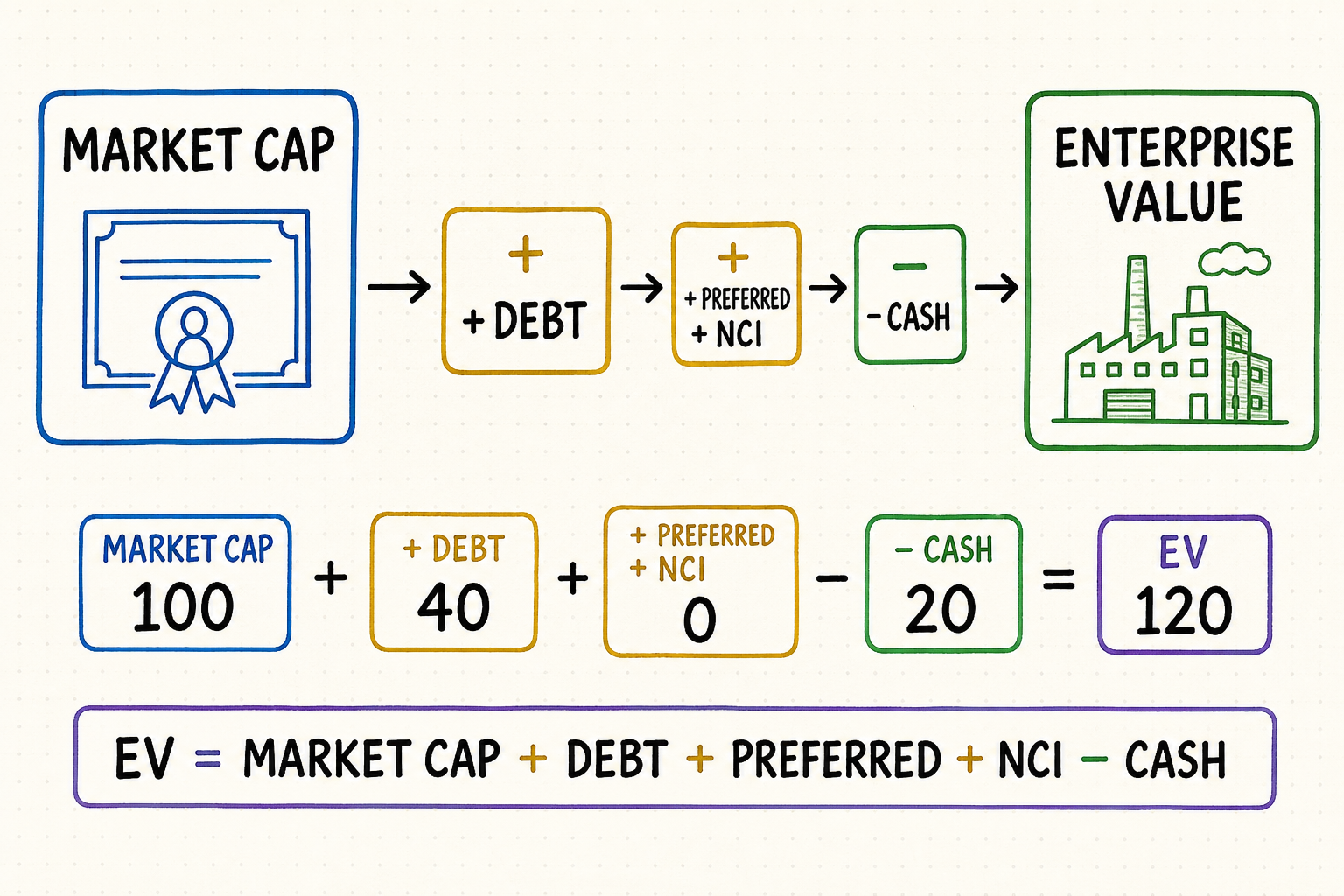
Enterprise value vs market cap compares the value of common equity with the value of a company’s operating business across equity, debt, and other claims.
企业价值与市值分别观察普通股股东权益和整个经营业务的价值,二者之间的差额主要来自债务、现金及其他资本索取权。
TL;DR
Market cap is equity value
Market capitalization equals current share price multiplied by outstanding common shares. It measures the market value attributable to common shareholders.
Enterprise value is operating-asset value
Enterprise value starts with equity value, adds debt and other senior claims, and subtracts cash and cash equivalents.
The gap is a capital-structure bridge
Net debt, preferred equity, and noncontrolling interests usually explain why enterprise value differs from market cap.
Neither number is intrinsic value
Both are market-based measures. They do not independently prove that a company is cheap, expensive, healthy, or a good investment.
市值是普通股权益价值
总市值等于当前股价乘以流通在外普通股数量,反映普通股股东所拥有权益的市场价值。
企业价值关注经营资产
企业价值从股权价值出发,加上债务和其他优先索取权,再减去现金及现金等价物。
差额来自资本结构桥接
净债务、优先股和少数股东权益通常解释了企业价值与市值之间的差额。
两者都不是内在价值
它们都是市场口径,不能单独证明公司便宜、昂贵、经营健康或值得投资。
What enterprise value and market cap actually measure企业价值和市值分别衡量什么
The cleanest way to understand enterprise value and market capitalization is to ask whose claim each number represents. Market cap belongs to common equity holders. Enterprise value estimates the market value of the operating business available to all capital providers, after removing cash treated as a non-operating asset.
理解企业价值和市值最清晰的方法,是先判断每个数字代表谁的索取权。市值属于普通股股东;企业价值则估计经营业务对全部资本提供者的市场价值,并扣除通常视为非经营资产的现金。
Market capitalization formula总市值计算公式
Market cap = current share price × common shares outstanding. For a company with multiple share classes, analysts should include the value of all economically relevant common shares, not only the most liquid class.
总市值 = 当前股价 × 流通在外普通股数量。如果公司存在多个股份类别,应纳入所有具有经济权益的普通股,而不是只计算流动性最高的一个类别。
Enterprise value formula企业价值计算公式
EV = market cap + debt + preferred equity + noncontrolling interest − cash and cash equivalents. A simplified screen often uses market cap plus total debt minus cash, but the fuller bridge is safer when the omitted claims are material.
企业价值 = 市值 + 债务 + 优先股 + 少数股东权益 − 现金及现金等价物。快速筛选时常简化为“市值 + 总债务 − 现金”,但当其他索取权金额较大时,应使用完整桥接公式。
Enterprise value vs equity value企业价值与股权价值
For a public company, market cap is the most visible version of common equity value. A fully diluted equity value may also include options, warrants, convertibles, or other equity claims, so “market cap” and “equity value” are often close but are not automatically identical in detailed transaction models.
对上市公司而言,市值是最直观的普通股股权价值。完整稀释股权价值还可能包括期权、认股权证、可转换证券等权益,因此在交易模型中,“市值”和“股权价值”并不必然完全相同。
Enterprise value vs market cap: side-by-side differences企业价值和市值的区别:逐项对比
| Dimension维度 | Market cap市值 | Enterprise value企业价值 |
|---|---|---|
| Primary perspective主要视角 | Common shareholders普通股股东 | All capital providers and operating assets全部资本提供者与经营资产 |
| Core formula核心公式 | Share price × shares outstanding股价 × 流通股数量 | Market cap + debt + preferred equity + NCI − cash市值 + 债务 + 优先股 + 少数股东权益 − 现金 |
| Debt债务 | Excluded不包含 | Added because lenders also finance the business加入,因为债权人同样为业务提供资本 |
| Cash现金 | Not adjusted separately不单独调整 | Subtracted when treated as a non-operating asset作为非经营资产时予以扣除 |
| Typical multiples常见估值倍数 | P/E, P/B, equity yield measures市盈率、市净率、股权收益指标 | EV/EBITDA, EV/EBIT, EV/SalesEV/EBITDA、EV/EBIT、EV/Sales |
| Capital-structure sensitivity资本结构影响 | Reflects only common equity value只反映普通股权益价值 | Makes debt and cash differences explicit明确反映债务和现金差异 |
| Best question answered最适合回答 | What is the listed common equity worth?上市普通股权益值多少钱? | What are the operating assets worth across the capital structure?整个资本结构下的经营资产值多少钱? |
| Important limitation重要局限 | Ignores leverage and excess cash忽略杠杆和超额现金 | Depends on timely, correctly classified balance-sheet data依赖及时且分类正确的资产负债表数据 |
Enterprise value vs market cap example: build the full bridge企业价值与市值计算案例:完成整套桥接
Assume a fictional public company has a share price of $25 and 40 million common shares outstanding. Its latest balance sheet shows $300 million of debt, $40 million of preferred equity, $10 million of noncontrolling interest, and $200 million of cash and cash equivalents. All values below use the same date, currency, and unit.
假设一家虚构上市公司的股价为25美元,流通在外普通股为4,000万股。最新资产负债表显示债务3亿美元、优先股4,000万美元、少数股东权益1,000万美元,以及现金及现金等价物2亿美元。以下数据均使用同一日期、币种和单位。
| Bridge item桥接项目 | Amount金额 | Running value累计价值 |
|---|---|---|
| Market cap: $25 × 40m shares市值:25美元 × 4,000万股 | $1,000m | $1,000m |
| Add total debt加:总债务 | +$300m | $1,300m |
| Add preferred equity加:优先股 | +$40m | $1,340m |
| Add noncontrolling interest加:少数股东权益 | +$10m | $1,350m |
| Subtract cash and cash equivalents减:现金及现金等价物 | −$200m | Enterprise value $1,150m企业价值11.5亿美元 |
Step 1: calculate market cap步骤1:计算市值
$25 per share × 40 million shares = $1.0 billion market cap. This is the market value of the listed common equity.
每股25美元 × 4,000万股 = 10亿美元市值,代表上市普通股权益的市场价值。
Step 2: add senior and outside claims步骤2:加入优先及外部索取权
Debt, preferred equity, and noncontrolling interest total $350 million. These claims finance or participate in the consolidated operating business but are not captured by common market cap.
债务、优先股和少数股东权益合计3.5亿美元。这些项目为合并经营业务提供资本或参与其价值,但不会体现在普通股市值中。
Step 3: subtract cash步骤3:扣除现金
Subtracting $200 million of cash produces $1.15 billion enterprise value. EV exceeds market cap by $150 million, equal to net debt plus the additional claims in this simplified bridge.
扣除2亿美元现金后,得到11.5亿美元企业价值。企业价值比市值高1.5亿美元,等于该简化案例中的净债务加其他索取权。
This example is fictional and educational. A real model must align the share-price date with diluted share count and the most relevant balance-sheet date before interpreting the result.
本案例为虚构教学示例。真实分析必须先对齐股价日期、稀释后股份数量和相关资产负债表日期,再解释计算结果。
Why enterprise value adds debt and subtracts cash企业价值为什么加债务、减现金
The bridge is not an arbitrary accounting adjustment. It aligns the numerator with the operating assets and the capital providers whose claims are supported by those assets. The direction of each adjustment follows that ownership logic.
企业价值桥接并不是任意的会计调整,而是为了让分子与经营资产及相关资本提供者保持一致。每个调整项目的加减方向,都来自这种索取权逻辑。
Debt is added债务需要加回
Market cap pays only common shareholders. The operating business is also financed by lenders, so interest-bearing debt is added when moving from common equity value to enterprise value.
市值只覆盖普通股股东。经营业务也由债权人提供资金,因此从普通股股权价值桥接到企业价值时,需要加入有息债务。
Cash is subtracted现金需要扣除
Cash is usually treated as a non-operating asset whose interest income is not included in EBITDA or operating income. In a takeover analogy, available cash could also help reduce the effective funding required. In practice, analysts may distinguish operating cash from excess cash.
现金通常被视为非经营资产,其利息收入不包含在EBITDA或营业利润中。在理论收购类比中,可动用现金也能降低实际资金需求。实务中还应区分维持经营所需现金与超额现金。
Preferred equity is added优先股需要加入
Preferred holders have a claim senior to common equity. If preferred equity is material and omitted, EV understates the claims supported by the business.
优先股股东的索取权通常优先于普通股。当优先股金额较大却被遗漏时,企业价值会低估经营业务需要支持的资本索取权。
Noncontrolling interest is added少数股东权益需要加入
Consolidated revenue and EBITDA may include 100% of a controlled subsidiary even when the parent owns less than 100%. Adding noncontrolling interest helps align enterprise value with those fully consolidated operating results.
合并收入和EBITDA可能包含受控子公司的全部业绩,即使母公司并未持有100%权益。加入少数股东权益,可以让企业价值与完整合并的经营结果保持一致。
When enterprise value is higher, lower, equal to, or below zero企业价值高于、低于市值或为负意味着什么
| Observed relationship观察到的关系 | Common mechanical explanation常见机械原因 | What to investigate需要进一步检查 |
|---|---|---|
| EV > market cap企业价值高于市值 | Debt and other added claims exceed cash债务和其他加入项超过现金 | Leverage, debt maturity, preferred equity, NCI杠杆、债务期限、优先股、少数股东权益 |
| EV < market cap企业价值低于市值 | Net cash exceeds debt and other claims净现金超过债务和其他索取权 | Cash quality, restrictions, operating cash needs现金质量、使用限制、经营现金需求 |
| EV ≈ market cap企业价值接近市值 | Cash roughly offsets debt and other additions现金大致抵消债务和其他加入项 | Whether small bridge items were omitted是否遗漏了规模较小的桥接项目 |
| EV < 0企业价值为负 | Cash exceeds market cap, debt, and other claims combined现金超过市值、债务及其他索取权之和 | Stale data, cash burn, restrictions, distress, market expectations数据时效、现金消耗、使用限制、困境风险、市场预期 |
These relationships describe the balance-sheet bridge; they are not automatic buy or sell signals. A cash-rich company can have EV below market cap and still destroy value, while a leveraged company can have EV above market cap and still operate a strong business.
这些关系描述的是资产负债表桥接,并不是自动的买卖信号。现金充裕的公司即使企业价值低于市值,也可能持续损害价值;高杠杆公司即使企业价值高于市值,也可能拥有强劲业务。
When to use market cap or enterprise value in valuation估值时应该使用市值还是企业价值
The correct numerator depends on who receives the denominator’s earnings or cash flow. Pair equity value with equity-level results; pair enterprise value with operating results available before payments to debt and equity providers.
正确的估值分子取决于分母收益或现金流最终属于谁。股权价值应与股东层面的结果配对;企业价值应与向债权人和股东支付之前的经营结果配对。
| Metric指标 | Recommended value basis推荐价值口径 | Reason原因 |
|---|---|---|
| P/E | Market cap / equity value市值/股权价值 | Net income is after interest and belongs to common equity after senior claims净利润已经扣除利息,并在优先索取权之后归属于普通股股东 |
| P/B | Market cap / equity value市值/股权价值 | Book equity is an equity-holder measure账面股东权益属于股权层面指标 |
| EV/EBITDA | Enterprise value企业价值 | EBITDA is measured before interest paid to debt providersEBITDA在向债权人支付利息之前计算 |
| EV/EBIT | Enterprise value企业价值 | Operating income belongs to the operating-asset side of the capital structure营业利润对应资本结构中的经营资产一侧 |
| EV/Sales | Enterprise value企业价值 | Revenue is generated by operating assets financed by debt and equity收入由债务和权益共同融资的经营资产产生 |
“Which metric is better?” has no universal answer. Market cap is appropriate for common-shareholder questions; enterprise value is usually more coherent for capital-structure-neutral operating comparisons.
“哪个指标更好”没有统一答案。分析普通股股东权益时适合使用市值;进行尽量中性的经营层面对比时,企业价值通常更一致。
How to calculate enterprise value from market cap data如何使用市值和财务数据计算企业价值
1. Align company, security, and valuation date1. 对齐公司、证券和估值日期
Confirm the ticker, exchange, share class, corporate actions, and market close used for the price. A split-adjusted price combined with an unadjusted share count will corrupt market cap.
确认股票代码、交易所、股份类别、公司行动和股价时点。拆股调整后的股价如果与未调整的股份数量组合,会直接算错市值。
2. Select the right share count2. 选择正确的股份数量
Basic shares, weighted-average shares, period-end shares, and fully diluted shares answer different questions. Market cap normally needs current shares outstanding; transaction models may require a fully diluted count.
基本股数、加权平均股数、期末股数和完全稀释股数用途不同。市值通常需要当前流通股数量;交易模型则可能需要完全稀释股数。
3. Map interest-bearing debt3. 映射有息债务
Include relevant short- and long-term borrowings and decide consistently how to treat leases or debt-like obligations. Analysts often use book debt when market debt is unavailable, but that approximation can be weak for distressed issuers.
纳入相关短期和长期借款,并一致处理租赁或类债务义务。债务市值不可得时常使用账面值,但对困境企业而言,这种近似可能偏差很大。
4. Define cash consistently4. 一致定义现金口径
Cash and equivalents are the usual starting point. Restricted cash, short-term investments, customer funds, and minimum operating cash require judgment rather than automatic subtraction.
现金及现金等价物通常是起点。受限现金、短期投资、客户资金和最低经营现金需求不能机械扣除,需要结合业务判断。
5. Add preferred equity and noncontrolling interest5. 加入优先股和少数股东权益
Check whether consolidated operating results include claims not represented in common market cap. Use a consistent market or defensible proxy value when the required market value is unavailable.
检查合并经营结果是否包含普通股市值未覆盖的索取权。当所需市场价值不可得时,应使用一致且可解释的代理值。
6. Normalize currency, units, and timestamps6. 统一币种、单位和时间戳
Do not add a share-price market cap in dollars to debt reported in thousands of another currency. Record source, period, currency, unit, and retrieval time for every bridge input.
不能把美元股价计算的市值与另一币种、千元单位的债务直接相加。每个桥接输入都应记录来源、期间、币种、单位和获取时间。
7. Reconcile the bridge and retain provenance7. 核对桥接并保留数据来源
Store the formula components—not only the final EV—so another analyst or agent can reproduce the result, identify stale fields, and explain why the number changed.
保存全部公式组成项,而不只是最终企业价值,这样其他分析师或Agent才能复算结果、识别过期字段并解释数值变化。
Common enterprise value and market cap mistakes企业价值与市值分析中的常见错误
Calling EV the literal acquisition price把企业价值当成实际收购价格
EV is a useful theoretical bridge, not a signed purchase price. A real transaction can include control premiums, synergies, transaction fees, debt-like items, working-capital adjustments, taxes, and negotiated cash treatment.
企业价值是有用的理论桥接值,并不是签约收购价。真实交易还可能包含控制权溢价、协同效应、交易费用、类债务项目、营运资金调整、税务及现金处理谈判。
Mixing dates and data frequencies混用不同日期和数据频率
Market cap moves with share price, while debt and cash may come from the last quarterly filing. Label the valuation date and recognize the unavoidable timing mismatch.
市值随股价变化,而债务和现金可能来自上一份季度报告。必须标注估值日期,并识别这种时间错配。
Subtracting every cash-like asset扣除所有类似现金的资产
Restricted cash or required operating liquidity may not be available to reduce acquisition funding. The simple formula should not replace a review of cash quality and accessibility.
受限现金或维持经营所需流动性未必能够用于降低收购资金需求。简单公式不能替代对现金质量和可用性的检查。
Applying the bridge mechanically to financial institutions机械套用到金融机构
For banks and some financial companies, debt and cash are integral operating inputs rather than clean financing and non-operating adjustments. Equity-value approaches are often more interpretable.
对银行及部分金融公司而言,债务和现金本身就是核心经营投入,无法简单视为融资与非经营调整。股权价值口径通常更容易解释。
Interpreting negative EV as free money把负企业价值理解为“免费公司”
Negative EV may reflect cash burn, restricted funds, expected losses, governance concerns, stale statements, or practical barriers to realizing the cash. It is a signal to investigate, not an arbitrage conclusion.
负企业价值可能反映现金消耗、资金受限、预期亏损、治理问题、报表过期或现金难以兑现。它只是需要继续调查的信号,不是套利结论。
How QVeris supports an enterprise value vs market cap workflowQVeris如何支持企业价值与市值分析流程
The difficult part of EV analysis is often not the arithmetic; it is discovering suitable data capabilities, understanding field definitions, aligning dates and units, and retaining enough provenance to reproduce the bridge. QVeris can support that capability-access workflow without deciding what a company is worth.
企业价值分析的难点往往不是算术,而是发现合适的数据能力、理解字段定义、统一日期和单位,并保留足够来源信息以便复算。QVeris可以支持这种能力访问流程,但不会替用户判断公司应值多少钱。
Discover relevant market and statement data发现相关市场和财务报表数据
Use QVeris to discover capabilities for current or historical prices, share counts, debt, cash, preferred equity, noncontrolling interests, and company filings. Start with the financial statements API for AI agents guide.
通过QVeris发现当前或历史股价、股份数量、债务、现金、优先股、少数股东权益和公司文件相关能力。可先阅读面向AI智能体的财务报表API指南。
Inspect schemas before mapping fields映射字段前检查数据模式
Confirm whether a capability returns basic or diluted shares, period-end or weighted-average counts, total or net debt, and unrestricted or total cash. The Financial Modeling Prep API guide provides one relevant financial-data context.
确认能力返回的是基本股数还是稀释股数、期末股数还是加权平均股数、总债务还是净债务,以及非受限现金还是全部现金。Financial Modeling Prep API指南提供了一个相关金融数据场景。
Call capabilities through a deterministic bridge通过确定性桥接执行调用
Let tools retrieve source fields, but keep the EV formula explicit in code or an auditable workflow. Do not ask a model to guess missing values or silently mix providers.
让工具负责获取来源字段,同时把企业价值公式明确保留在代码或可审计流程中。不要让模型猜测缺失值,也不要静默混用不同供应商口径。
Audit every input and calculation审计每个输入和计算步骤
Retain company, ticker, source, field name, period, currency, unit, timestamp, formula version, and any manual classification decisions. See the QVeris documentation for capability-access details.
保留公司、股票代码、来源、字段名、期间、币种、单位、时间戳、公式版本和人工分类决策。能力访问细节可参考QVeris文档。
QVeris helps agents discover, inspect, call, and audit capabilities. It does not guarantee data completeness, replace filing review, produce investment advice, or determine intrinsic value.
QVeris帮助Agent发现、检查、调用和审计能力,但不保证数据完整性,不能替代公司文件复核,也不会提供投资建议或确定内在价值。
FAQ
What is the difference between enterprise value and market cap?
Market cap measures the market value of common equity. Enterprise value adds debt, preferred equity, and noncontrolling interest, then subtracts cash to estimate the value of operating assets across the capital structure.
Why is enterprise value usually higher than market cap?
EV is higher when debt and other added claims exceed cash. This is common for companies with positive net debt, but the relationship alone does not measure operating quality.
Can enterprise value be lower than market cap?
Yes. EV falls below market cap when cash exceeds debt and other additions. Analysts should still check whether the cash is unrestricted and available beyond operating needs.
Can enterprise value be negative?
Yes. A simplified EV can be negative when cash exceeds market cap plus debt and other claims. Negative EV requires investigation of data timing, cash restrictions, cash burn, and market expectations.
Is enterprise value the same as market value?
No. “Market value” can refer to equity, debt, an asset, or a whole business. Enterprise value is a defined bridge focused on operating assets and all relevant capital claims, net of cash.
Which is better: enterprise value or market cap?
Neither is universally better. Use market cap for common-equity questions and equity multiples; use enterprise value for operating comparisons and EV-based multiples.
Why use EV/EBITDA instead of market cap/EBITDA?
EBITDA is measured before interest and is generated for both debt and equity capital providers. Pairing it with enterprise value keeps numerator and denominator on the same operating basis.
企业价值和市值有什么区别?
市值衡量普通股权益的市场价值;企业价值在此基础上加债务、优先股和少数股东权益,再减现金,用于估计整个资本结构下经营资产的价值。
为什么企业价值通常高于市值?
当债务和其他加入项超过现金时,企业价值就高于市值。这在净债务为正的公司中很常见,但这种关系本身不能衡量经营质量。
企业价值可以低于市值吗?
可以。当现金超过债务和其他加入项时,企业价值会低于市值,但仍需检查现金是否受限,以及是否超出经营所需。
企业价值可以为负吗?
可以。当现金超过市值、债务和其他索取权之和时,简化企业价值可能为负。此时需要检查数据日期、现金限制、现金消耗和市场预期。
企业价值等于公司市场价值吗?
不一定。“市场价值”可能指股权、债务、单项资产或整个业务。企业价值是聚焦经营资产及相关资本索取权、扣除现金后的特定桥接值。
企业价值和市值哪个更重要?
没有统一答案。普通股权益问题和股权倍数使用市值;经营层面对比和EV倍数通常使用企业价值。
为什么EBITDA要与企业价值配对?
EBITDA在利息之前计算,由债务和权益资本共同支持。与企业价值配对,可以让估值分子和分母保持同一经营口径。
Authoritative references and related guides权威参考与相关指南
Investor.gov defines market capitalization as current public share price multiplied by total outstanding shares. NYU Stern’s valuation definitions explain enterprise value as market equity plus debt, minus cash, with noncontrolling interest included for consolidated comparisons.
Investor.gov将市值定义为当前公开市场股价乘以流通在外股份总数。纽约大学Stern估值资料将企业价值解释为股权市场价值加债务、减现金,并在合并对比中纳入少数股东权益。