
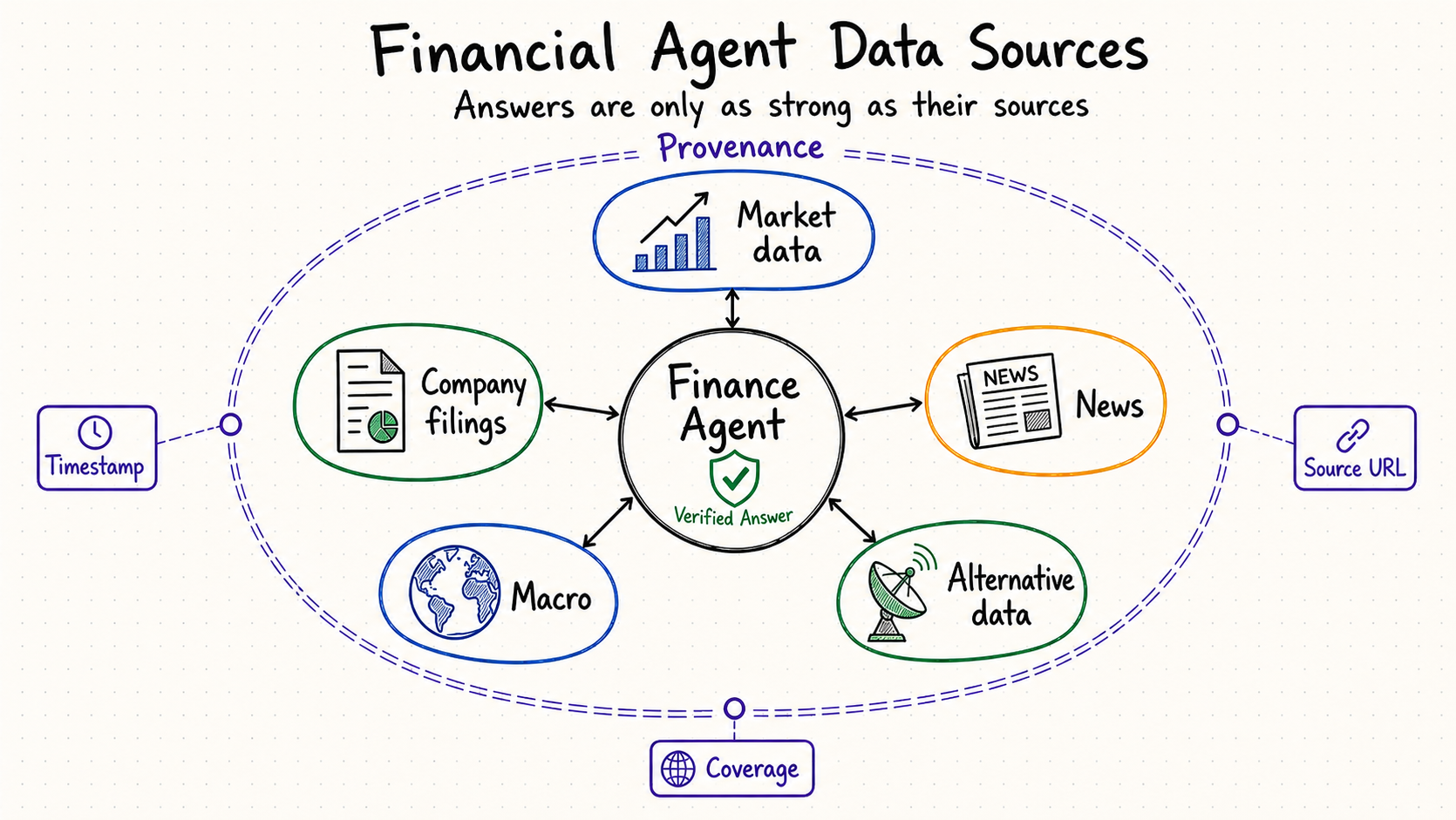
Why Financial Agent Data Sources Matter
Finance is unforgiving when an AI agent guesses. A model can write a polished explanation about revenue, valuation, or market sentiment even when it has not checked the source. For investment research, compliance, and market monitoring, the workflow needs data provenance before language.
The related QVeris blog makes the same point: stop letting AI make up financial analysis. A financial agent should locate useful data sources first, then use those sources to support or reject a claim.
Core Data Sources for Financial Agents
A source-backed finance agent usually needs several classes of data. The exact mix depends on the task, but the map should be explicit before the agent writes a conclusion.
Prices, volume, movers, historical ranges, and liquidity context.
10-K, 10-Q, 8-K, risk factors, management discussion, and source URLs.
Revenue, margins, cash flow, debt, ROE, valuation, and share data.
Company news, market-moving events, analyst reactions, and sentiment signals.
Rates, inflation, economic calendars, central-bank events, and currency context.
Crypto, web, supply-chain, social, or product-level signals when relevant.
The Source-First Rule for AI Finance
Financial Agent Data Sources vs Generic AI Answers
| Dimension | Generic AI answer | Source-first financial agent |
|---|---|---|
| Starting point | Prompt and model memory. | Specific data source and retrieval path. |
| Trust | Depends on generated language quality. | Depends on evidence, timestamp, and source coverage. |
| Output | A polished narrative. | A claim with linked data, caveats, and next checks. |
How QVeris Helps Agents Find the Right Data Source
QVeris gives agents a capability routing layer for financial data. Instead of hardcoding one provider per task, an agent can discover available capabilities, inspect inputs and metadata, then call the best matching source for market data, filings, fundamentals, news, macro, crypto, or workflow actions.
This makes QVeris especially useful for teams that want verifiable financial AI: the agent can cite what it used, reveal what it could not verify, and route to another capability when the first source is incomplete.
Build a Source Hierarchy and Financial Data Contract
A financial agent should not treat every source as interchangeable. Before retrieval begins, define which source is authoritative for each claim type, how freshness is measured, and what metadata must travel with a value into the final answer.
For filings, financial statements, guidance, corporate actions, and official policy data, prefer the issuer, regulator, exchange, central bank, or statistics agency. Aggregators improve access, but important claims should preserve a path back to the originating record.
A price is incomplete without asset identity, venue, currency, timestamp, session, and adjustment method. Document whether data is real time, delayed, end of day, consolidated, or venue-specific so the agent cannot compare incompatible observations.
Consensus estimates, factors, ratios, and scores depend on methodology. Store the formula, fiscal-period mapping, constituent set, update time, restatement policy, and provider so a plausible number does not hide a different definition.
Attach source URL or identifier, provider, retrieval time, effective period, units, transformations, confidence, and licensing constraints to each material field. When two sources conflict, surface the disagreement instead of silently averaging or overwriting it.
Financial Agent Source Selection Matrix
Choose sources by the decision being made, not by a generic provider ranking. The same agent may need an official filing for a disclosed number, a low-latency feed for an alert, and cross-source confirmation for a material conclusion.
| Research need | Preferred source profile | Validation questions |
|---|---|---|
| Reported fundamentals | Issuer or regulator record, plus normalized structured data for scale | Is the value filed or adjusted? Which fiscal period, currency, taxonomy, and restatement version? |
| Market monitoring | Timestamped venue or consolidated feed with explicit latency and coverage | Is it real time or delayed? Which session, venue, corporate-action treatment, and outage policy? |
| News and events | Original announcement plus reputable reporting and event metadata | When did the event occur versus publish? Is the claim confirmed, corrected, duplicated, or still developing? |
| Investment conclusion | Multiple independent source types with a documented evidence chain | Which facts are observed, which are estimates, which are model outputs, and what evidence could disprove the thesis? |
Financial Agent Data Sources FAQ
Most research workflows combine filings and fundamentals, market prices and reference data, earnings materials, news and corporate events, macroeconomic series, and sometimes alternative or workflow data. The right mix depends on the claim and required freshness.
It may be enough for a narrow prototype, but production research often needs primary-source verification, specialized coverage, and a fallback for gaps or outages. Adding providers only helps when identities, units, periods, and provenance are normalized.
Do not silently choose or average. Compare definitions, timestamps, reporting periods, adjustment policies, and source authority. Keep both observations, explain the likely reason for the conflict, and escalate when the difference could change the decision.
QVeris lets an agent discover capabilities by intent, inspect schemas and provider signals, and call the best match through a consistent workflow. The application should still define its own authority hierarchy, compliance rules, and evidence thresholds.