
Financial Data Integration
for AI Agents
面向 AI Agent 的
金融数据集成
Why Financial Data Integration Breaks in AI Workflows 为什么 AI 工作流里的金融数据集成容易失效
A finance AI agent usually starts with a simple question: explain a stock move, summarize a filing, compare competitors, or monitor a portfolio. The data work behind that question is not simple. Developers must combine real-time prices, historical context, financial statements, SEC filings, analyst estimates, news, and macro calendars. 金融 AI Agent 往往从一个简单问题开始:解释股价波动、总结文件、比较竞品或监控组合。但这个问题背后的数据工作并不简单。开发者需要组合实时价格、历史背景、财务报表、SEC 文件、分析师预期、新闻和宏观日历。
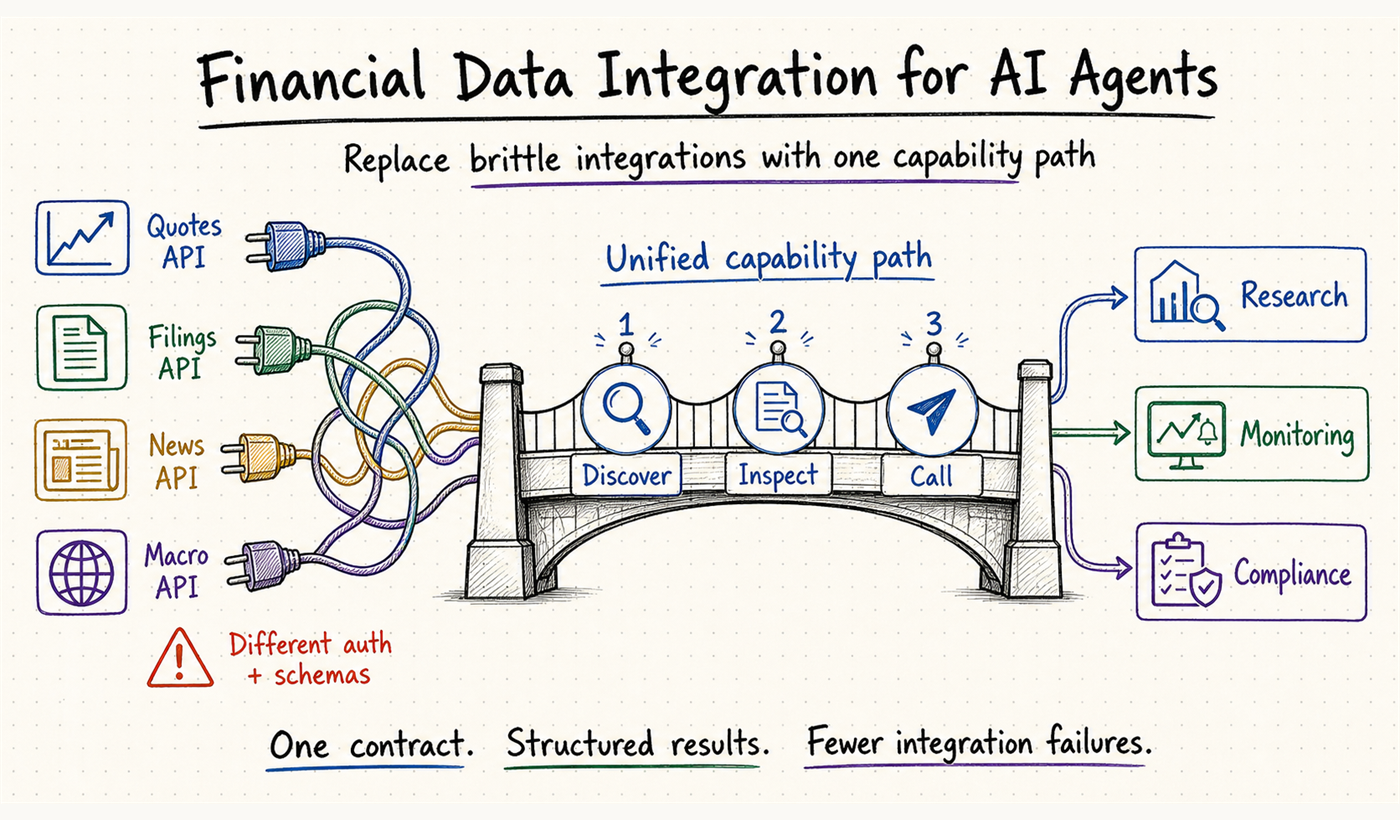
Traditional integration often hardcodes one provider per task. That works for demos, but fails when coverage changes, fields differ, rate limits appear, or an agent needs evidence before it can write a conclusion. A better architecture treats financial data integration as a discoverable capability layer. 传统集成通常为每个任务硬编码一个供应商。这适合 demo,但当覆盖范围变化、字段不同、速率限制出现,或 Agent 需要先拿到证据再写结论时,就会失效。更好的架构是把金融数据集成视为可发现的能力层。
Financial Data Integration Sources AI Agents Need AI Agent 需要集成哪些金融数据源
The exact stack depends on the use case, but most financial agents need more than a quote endpoint. They need a source map that tells the model which data can support which claim. 具体数据栈取决于场景,但大多数金融 Agent 不只需要一个报价接口。它们需要一张来源地图,告诉模型哪些数据可以支撑哪些结论。
Real-time quotes, historical prices, volume, movers, sector context, and delayed data rules. 实时行情、历史价格、成交量、异动、行业背景和延迟数据规则。
10-K, 10-Q, 8-K, risk factors, source URLs, accession numbers, and filing dates. 10-K、10-Q、8-K、风险因素、来源 URL、文件编号和提交日期。
Income statements, balance sheets, cash flow, ratios, valuation, and company profiles. 利润表、资产负债表、现金流、财务比率、估值和公司资料。
Market-moving news, earnings calendars, analyst actions, corporate events, and sentiment. 影响市场的新闻、财报日历、分析师动作、公司事件和情绪信号。
Rates, inflation, employment, currencies, central-bank events, and economic calendars. 利率、通胀、就业、汇率、央行事件和经济日历。
Freshness, latency, cost, provider notes, success rate, and whether the output is citeable. 新鲜度、延迟、成本、供应商说明、成功率以及输出是否可引用。
A Better Pattern: Discover, Inspect, Call 更好的模式:发现、检查、调用
Example Financial Data Integration Flow 金融数据集成流程示例
A source-aware agent can keep the integration layer separate from the analysis layer. The model asks for the data it needs; the capability layer handles provider selection and returns structured evidence. 具备来源意识的 Agent 可以把集成层和分析层分开。模型提出需要什么数据,能力层负责选择供应商并返回结构化证据。
# User intent
task = "Explain why AAPL moved today with source links"

capabilities = qveris.discover(
    query="real-time stock price, company news, filings, analyst estimate"
)

price_tool = qveris.inspect("market.real_time_quote")
news_tool = qveris.inspect("news.company_events")

result = qveris.call(
    capability="market.real_time_quote",
    params={"symbol": "AAPL", "include_source": True}
)

agent.write_brief(data=result, require_citations=True)
Financial Data Integration APIs vs Agent-Native Integration 金融数据 API 集成与 Agent 原生集成的区别
| Dimension 维度 | Traditional API integration 传统 API 集成 | Agent-native integration Agent 原生集成 |
|---|---|---|
| Tool selection 工具选择 | Developer picks one provider in code. 开发者在代码里固定一个供应商。 | Agent discovers candidate capabilities by task intent. Agent 按任务意图发现候选能力。 |
| Schema handling Schema 处理 | Each API format must be normalized manually. 每个 API 格式都要手动标准化。 | The capability layer exposes parameters and structured output before calls. 能力层在调用前暴露参数和结构化输出。 |
| Reliability 可靠性 | Failures often require custom fallback code. 失败时通常需要自定义 fallback 代码。 | Routing can select a better source when coverage or cost changes. 当覆盖或成本变化时,路由可以选择更好的来源。 |
| Citation 引用 | Source URLs and timestamps are easy to lose. 来源 URL 和时间戳容易丢失。 | Source metadata travels with the result. 来源元数据随结果一起返回。 |
Where QVeris Fits in Financial Data Integration QVeris 在金融数据集成中的位置
QVeris is useful when a team does not want to maintain a hardcoded provider list for every financial agent workflow. The platform gives agents a routing layer: discover the right capability, inspect the schema and quality signals, then call the capability through a unified interface. 当团队不想为每个金融 Agent 工作流维护硬编码供应商列表时,QVeris 很有用。它为 Agent 提供路由层:发现合适能力,检查 Schema 和质量信号,再通过统一接口调用。
That means a stock research assistant, earnings analysis agent, market monitoring workflow, or compliance agent can all start from the same operating pattern. The data source may change, but the agent does not need to rewrite its integration logic from scratch. 这意味着股票研究助手、财报分析 Agent、市场监控工作流或合规 Agent 都可以使用同一种操作模式。数据源可以变化,但 Agent 不需要从头重写集成逻辑。
A Production Architecture for Financial Data Integration生产级金融数据集成架构
The durable architecture is not a pile of provider-specific API calls. It separates capability routing, source adapters, normalization, evidence storage, and agent-facing contracts so each layer can change without silently changing the meaning of the data.
可持续的架构不是一堆供应商专属 API 调用,而是将能力路由、来源适配、规范化、证据存储与 Agent 接口分层,使每一层都能独立变化,又不会悄悄改变数据含义。
Define the entity, data type, geography, time range, freshness, latency, source authority, and cost ceiling before selecting a provider. Route against those constraints so a request for official quarterly revenue is not treated like a low-latency price lookup.
选择供应商前明确实体、数据类型、地域、时间范围、新鲜度、延迟、来源权威性和成本上限。根据这些约束路由,避免把“官方季度营收”当成低延迟行情查询来处理。
Adapters handle authentication, pagination, throttling, symbols, calendars, provider errors, and raw response shapes. Version them explicitly and retain the raw payload or source reference needed to investigate a downstream discrepancy.
适配层负责认证、分页、限流、证券代码、交易日历、供应商错误和原始响应格式。对适配器显式版本化,并保留调查下游差异所需的原始载荷或来源引用。
Map entity identifiers, currencies, units, fiscal periods, timestamps, corporate actions, and accounting taxonomies. A common JSON key is not a common data model if two providers still mean different things by revenue, close, or consensus.
统一实体标识、币种、单位、财务期间、时间戳、公司行动和会计分类体系。如果两个供应商对营收、收盘价或一致预期的定义仍不同,仅拥有相同 JSON 字段名并不代表拥有共同数据模型。
Every material value should carry its source, effective time, retrieval time, transformation history, confidence or validation status, and usage restrictions. Cache and retain data according to provider licensing, privacy obligations, and the needs of audit or model evaluation.
每个重要数值都应携带来源、生效时间、获取时间、转换历史、置信度或校验状态以及使用限制。缓存和留存数据时,应遵守供应商许可、隐私义务以及审计或模型评估要求。
Rollout and Monitoring Checklist上线与监控清单
Integration quality changes over time as schemas, coverage, prices, and upstream records change. Treat rollout as an evidence-based process with shadow traffic, reconciliation, observable service levels, and a controlled fallback path.
随着 Schema、覆盖范围、价格和上游记录变化,集成质量也会持续变化。上线应采用基于证据的过程,包括影子流量、数据核对、可观察服务指标和受控降级路径。
| Checkpoint检查点 | Questions to answer需要回答的问题 | Evidence to retain需要保留的证据 |
|---|---|---|
| Contract tests契约测试 | Do representative and edge-case responses map to the documented schema without losing units or provenance?代表性与边界响应能否映射到文档化 Schema,同时不丢失单位和来源信息? | Versioned fixtures, expected normalized records, validation errors, and adapter release notes版本化样本、预期规范化记录、校验错误和适配器发布说明 |
| Reconciliation数据核对 | Where do primary records, incumbent feeds, and the new path differ, and is the difference explainable?第一方记录、现有数据源和新链路在哪里不同?差异能否解释? | Field-level diffs grouped by source, period, entity, severity, and resolution按来源、期间、实体、严重程度和解决状态分组的字段级差异 |
| Service health服务健康 | Are freshness, completeness, latency, error rate, throttling, and cost within task-specific objectives?新鲜度、完整性、延迟、错误率、限流和成本是否满足特定任务目标? | Dashboards, traces, provider status, stale-data alarms, budget alarms, and sampled outputs仪表盘、追踪记录、供应商状态、过期数据告警、预算告警和抽样输出 |
| Change and fallback变更与降级 | Can the team detect schema drift, stop unsafe traffic, and switch sources without changing data meaning?团队能否发现 Schema 漂移、停止不安全流量,并在不改变数据含义的前提下切换来源? | Ownership, runbooks, change approvals, fallback ranking, replay results, and incident reviews负责人、运行手册、变更审批、降级排序、重放结果和事故复盘 |
Financial Data Integration for AI Agents FAQAI Agent 金融数据集成常见问题
An agent chooses data dynamically and may turn it directly into a recommendation or action. The integration therefore needs machine-readable schemas, source and freshness metadata, predictable errors, controlled permissions, and verification—not just a response that an application can parse.
Use a stable shared core for identities, time, units, provenance, and common observations, but preserve source-specific fields and raw evidence. Forcing every specialized dataset into one flat schema can erase the distinctions that make it useful.
Set freshness objectives by task, carry effective and retrieval timestamps, reject or label records outside the allowed window, monitor upstream update patterns, and make cache behavior explicit. A fallback must meet the same freshness requirement or disclose the limitation.
QVeris provides a discover-inspect-call pattern that helps agents route to capabilities and interact through a consistent interface. Teams still own domain normalization, access policy, source authority, licensing compliance, and the controls required by their application.
Agent 会动态选择数据,并可能直接把数据转成建议或动作。因此,集成不仅要返回应用可解析的响应,还需要机器可读 Schema、来源与新鲜度元数据、可预测错误、受控权限和验证机制。
可为实体、时间、单位、来源和常见观测建立稳定公共核心,但应保留来源专属字段和原始证据。把所有专业数据强行压入扁平 Schema,可能抹掉真正有价值的差异。
按任务设置新鲜度目标,携带生效与获取时间戳,拒绝或标记超出允许窗口的记录,监控上游更新规律,并明确缓存行为。降级来源也必须满足相同新鲜度要求,否则应披露限制。
QVeris 提供 Discover、Inspect、Call 工作模式,帮助 Agent 路由能力并通过一致接口交互。团队仍需负责领域规范化、访问策略、来源权威、许可合规和自身应用要求的控制。