
Best Fiscal.ai Alternatives for Investors and AI Developers
The right Fiscal.ai alternative depends on what you are replacing. Investors may want a comparable research terminal with global fundamentals, dashboards, screeners and exports. Developers may instead need a financial API, an MCP server or a multi-provider layer for an AI research agent. This guide separates those two decisions, compares realistic options, and explains when keeping Fiscal.ai is still the better choice.
Koyfin is the closest choice for visual dashboards and multi-asset analysis; TIKR is strong for global fundamentals and estimates; Stock Rover fits North American screening and portfolio analysis; ROIC.ai offers an accessible fundamentals API and MCP path; and GeminIQ emphasizes filing-level traceability for U.S. research. Choose QVeris when the goal is not another terminal but a financial AI agent that can discover and call capabilities across multiple providers. Keep Fiscal.ai when its proprietary KPI coverage, global company universe and integrated Copilot already match the job.
What Fiscal.ai Does—and Why People Evaluate Alternatives
Fiscal.ai, formerly known as FinChat, combines a financial research terminal with an AI Copilot, company dashboards, standardized statements, estimates, filings, transcripts, screeners and proprietary segment or KPI data. It now also provides a REST API and an official MCP connector, so it should not be described as a closed, UI-only product.
As of July 2026, Fiscal.ai advertises a free terminal plan, a Pro plan at $39 per month and an Enterprise plan at $199 per month when billed monthly. The free API documentation lists up to 45 supported companies, 50 burst requests per minute and 250 requests per day. Paid commercial limits are defined by contract. Pricing, entitlements and coverage can change, so production teams should verify the official pages before purchasing or migrating.
People still compare Fiscal.ai competitors because “financial research” can mean very different workloads. A long-term investor may care about charting, estimates and portfolio dashboards; a developer may care about schemas, redistribution rights, automation and predictable API behavior. A fair comparison must separate those needs.
A developer may need to combine fundamentals with exchange-grade quotes, macro series, crypto data, sentiment, or specialized document tools. One provider rarely supplies the ideal source for every research step.
Screening thousands of companies, reacting to new filings, or running portfolio-wide research requires queues, caching, retries, and provider-aware rate handling beyond an interactive terminal workflow.
Fintech teams often need to expose data and analysis inside their own application, internal research system, or customer workflow. Licensing, redistribution rights, schemas, and latency become as important as the interface.
Fiscal.ai now has native MCP support for Claude, Cursor, and other clients. A team may still want an MCP layer that discovers capabilities across multiple sources instead of exposing one provider’s endpoint catalog.
Research terminals commonly price by plan or seat, while APIs may charge by endpoint, request, data entitlement, or commercial license. Agent workloads benefit from comparing total execution cost rather than subscription price alone.
The decision should begin with the workload. A human analyst using dashboards has different needs from an autonomous process that evaluates 500 companies overnight and writes results into a proprietary application.
Best Fiscal.ai Alternatives for Investors and Analysts
These products are the most relevant choices when the search intent is “replace the Fiscal.ai research experience,” rather than “assemble a new data stack.” None is a perfect clone. The useful question is which Fiscal.ai job—visual analysis, global fundamentals, screening, source verification or AI-assisted research—matters most.
Koyfin: Best for Dashboards and Multi-Asset Research
Koyfin is a strong direct alternative for analysts who value configurable dashboards, charting, watchlists and cross-asset context. It is closer to a visual research workstation than an API platform. Choose it when macro, equities, funds and portfolio views need to live in one polished interface.
Trade-off: Koyfin is not designed as a public API or MCP-first infrastructure layer. Teams building autonomous agents will still need another programmable data source.
Best for: investors replacing Fiscal.ai’s visual workspace rather than its AI or developer access.
TIKR: Best for Global Fundamentals and Estimates
TIKR is a practical option for investors comparing global companies, historical financials, valuation multiples, analyst estimates and earnings information. It competes more directly with the research-terminal side of Fiscal.ai than a raw market data API does.
Trade-off: TIKR’s main value is the analyst interface. It is not a substitute for a cross-provider MCP catalog or an embedded agent execution layer.
Best for: fundamental investors who need international coverage and forward estimates in a familiar research workflow.
Stock Rover: Best for Screening and Portfolio Analytics
Stock Rover focuses on deep screening, portfolio analytics, custom metrics and comparative research for North American equities. It is useful when the reason for leaving Fiscal.ai is a need for more filtering depth or portfolio-centered analysis rather than conversational AI.
Trade-off: geographic scope is narrower than Fiscal.ai’s global company coverage, and it is not an API-first agent platform.
Best for: investors who prioritize repeatable screens, watchlists and portfolio diagnostics.
ROIC.ai: Best Free-Entry Option for Fundamentals, API and MCP
ROIC.ai is relevant to both investors and developers because it combines financial-statement research with programmatic access. It can be a lower-friction starting point for teams that want to query fundamentals from an AI client without adopting a broad routing platform.
Trade-off: free access, history depth, real-time entitlements and commercial usage vary by plan. Verify the current contract against the exact companies and periods required.
Best for: individual researchers and prototypes that want a fundamentals-focused Fiscal.ai API or MCP alternative.
GeminIQ: Best for U.S. Filing Traceability
GeminIQ is a focused alternative for researchers who want to trace reported numbers back to filing data and inspect U.S. company fundamentals with a stronger primary-source orientation. That is a different value proposition from Fiscal.ai’s global Copilot and proprietary KPI layer.
Trade-off: it is less suitable when conversational research, global coverage and company-specific KPI depth are the primary reasons for using Fiscal.ai.
Best for: U.S.-focused analysts who put auditability and as-filed evidence ahead of a broad AI terminal.
Best Fiscal.ai API and MCP Alternatives for Developers
A developer replacing Fiscal.ai may not need another analyst terminal. The alternatives below are building blocks for custom products, scheduled research, embedded analytics and financial AI agents. Compare them by data rights, latency, coverage, rate limits and orchestration burden—not by the number of dashboard features.
1. QVeris: Fiscal.ai Alternative for Financial AI Agents
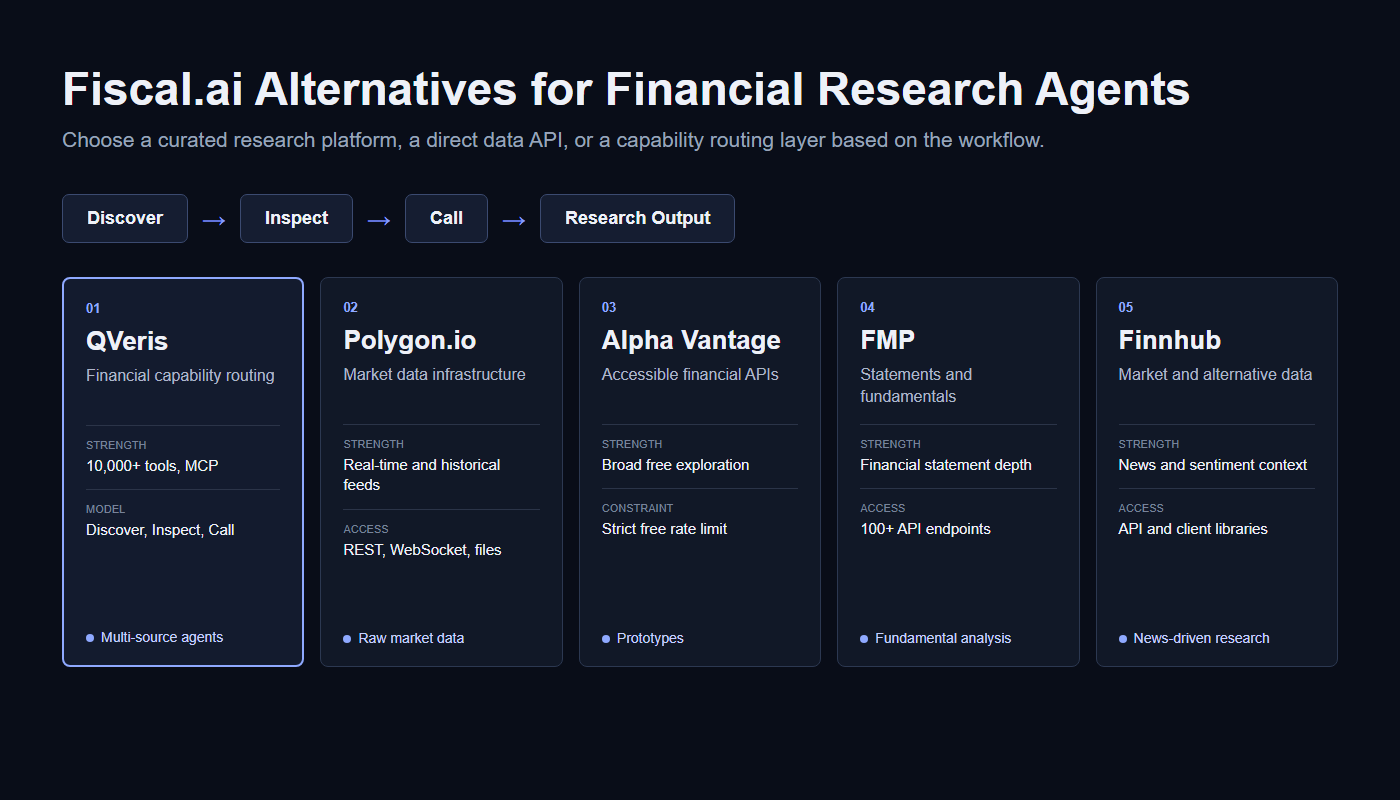
QVeris is a financial capability routing network for AI agents. It does not try to replace a research terminal with another dashboard. Instead, it gives agents one workflow for finding and executing financial tools:
This approach is useful when a research agent needs different sources for different stages. A single workflow may require company fundamentals, a live quote, an SEC filing, an earnings transcript, macroeconomic context, and market news. With direct integrations, developers must maintain multiple credentials, schemas, retry policies, and provider-specific clients. QVeris places discovery and routing above those capabilities and exposes the same model through MCP, Claude Desktop, Cursor, OpenCode, a Python SDK, and REST.
Discover and Inspect are always free. The current program includes 1,000 signup credits and 100 daily login credits, while Call consumes credits according to the capability. Developers should confirm current limits on the pricing page because offers can change.
from qveris import QVeris

client = QVeris(api_key="YOUR_API_KEY")

tools = client.discover("latest SEC filing and revenue trend for NVDA")
schema = client.inspect(tools[0]["capability_id"])
result = client.call(
    tools[0]["capability_id"],
    {"ticker": "NVDA", "period": "annual"}
)

print(result)
The example illustrates the intended pattern; developers should use the exact current SDK methods from the official documentation. QVeris is strongest when the research process spans many capability categories. If a team only needs Fiscal.ai’s curated fundamentals and filing-linked data, using Fiscal.ai directly may be simpler.
Best for: developers and fintech teams that want to build a financial research agent with dynamic tool selection and unified execution.
2. Polygon.io: Fiscal.ai Alternative for Raw Market Data
Polygon.io is a developer-focused market data platform. Its stock offering covers real-time and historical prices, trades, quotes, aggregates, reference data, corporate actions, news, and data from major U.S. exchanges and reporting facilities. Developers can use REST APIs, WebSocket streams, and flat files, making it suitable for research systems that need detailed or low-latency market observations.
Polygon.io is often a better fit than a research terminal when the application needs raw market events, historical bars, or streaming prices. The tradeoff is integration responsibility. Developers still design their own research abstractions, combine fundamentals or filings from other providers, map schemas, and decide which endpoint an agent should call. It is a data source rather than a cross-provider agent routing layer.
Best for: trading, charting, alerting, backtesting, and research products that need reliable underlying market data.
3. Alpha Vantage: Budget Fiscal.ai Alternative
Alpha Vantage provides APIs for global equities, options, forex, crypto, commodities, economic indicators, fundamentals, and technical indicators. Most endpoints can be explored with a free API key, which makes it attractive for prototypes, student projects, and individual developers.
The standard free limit is currently 25 requests per day, and real-time or delayed U.S. intraday data may require a premium entitlement. Those constraints make large batch jobs difficult. Coverage is broad, but developers must understand separate endpoint functions and handle throttling carefully. Alpha Vantage now also documents MCP-related integrations, so it should not be described as purely legacy REST; however, it does not provide the same cross-provider capability discovery model as QVeris.
Best for: low-budget experiments, proof-of-concept applications, technical indicators, and modest research tasks.
4. Financial Modeling Prep: Fundamentals-Focused Fiscal.ai Alternative
Financial Modeling Prep, commonly called FMP, offers a large financial data API catalog covering income statements, balance sheets, cash flows, ratios, historical prices, company profiles, news, SEC filings, earnings transcripts, insider activity, and other datasets. Its depth in standardized financial statements makes it useful for valuation models and fundamental screening.
FMP’s current documentation advertises more than 100 endpoints and a free Basic tier with 250 calls per day. Paid plans raise limits and unlock additional history and coverage. Developers still need to select endpoints, normalize outputs, and build the orchestration layer that turns data into an agent workflow. FMP is an effective direct API source, but AI agent discovery is not its central abstraction.
Best for: analysts and developers building statement analysis, valuation, screening, and company fundamental workflows.
5. Finnhub: News and Alternative-Data Fiscal.ai Alternative
Finnhub provides real-time market data, company fundamentals, economic data, news, estimates, ownership information, and alternative datasets. Its company news endpoint offers historical and current North American company news on the free tier, while some sentiment and premium feeds require paid access. Official client libraries are available for Python, JavaScript, Go, and other languages.
Finnhub is useful when a research agent needs news context, market status, or sentiment-related inputs alongside standard company data. As with other direct APIs, the developer is responsible for matching user intent to endpoints, controlling tool schemas, and combining results from other providers. It supplies strong ingredients but not a general capability discovery layer.
Best for: applications that combine market data with company news, event context, estimates, or alternative signals.
Fiscal.ai Alternatives Comparison: Terminal vs API
Do not compare a dashboard product and an API as if they solve the same problem. The first table covers ready-to-use research experiences; the second covers infrastructure for developers.
| Platform | Primary strength | Market scope | AI / natural language | API or MCP | Best reason to choose it |
|---|---|---|---|---|---|
| Fiscal.ai | Global fundamentals, KPIs and Copilot | Global; 100,000+ securities advertised | Yes | REST API + MCP | Keep it for an integrated AI research terminal |
| Koyfin | Dashboards, charting and multi-asset context | Global, multi-asset | Not the main workflow | Not API-first | Visual investment research |
| TIKR | Global fundamentals and estimates | Global equities | Not the main workflow | Not API-first | Company comparison and valuation |
| Stock Rover | Deep screening and portfolio analytics | United States and Canada | Limited | Not API-first | Repeatable screens and portfolio review |
| ROIC.ai | Fundamentals with programmatic access | Global company data | Through compatible AI clients | API + MCP | Free-entry fundamentals workflows |
| GeminIQ | As-filed and XBRL-oriented traceability | U.S. public companies | Not the main differentiator | Check current plan | Primary-source verification |
| Platform | MCP native | Agent tool discovery | Financial coverage | Free access | Pricing model | Best fit |
|---|---|---|---|---|---|---|
| QVeris | Yes | Discover + Inspect | 10,000+ routed capabilities | 1,000 signup + 100 daily credits | Credit / usage based | Multi-source finance agents |
| Fiscal.ai | Yes | Fiscal.ai endpoint tools | Curated fundamentals, KPIs, filings, prices | 45 companies; 250 requests/day | Free; Pro $39/month; Enterprise $199/month for the terminal, plus commercial API terms | Fundamental research and sourced data |
| Polygon.io | Not the primary interface | No cross-provider discovery | Strong market and reference data | Free stock plan; plan limits apply | Asset-class subscriptions | Raw and real-time market data |
| Alpha Vantage | Integration support available | No cross-provider discovery | Broad, lighter-depth API catalog | 25 requests/day | Free and monthly plans | Prototypes and individual developers |
| FMP | Not the primary interface | No cross-provider discovery | Strong statements and fundamentals | 250 calls/day | Free and subscription tiers | Financial statement analysis |
| Finnhub | Not the primary interface | No cross-provider discovery | Market, news, fundamentals, alternative data | Free API access; endpoint limits vary | Free and premium access | News and market context |
Why QVeris Is a Fiscal.ai Alternative for Agent Infrastructure
The clearest distinction is product scope. Fiscal.ai provides a high-quality research terminal plus direct access to its own financial data through API and MCP. QVeris acts as infrastructure above many financial capabilities. It helps an agent identify a suitable tool, understand its contract, and execute it without the developer maintaining a separate discovery experience for every provider.
That distinction matters when building a finance AI agent API layer. A research request such as “explain why margins changed, compare management commentary, and show the market reaction” can require statements, filing sections, transcripts, news, and intraday prices. Direct APIs remain valuable, but each adds authentication, rate limits, data contracts, errors, and licensing considerations. QVeris unifies the interaction pattern while preserving structured calls.
MCP support lets developers connect compatible clients without defining every tool manually. The Python SDK and REST API support application-side orchestration, scheduled jobs, and embedded products. Because Discover and Inspect are free, a team can test whether a capability fits before consuming credits on Call. This model is especially useful during development, when engineers repeatedly inspect schemas and compare tools but execute relatively few production calls.
QVeris is not automatically cheaper or better for every workload. A team that repeatedly queries one Fiscal.ai endpoint at high volume should compare direct API pricing, licensing, latency, and reliability with routed execution. The strongest case for QVeris appears when capability diversity and integration maintenance cost exceed the value of a single-provider contract.
How to Choose the Best Fiscal.ai Alternative
Start with a representative workflow and list every decision the user or agent must make. Choose Fiscal.ai when curated fundamental data, source-linked filings, company KPIs and an integrated Copilot match the task. Choose Koyfin for visual multi-asset dashboards, TIKR for global fundamentals and estimates, Stock Rover for screening and portfolio analytics, ROIC.ai for a lower-friction fundamentals API or MCP path, and GeminIQ for U.S. filing traceability.
For a custom product, choose Polygon.io for detailed market feeds, Alpha Vantage for economical experiments, FMP for statement-heavy applications, and Finnhub for market news and alternative context. Choose QVeris when the agent must discover and coordinate capabilities across categories through one interface rather than remain tied to a single provider catalog.
Then measure total cost under realistic volume: provider fees, exchange entitlements, commercial redistribution rights, engineering time, retries, storage, and monitoring. Validate data freshness and source traceability rather than comparing endpoint counts alone. Finally, test how the system behaves when a provider returns an error or lacks coverage for a company.
Prioritize dashboards, charting, watchlists, estimates, exports and collaboration. Shortlist Fiscal.ai, Koyfin, TIKR and Stock Rover.
Compare the free tiers of Fiscal.ai, Koyfin, TIKR, Stock Rover and ROIC.ai against the exact history, export and company limits you need.
Evaluate Fiscal.ai and ROIC.ai for direct fundamentals, then QVeris when a workflow needs discovery across multiple capability providers.
Start with market-data licensing and latency. Polygon.io or another exchange-entitled feed may be more suitable than a research terminal.
A well-designed fiscal.ai alternative for developers should fit the architecture, not merely reproduce a terminal screen. For a custom research agent, programmable discovery and stable tool contracts can matter as much as the underlying dataset. Teams evaluating fiscal.ai alternatives should prototype the complete research loop before committing to a migration.
Fiscal.ai Alternatives FAQ
What is the best Fiscal.ai alternative?
There is no universal winner. Koyfin is a strong choice for visual dashboards, TIKR for global fundamentals and estimates, Stock Rover for North American screening, ROIC.ai for accessible fundamentals through API or MCP, and QVeris for multi-provider financial AI agents. Fiscal.ai remains a strong option when its global Copilot, proprietary KPIs and integrated terminal fit the workflow.
Is there a free Fiscal.ai alternative?
Yes, several products offer free access, but the restrictions differ. Compare company coverage, history depth, AI prompt limits, dashboards, exports and API quotas rather than treating “free” as equivalent. Fiscal.ai itself also has a free terminal plan and a limited free API tier.
How much does Fiscal.ai cost?
As of July 2026, the official monthly pricing page lists Free, Pro at $39 per month and Enterprise at $199 per month. Annual billing and commercial API agreements can differ. Always confirm the current price and data entitlements on Fiscal.ai before making a procurement decision.
Does Fiscal.ai have an API and MCP server?
Yes. Fiscal.ai publishes a REST API and an official remote MCP endpoint. The MCP server exposes the same financial data and plan entitlements as the account’s API access; it does not bypass company, feature or rate-limit restrictions.
Is Fiscal.ai the same product as FinChat?
Fiscal.ai is the current brand of the product previously known as FinChat. People still searching for “FinChat alternatives” are generally evaluating the same category: AI-assisted fundamental research, company dashboards, filings, estimates and financial data access.
What is the best Fiscal.ai alternative for developers?
Use a direct provider when one dataset satisfies the entire workload. Choose QVeris when the application must discover, inspect and call different financial capabilities across providers. The correct choice depends on licensing, latency, schema stability, failure handling and total engineering cost—not keyword-level feature parity.
Test a Fiscal.ai Alternative with Your Research Workflow
Review QVeris usage pricing, then use the documentation to prototype Discover, Inspect, and Call against a real financial research task.
Official Sources for This Fiscal.ai Alternatives Review
- Fiscal.ai platform and official API documentation
- Fiscal.ai terminal pricing and official API rate limits
- Fiscal.ai MCP integration guide
- Koyfin, TIKR, Stock Rover, ROIC.ai, and GeminIQ product pages
- Polygon.io documentation
- Alpha Vantage documentation
- Financial Modeling Prep documentation
- Finnhub API documentation