
What is the difference between forward P/E and trailing P/E?前瞻市盈率与滚动市盈率有什么区别?
Trailing P/E uses reported LTM EPS. Forward P/E uses estimated future EPS, often for the next twelve months or fiscal year.
滚动市盈率采用过去十二个月已报告EPS;前瞻市盈率采用未来十二个月或下一财年的预期EPS。
Forward PE vs trailing PE uses the same current share price but changes the earnings denominator—from reported history to estimated future profit.
前瞻市盈率与滚动市盈率使用同一个当前股价,但分母不同:一个采用未来预期每股收益,另一个采用过去十二个月实际每股收益。
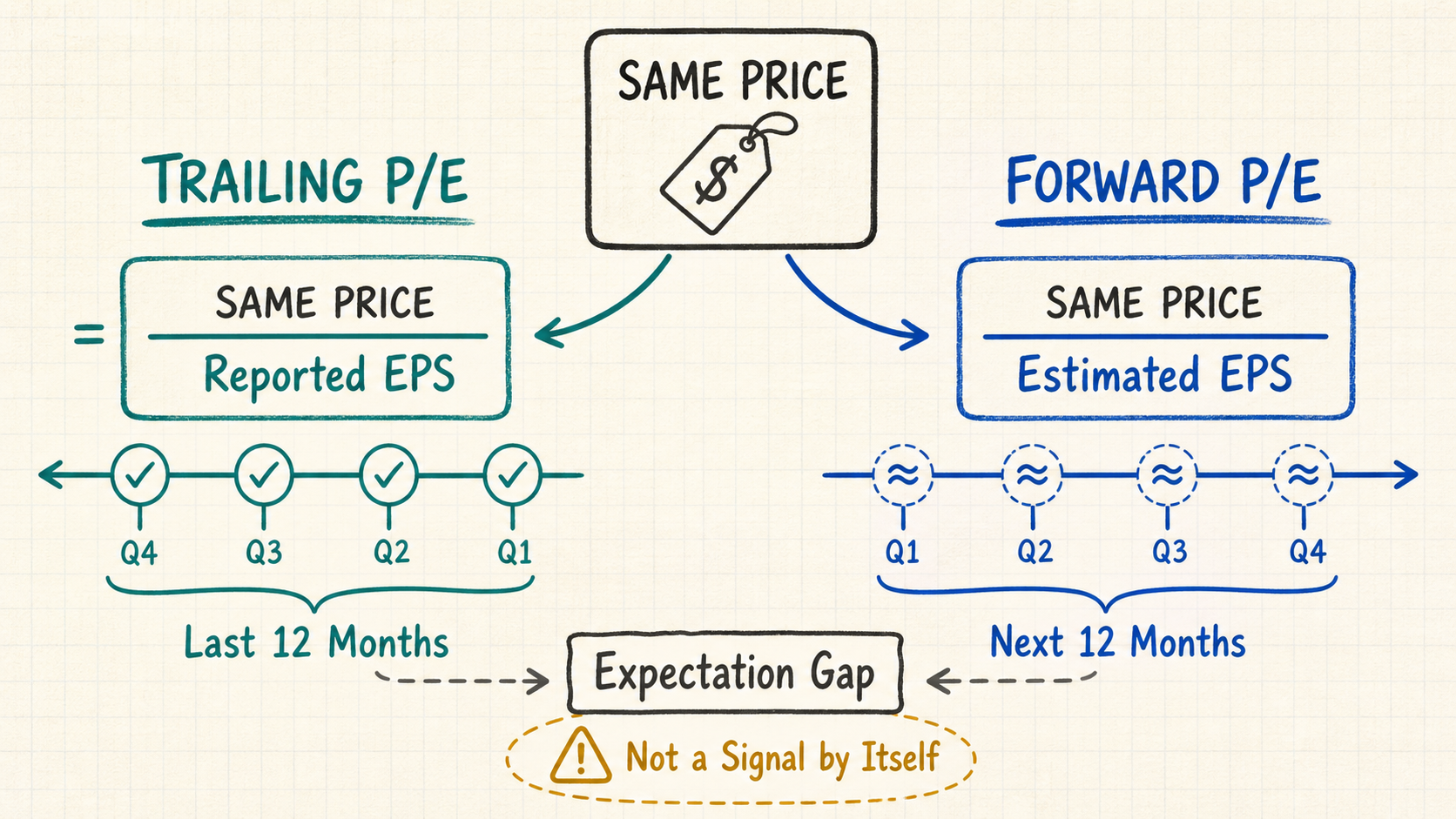
Both ratios compare a current share price with earnings per share. Trailing P/E typically uses reported EPS for the last twelve months, often labeled LTM or TTM. Forward P/E uses estimated EPS for a future period, commonly the next twelve months or the next fiscal year. The numerator may be identical while the denominator reflects a different time horizon and evidence standard.
两种市盈率都把当前股价与每股收益比较。滚动市盈率通常采用过去十二个月已报告的每股收益,也称LTM或TTM EPS;前瞻市盈率采用未来十二个月或下一财政年度的预期每股收益。即使分子相同,分母的时间范围和证据性质也完全不同。
Backward-looking, observable, affected by actual one-time items and cycle conditions.
回顾过去、可观察,但会受到一次性项目和当期周期环境影响。
Forward-looking, assumption-dependent, revised as analysts and companies update forecasts.
面向未来、依赖假设,会随着分析师和公司更新预测而变化。
In Chinese-market data, “trailing P/E,” “static P/E,” and “dynamic P/E” may use different provider-specific definitions. TTM P/E is the closest direct match to trailing P/E. Always inspect the field definition rather than assuming that similarly translated labels use the same earnings period.
在中文市场数据中,“滚动市盈率”“静态市盈率”和“动态市盈率”可能采用不同的数据商口径。TTM市盈率最接近英文Trailing P/E。不能仅凭中文名称相似就假设盈利期间相同,必须核对字段定义。
Use EPS from the latest four reported quarters or a clearly defined trailing twelve-month period.
使用最近四个已报告季度或明确界定的过去十二个月每股收益。
State whether the estimate covers NTM, the next fiscal year, or another forecast window.
明确预期收益覆盖未来十二个月、下一财政年度,还是其他预测区间。
P/E is a point-in-time multiple. A price observed today should not be casually paired with an EPS estimate captured months earlier. When reconstructing a historical multiple, use the price and the earnings information that were actually available on that date to avoid look-ahead bias.
市盈率是时点指标。今天的股价不能随意搭配数月前的盈利预测。重建历史估值时,应使用当时已经可获得的股价和盈利信息,避免前视偏差。
This fictional example demonstrates the mechanics only. It is not a real security, forecast, fair-value estimate, recommendation, or performance claim.
下面使用虚构数据演示计算逻辑,不代表真实证券、盈利预测、公允价值、投资建议或业绩承诺。
The lower forward P/E does not come from a lower share price; it comes from a higher forecast EPS denominator. The market may expect earnings growth, but the 15.0× result only holds if the estimate is achieved. If the NTM estimate is revised from $4.00 to $3.20 while price remains $60, forward P/E rises to 18.75×.
前瞻市盈率较低并不是因为股价更低,而是因为预期每股收益分母更高。这可能反映盈利增长预期,但15.0倍只有在预测实现时才成立。若预期每股收益从4.00美元下调至3.20美元,而股价保持60美元,前瞻市盈率将升至18.75倍。
Forward P/E can rise because analysts cut EPS estimates. It can fall because forecasts increase. A valuation dashboard therefore needs both price timestamps and estimate-version timestamps, not just the latest ratio.
分析师下调盈利预期会让前瞻市盈率上升,上调预期则会让其下降。因此估值看板需要同时保留股价时间戳和预测版本时间戳,不能只保存最新比率。
With the same price, the direction of the gap is driven by the relationship between estimated and reported EPS. It is a compact expectation signal, but it is not a standalone buy, sell, cheap, or expensive signal.
股价相同时,两种市盈率的差距方向取决于预期每股收益与已报告每股收益的关系。它可以浓缩市场盈利预期,但不能单独作为买入、卖出、低估或高估信号。
Forecast EPS is higher than trailing EPS. Possible explanations include expected growth, recovery, easier comparisons, or optimistic estimates.
预期EPS高于过去EPS,可能来自增长、复苏、低基数,也可能只是预测偏乐观。
Forecast EPS is close to trailing EPS. This may indicate stable expectations, but it can also hide offsetting quarterly changes.
预期EPS接近过去EPS,可能反映稳定预期,也可能掩盖季度之间相互抵消的变化。
Forecast EPS is lower than trailing EPS. Possible explanations include expected decline, normalization from a peak, cyclicality, or forecast cuts.
预期EPS低于过去EPS,可能意味着盈利下滑、周期高点回归正常,或预测遭到下调。
The forecast may already assume aggressive margin expansion, demand growth, or cost reductions. Compare the estimate with company guidance, analyst dispersion, prior forecast error, industry conditions, and a scenario range before treating the forward multiple as credible.
盈利预测可能已经包含激进的利润率扩张、需求增长或降本假设。使用前瞻倍数前,应比较公司指引、分析师分歧、历史预测误差、行业环境和情景区间。
Trailing P/E is based on reported data, so its denominator is observable. That does not make it automatically representative: past earnings may contain restructuring charges, asset sales, tax effects, acquisition accounting, or cyclical peaks. Forward P/E is designed to reflect future economics, but its denominator is uncertain and can differ by estimate source.
滚动市盈率基于已报告数据,分母可以观察,但不一定具有代表性:历史盈利可能包含重组费用、资产出售、税务影响、并购会计或周期高点。前瞻市盈率试图反映未来经营状况,但分母存在不确定性,不同预测来源也可能给出不同结果。
Company guidance, single-analyst forecasts, and consensus estimates are not interchangeable.
公司指引、单一分析师预测和一致预期不能混为一谈。
Next fiscal year and next twelve months can contain different quarters and produce different EPS.
下一财政年度与未来十二个月包含的季度可能不同,EPS也会不同。
The direction and breadth of estimate revisions can matter as much as the latest point estimate.
预测上调或下调的方向与覆盖范围,可能与最新单点预测同样重要。
Calculate the multiple under lower, base, and higher EPS cases instead of treating one forecast as certain.
使用较低、基准和较高EPS情景计算倍数,不要把单一预测当作确定结果。
A peer table is only useful when the ratios follow the same contract. Align the measurement date, earnings horizon, EPS definition, estimate source, and business model. Comparing one company's NTM adjusted EPS multiple with another company's fiscal-year GAAP EPS multiple is not a clean comparison.
同行表只有在各项比率遵循相同口径时才有意义。应统一测量日期、盈利期间、EPS定义、预测来源和业务模式。把一家公司的未来十二个月调整后EPS倍数与另一家公司的下一财年GAAP EPS倍数直接比较并不严谨。
QVeris can help an AI agent discover and inspect FMP capabilities for stock prices, reported financials, ratios, and analyst estimates. The analysis layer should still preserve every input and calculate the ratios explicitly.
QVeris可以帮助AI Agent发现并检查FMP的股价、已报告财报、财务比率和分析师预期能力。分析层仍应保留每项输入,并明确计算估值倍数。
Choose one timestamp for price and record market, currency, share class, and split adjustments.
为股价选择一个时间点,并记录市场、币种、股份类别和拆股调整。
Collect the latest four comparable quarters, verify diluted versus basic EPS, and note restatements.
获取最近四个可比季度,核对摊薄或基本EPS,并记录报表重述。
Record estimate horizon, consensus date, analyst count where available, and adjusted-versus-GAAP basis.
记录预测区间、一致预期日期、可用时的分析师数量,以及调整后或GAAP口径。
Compute both ratios from raw inputs, then compare with provider-supplied ratios and investigate differences.
使用原始输入计算两种比率,再与数据商提供的比率比较并调查差异。
Store capability, endpoint, parameters, timestamps, fields, units, estimate version, and calculation formula.
保存能力、接口、参数、时间戳、字段、单位、预测版本和计算公式。
See the QVeris guides to the Financial Modeling Prep API, FMP stock price API, FMP financial statements API, and the QVeris documentation.
可参考QVeris的Financial Modeling Prep API指南、FMP股价API指南、FMP财报API指南和QVeris文档。
The lower multiple may depend on an optimistic EPS forecast.
更低倍数可能完全依赖乐观的盈利预测。
Negative P/E is generally not meaningful in the usual valuation sense.
负市盈率通常不具备常规估值含义。
Exclusion choices can materially change the earnings denominator.
排除项目的选择可能显著改变盈利分母。
Peak earnings can make trailing P/E appear unusually low before profits normalize.
周期高点盈利会让滚动市盈率在利润回落前显得异常低。
An old consensus paired with a new price produces a misleading multiple.
旧预测搭配新股价会形成误导性倍数。
P/E does not by itself capture leverage, cash flow quality, reinvestment needs, or risk.
P/E不能单独反映杠杆、现金流质量、再投资需求和风险。
Trailing P/E uses reported LTM EPS. Forward P/E uses estimated future EPS, often for the next twelve months or fiscal year.
滚动市盈率采用过去十二个月已报告EPS;前瞻市盈率采用未来十二个月或下一财年的预期EPS。
Trailing P/E uses observable history but may be stale or distorted. Forward P/E is more future-oriented but depends on uncertain estimates. Review both.
滚动口径基于可观察历史,但可能滞后或失真;前瞻口径更面向未来,但依赖不确定预测。应同时查看。
It usually means forecast EPS exceeds trailing EPS. That reflects an expectation, not a guarantee of growth or undervaluation.
通常表示预期EPS高于过去EPS,反映的是预期,并不保证盈利增长或股票被低估。
It usually means forecast EPS is below trailing EPS, potentially due to expected decline, normalization, or estimate cuts.
通常表示预期EPS低于过去EPS,可能源于盈利下降、周期回归或预测下调。
A negative earnings denominator produces a negative multiple without the usual valuation interpretation. Explain the loss and consider other relevant measures.
负盈利分母会产生缺乏常规估值含义的负倍数,应解释亏损原因并考虑其他适用指标。
Yes, after aligning price dates, EPS periods, accounting basis, estimate sources, and business models.
可以,但必须统一股价日期、EPS期间、会计口径、预测来源和业务模式。
The definitions are consistent with FMP and AccountingTools educational materials. The NYU Stern valuation notes provide broader context for price and enterprise-value multiples. These sources do not endorse QVeris or the fictional example.
本页定义与FMP和AccountingTools的教学资料一致,NYU Stern估值讲义提供价格倍数和企业价值倍数的更广泛背景。这些来源不代表其为QVeris或虚构案例背书。