
Free 10-Q API
for SEC Filing Data免费 10-Q API
获取 SEC 申报数据
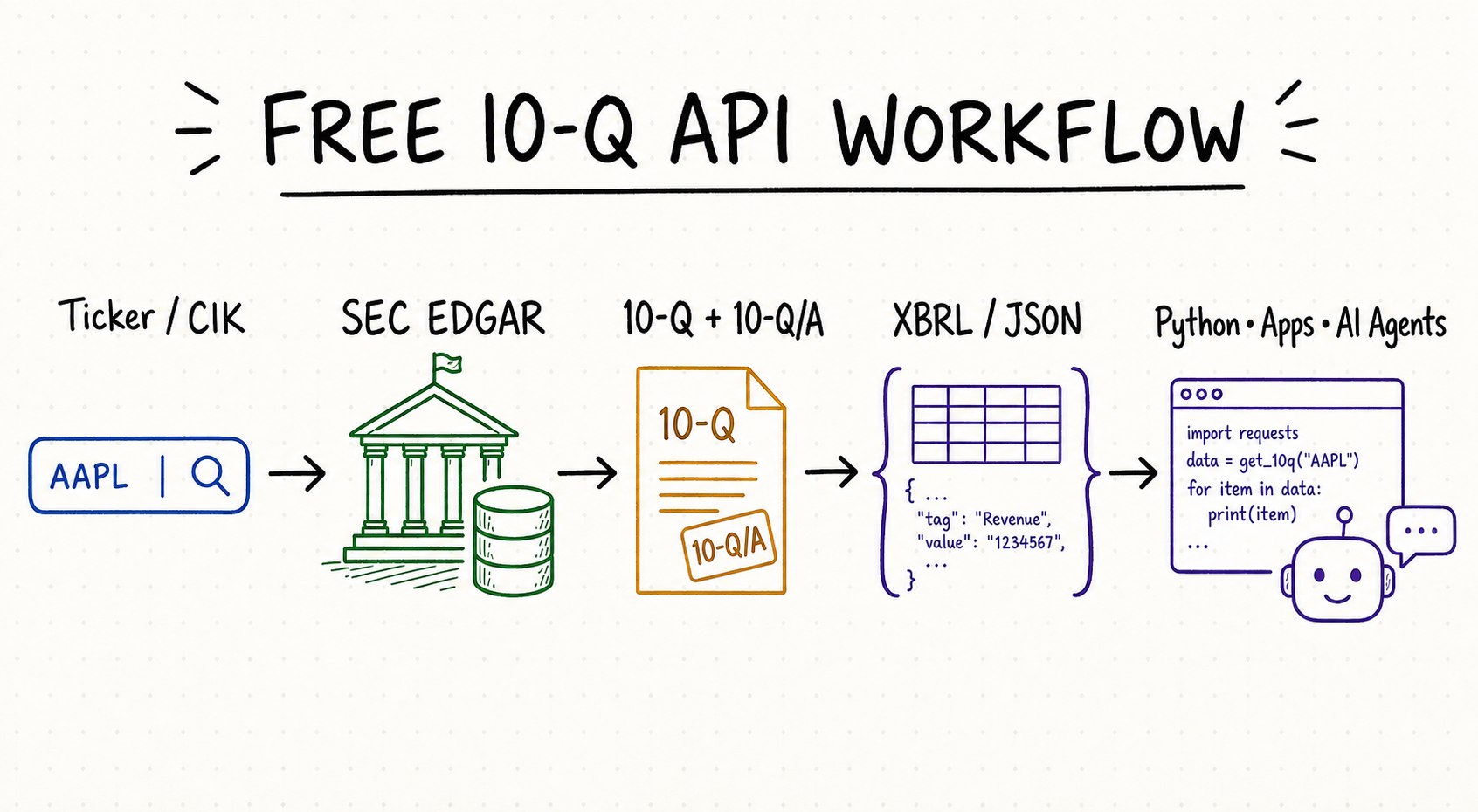
Build a free 10-Q data workflow that finds the right quarterly filing, separates quarter-only from year-to-date facts, preserves 10-Q/A versions, and supports defensible period-over-period analysis.
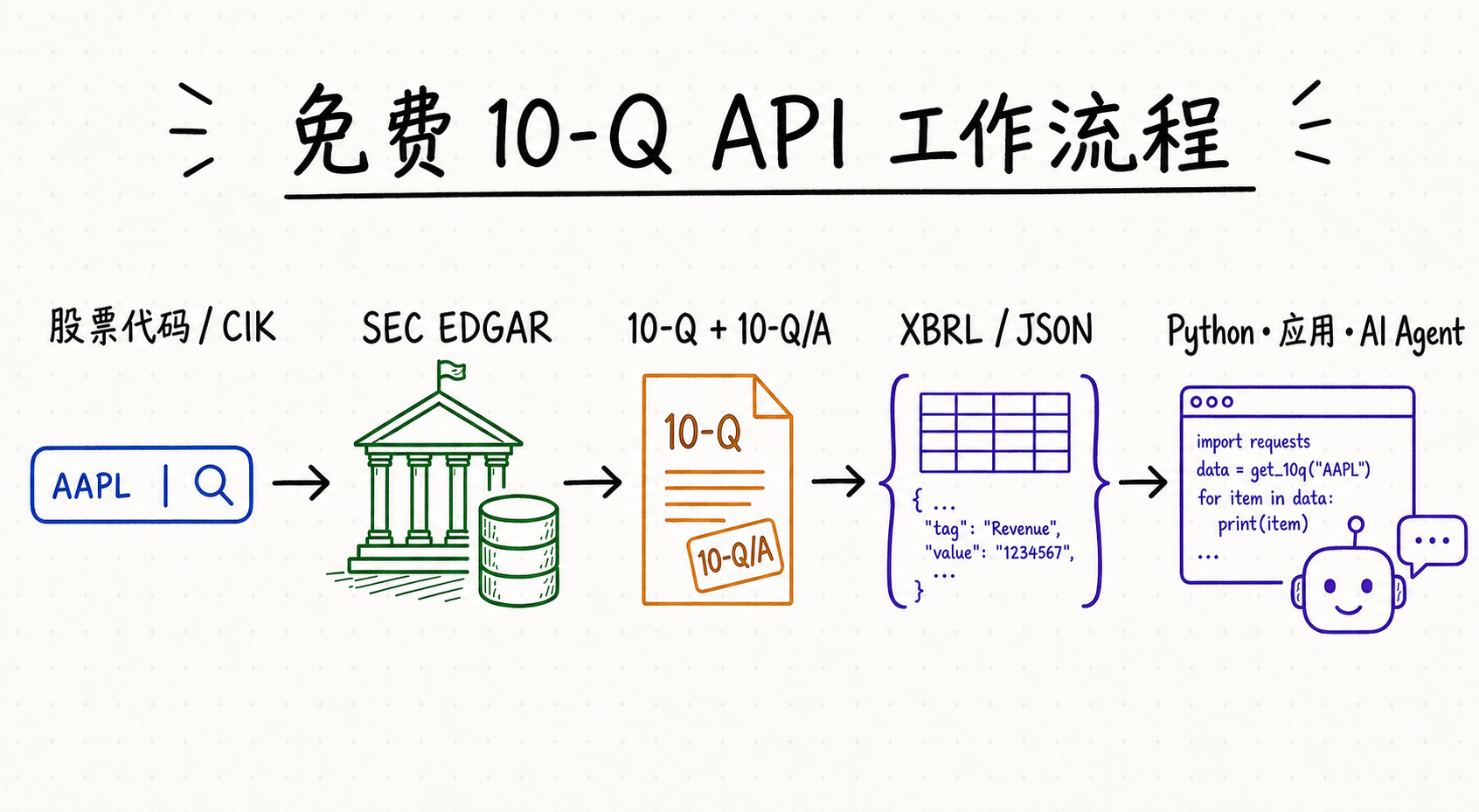
建立可靠的免费 10-Q 数据流程:准确定位季度申报,区分单季度与年初至今 facts,保留 10-Q/A 版本,并支持可解释的跨期分析。
TL;DR摘要
Retrieve each issuer’s quarterly report and convert fiscal periods and XBRL facts into comparable, source-backed observations.
Keep fiscal year, fiscal period, document period end, fact start and end dates, units, decimals, and accession with every metric.
A three-month quarter and a six- or nine-month year-to-date fact may share the same concept; context duration decides what can be compared.
QVeris helps agents discover and call relevant financial-data capabilities; provider terms and quotas still govern each API.
获取发行人季度报告,把财务期间和 XBRL 事实转成可比较且能够追溯来源的观测。
为每个指标保留财年、财务季度、报告期末、事实起止日、单位、小数精度和 accession。
单季度与六个月或九个月累计事实可能使用同一概念,只有上下文持续时间才能决定能否比较。
QVeris 帮助 Agent 发现并调用金融数据能力;实际免费额度和使用条款仍由各 API 提供方决定。
How to use a free 10-Q API for SEC filings如何使用免费 10-Q API 获取 SEC 申报
A 10-Q API is useful when the job is quarterly financial analysis, not merely filing discovery. Start with CIK, retrieve the original 10-Q plus later 10-Q/A filings, map fiscal periods, and preserve XBRL facts with their concepts, units, start and end dates, filing context, and source accession. The hard part is distinguishing a single quarter from year-to-date values and comparing periods without mixing restated and originally reported facts.
10-Q API 的核心任务是季度财务分析,而不只是发现文件。应从 CIK 出发,获取原始 10-Q 与后续 10-Q/A,映射财务期间,并保存 XBRL 事实对应的概念、单位、起止日期、上下文和来源 accession。真正困难的是区分单季度与年初至今数值,并避免在跨期比较中混用重述值和初始披露值。
Unlike a 10-K, a 10-Q sits inside an incomplete fiscal year. Balance-sheet facts are usually instants, while income-statement and cash-flow facts cover durations that may be three, six, or nine months. A provider that returns “quarterly revenue” without start date, end date, fiscal period, and source accession leaves the consumer unable to tell whether the number is Q2 alone or the first half of the year.
与 10-K 不同,10-Q 位于尚未结束的财年之中。资产负债表 facts 通常对应时点,利润表与现金流量表 facts 则对应三个月、六个月或九个月等持续期间。如果服务只返回“季度营收”,却没有起止日期、财务季度和来源 accession,使用者就无法判断它究竟是单独 Q2,还是上半年累计值。
Store fiscal year, fiscal period, document period end, filed date, and form. Calendar quarter is not a safe substitute because issuers use different fiscal calendars and 53-week years.
Income and cash-flow facts may use three-, six-, or nine-month contexts. Compare context dates and duration before calculating quarter-over-quarter growth.
Keep taxonomy concept, issuer extension, unit, decimals, context, accession, and source URL. A normalized metric without its source fact cannot explain a later discrepancy.
Do not overwrite the original 10-Q silently. Version facts by filing and decide whether downstream screens show as-filed, latest-known, or both.
If an issuer reports six- or nine-month cumulative values, a standalone quarter may be derived by subtracting the prior cumulative period. Mark the result as derived, require compatible concepts, units, dimensions, and versions, and never subtract values from different filing bases silently.
For year-over-year analysis, match fiscal quarter and comparable duration from the prior fiscal year. For sequential analysis, document seasonality and any derivation. A label such as “Q3” is not enough when fiscal calendars or reporting-week lengths differ.
保存财年、财务季度、报告期末、申报日和表单类型。不能直接用自然季度替代,因为发行人的财务日历和 53 周年度并不一致。
利润表和现金流量表事实可能采用三个月、六个月或九个月上下文。计算环比前必须比较上下文起止日期和持续时间。
保留分类标准概念、发行人扩展、单位、小数精度、上下文、accession 和来源链接。丢失来源事实的标准化指标无法解释后续差异。
不能用 10-Q/A 静默覆盖原始 10-Q。应按申报版本保存事实,并明确下游展示初始披露、最新已知值,还是同时展示两者。
如果发行人只报告六个月或九个月累计值,可以通过减去上一累计期间推导单季度数值。但必须把结果标记为派生值,并确保 concept、单位、维度与文件版本相容,不能悄悄相减不同申报基础上的数值。
同比分析应匹配上一财年的同一财务季度与相同持续期间;环比分析则要说明季节性和派生方式。发行人的财务日历或报告周数不同时,单独一个“Q3”标签并不足以证明可比。
Free SEC filing API fields and capabilities免费 SEC 申报接口的字段与能力
| Layer层级 | Main job主要作用 | Best for适合场景 | Boundary边界 |
|---|---|---|---|
| Form type表单类型 | 10-Q or 10-Q/A.10-Q 或 10-Q/A。 | Separating originals from amendments.区分原始季报与修订文件。 | Form type alone does not prove successful parsing.不能据此推断数据已完成解析。 |
| CIK / tickerCIK / 股票代码 | Issuer lookup key.发行人查询键。 | Company-specific 10-Q search.查询特定公司的 10-Q。 | Ticker may be absent or change.股票代码可能缺失或变化。 |
| Accession / URL申报编号 / URL | Unique filing reference and source document.唯一申报标识与原始文档。 | Deduplication and audit trails.去重与审计追踪。 | Document parsing may be separate.文档解析可能需要另一接口。 |
| 10-Q financial statement fields10-Q 财务报表字段 | Revenue, net income, assets, cash flow, periods, units, and source facts.营收、净利润、资产、现金流、期间、单位与来源事实。 | Structured quarterly financial analysis.结构化季度财务分析。 | Coverage varies by provider and plan.覆盖范围取决于提供方和套餐。 |
| Fact duration / instant事实期间 / 时点 | Distinguishes balance-sheet instants from three-, six-, or nine-month performance facts.区分资产负债表时点值,以及三个月、六个月或九个月经营结果。 | Quarter-only derivation and valid growth calculations.推导单季度数值和进行有效增长计算。 | Fiscal-period labels cannot replace exact start and end dates.财务季度标签不能替代准确起止日期。 |
| Dimensions and segments维度与分部 | Identifies consolidated, product, geographic, or other dimensional facts.识别合并口径、产品、地区或其他维度 facts。 | Preventing segment values from being mistaken for consolidated totals.避免把分部数值误当成合并总额。 | Dropping dimensions can create plausible but wrong duplicates.丢弃维度会产生看似合理但实际错误的重复值。 |
| Accepted time / filed date受理时间 / 申报日 | Controls point-in-time availability and monitoring order.控制时点可见性与监控顺序。 | Backtests, alerts, and “known as of” research.回测、提醒与“当时已知”研究。 | Report-period end is not the time the market learned the filing.报告期末并不是市场获知文件的时间。 |
Worked example: derive a standalone quarter from cumulative facts实算示例:由累计值推导单季度数值
Assume an issuer reports revenue of 100 for the three months ended March 31, 210 for the six months ended June 30, and 330 for the nine months ended September 30, all in USD millions. The standalone second quarter is 210 − 100 = 110; the standalone third quarter is 330 − 210 = 120. Store those outputs as derived facts, not as values directly reported by the issuer, and retain both source contexts and accessions behind each subtraction.
假设某发行人披露:截至 3 月 31 日的三个月收入为 100,截至 6 月 30 日的六个月累计收入为 210,截至 9 月 30 日的九个月累计收入为 330,单位均为百万美元。那么第二季度单季收入为 210 − 100 = 110,第三季度单季收入为 330 − 210 = 120。这两个结果应标记为“推导值”,不能伪装成发行人直接披露的数值;每次相减还要保留两条来源事实的 context 与 accession。
Subtract only compatible facts. Concept, unit, consolidation and segment dimensions, fiscal-year basis, duration boundary, and filing-version policy must match. If the Q2 filing later amends the six-month value from 210 to 214, an as-filed Q3 analysis may still use the version available at that cutoff, while a latest-known series may recompute Q2 and Q3 history. Keep these two policies separate and label them explicitly; silently mixing an amended prior value with an original current value creates a series that never existed at any real point in time.
只有口径兼容的事实才能相减。concept、单位、合并与分部维度、财年口径、期间边界和申报版本政策必须一致。若后续修订把 Q2 的六个月累计值从 210 改为 214,“当时已披露”序列应使用研究截止时点真正可见的版本;“最新已知”序列则可以依据修订重新计算 Q2 与 Q3 历史。两套政策必须分开保存并明确标注。把修订后的上期值与原始本期值静默混用,会生成一条在任何真实时点都不存在的序列。
10-Q filings API example and validation checklist10-Q 申报 API 示例与验证清单
A useful JSON response should preserve filing identity and evidence before adding normalized financial facts. The following provider-neutral record uses placeholders deliberately; it shows the contract your application should require, not a live filing.
一条可用的 JSON 响应,应先保留申报身份与证据,再附加标准化财务 facts。下面使用的是与提供方无关的占位示例,展示应用应要求的数据契约,并不代表某一份实时申报。
{
  "issuer": {
    "cik": "CIK_PLACEHOLDER",
    "ticker": "TICKER_PLACEHOLDER",
    "name": "ISSUER_NAME"
  },
  "filing": {
    "accession_number": "ACCESSION_PLACEHOLDER",
    "form": "10-Q",
    "is_amendment": false,
    "filed_date": "YYYY-MM-DD",
    "accepted_at": "YYYY-MM-DDThh:mm:ss-04:00",
    "report_period": "YYYY-MM-DD",
    "primary_document": "PRIMARY_DOCUMENT.htm",
    "source_url": "SOURCE_DOCUMENT_URL"
  },
  "xbrl": {
    "facts_source_url": "XBRL_FACTS_SOURCE_URL",
    "units_present": ["USD", "shares", "USD/shares"]
  },
  "retrieved_at": "YYYY-MM-DDThh:mm:ssZ"
}
Do not collapse three different SEC layers into one undocumented payload. Submissions metadata tells you what was filed and when; the archive document is the authoritative narrative and disclosure source; XBRL facts provide tagged values with units, periods, dimensions, and filing contexts. A normalized API may join them, but every joined value should still retain its source URL, accession, period context, unit, and retrieval time.
不要把 SEC 的三个数据层合并成一份来源不明的响应。Submissions 元数据说明提交了什么、何时提交;存档原文是叙述性披露的权威来源;XBRL facts 则提供带单位、期间、维度与申报上下文的标签化数值。标准化 API 可以整合这些数据,但每个合并后的值仍应保留来源 URL、accession、期间上下文、单位和抓取时间。
Send the issuer identifier plus a form filter such as form=10-Q. If the provider supports date ranges, use them for incremental jobs and paginate until no next page remains.
Confirm that every record includes a parseable filing date, exact form type, issuer identifier, and a source URL. Reject malformed dates and duplicate accession numbers.
Read the provider’s quota and 429 behavior. Add bounded retries with backoff, cache stable filing metadata, and avoid repeatedly downloading unchanged documents.
Persist the last successful checkpoint, compare new accession numbers, and send alerts only after the source record passes validation.
For every metric, group candidates by concept, unit, dimensions, period dates, form, and accession. Prefer an explicit provider policy for amendments and duplicates. Flag missing prior periods instead of filling them with a non-comparable context.
Simulate a timeout after one page or one issuer, resume from the stored checkpoint, and confirm that replay neither misses nor duplicates accessions. Keep raw responses and retrieval timestamps so later parser corrections can be rerun.
发送发行人标识与 form=10-Q 一类表单筛选条件。若接口支持日期范围,可用于增量任务,并持续翻页直至没有下一页。
确认每条记录都包含可解析的申报日期、准确表单类型、发行人标识和来源 URL;拒绝异常日期与重复 accession number。
查看免费额度与 429 行为,使用有上限的退避重试,缓存稳定的申报元数据,避免反复下载未变化的文档。
持久化最后一次成功检查点,对比新的 accession number,并在来源记录验证通过后再发送提醒。
每个指标都应按 concept、单位、维度、期间起止日、表格与 accession 对候选值分组,并明确规定修订与重复值的选择逻辑。如果缺少可比上期,应标记缺失,而不是拿不相容的上下文强行补齐。
模拟抓取一页或一家发行人后发生超时,从已保存检查点恢复,并确认重放既不漏掉也不重复 accession。保留原始响应和抓取时间,便于解析规则修正后重新处理。
How QVeris helps discover a 10-Q filing APIQVeris 如何帮助发现 10-Q 申报接口
QVeris is a capability routing network for AI agents. It can help an agent discover and inspect tools for filing discovery, source-document retrieval, XBRL facts, or normalized quarterly statements. Before a call, the agent should state whether it needs as-filed or latest-known data, quarter-only or year-to-date values, and which fiscal period and evidence fields must be returned. QVeris does not change the provider’s data rights, quota, freshness, or usage terms.
QVeris 是面向 AI Agent 的能力路由网络,可帮助 Agent 发现并检查申报检索、原始正文下载、XBRL facts 或标准化季度报表等工具。调用前,Agent 应明确需要初始披露还是最新已知值、单季度还是年初至今数值,以及必须返回的财务期间与证据字段。QVeris 不会改变底层提供方的数据权利、额度、更新频率或使用条款。
- Open the QVeris tool details for issuer lookup, SEC filing search, or structured filing extraction.
- Inspect required parameters and returned fields before connecting the capability to an agent workflow.
- Keep the SEC source URL and provider attribution in every research output.
- 打开 QVeris 工具详情,查看符合发行人查询、SEC 申报检索或结构化解析需求的能力。
- 接入 Agent 工作流前,先检查必填参数、返回字段与提供方条款。
- 在研究输出中保留 SEC 原始链接与提供方归属。
FAQ常见问题
Yes. SEC EDGAR provides public submissions and XBRL data without an API key. Filter filing metadata for 10-Q and 10-Q/A, follow current automated-access guidance, and retrieve the source filing or facts needed by the application.
The same concept may appear with three-, six-, or nine-month durations, different units or dimensions, and multiple filing versions. Select using the complete context and accession—not concept name alone.
Subtract the compatible prior cumulative value only when concept, unit, dimensions, fiscal basis, and filing-version policy match. Mark the output as derived and retain both source facts; otherwise report that a comparable quarter-only value is unavailable.
Store the original and amendment as separate accessioned versions. Link them, identify changed disclosures or facts, and define whether downstream consumers see as-filed, latest-known, or both views.
Yes. Poll a form-filtered feed or use alerts, checkpoint by accepted time, deduplicate by accession number, validate the source URL, and support replay of an overlap window after failures.
是。SEC EDGAR 无需 API key 即可提供公开 submissions 与 XBRL 数据。可筛选 10-Q 和 10-Q/A 元数据,并在遵守当前自动访问指引的前提下获取应用所需原文或 facts。
同一 concept 可能对应三个月、六个月或九个月期间,也可能拥有不同单位、维度和文件版本。必须结合完整上下文与 accession 选择,不能只看概念名称。
只有在 concept、单位、维度、财务口径与文件版本策略一致时,才可以减去上一累计期间。结果应标记为派生值并保留两个来源 facts;不满足条件时,应明确说明缺少可比单季度值。
原始文件与修订文件应作为不同 accession 版本分别保存并建立关联,同时识别变化的披露或 facts,并明确下游使用初始披露、最新已知值还是同时展示两者。
可以。轮询按表格筛选的数据流或使用提醒服务,按 accepted time 保存检查点,以 accession number 去重,验证来源 URL,并支持故障后重放一段重叠窗口。