
Choose a Free Analyst Ratings API
with Confidence如何可靠选择
免费分析师评级 API
Evaluate consensus ratings, target prices, revision history, coverage, timestamps, quotas, and usage rights before you build an analyst-data workflow.
在构建分析师数据工作流前,系统评估共识评级、目标价、评级修订记录、覆盖范围、时间戳、请求配额与使用授权。
TL;DR核心摘要
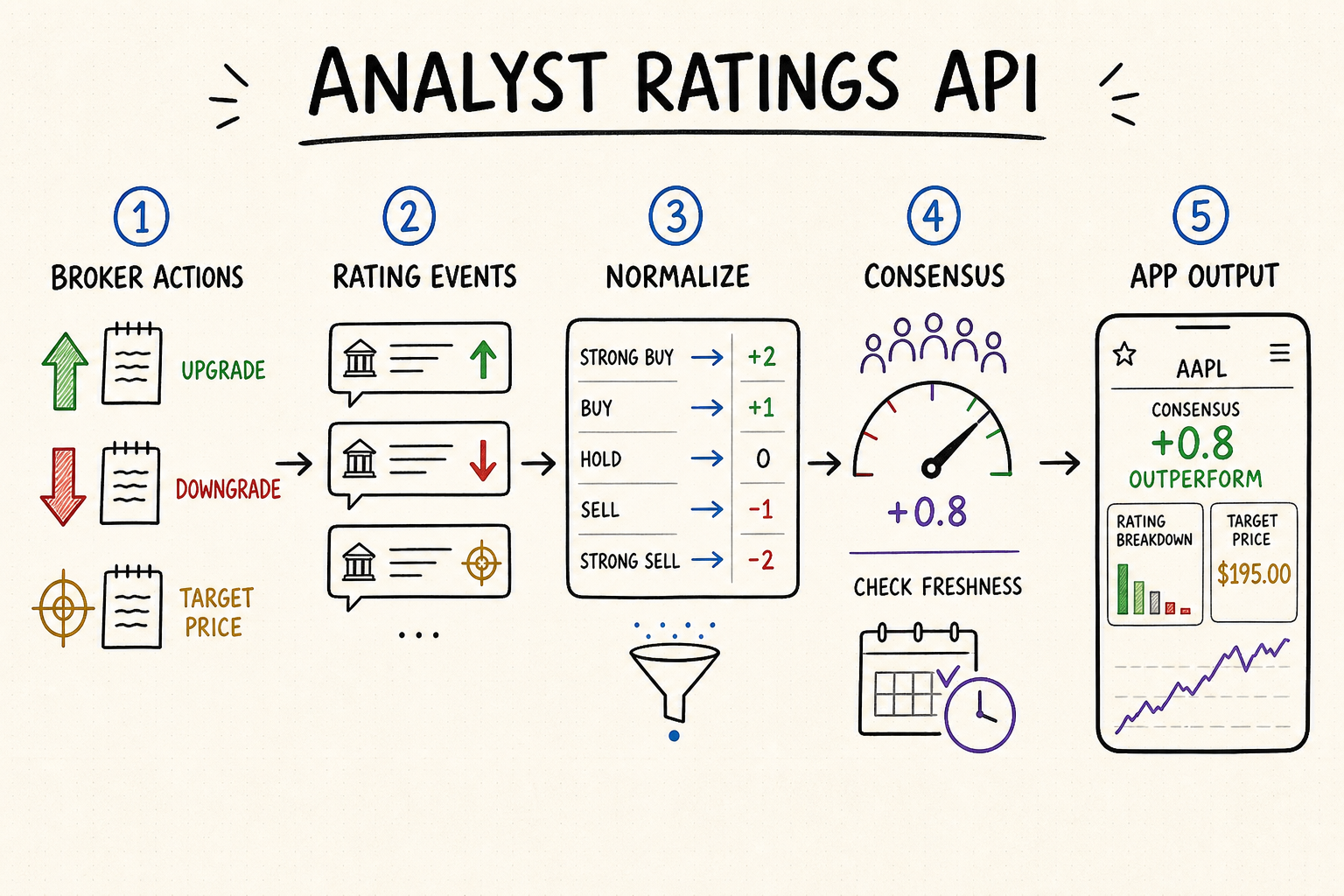
An analyst ratings API should preserve each research action as an event: who issued it, which security it covered, what the prior and new recommendation were, whether the action was an initiation, reiteration, upgrade, downgrade, or withdrawal, and how any target price changed. Consensus summaries are useful only when the underlying scale, contributor set, freshness window, and observation time remain visible.
分析师评级 API 应把每次研究观点变化保存为独立事件:由哪家机构或哪位分析师发布、针对哪只证券、调整前后分别是什么评级、属于首次覆盖、重申、上调、下调还是终止覆盖,以及目标价如何变化。汇总后的共识评级只有在评级体系、参与机构范围、数据新鲜度和观察时间清楚可见时才有意义。
Buy, outperform, overweight, and positive are not identical. Preserve the source label, then map it to a documented normalized scale.
A current consensus cannot explain when an analyst upgraded, downgraded, initiated, reiterated, or withdrew coverage.
Keep the announcement time, effective date, ingestion time, and target-price currency so users can judge what was known when.
“买入”“跑赢大盘”“增持”与“正面”等评级并不完全等价。应保留研究机构使用的原始评级标签,再映射到定义清晰的标准化评级体系。
当前的共识评级无法说明分析师何时上调、下调、首次覆盖、重申或终止覆盖,因此需要保留完整的评级事件记录。
应保留评级发布时间、生效日期、数据入库时间与目标价所用币种,方便用户判断在任一历史时点实际可获得的信息。
Understand the analyst ratings data model掌握分析师评级数据模型
An analyst ratings API may return individual actions, aggregated consensus, or both. Event records need the security, firm, action, old and new rating, old and new target, currency, publication time, and source. Consensus responses need contributor count, rating distribution, calculation method, observation window, and last update.
A target-price average is not timeless: an old outlier can distort the mean, while a median can hide widening disagreement. Store the range, mean, median, contributor count, and observation age. Distinguish company research from a share class, ADR, or regional listing, and use stable identifiers because tickers change.
分析师评级 API 可能返回单项评级操作、汇总后的市场共识,也可能同时提供两类数据。评级事件记录应包含证券标识、研究机构、操作类型、调整前后的评级与目标价、币种、发布时间和数据来源。市场共识数据则应说明参与统计的分析师数量、各评级档位的分布、计算方法、观察窗口及最后更新时间。
目标价均值会随时间失去参考意义:较早的极端值可能扭曲均值,而中位数可能掩盖日益扩大的意见分歧。因此,应同时保留目标价区间、均值、中位数、参与统计的分析师数量,以及纳入统计的数据距今多久。还应区分针对公司整体的研究结论与针对特定股份类别、存托凭证或地区上市证券的研究结论。由于股票代码可能变更,应使用稳定的证券标识。
Use stable IDs for the covered security, research firm, and analyst where licensing permits. Preserve exchange, share class, ADR relationship, firm aliases, analyst moves between employers, and effective dates rather than matching by ticker or surname alone.
Keep the source label exactly as published, then map it to a documented ordinal scale. Do not assume that outperform, overweight, sector perform, market perform, and neutral have identical meaning across firms.
Separate initiation, reiteration, upgrade, downgrade, resumption, suspension, and withdrawal. An unchanged positive rating with a lower target is different from a downgrade, even if both may signal reduced conviction.
Store old and new target, currency, horizon, publication time, split-adjustment status, and security. Convert currencies only in a separate derived field with an exchange-rate timestamp.
Record recommendation counts by source bucket, contributor count, normalized score, target mean and median, range, age distribution, calculation method, and as-of time. Keep the event stream that produced the snapshot.
许可允许时,应为被覆盖证券、研究机构和分析师使用稳定 ID,并保留交易所、股权类别、ADR 关系、机构别名、分析师更换雇主及其生效日期,不能只凭股票代码或姓氏匹配。
先完整保留机构发布的原始标签,再映射到规则清晰的有序评级体系。不能假定不同机构使用的“跑赢大盘”“增持”“与行业同步”“与市场同步”和“中性”完全等价。
应区分首次覆盖、重申、上调、下调、恢复覆盖、暂停和终止覆盖。维持正面评级但下调目标价,与直接下调评级属于不同事件,即使两者都可能反映信心减弱。
保存调整前后目标价、币种、预测期限、发布时间、拆股调整状态和对应证券。币种换算只能放在独立的衍生字段中,并附上汇率时间戳。
记录各评级档位数量、贡献者总数、标准化分数、目标价均值与中位数、区间、数据年龄分布、计算方法和数据时点,同时保留生成快照的底层评级事件。
A worked snapshot shows why one consensus number is not enough. Assume the application observes four hypothetical research firms at a 2026-07-31 cutoff. The mapping below is illustrative; a real workflow must version its own firm-specific rules and retain every original label.
一个完整快照能够说明为什么不能只提供单一共识分数。假设应用在 2026 年 7 月 31 日截止时点观察到四家虚构研究机构的评级。下表中的映射仅用于说明方法;真实工作流必须为各机构维护带版本的映射规则,并始终保留原始标签。
| Observed event观察到的事件 | Normalized treatment标准化处理 | Consensus eligibility是否纳入共识 | Reason理由 |
|---|---|---|---|
| Firm A initiates “Outperform” at $64机构 A 首次覆盖,评级为“跑赢大盘”,目标价 64 美元 | Positive bucket; initiation event; original label retained.映射到正面档;记录为首次覆盖;保留原始标签。 | Include纳入 | Current, independent contributor with complete security, currency, and publication fields.当前有效的独立贡献者,证券、币种和发布时间字段完整。 |
| Firm B reiterates “Buy” and raises target from $60 to $66机构 B 重申“买入”,目标价由 60 美元上调至 66 美元 | Positive bucket; recommendation unchanged; target-change event stored separately.映射到正面档;推荐等级未变;目标价变化另行保存。 | Include once仅纳入一次 | A syndicated copy of the same note must not create a second contributor.同一研报的转载记录不能制造第二个贡献者。 |
| Firm C downgrades from “Overweight” to “Equal Weight” at $52机构 C 从“增持”下调至“等权”,目标价 52 美元 | Neutral bucket; downgrade event supersedes the prior positive state.映射到中性档;下调事件替代此前的正面状态。 | Include latest state纳入最新状态 | Counting both old and new labels would double-weight one firm.同时统计调整前后评级会让同一机构获得双重权重。 |
| Firm D withdraws coverage after an analyst departure机构 D 因分析师离职终止覆盖 | Withdrawal event; previous rating remains historical evidence.记录为终止覆盖;此前评级仍作为历史证据保留。 | Exclude after withdrawal终止后排除 | A withdrawn opinion is not a current negative recommendation.已撤回的观点不等于当前负面评级。 |
Resulting snapshot: two positive contributors and one neutral contributor are eligible; the withdrawn firm is not. Report the distribution positive 2 / neutral 1 / negative 0, contributor count 3, cutoff time, oldest included opinion, mapping version, and target-price range $52–$66. The mean target is $60.67 and the median is $64, but both statistics need the original observations and age distribution. If Firm B's event was duplicated by a news syndication feed, the consensus must remain unchanged.
最终快照:两家正面机构和一家中性机构符合纳入条件,已经终止覆盖的机构不再参与。页面应展示 正面 2 / 中性 1 / 负面 0 的分布、贡献者数量 3、截止时间、最早一条有效观点的年龄、映射版本,以及 52–66 美元 的目标价区间。目标价均值为 60.67 美元,中位数为 64 美元,但两项统计都必须能够回到原始观测和数据年龄分布。如果机构 B 的事件被新闻转载源重复收录,共识结果不得因此变化。
Corporate actions require another versioned layer. After a 2-for-1 split, a pre-split $100 target may be comparable with a post-split $50 target only when the provider or application records the split factor, effective date, original target, adjusted target, and adjustment source. Never overwrite the published target; keep the adjustment as a derived value and exclude records whose adjustment status is unknown.
公司行动还需要独立的版本层。发生 1 拆 2 后,拆股前 100 美元的目标价只有在记录拆股比例、生效日期、原始目标价、调整后目标价和调整来源时,才能与拆股后 50 美元的目标价比较。不能覆盖机构当时发布的原始目标价;调整值应作为衍生字段保存,调整状态不明的记录不能直接进入共识统计。
Evaluate a free analyst ratings API如何评估免费的分析师评级 API
| Check评估维度 | Question需要确认的问题 | Why it matters实际影响 |
|---|---|---|
| Coverage覆盖范围 | Which markets, firms, and security types are included?覆盖范围包括哪些市场、研究机构和证券类型? | Sparse input can make consensus misleading.样本数量过少可能导致共识评级失真。 |
| Freshness数据时效 | Are actions live, delayed, daily, or irregular?评级事件是实时发布、延迟发布、按日更新,还是不定期更新? | A timestamp does not guarantee prompt delivery.记录中有时间戳,并不意味着数据会及时送达。 |
| History历史记录 | Can you replay revisions without survivorship gaps?能否完整回放历次评级修订,并避免因幸存者偏差造成记录缺失? | Backtests need point-in-time event history.回测需要使用在各个历史时点实际可得的评级事件记录。 |
| Scale mapping评级映射 | Are original labels, firm scales, normalized values, and mapping versions retained?是否保留原始标签、机构评级体系、标准化值和映射版本? | A rough universal mapping can create false upgrades or downgrades.粗糙的统一映射可能制造虚假的上调或下调。 |
| Target prices目标价 | Are currency, horizon, security, split adjustment, prior target, and publication time available?是否提供币种、预测期限、对应证券、拆股调整、此前目标价和发布时间? | Unlabelled targets cannot be compared or aggregated safely.缺少这些信息的目标价无法安全比较或汇总。 |
| Contributors贡献者 | Can firms, analysts, duplicates, employment changes, and stale coverage be resolved?能否识别机构、分析师、重复记录、任职变更和长期未更新的覆盖? | Contributor count and independence affect consensus quality.贡献者数量和独立性会影响共识质量。 |
| License使用授权 | May data be cached, displayed, or redistributed?是否允许缓存、展示或再分发这些数据? | Free access may exclude commercial products.免费访问权限可能不允许将数据用于商业产品。 |
Check per-minute bursts, daily resets, endpoint weights, symbols per call, pagination, and separate historical allowances. Test missing values, duplicates, split-adjusted targets, withdrawn coverage, and corrections. A useful free plan should report failures with status codes and quota headers, not silently return partial data.
不能只看宣传页上的请求次数,还要核对每分钟请求峰值上限、每日配额重置时间、接口权重、单次请求可传入的证券代码数量、分页规则,以及历史数据接口是否使用独立配额。接入测试应覆盖缺失值、重复评级事件、拆股调整后的目标价、终止覆盖与更正记录。可靠的免费套餐应通过明确的状态码和配额响应头报告失败,而不是静默返回不完整数据。
Build a reliable ratings integration构建可靠的评级数据接入流程
- Define a normalized scale: version firm-specific mappings before ingesting history, and retain every original recommendation label beside the mapped value.
- Resolve identities separately: map the security, research firm, and analyst to stable IDs, with effective dates for ticker changes, firm aliases, and employment moves.
- Preserve raw events: store the source payload, URL, publication time, prior and new labels, target prices, currency, and action type before normalization.
- Use event IDs: deduplicate with a provider ID or a composite security, firm, analyst, time, action, and content key.
- Model corrections and withdrawals: append versions, and distinguish a corrected record from a genuinely new research action.
- Separate events from snapshots: calculate consensus from point-in-time eligible events and record the method, cutoff, contributor count, age distribution, and mapping version.
- Monitor quality: alert on delivery delays, contributor loss, stale targets, currency gaps, impossible target changes, duplicates, and schema drift.
- 定义标准化评级体系:在导入历史数据前,为不同机构的评级映射建立版本,并在映射值旁保留每条原始评级标签。
- 分别解决主体身份:为证券、研究机构和分析师建立独立稳定 ID,并记录股票代码变更、机构别名和分析师任职变动的生效日期。
- 保留原始评级事件:标准化之前先保存源响应、原文链接、发布时间、调整前后评级、目标价、币种和评级动作类型。
- 使用事件 ID:优先使用数据商提供的事件 ID;若没有,可组合证券、机构、分析师、时间、动作和内容生成稳定键去重。
- 保存更正与撤回:以追加版本的方式记录变化,并区分数据更正与真正新增的研究观点。
- 区分事件与共识快照:只用历史时点当时有效的评级事件计算共识,同时记录计算方法、截止时间、贡献者数量、数据年龄分布和映射版本。
- 监控数据质量:针对交付延迟、贡献者减少、目标价过期、币种缺失、异常目标价变化、重复记录和结构漂移设置告警。
Use QVeris to find analyst-data capabilities借助 QVeris 查找分析师数据能力
QVeris helps AI agents compare recommendation-event, target-price, and consensus-rating capabilities by identifiers, fields, timing, access requirements, and documented limits before routing a request. It can simplify capability access; the application still owns scale mapping, contributor identity, target-price normalization, point-in-time consensus, corrections, licensing, and how third-party opinions are presented.
QVeris 可帮助 AI 智能体在路由请求前,根据标识体系、字段、时效、接入条件和公开限制,比较评级事件、目标价和共识评级能力。它能够简化能力访问,但评级映射、贡献者身份、目标价标准化、历史时点共识、更正版本、使用许可,以及第三方观点的呈现方式,仍由应用方负责。
FAQ常见问题
No. They are third-party opinions. Present source, date, method, and risk context.
Only with point-in-time history preserving publication timing, revisions, and delisted securities.
It can be if coverage, uptime, quota, licensing, and corrections fit the workload. Keep a fallback.
No scale is universal. Document the mapping and retain the original label.
不是。分析师评级属于第三方观点,本身不构成投资建议。展示评级时,应同时说明其来源、日期、评估方法与相关风险。
可以,但必须使用按历史时点还原的数据,并完整保留原始发布时间、后续修订以及已退市证券记录。
可以,前提是其覆盖范围、服务可用性、请求配额、使用授权与数据更正机制能够满足实际业务负载,同时还应准备备用数据源。
没有适用于所有场景的最佳体系。应清楚说明评级映射规则,并始终保留服务商提供的原始评级标签。
No. An upgrade changes the recommendation category; a target-price increase changes the valuation objective. Store and analyze them as separate fields and actions.
Apply a documented age or supersession rule, exclude withdrawn coverage, and expose the age distribution instead of hiding old views inside one score.
Only after mapping each target to the correct security and converting it in a separate derived field with a timestamped FX rate. Preserve the original value and currency.
It repeats the existing recommendation, sometimes with a new target or rationale. It is a new event, but not automatically an upgrade or downgrade.
不是。上调评级改变的是推荐档位,上调目标价改变的是估值目标。两者应作为独立字段和独立动作保存与分析。
应采用明确的数据年龄或替代规则,排除已经撤回的覆盖,并展示评级年龄分布,不能把过时观点悄悄混入一个总分。
不可以。必须先确认目标价对应的证券,再用带时间戳的汇率生成独立换算字段,同时保留原始数值和币种。
它表示机构再次确认原有推荐档位,有时会同时更新目标价或理由。它是一条新事件,但不应自动记为上调或下调。