
Choose a Reliable
Free Balance Sheet API如何选择可靠的
免费资产负债表 API
Evaluate coverage, accounting fields, history, limits, and reporting dates before a free endpoint becomes part of your analysis.
从覆盖范围、会计字段、历史期数、使用限制和报告日期入手,
判断免费接口是否适合纳入正式分析流程。
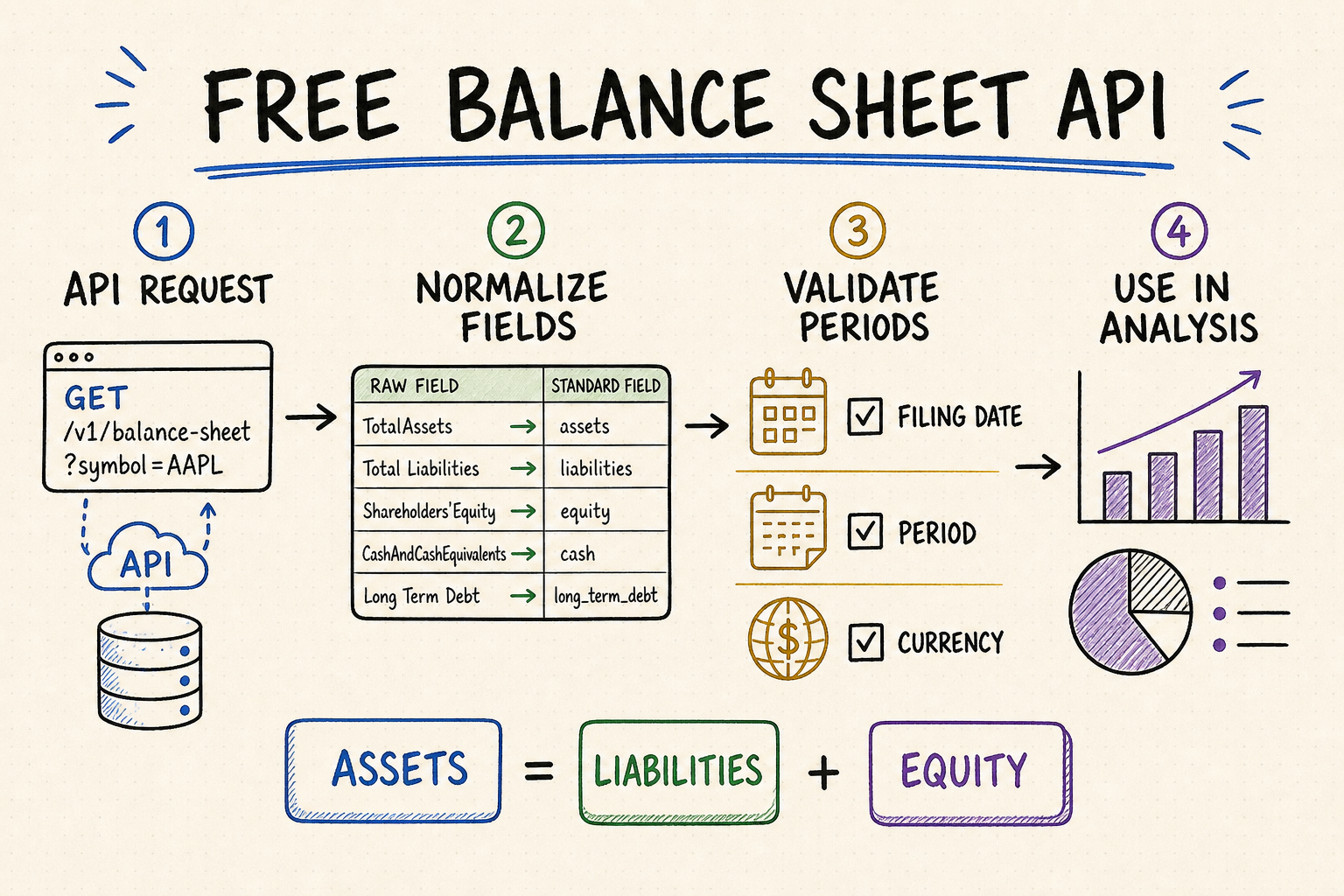
TL;DR核心摘要
A balance sheet API returns a company's financial position at a specific date, not activity over a period. Reliable data preserves the reporting entity, period end, currency, unit, consolidation scope, filing version, and current versus non-current classifications. It should let you test whether assets equal liabilities plus equity and explain changes in liquidity, debt, working capital, and book value without mixing dates.
资产负债表 API 返回的是企业在某一特定日期的财务状况,而不是一段期间内的经营活动。可靠数据应保留财务报告主体、报告期末、币种、计量单位、合并范围、文件版本,以及流动与非流动分类。它还应支持验证“资产等于负债加所有者权益”,并在不混用数据时点的前提下解释流动性、债务、营运资本和账面价值的变化。
A free endpoint can suit prototypes, screening, education, and light research, but not every production workload.
Confirm annual and quarterly statements, consolidated values, currency, filing dates, and restatement behavior.
Request frequency limits matter, but history depth, symbol coverage, latency, and licensing can be tighter constraints.
Map provider fields to a stable schema and test the accounting equation across companies and reporting periods.
免费接口可用于原型开发、标的筛选、教学和轻量研究,但未必能满足所有生产环境的负载要求。
确认是否提供年度与季度报表、合并口径数据和币种信息,并了解申报日期及财报重述的处理方式。
除请求频率限制外,历史深度、证券代码覆盖范围、响应延迟和授权条款也可能构成更严格的约束。
将数据服务商的字段映射到稳定的数据结构,并跨公司、跨报告期检验会计恒等式。
How to evaluate a free balance sheet API如何评估免费资产负债表 API
“Free” describes price, not fitness. Begin with the exchanges and company types you need, then verify whether the API returns standardized statements or filing-native facts. Standardized data is easier to compare; filing-native data preserves detail but requires more accounting logic. Because a balance sheet is an instant snapshot, even a small mismatch between period end, filing version, or consolidation scope can invalidate a ratio or liquidity comparison.
“免费”只说明价格,并不代表接口适合具体任务。先确认需要覆盖的交易所和公司类型,再判断接口返回的是标准化报表,还是监管申报文件中的原始事实数据。标准化数据便于横向比较;申报原始数据保留的细节更多,但需要运用更多会计逻辑进行处理。由于资产负债表反映的是一个时点,报告期末、文件版本或合并范围哪怕只有一项不一致,都可能使财务比率或流动性比较失效。
Check active and delisted companies, primary listings, ADRs, funds, and foreign issuers. Prefer stable legal-entity IDs over tickers, and verify whether the statement covers the parent, consolidated group, guarantor, regulated subsidiary, or another reporting entity.
Count available annual and quarterly period ends rather than accepting a vague “historical data” claim. Distinguish the balance-sheet date, filing date, regulatory acceptance time, provider availability time, and any later amendment.
Confirm current and non-current presentation, currency, units, accounting standard, consolidation scope, and whether leases, restricted cash, held-for-sale assets, deferred taxes, and non-controlling interests retain their reported treatment.
Acquisitions, disposals, spin-offs, foreign-exchange translation, reclassifications, and restatements can create breaks. Preserve comparative values as reported in each filing and do not assume every change represents operating movement.
Differentiate not disclosed, not applicable, mapping failure, delayed data, and true zero. Financial institutions and funds use balance-sheet structures that differ from industrial companies; a generic schema should not erase sector-specific assets and obligations.
Before calculating liquidity, leverage, or book-value ratios, verify that total assets equal total liabilities plus equity within a documented tolerance. Reconcile cash to the cash-flow statement, retained earnings to prior periods, and debt totals to current and non-current components. A ratio calculated from a balanced-looking but semantically mixed statement is still unreliable.
Store the statement exactly as it was available at each research cutoff, including filing version, provider retrieval time, currency, units, and normalization rules. Later amendments and provider remappings should create a new version rather than overwrite the evidence used by an earlier screen, backtest, credit model, or AI-generated brief.
检查当前上市及已退市公司、主上市证券、ADR、基金和境外发行人的覆盖情况。应优先使用稳定的法律主体 ID,而不是股票代码,并确认报表对应母公司、合并集团、担保主体、受监管子公司,还是其他财务报告主体。
应统计可用的年度和季度报告期末数量,而不是只接受“提供历史数据”的模糊表述。还要区分资产负债表日、文件提交日期、监管系统接收时间、供应商首次提供数据的时间,以及后续修订日期。
确认流动与非流动项目、币种、单位、会计准则和合并范围,并检查租赁、受限现金、持有待售资产、递延所得税和少数股东权益是否保留企业原始列报口径。
并购、资产处置、分拆、外币折算、项目重分类和财报重述都可能造成数据断点。应保留每份申报文件中的比较期数值,不能把每一项变化都简单理解为经营活动造成的增减。
应区分企业未披露、不适用、字段映射失败、数据尚未更新和真实零值。金融机构与基金的资产负债表结构不同于普通工业企业,通用数据结构不能因此删除行业特有资产和负债项目。
计算流动性、杠杆或每股账面价值之前,应在明确容差内确认资产总额等于负债与权益之和,并把现金与现金流量表、留存收益与前期数据、债务总额与流动及非流动债务明细相互核对。外表平衡但混用了不同口径的报表,算出的比率仍然不可靠。
保存每个研究截止时点真实可见的报表版本,同时记录申报版本、供应商获取时间、币种、单位和标准化规则。后续更正或字段重映射应生成新版本,不能覆盖此前选股、回测、信用模型或 AI 研究简报所使用的证据。
Fields and reporting periods that matter需要重点核对的字段与报告期
| Category类别 | Typical fields典型字段 | Analysis use分析用途 | Validation focus校验重点 |
|---|---|---|---|
| Assets资产 | Cash, receivables, inventory, investments, property, goodwill, and other assets.现金、应收款项、存货、投资、不动产、商誉及其他资产。 | Liquidity and asset quality.流动性与资产质量。 | Current/non-current split.流动资产与非流动资产的划分。 |
| Liabilities负债 | Payables, short-term borrowings, long-term debt, leases, and deferred items.应付款项、短期借款、长期债务、租赁负债和递延项目。 | Leverage and obligations.杠杆水平与偿付义务。 | Maturity classification.按到期期限分类。 |
| Equity所有者权益 | Common stock, paid-in capital, retained earnings, treasury stock, and OCI.普通股股本、实收资本、留存收益、库存股和其他综合收益。 | Book value and capital structure.账面价值与资本结构。 | Minority interest treatment.少数股东权益的处理口径。 |
| Working capital营运资本 | Receivables, inventory, payables, accrued liabilities, contract assets, and contract liabilities.应收账款、存货、应付账款、应计负债、合同资产和合同负债。 | Short-term operating funding.企业短期经营资金占用与来源。 | Operating versus financing classification.经营性项目与融资性项目的分类。 |
| Debt and liquidity债务与流动性 | Cash, restricted cash, revolvers, current debt, long-term debt, leases, and maturities.现金、受限现金、循环信贷、流动负债、长期债务、租赁和到期安排。 | Liquidity runway and refinancing risk.流动性缓冲与再融资风险。 | Net-debt definition and current portion.净债务定义及一年内到期部分。 |
| Accounting checks会计校验 | Assets, liabilities, equity, subtotals, and comparative presentation.资产、负债、所有者权益、小计和比较期列报。 | Detect mapping, scaling, and sign errors.发现字段映射、数量级和正负号错误。 | Run the accounting equation and subtotal checks.运行会计恒等关系与各层级小计检查。 |
| Period metadata报告期信息 | Fiscal year, quarter, period end, filing date, currency, and form type.会计年度、季度、报告期末日期、申报日期、币种和申报表格类型。 | Point-in-time alignment.数据时点对齐。 | Restatements and late filings.财报重述及延迟申报情况。 |
Build an auditable balance sheet API workflow构建可审计的资产负债表 API 接入流程
Do not flatten the first successful response directly into an analysis table. A provider may return company-normalized fields, filing-native concepts, comparative periods, and later amendments through the same endpoint. Preserve the source record first, then create a validated statement version whose entity, instant date, currency, units, and consolidation scope are explicit.
不要把第一次成功返回的响应直接压平成分析表。同一个接口可能同时提供供应商标准化字段、申报文件原始科目、比较期数据和后续修订版本。应先保留来源记录,再生成经过验证的报表版本,并明确标注财务报告主体、资产负债表日、币种、单位和合并范围。
Save request parameters, raw payload, provider, retrieval time, filing URL or accession, acceptance time, form type, amendment status, and taxonomy version. Keep source facts beside normalized fields so a later mapping change does not erase the originally reported meaning.
Map the legal reporting entity separately from its ticker and share class. Require one instant date, reporting currency, unit scale, accounting standard, and consolidation scope for each statement. Reject ambiguous records rather than joining values merely because they share a fiscal-quarter label.
Test assets against liabilities plus equity within a documented tolerance, then recalculate major subtotals. Reconcile cash with the cash-flow statement, retained earnings with prior periods and earnings movements, and debt with current and long-term components. Keep any unexplained difference visible instead of inserting a balancing value.
Create a new immutable version when a filing is amended or a provider remaps a concept. Track missing required fields, reconciliation differences, unexpected unit changes, stale filings, classification drift, and coverage by company type. Research outputs should retain the exact statement version used.
保存请求参数、原始响应、数据服务商、获取时间、文件链接或申报编号、监管系统接收时间、表格类型、修订状态和分类体系版本。来源事实与标准化字段应并列保留,避免后续字段映射调整覆盖企业最初披露的含义。
法律报告主体应与股票代码和股份类别分别识别。每份报表都必须明确唯一的资产负债表日、报告币种、计量单位、会计准则和合并范围。记录存在歧义时应停止处理,不能因为财季标签相同就把不同口径的数据拼在一起。
先在书面容差内验证资产总额是否等于负债与权益之和,再复算重要小计。随后把现金与现金流量表、留存收益与前期余额及本期利润变化、债务总额与流动及长期债务明细相互核对。无法解释的差额应保留并标记,不能人为添加平衡数。
企业提交修订文件或服务商重新映射科目时,应生成新的不可变版本。持续监控必需字段缺失、勾稽差异、单位异常变化、财报更新滞后、项目分类漂移和不同公司类型的覆盖情况;研究结果还应保留实际使用的报表版本。
Use QVeris to compare callable data options使用 QVeris 比较可直接调用的数据接口
Providers label coverage, quotas, and balance-sheet endpoints differently. QVeris helps teams discover and inspect callable statement, filing, company-fact, and debt-data capabilities before committing integration time. It can streamline access, but the application still owns reporting-entity resolution, period-end alignment, accounting classifications, reconciliation, and the license decision.
不同数据服务商对覆盖范围、配额和资产负债表接口的标注方式各不相同。QVeris 可帮助团队在投入接入工作前发现并检查可调用的报表、监管文件、公司数据项和债务数据能力。它能够简化访问流程,但财务报告主体识别、报告期末对齐、会计分类、报表勾稽和许可判断仍由应用方负责。
- Search by the actual task—balance sheets, filings, company fundamentals, or statement history—not only by vendor category.
- Inspect input parameters and returned fields before writing an adapter, then compare alternatives against the same test set.
- Keep validation and licensing decisions in your application; discovery does not replace accounting review or legal approval.
- 按资产负债表、申报文件、公司基本面数据或报表历史等实际任务搜索,而不是只按数据服务商类别筛选。
- 编写适配器前先检查输入参数和返回字段,再用同一测试集比较不同方案。
- 数据校验与许可条款评估仍需在应用侧完成;API 查找服务不能替代会计复核或法务审批。
FAQ常见问题
It can be, but price does not prove accuracy. Compare sampled values with source filings, test amendments, and monitor reconciliation failures.
At minimum, require total assets, total liabilities, equity, currency, period end, filing date, fiscal period, and a stable company identifier.
Free plans vary widely. Count complete annual and quarterly periods for your target companies and verify whether older records use the same taxonomy.
Common causes include unit scaling, sign conventions, missing non-controlling interest, incomplete custom concepts, mixed filing versions, or a provider mapping error. Inspect source facts before adding a balancing plug.
Yes, but define whether you mean current assets minus current liabilities or operating working capital that excludes cash and financing items. Preserve the components and period end with the result.
Separate short-term borrowings, current maturities, long-term debt, leases, and other financing obligations. Record cash and restricted cash separately before calculating net debt.
Not through a generic balance-sheet template alone. Banks require sector-specific fields for loans, deposits, securities, capital, and allowances, with different liquidity and leverage interpretation.
有可能,但免费并不代表数据一定准确。应抽样将接口返回值与原始申报文件进行核对,测试修订申报后的数据更新情况,并持续监控会计勾稽关系校验失败。
至少应包含资产总额、负债总额、所有者权益、币种、报告期末日、申报日期、财年或季度等报告期标识,以及稳定的公司标识符。
免费套餐的历史数据覆盖范围差异很大。应统计目标公司具有完整数据的年度和季度报告期数量,并核实早期记录是否沿用同一套报表科目分类体系。
常见原因包括数量级换算、正负号约定、少数股东权益缺失、自定义科目未完整映射、混用了不同文件版本,或供应商字段映射错误。发现差额时应先检查原始数据,不能直接添加平衡项。
可以,但需要说明采用“流动资产减流动负债”,还是排除现金和融资项目后的经营性营运资本。计算结果应同时保留各构成项和报告期末。
应分别记录短期借款、一年内到期债务、长期债务、租赁负债和其他融资义务。在计算净债务前,还要区分可自由使用的现金与受限现金。
不能只依赖通用资产负债表模板。银行需要贷款、存款、证券投资、监管资本和损失准备等行业字段,流动性和杠杆的解释方法也不同。