
Choose a Free Blockchain Data API
for On-Chain Applications选择免费区块链数据 API
构建链上应用
Compare free blockchain data API options for transactions, blocks, wallet balances, smart contracts, historical data, and multi-chain access.
比较免费链上数据 API 的交易、区块、钱包余额、智能合约、历史数据与多链覆盖,找到适合开发任务的接口。
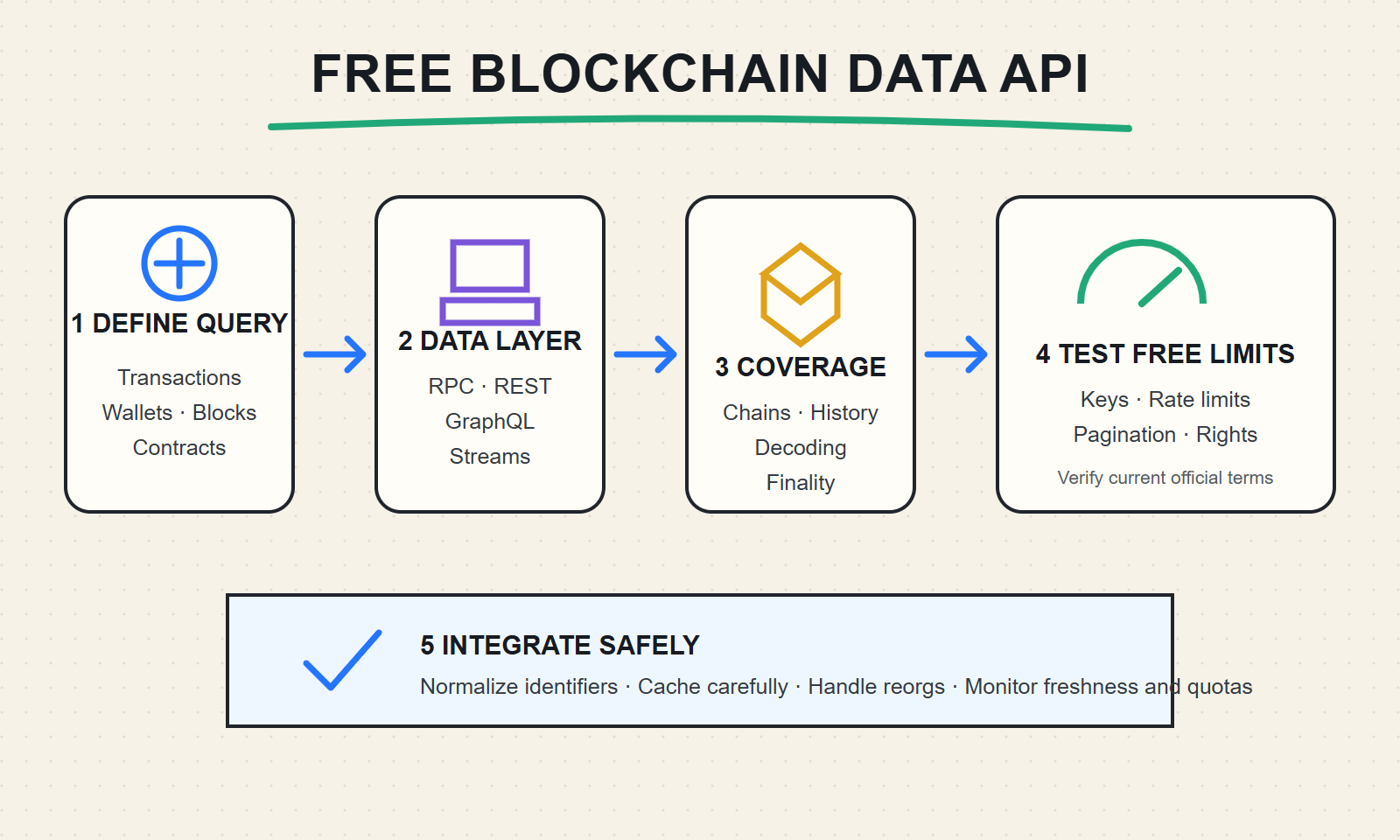
Free blockchain data API: the short answer免费区块链数据 API:快速结论
A useful free blockchain API returns the on-chain records your application needs without requiring you to operate and index a node. The right choice depends on chain coverage, decoded versus raw data, historical depth, freshness, authentication, quotas, and permitted use. A free crypto price API is a different product and should not be treated as a substitute for transaction, address, block, log, or contract data.
实用的免费区块链 API 能在无需自建节点和索引器的情况下返回应用所需的链上记录。选型应看公链覆盖、原始或解析数据、历史深度、时效、鉴权、配额与使用许可。数字货币行情 API 属于不同产品,不能替代交易、地址、区块、事件日志或合约数据接口。
Start with the query
Define whether you need transactions, balances, token transfers, logs, contracts, blocks, traces, NFTs, or real-time streams.
Match the data layer
RPC returns chain-native state; indexed REST or GraphQL APIs return normalized and searchable history.
Verify “free”
Check credits, requests per second, endpoint restrictions, historical retention, attribution, and commercial-use terms.
Design for change
Normalize identifiers, preserve provenance, cache safely, handle reorgs, and keep a provider migration path.
先定义查询任务
明确需要交易、余额、代币转账、日志、合约、区块、内部调用、NFT 还是实时推送。
匹配数据层
RPC 返回链原生状态;索引型 REST 或 GraphQL API 更适合查询标准化历史记录。
核验“免费”边界
检查积分、每秒请求、端点限制、历史保留、署名与商业使用条款。
为变化留出适配层
统一标识符、保留来源、合理缓存、处理链重组,并准备供应商迁移路径。
What data can a free blockchain API return?免费链上数据 API 能返回哪些数据?
Blockchain transaction API data
Transaction hashes, senders, recipients, values, fees, status, timestamps, decoded calls, token transfers, and internal traces. Confirm whether pending and failed transactions are included.
Wallet balance and address history
Native balances, fungible tokens, NFTs, UTXOs, portfolio positions, and paginated history. Verify whether balances are current snapshots or reproducible at a historical block.
Blocks, logs, contracts, and token metadata
Block headers, receipts, event logs, verified ABIs, bytecode, contract creation, token supply, decimals, symbols, and ownership metadata may come from different indexes.
Historical blockchain data API access
Archive state, full transaction history, decoded events, and backfills are often limited separately from recent data. Test the oldest required block and a busy address.
Real-time blockchain data API streams
WebSocket, webhook, SSE, or gRPC streams can deliver blocks and transactions. Document confirmation level, duplicate handling, reconnects, and reorg behavior.
区块链交易查询 API
可返回交易哈希、发送方、接收方、金额、手续费、状态、时间戳、解析后的调用、代币转账与内部调用;需确认是否包含待确认和失败交易。
钱包余额与地址历史
包括原生币余额、代币、NFT、UTXO、持仓与分页历史;需区分当前快照和指定历史区块可复现余额。
区块、日志、合约与代币元数据
区块头、回执、事件日志、已验证 ABI、字节码、合约创建、供应量、精度和符号可能来自不同索引。
区块链历史数据接口
归档状态、完整交易历史、解析事件和批量回填常有独立限制,应测试最早目标区块和高活跃地址。
实时链上数据推送
WebSocket、Webhook、SSE 或 gRPC 可推送区块与交易;必须定义确认数、去重、重连和链重组处理。
Choose the right multi-chain blockchain API type选择合适的多链区块链 API 类型
| API type接口类型 | Best for适合任务 | Typical output常见输出 | Main trade-off主要取舍 |
|---|---|---|---|
| Node / JSON-RPC | Current state and chain-native methods当前状态与链原生方法 | Blocks, receipts, calls, logs区块、回执、调用、日志 | Raw data requires decoding and indexing.原始数据需要自行解析和索引。 |
| Indexed REST API索引型 REST API | Wallets, explorers, dashboards钱包、浏览器、看板 | Normalized transactions and balances标准化交易和余额 | Provider schema and credit model.受供应商字段和积分模型约束。 |
| GraphQL / Subgraph | Application-specific entities and joins应用实体与关联查询 | Queryable indexed entities可查询的索引实体 | Schema and indexing lag vary.Schema 与索引延迟不同。 |
| Streaming API流式 API | Alerts, monitoring, live products告警、监控、实时产品 | Transactions, blocks, decoded events交易、区块、解析事件 | Reconnect, ordering, and reorg complexity.重连、顺序和重组处理更复杂。 |
Compare the data-source category before comparing provider names. Decide between raw RPC and indexed data, single-chain and multi-chain coverage, REST and GraphQL access, transaction or address endpoints, historical archives and live webhooks; only then evaluate authentication, rate limits, and operational fit within the relevant category.
比较供应商之前,应先确定需要哪一类数据来源:原始 RPC 还是索引数据、单链还是多链覆盖、REST 还是 GraphQL、交易或地址端点、历史归档还是实时 Webhook。数据类别明确后,再在同类方案中评估鉴权、限流和运维适用性,避免把解决不同问题的接口直接放在一起比较。
Match the blockchain API to the application按应用场景匹配区块链 API
Endpoint counts are a weak comparison metric. A wallet, tax tool, compliance monitor, explorer, and event-driven agent can all request “blockchain data” while requiring different confirmation rules, history, decoding, and latency. Write an acceptance query for the actual product before evaluating a free plan.
端点数量不是可靠的选型指标。钱包、税务工具、合规监控、区块浏览器和事件驱动 Agent 都会查询“区块链数据”,但确认规则、历史深度、解析方式和延迟要求完全不同。评估免费套餐前,应先为真实产品写出验收查询。
| Application应用 | Required data必要数据 | Acceptance test验收测试 | Typical risk常见风险 |
|---|---|---|---|
| Wallet or portfolio钱包或资产组合 | Native balance, tokens, NFTs, transfers, prices as a separate dependency.原生币余额、代币、NFT、转账;价格作为独立依赖。 | Query a high-activity address across every supported chain.查询各支持公链上的高活跃地址。 | Missing spam filters, bridged assets, or pagination.缺少垃圾资产过滤、跨链资产识别或分页。 |
| Explorer or investigation区块浏览器或调查工具 | Receipts, logs, traces, decoded calls, contract metadata.回执、日志、内部调用、解析调用和合约元数据。 | Reconstruct a transaction with nested contract calls.重建一笔包含嵌套合约调用的交易。 | A “transaction” endpoint may omit traces or failed calls.“交易”端点可能省略内部调用或失败调用。 |
| Accounting or tax会计或税务 | Complete history, stable timestamps, fees, token identity, exports.完整历史、稳定时间戳、手续费、代币身份与导出。 | Backfill multiple years and reconcile totals independently.回填多年历史并独立核对汇总结果。 | Silent gaps, duplicate transfers, and mutable metadata.静默缺口、重复转账和可变元数据。 |
| Alerts and automation告警与自动化 | Webhooks or streams, confirmations, replay, delivery IDs.Webhook 或流式接口、确认数、重放与投递 ID。 | Disconnect, resume, replay, and simulate a short reorg.测试断线、续传、重放并模拟短链重组。 | Duplicate, out-of-order, or unconfirmed events.重复、乱序或尚未确认的事件。 |
Validate blockchain data quality and completeness验证链上数据质量与完整性
A successful HTTP response proves transport, not correctness. Blockchain records have chain-specific semantics, and indexed APIs can lag, omit unsupported record types, or revise data after a reorganization. Validation should cover completeness, provenance, freshness, identity, and reproducibility.
HTTP 请求成功只说明传输完成,并不能证明数据正确。链上记录具有公链特有语义,索引 API 可能延迟、遗漏不支持的记录类型,或在链重组后修订结果。验证应同时覆盖完整性、来源、时效、身份和可复现性。
Distinguish transaction, transfer, log, and trace
One transaction can emit many token transfers and logs while triggering nested calls. Confirm which layer each endpoint represents and which failed operations remain visible.
Preserve block identity and finality
Store block number and block hash together. Record the provider’s confirmation state, then update or reverse downstream records if the canonical block changes.
Verify token and contract identity
Use chain ID plus contract address rather than symbol alone. Track decimals, proxy implementations, metadata source, native assets, wrapped assets, and bridge representations separately.
Measure indexing lag explicitly
Compare the provider’s latest indexed block with a trusted chain head. Record observed-at time separately from block time so stale data is detectable.
区分交易、转账、日志与内部调用
一笔交易可能产生多条代币转账和事件日志,并触发嵌套调用。应确认每个端点代表哪一层数据,以及失败操作是否仍然可见。
同时保留区块身份与终局状态
区块高度和区块哈希必须一起保存,并记录供应商返回的确认状态;规范链变化时,应更新或撤销下游记录。
验证代币与合约身份
使用链 ID 与合约地址组合识别资产,不能只依赖 Symbol;原生资产、封装资产和跨链映射应分别记录。
显式测量索引延迟
把供应商最新索引区块与可信链头比较,并把观察时间与区块时间分开保存,以便识别过期数据。
Practical control: keep a small fixture set containing a normal transfer, failed transaction, contract event, token transfer, busy wallet, old block, and known reorg-sensitive case. Re-run it when a provider changes schema or infrastructure.
实用控制:维护一组小型固定测试数据,包含普通转账、失败交易、合约事件、代币转账、高活跃钱包、历史区块和重组敏感案例;供应商修改 Schema 或基础设施后重新执行。
Worked reorganization example: do not finalize the first response链重组案例:首次返回的记录不能立即终局
Assume block 19,999,900 with hash 0xAAA contains transaction 0xTX1, log index 3, transferring a raw amount of 250000000 for a token with 6 decimals—250.000000 units. The indexer first returns the event as pending and the application credits 250 units. At chain head 19,999,902, a short reorganization replaces that block with hash 0xBBB; the old log disappears and 0xTX1 may either be absent or reappear in a later canonical block. A ledger keyed only by block height, address, and amount will leave a ghost credit or create a duplicate when the transaction returns.
Use chain_id + transaction_hash + log_index as the event identity, retain block number and block hash as placement evidence, and keep the record reversible while it is pending. When the hash at height 19,999,900 changes, mark the old event removed and reverse its downstream effect; if the same event later appears under a canonical block, update its placement rather than crediting it twice. Promote it to finalized only after the chain- and workload-specific policy is satisfied—for example, 12 confirmations—not merely because an API returned HTTP 200. The threshold is an application policy, not a universal property of every chain.
链重组案例:首次返回的记录不能立即终局
假设高度 19,999,900 的区块哈希为 0xAAA,其中交易 0xTX1 的第 3 条日志转移了某种 6 位精度代币,原始数量为 250000000,即 250.000000 枚。索引服务最初把事件标记为待确认,应用随即记入 250 枚。当链头到达 19,999,902 时发生短链重组,同一高度的规范区块变为 0xBBB;旧日志消失,0xTX1 可能彻底不在规范链上,也可能稍后重新进入其他区块。若账本只用区块高度、地址和数量去重,就会留下幽灵余额,或在交易重新出现时重复入账。
应使用 chain_id + transaction_hash + log_index 标识事件,把区块高度与区块哈希作为事件所在位置的证据,并在待确认阶段保持记录可撤销。发现高度 19,999,900 的哈希变化后,应将旧事件标记为已移除并冲销下游影响;同一事件后来进入规范区块时,只更新它的位置,不能再次记账。只有满足该公链和业务共同设定的策略后,例如达到 12 个确认,才能把状态改为已终局;HTTP 200 本身不代表链上终局。确认阈值属于应用策略,并不存在适用于所有公链的统一数字。
Free blockchain data API comparison checklist免费区块链数据 API 对比清单
| Criterion维度 | What to test测试内容 | Failure to avoid应避免的问题 |
|---|---|---|
| Chain coverage公链覆盖 | Mainnet/testnet, EVM/non-EVM, chain IDs, finality.主网/测试网、EVM/非 EVM、链 ID、终局性。 | Assuming one schema means identical semantics.误以为统一 Schema 等于语义完全一致。 |
| Data completeness数据完整性 | Failed transactions, traces, logs, token transfers, reorgs.失败交易、内部调用、日志、代币转账、链重组。 | Treating a convenient response as a complete ledger.把便捷响应当成完整账本。 |
| History and freshness历史与时效 | Oldest block, indexing lag, confirmation level, timestamps.最早区块、索引延迟、确认数、时间戳。 | Mixing unconfirmed and finalized records.混用未确认与已终局记录。 |
| Free limits免费限制 | Credits, RPS, pagination, batch size, endpoint access.积分、RPS、分页、批量大小、端点权限。 | Using an old plan comparison as current truth.把旧套餐对比当作当前事实。 |
| Operations and rights运维与权利 | Status page, errors, SLA, retention, attribution, redistribution.状态页、错误、SLA、保留、署名、再分发。 | Shipping without monitoring or permitted-use review.未做监控和使用权审核就上线。 |
How to use a free blockchain data API如何接入免费区块链数据 API
1. Write a representative on-chain query
Choose one real wallet, transaction, contract event, or historical block and define the fields and confirmation level the application requires.
2. Test authentication, pagination, and rate limits
Keep API keys server-side, set timeouts, follow cursors, record credit cost, and deliberately test 401, 429, and server errors.
3. Normalize chain-specific identifiers
Preserve chain ID, block number and hash, transaction hash, log index, contract address, provider, endpoint, and raw payload version.
4. Handle confirmations and blockchain reorgs
Mark records pending until the chosen confirmation threshold, detect replaced blocks, and make event processing idempotent.
5. Validate production fit
Monitor lag, missing pages, duplicate events, schema changes, quotas, license terms, and provider status; add fallback only after checking semantic equivalence.
1. 编写代表性的链上查询
选择真实钱包、交易、合约事件或历史区块,并定义应用需要的字段与确认级别。
2. 测试鉴权、分页与限流
API Key 保存在服务端,设置超时,正确跟随游标,记录积分消耗,并主动测试 401、429 和服务端错误。
3. 统一链特有标识符
保留链 ID、区块高度与哈希、交易哈希、日志索引、合约地址、供应商、端点和原始响应版本。
4. 处理确认数与链重组
达到设定确认阈值前标记为待确认,检测被替换区块,并保证事件处理幂等。
5. 验证生产适用性
监控索引延迟、缺页、重复事件、Schema 变化、配额、许可和供应商状态;仅在语义等价后配置回退。
Minimum normalized record to preserve建议保留的最小标准化记录
| Field group字段组 | Recommended fields建议字段 | Purpose用途 |
|---|---|---|
| Chain公链 | chain_id, network, block_number, block_hash | Prevents cross-chain collisions and supports reorg checks.避免跨链冲突并支持链重组检查。 |
| Record记录 | transaction_hash, transaction_index, log_index, status | Creates an idempotent event key and preserves execution state.建立幂等事件键并保留执行状态。 |
| Asset资产 | contract_address, token_id, decimals, raw_amount | Keeps raw precision and unambiguous identity.保留原始精度与明确资产身份。 |
| Time and source时间与来源 | block_time, observed_at, provider, endpoint, payload_version | Supports freshness checks, audits, and replay.支持时效检查、审计与重放。 |
Design a production-ready blockchain data layer设计可用于生产的区块链数据层
A free tier can be useful for prototypes, development, and low-volume workloads, but production readiness comes from the application architecture rather than the plan label. Separate provider-specific transport from normalized records and business logic.
免费层适合原型、开发和低流量任务,但生产可用性来自应用架构,而不是套餐名称。应把供应商特有的传输与标准化记录、业务逻辑分层。
Provider adapter
Own authentication, request construction, pagination, error mapping, credit accounting, and provider-specific field conversion in one boundary.
Raw and normalized storage
Retain selected raw payloads for investigations while exposing a stable internal schema to product code and agents.
Backfill and live ingestion
Use separate workers and checkpoints. Live delivery should not silently skip records while a large historical backfill consumes the quota.
Observability and reconciliation
Monitor request errors, credits, indexing lag, duplicates, missing ranges, reorg reversals, schema drift, and differences against a second source.
供应商适配层
在单一边界内处理鉴权、请求构造、分页、错误映射、积分统计和供应商字段转换。
原始与标准化存储
保留必要原始响应用于调查,同时向产品代码和 Agent 提供稳定的内部 Schema。
历史回填与实时摄取
使用独立任务与检查点,避免大规模历史回填占满配额并导致实时记录被静默跳过。
可观测性与数据核对
监控请求错误、积分、索引延迟、重复、缺失区间、重组撤销、Schema 漂移,以及与第二数据源的差异。
Estimate whether the free tier is sufficient估算免费额度是否足够
Estimate daily requests from active users × addresses per user × chains × refreshes, then add pagination, retries, backfills, health checks, and webhook verification. Convert requests into provider credits because one endpoint may consume more than one credit. Test peak rate separately from monthly allowance.
先用活跃用户数 × 每用户地址数 × 公链数 × 刷新次数估算每日请求,再加入分页、重试、历史回填、健康检查和 Webhook 验证。由于某些端点一次请求会消耗多个积分,还应把请求量换算为供应商积分,并把峰值速率与月度额度分开测试。
Security and operational controls安全与运维控制
- Keep API keys server-side, scope them where supported, rotate them, and separate development from production credentials.
- Validate chain ID, addresses, block tags, pagination cursors, and webhook signatures before processing.
- Use bounded retries with jitter; do not retry permanent authentication or validation errors indefinitely.
- Document provider outage behavior, stale-data policy, manual recovery, and the conditions for switching to a fallback.
- API Key 保存在服务端,在支持时限制权限并定期轮换;开发与生产使用不同凭证。
- 处理前验证链 ID、地址、区块标签、分页游标和 Webhook 签名。
- 使用有上限且带抖动的重试,不要无限重试永久鉴权或参数错误。
- 记录供应商故障行为、过期数据策略、人工恢复流程和切换回退源的条件。
Use QVeris to discover blockchain data API capabilities用 QVeris 发现链上数据 API 能力
QVeris helps developers and AI agents discover callable tools, inspect inputs and output schemas, and route a request to an available capability. It does not change a provider’s free-tier limits, license, data quality, or production suitability.
QVeris 帮助开发者与 AI Agent 发现可调用工具、检查输入与输出 Schema,并把请求路由到可用能力;它不会改变供应商的免费额度、许可、数据质量或生产适用性。
- Open the QVeris provider details to review transaction, wallet, block, contract, and multi-chain capabilities.
- Review the Capability Map before binding an agent workflow to a provider-specific schema.
- Keep confirmation, attribution, licensing, and risk checks in the application’s approval path.
- 在 QVeris 服务商详情中搜索交易、钱包、区块、合约和多链能力。
- 绑定供应商字段前先查看 能力地图。
- 把确认数、署名、许可和风险检查保留在应用审批路径中。
Free blockchain data API FAQ免费区块链数据 API 常见问题
Is there a free blockchain data API?
Yes. Public RPC endpoints and indexed providers offer free access or development tiers, but chain coverage, quotas, history, endpoint access, and permitted use differ.
Which API provides blockchain transaction data?
Node RPC, explorer APIs, and indexed multi-chain APIs can return transactions. Choose based on decoded fields, traces, token transfers, pagination, and historical depth.
Can I get historical blockchain data for free?
Sometimes. Recent history is common; archive state, deep history, bulk export, and high-volume backfills may have separate limits.
Do free blockchain APIs require an API key?
Some public endpoints are keyless, while managed free plans require a key. Keep credentials out of public browser code and rotate exposed keys.
What is the difference between a blockchain API and a crypto price API?
A blockchain API exposes on-chain state and history. A crypto price API usually aggregates market quotes, volume, and metadata from exchanges or trading venues.
Can a free blockchain API be used in production?
Only after its availability, quotas, data completeness, reorg handling, change policy, licensing, monitoring, and fallback meet the application’s requirements.
有免费的区块链数据 API 吗?
有。公共 RPC 与索引服务提供免费访问或开发者套餐,但公链覆盖、配额、历史、端点权限和使用许可不同。
哪个 API 可以查询区块链交易?
节点 RPC、区块浏览器 API 和索引型多链接口都能返回交易,应比较解析字段、内部调用、代币转账、分页与历史深度。
可以免费获取区块链历史数据吗?
部分可以。近期历史较常见,归档状态、深度历史、批量导出与大规模回填可能有独立限制。
免费链上数据接口需要 API Key 吗?
部分公共端点免 Key,托管免费层通常需要密钥。不要把凭证放入公开浏览器代码,并及时轮换泄露密钥。
区块链 API 与币价 API 有什么区别?
区块链 API 返回链上状态与历史;币价 API 通常聚合交易所或交易场所的报价、成交量和市场元数据。
免费区块链 API 能用于生产吗?
只有可用性、配额、数据完整性、重组处理、变更策略、许可、监控与回退满足要求时才适合。