
Find a Free Central Bank Data API
and Use It Safely查找并安全使用
免费央行数据 API
Use this free central bank data API guide to find policy rates, inflation, exchange rates, and monetary data, then validate access before you integrate.
查找政策利率、通胀、汇率与货币数据来源,
并在接入应用前验证权限、格式与数据出处。
TL;DR快速结论
A practical shortlist of free official or aggregated APIs, plus enough detail to make a first verified request.
Policy rates, inflation, foreign exchange, money supply, banking statistics, and historical time series.
Check registration, API keys, quotas, licensing, attribution, formats, and production restrictions.
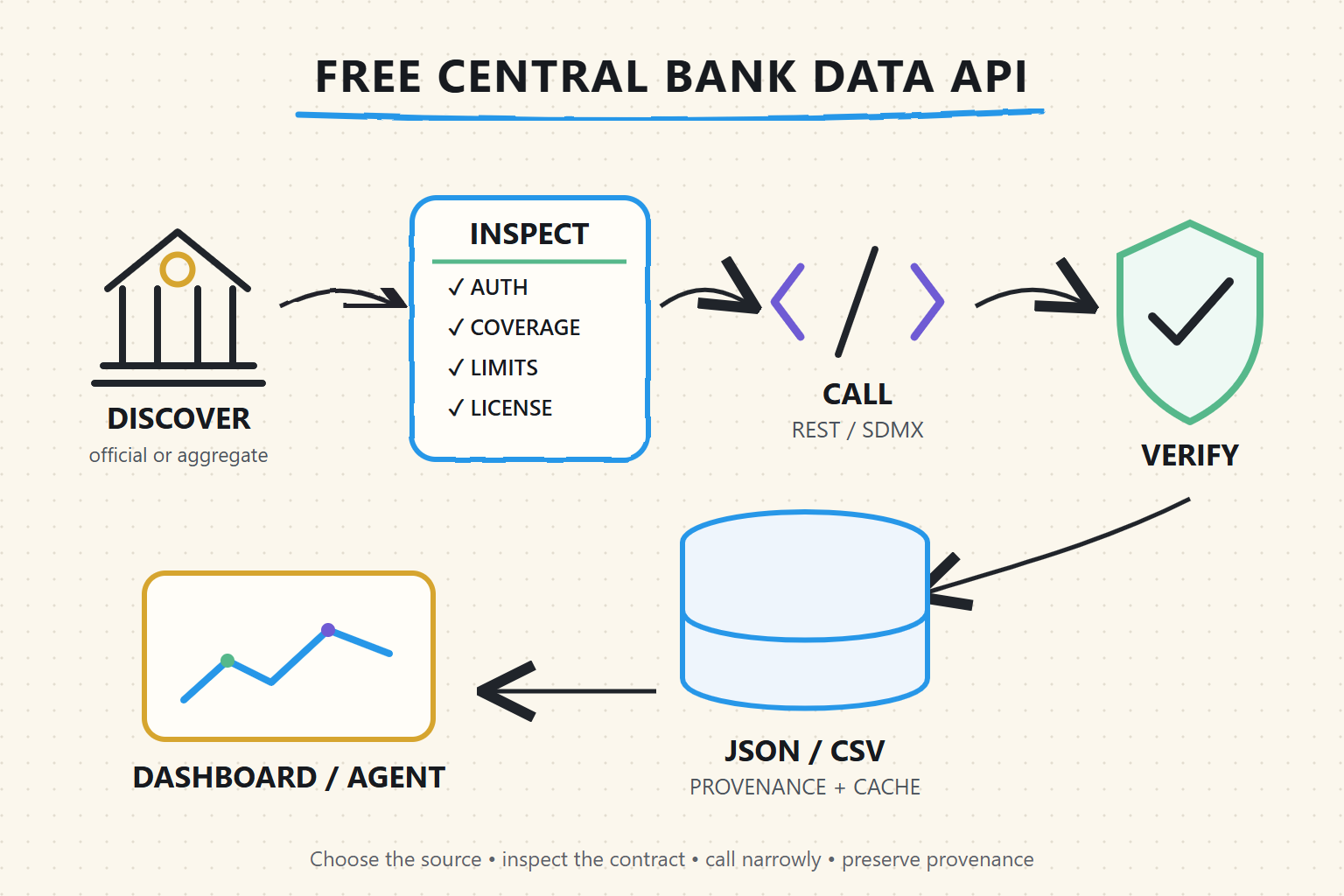
Choose one source, inspect metadata, make a small request, validate provenance, then add caching.
一份可用的免费官方或聚合 API 清单,以及完成第一次可验证调用所需的信息。
政策利率、通胀、外汇、货币供应量、银行统计与历史时间序列。
注册、API Key、额度、许可、署名、返回格式和生产使用限制。
选择一个来源,检查元数据,小范围调用,验证出处,再加入缓存。
What people want from a free central bank data API用户搜索免费央行数据 API 时要完成什么
Current results are dominated by API documentation, open-data portals, source directories, and implementation guides. The main intent is informational with a practical task: identify a trustworthy source and retrieve official economic time-series data programmatically. A smaller commercial-investigation intent appears when users compare one normalized API with several central-bank-specific services.
当前中文结果主要由 API 文档、开放数据目录、开发教程和聚合服务构成。用户的核心需求是找到可信来源,并通过程序获取官方经济时间序列;其次是比较聚合 API 与单一央行接口在覆盖范围、认证方式和维护成本上的差异。
Data and features repeated across ranking pages排名页面反复覆盖的数据与功能
Recurring entities include the ECB Data Portal, FRED, World Bank, DBnomics, and national central-bank open-data systems. Repeated evaluation points include policy rates, inflation, exchange rates, money and banking statistics, historical coverage, REST or SDMX access, JSON or CSV output, API keys, quotas, metadata, and licensing.
反复出现的实体包括欧洲央行数据门户、FRED、世界银行、DBnomics 与各国央行开放数据系统。常见评估点包括政策利率、通胀、汇率、货币与银行统计、历史覆盖、REST 或 SDMX、JSON 或 CSV、API Key、额度、元数据和许可。
Free central bank data API sources to evaluate值得评估的免费央行与经济数据 API
| Source来源 | Typical coverage典型覆盖 | Interface接口形式 | Check before use使用前核对 |
|---|---|---|---|
| ECB Data Portal | Euro-area monetary, inflation, financial, and FX statistics.欧元区货币、通胀、金融和汇率统计。 | SDMX 2.1 REST service.SDMX 2.1 REST 服务。 | Dataset keys, dimensions, frequency, and revisions.数据集标识、维度、频率和修订记录。 |
| FRED API | US and international economic series from many sources.多来源的美国及国际经济序列。 | REST, XML or JSON; API key required.REST、XML 或 JSON;需要 API Key。 | Attribution, metadata, and key handling.来源署名、元数据和 Key 管理。 |
| DBnomics | A normalized catalog spanning public economic-data providers.覆盖多个公共经济数据提供方的统一目录。 | REST JSON API with provider/dataset/series IDs.REST JSON API 与多级 ID。 | Original terms, transformation, and freshness.原始条款、转换过程和时效。 |
| National bank portals各国央行数据门户 | Country rates, FX, reserves, money, and banking data.单一国家的利率、汇率、储备和银行数据。 | REST, SDMX, OData, files, or custom services.REST、SDMX、OData 或文件。 | Language, schema stability, quotas, and license.语言、数据结构稳定性、额度和许可。 |
“Free” does not mean identical terms. Verify each provider’s documentation on the day you integrate it because authentication, quotas, acceptable use, and dataset availability can change.
“免费”不代表条款完全相同。接入当天仍应核对各提供方文档,因为认证、额度、合理使用规则和数据集可用性可能变化。
How to use a free central bank data API如何调用免费央行数据 API
1. Define the indicator and geography1. 明确指标、地区和频率
Specify the concept—policy rate, CPI, exchange rate, reserves, or money supply—plus geography, frequency, units, and required history. Similar labels can represent different methods.
先写清政策利率、CPI、汇率、储备资产或货币供应量等准确概念,以及地区、频率、单位和历史区间。相似名称可能对应不同统计方法。
2. Inspect metadata, authentication, and limits2. 检查元数据、认证和调用限制
Confirm the series ID, dimensions, units, seasonal adjustment, revision policy, API-key requirement, rate limits, reuse license, and attribution before writing production code.
确认序列 ID、维度、单位、季节调整、修订政策、API Key、限流、再使用许可与署名要求,再编写生产代码。
3. Make a small request and validate it3. 小范围调用并验证响应
curl "https://api.example.org/data/SERIES_ID?format=json&start=2025-01-01" is an example shape only. Use the provider’s documented URL and identifiers, compare sample observations with its visible portal, and inspect missing-value or revision flags.
curl "https://api.example.org/data/SERIES_ID?format=json&start=2025-01-01" 仅展示请求结构。请使用提供方文档中的 URL 与 ID,并把样本观测值与其网页端数据核对。
4. Add caching, retries, and provenance4. 加入缓存、重试和出处记录
Cache to match the release schedule, respect retry guidance, record retrieval time and series metadata, preserve the source URL, and monitor schema changes.
按发布日程缓存,遵循重试建议,记录抓取时间和序列元数据,保留来源 URL,并监控数据结构变化。
Validate a central bank API response before publishing it发布前验证央行 API 响应
A successful HTTP status only proves that the server answered. It does not prove that the requested policy rate, exchange rate, inflation series, or reserve measure is the one your application intended to use. Inspect the provider, dataset, series identifier, frequency, unit, multiplier, geography, seasonal-adjustment status, observation date, and release status in every response. Treat missing values as missing rather than zero, preserve status flags, and compare several observations with the institution’s visible data portal before approving an integration.
HTTP 请求成功只说明服务器已响应,并不能证明返回的政策利率、汇率、通胀或储备指标符合应用需求。应检查提供方、数据集、序列 ID、频率、单位、倍数、地区、季调口径、观测日期和发布状态。缺失值不能转成零,并应把多个样本值与机构公开数据门户逐项核对。
Keep raw data, provenance, and revision history保留原始数据、出处和修订历史
Store the raw response together with the request URL, parameters, retrieval timestamp, HTTP status, and relevant headers. A normalized record should retain the original provider code and series ID so a reviewer can reproduce the call. Central bank time series may be corrected, rebased, seasonally adjusted again, or replaced with final observations. Decide whether the product always shows the latest vintage or preserves the value available on each retrieval date. Log schema changes and unexpected empty responses separately from network failures, and use bounded retries only for temporary errors.
For high-impact dashboards, alerts, or agent answers, add a release-date check before delivery. Confirm that the latest period is actually published, that a revised observation did not trigger a duplicate alert, and that a fallback source uses the same statistical concept. Display the observation date and retrieval time separately so users can distinguish when a value applies from when the application fetched it. Record the check result for later operational review and incident analysis.
应把原始响应与请求 URL、参数、抓取时间、HTTP 状态和相关响应头一起保存;标准化记录仍需保留原始提供方代码和序列 ID。央行时间序列可能更正、换基、重新季调,初值也可能被终值替代,因此要明确是只展示最新版本,还是保留各次历史抓取版本,并区分数据结构变化、异常空响应与网络错误。
Official central bank APIs vs aggregated economic data APIs官方央行 API 与经济数据聚合 API 怎么选
An official central bank API is usually the strongest choice when authority, methodology, and release timing matter more than convenience. The institution publishes the definitions, statistical notes, revision policy, and release calendar alongside the series. This makes the source suitable for regulatory research, policy analysis, citations, and any workflow where a reviewer must trace a value back to its producer. The trade-off is integration work: every institution may use different identifiers, dimensions, date formats, languages, authentication rules, and response structures. A project covering several economies can quickly accumulate multiple adapters and monitoring routines.
重视权威性、统计方法和发布时间时,应优先选择官方央行 API。官方来源通常提供指标定义、修订政策和发布日历,适合政策研究及需要追溯出处的任务;但不同机构的序列编号、维度、日期格式、认证和响应结构并不统一,跨国项目需要维护适配器。
When an aggregator is the better engineering choice什么时候更适合使用聚合 API
An aggregator is useful when the application needs one query model across several providers or countries. A normalized catalog can reduce discovery time, standardize common fields, and simplify prototypes, dashboards, comparative research, or agent tools. That convenience does not transfer authority to the aggregator. Always retain the original provider code, dataset code, series identifier, unit, frequency, retrieval timestamp, and source URL. Review whether the aggregator transforms values, renames dimensions, changes missing-value markers, delays updates, or applies a separate license. For high-impact outputs, compare representative observations with the original portal and define a fallback path to the producer’s service.
需要统一查询多个国家或提供方时,聚合 API 更适合原型、跨国看板和 Agent 工具,但不会取代原始机构的权威性。应保存提供方、数据集与序列 ID、单位、频率、抓取时间和来源 URL,并检查数值转换、更新延迟和许可;重要结果仍需与官方门户核对。
Validate metadata, revisions, and data quality before use使用前验证元数据、修订与数据质量
Do not treat a series label as a complete definition不要把序列名称当作完整定义
Two series can share a familiar label while measuring different concepts. An “interest rate” may be a policy target, an effective overnight rate, a lending facility rate, a deposit facility rate, or a monthly average. Inflation may be headline or core, monthly or annual, seasonally adjusted or unadjusted, preliminary or final. Before storing observations, capture the title, description, unit, multiplier, frequency, seasonal-adjustment status, geography, counterpart, valuation basis, and collection method. If the API provides dimension labels or codelists, store those mappings rather than relying only on compact codes.
名称相似的序列可能衡量不同概念。“利率”可能是政策目标、隔夜利率或月度均值;通胀也有总体与核心、环比与同比、季调与未季调之分。入库前应保存定义、单位、倍数、频率、季调状态、地区和采集方法,并保留维度代码与标签的映射。
Design explicitly for revisions and missing observations显式处理修订值与缺失观测
Economic time series are revised. A provider may correct an error, incorporate a benchmark survey, rebase an index, change seasonal factors, or replace an estimate with a final value. Decide whether your product needs the latest vintage or the value known at a historical point in time. Preserve retrieval timestamps and, when available, release or vintage identifiers. Do not silently convert missing values to zero. Keep provider status flags, distinguish “not available” from “not applicable,” and test how the parser handles blank strings, symbols, nulls, and suppressed values. Validation rules should detect unexpected frequency changes, duplicate periods, unit changes, large discontinuities, and disappearing series.
经济序列会因更正、换基或估算值转为终值而修订。应决定使用最新版本,还是保存各历史时点当时可得的数据,并记录抓取时间、发布批次或历史版本标识。不要把缺失值转成零;校验规则还应识别频率变化、重复时期、单位变化、异常断点和序列下线。
Build a reliable production integration构建可靠的生产级数据接入
Separate discovery, retrieval, normalization, and delivery分离发现、抓取、标准化与交付
A maintainable pipeline gives each stage one responsibility. Discovery resolves a human request to a provider, dataset, and series. Retrieval calls the documented endpoint and stores the raw response with HTTP status, headers, request parameters, and retrieval time. Normalization converts dates, units, codes, and missing-value conventions into an internal schema without destroying the source representation. Delivery exposes the verified records to a dashboard, research notebook, database, API, or agent capability. Keeping the raw payload makes later debugging and reprocessing possible when a provider changes its schema or a transformation rule is corrected.
数据管道应分离发现、抓取、标准化和交付。抓取阶段保存原始响应、HTTP 状态、请求参数和时间;标准化阶段统一日期、单位和缺失值,但保留原始表达;交付阶段再向看板、数据库、API 或 Agent 提供已验证数据。保留原始响应便于重新处理。
Match polling, caching, and retries to the release schedule让轮询、缓存和重试匹配发布日程
Most central bank statistics do not require continuous polling. Use the provider’s release calendar and series frequency to choose a refresh interval. Cache successful responses, send conditional requests when supported, and avoid rebuilding a full history when only the latest period can change. Apply bounded retries with backoff for timeouts and temporary server errors, but do not retry invalid identifiers or permission failures indefinitely. Record quota headers when they exist, protect API keys outside client-side code, and set alerts for repeated failures, stale data, or unexpected empty responses. A fallback should be an explicitly approved source, not an unreviewed scrape that silently changes provenance.
央行统计通常按日程更新,应据此设置刷新周期并缓存成功响应。超时和临时错误可有限退避重试,无效 ID 或权限错误不应重复请求。API Key 不得写入客户端;还需监控连续失败、数据陈旧和异常空响应。备用来源必须经过审核,不能改变数据出处。
Common applications for central bank data央行数据 API 的常见应用场景
Research, dashboards, alerts, and AI agents研究、看板、提醒与 AI Agent
Researchers may combine policy rates, inflation, exchange rates, and monetary aggregates to study transmission mechanisms or compare economic cycles. Product teams may use the same series in internal dashboards, country profiles, treasury tools, or release alerts. Each use case needs a different freshness and revision policy. A historical paper may require a reproducible snapshot, while an operational dashboard usually needs the latest published value plus a visible “last updated” time. An alerting system needs idempotent release detection so a revision does not look like a new period.
政策利率、通胀、汇率和货币总量可用于政策研究、跨国比较、内部看板、国家概览和发布提醒。历史研究强调可复现快照,运营看板需要最新值与更新时间,提醒系统则要避免把数据修订误判为新一期发布。
For an AI agent, expose narrow, documented operations such as “get the latest policy rate,” “retrieve a series for a date range,” or “search series metadata.” Define required parameters, supported geographies, output fields, units, error states, and provenance. Limit the amount of data returned by default and require explicit date ranges for large downloads. The agent should cite the producer and series, state the observation date, and distinguish retrieved facts from its own interpretation. QVeris can help discover, inspect, call, and audit such capabilities, while the central bank or original statistical producer remains the authority for values and methodology.
面向 AI Agent 时,应把“获取最新利率”“按日期读取序列”“搜索元数据”等任务封装成范围明确的操作,并说明参数、地区、字段、单位、错误和出处。Agent 输出应注明发布机构、序列和观测日期,并区分检索到的事实与模型生成的解释。QVeris 可帮助调用和保留审计记录,官方机构仍是权威来源。
How QVeris helps with central bank data APIsQVeris 如何帮助接入央行数据 API
QVeris can help an agent discover, inspect, call, and audit real-world capabilities. For central-bank data, each API should remain an inspectable capability with documented inputs, outputs, and provenance. QVeris does not own or change the underlying official data.
QVeris 可帮助 Agent 查找、检查和调用真实世界的工具,并保留审计记录。对于央行数据,API 的输入、输出和出处应当可核查;QVeris 不拥有,也不会改变底层官方数据。
- Use the QVeris Tool Finder to explore capabilities relevant to economic or financial data.
- Inspect an operation’s parameters and response shape before an agent calls it.
- Keep the provider URL, timestamp, series ID, and license context in downstream records.
- 使用 QVeris 工具查找器探索经济或金融数据相关能力。
- 在 Agent 调用前检查操作参数和响应结构。
- 在下游记录中保留提供方 URL、时间戳、序列 ID 和许可信息。
FAQ
Yes. Some services allow keyless access, including the ECB SDMX service. Others, such as FRED, require a free key. Verify current provider terms.
The best source depends on geography. A national central bank is authoritative for its own policy rate; aggregators can simplify cross-country work.
Often yes, but formats vary. REST commonly returns JSON; SDMX services may return XML, JSON, or CSV variants.
Check metadata, units, frequency, revisions, release dates, and attribution, then compare sample values with the official portal.
No. QVeris helps agents discover and call capabilities; the provider remains authoritative for data, methods, licensing, and releases.
部分服务支持免 Key 访问,例如欧洲央行 SDMX 服务;FRED 等则需要免费 Key。应以接入当天文档为准。
按地区选择官方央行接口,确认序列 ID、频率、单位、修订方式和历史区间;跨国比较可评估聚合入口,并用官方门户核对样本数据。
许多接口支持,但格式不统一。REST 常见 JSON,SDMX 可能提供 XML、JSON 或 CSV。
检查序列元数据、统计单位、更新频率、修订标记、发布时间和来源署名,并把多个样本观测值与官方数据门户逐项核对。
不会。QVeris 帮助 Agent 调用能力,原始提供方仍是数据、方法、许可和发布时间的权威来源。